

Only 2% of Australian properties currently (2026) offer EV charging access, yet EVs are projected to represent at least half of all new car sales by 2030. For developers, calculating EV charging demand for apartment buildings is no longer an optional exercise. It is a critical requirement for project viability and regulatory compliance. You’re likely aware that simply adding the peak kilowatt requirements for every parking bay leads to grid upgrade costs that can jeopardize a project’s budget. Over-engineering your electrical infrastructure is a costly mistake that many firms make during the initial planning phase.
This guide provides the technical framework to master calculation methodologies while ensuring your development meets evolving NVES requirements. You’ll learn how to design cost-effective infrastructure that avoids the trap of under-powering your site as adoption rises. We will cover the specific diversity factors and dynamic load management strategies necessary to secure council approval and future-proof your building’s electrical capacity. By the end of this article, you will understand how to balance technical requirements with the practicalities of site power limits.
Key Takeaways
- Identify the technical differences between standard residential loads and EV charging to prevent over-calculating maximum demand requirements.
- Evaluate the impact of 7kW versus 22kW chargers when calculating EV charging demand for apartment buildings to optimize electrical capacity.
- Implement dynamic load management strategies to distribute power efficiently and mitigate the high costs associated with grid infrastructure upgrades.
- Establish a baseline building load and determine required provisions to ensure your development meets all relevant regulatory and council standards.
- Integrate EV charging strategies into your Traffic Impact Assessment (TIA) to address modern council requirements and parking demand assessments.
Table of Contents
-
Why EV Charging Changes Apartment Maximum Demand Requirements
-
Static vs. Dynamic Load Management: Reducing Infrastructure Costs
Why EV Charging Changes Apartment Maximum Demand Requirements
Maximum demand is the cornerstone of electrical design under AS/NZS 3000. It represents the peak electrical load a building’s infrastructure must handle at any single point in time. Traditional apartment designs focus on intermittent loads such as lighting, power outlets, and HVAC systems. These systems rarely run at full capacity simultaneously. In contrast, EV charging represents a continuous, high-draw load that can run for eight hours or more. This fundamental difference changes how developers must approach site capacity. Integrating various EV charging methods into a building’s profile shifts the peak demand. This often creates a new overnight spike that challenges existing transformer limits and local grid constraints.
The transition from EV charging as a luxury amenity to a mandatory utility is accelerating across Australia. Building codes now reflect this shift as a standard requirement for modern living. Developers who fail to account for this during the initial design phase face significant rectification costs or the inability to obtain necessary approvals. Accurate calculating EV charging demand for apartment buildings ensures that the main switchboard and sub-mains are sized correctly. This prevents the need for unnecessary and expensive grid upgrades that can stall a project’s financial feasibility.
To better understand this concept, watch this helpful video:
The Concept of Diversity Factors in EV Charging
Calculating for 100% capacity on every charger is neither practical nor necessary. Diversity factors allow engineers to account for the reality that not all vehicles charge at the same time. In multi-unit residential scenarios, usage patterns vary based on resident behavior and vehicle battery levels. Diversity factor is the ratio of the sum of individual maximum demands to the maximum demand of the whole system. Applying this ratio correctly prevents over-engineering the infrastructure. It allows for more charging points to be installed without exceeding the building’s total power allocation.
Regulatory Compliance and Australian Standards
Compliance with AS/NZS 3000:2018 and its subsequent amendments is the baseline for all Australian developments. These "Wiring Rules" dictate the safety and performance standards for electrical installations. Recent updates to the National Construction Code (NCC) now mandate that a percentage of parking spaces be "EV-ready." This includes providing the necessary cable trays and circuit capacity for future installations. Engaging a specialist in Traffic Engineering ensures that site-wide compliance is achieved. This professional oversight links the technical requirements of calculating EV charging demand for apartment buildings with the physical constraints of car park design and vehicle access. It ensures that the proposed infrastructure is both legally compliant and practically functional for the end-user.
Key Factors Influencing EV Demand Calculations
Accurate demand assessment requires analyzing more than just electrical circuits. It involves a detailed understanding of the building’s specific operational profile. The first variable in calculating EV charging demand for apartment buildings is the ratio of total parking spaces to active charging points. While current regulations may only require 10% to 20% active ports, future-proofing requires planning for 100% "EV-ready" capacity. This means ensuring that the containment and switchboard space can accommodate future growth without structural modifications.
Charger power ratings significantly impact the total load. A 7kW single-phase charger is the residential standard. It provides approximately 40 to 50 kilometres of range per hour of charging. In contrast, 22kW three-phase chargers are often unnecessary for multi-unit developments where vehicles remain stationary for 8 to 12 hours. High-power chargers increase the risk of exceeding building transformer capacity without providing additional utility to residents. Planning for 2026 and beyond requires accounting for the fact that EVs are projected to make up at least half of all new car sales by 2030. This shift necessitates a scalable approach to infrastructure design.
Building use cases also influence demand. Luxury developments often prioritize individual charger access as a premium feature, requiring higher simultaneous power availability. High-density or affordable housing might instead utilize shared charging zones to manage costs and electrical load. A professional Car Parking Demand Assessment ensures that your infrastructure matches actual resident needs rather than generic estimates.
Vehicle Usage and Charging Profiles
Daily travel distances dictate energy replenishment needs. Most residential commuters travel less than 40 kilometres per day. This requires only 8 to 10kWh of energy to return the battery to its previous state. The "long-stay" nature of apartment parking is a distinct advantage. It allows for slow, steady charging overnight. This reduces the strain on the building’s electrical system compared to the rapid bursts required at public charging stations. By spreading the load over several hours, developers can support more vehicles on the same electrical footprint.
Existing Site Capacity and Grid Constraints
Evaluating the spare capacity of the existing main switchboard (MSB) is a mandatory step. Developers must identify if the MSB can support the additional EV load or if a secondary board is required. Proximity to local substations is also a critical factor. If the total demand exceeds the current supply agreement, the utility provider may trigger a substation upgrade. These upgrades can cost hundreds of thousands of dollars and significantly delay project timelines. Identifying bottlenecks in the vertical distribution, such as limited space in cable risers, is equally important to avoid design failures during the construction phase.
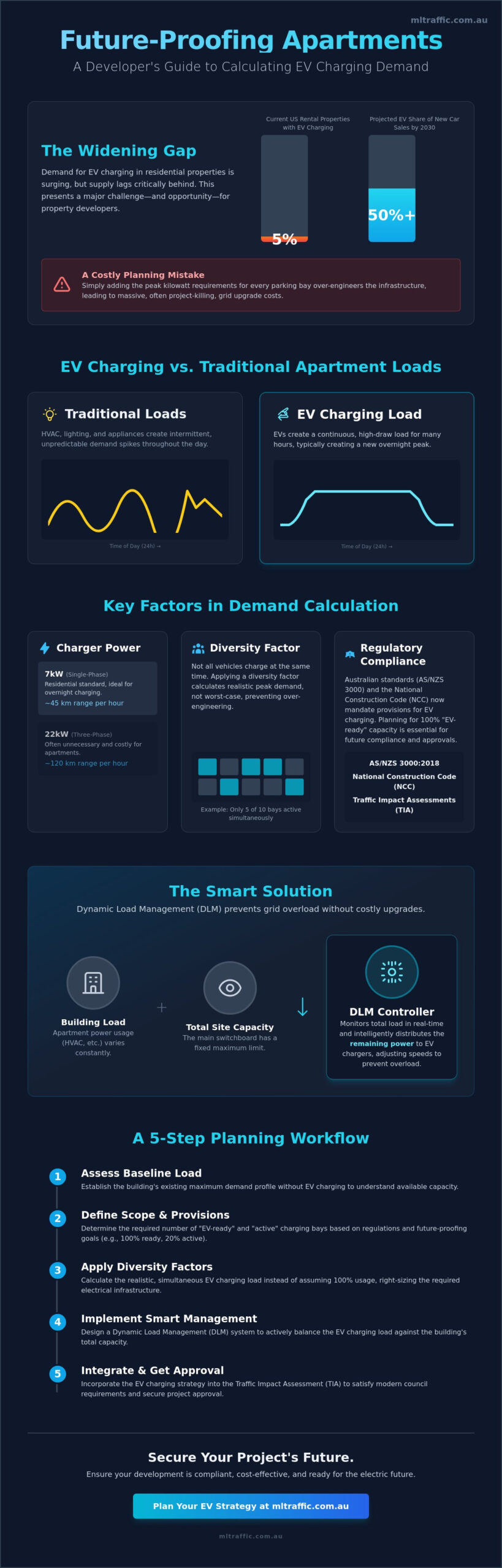
Static vs. Dynamic Load Management: Reducing Infrastructure Costs
Site capacity is a finite resource. When calculating EV charging demand for apartment buildings, developers must choose between hard-wired limits and intelligent software controls. Static load management involves setting a fixed maximum amperage for a specific group of chargers. This limit remains constant regardless of the building’s overall electricity consumption. It’s a "set and forget" approach that relies on hardware-level circuit protection to ensure the total draw never exceeds a pre-defined threshold.
Dynamic Load Management (DLM) utilizes a Load Management System (LMS) to monitor the building’s total electrical draw in real-time. The LMS communicates with individual chargers to adjust their output based on available capacity. If the building’s HVAC and lighting loads drop during the night, the system reallocates that "spare" power to the EV infrastructure. This allows for significantly higher charging speeds without requiring a larger main switchboard or a substation upgrade. The cost-benefit analysis usually favors DLM for larger developments. While software and controller costs are higher up-front, they often eliminate the need for six-figure grid reinforcement expenses.
When to Use Static Load Limits
Static limits are most effective for smaller developments with fewer than ten units or sites with substantial spare capacity. This method offers lower operational complexity. There’s no need for ongoing software subscriptions or complex networking hardware. Maintenance is simplified because the system relies on standard electrical components. However, static management lacks scalability. Once the hard cap is reached, adding more chargers requires a physical upgrade to the supply cables or the main switchboard. It’s a rigid solution that doesn’t adapt to changing resident behaviors.
The Advantages of Dynamic Load Management
DLM provides the highest level of efficiency by maximizing charging speeds during off-peak windows, such as 2 AM. It prevents the building from exceeding its maximum demand during early evening peaks when residents return home and appliance use is high. This intelligence is vital for avoiding expensive grid upgrades. By using real-time data, developers can future-proof sites for 100% EV uptake. The existing wiring can support more vehicles because the LMS ensures the total load is always optimized. This strategy supports long-term compliance with evolving building codes without requiring repetitive electrical renovations or additional infrastructure investment.
Step-by-Step Workflow for Calculating EV Demand
A structured approach is required to ensure electrical safety and regulatory approval. Calculating EV charging demand for apartment buildings begins with a clear understanding of the existing infrastructure and the future requirements of the residents. Developers must follow a logical sequence of assessments to avoid under-sizing the installation or over-investing in unnecessary capacity. This process ensures that the final design is both financially viable and technically sound.
-
Establish the baseline building load: Review historical billing data or perform interval metering to determine the existing peak demand excluding EVs.
-
Determine the required EV charging provision: Consult the National Construction Code (NCC) or specific Local Council requirements to identify the minimum number of "EV-ready" spaces.
-
Select the appropriate diversity factor: Choose a factor based on the total count of chargers as outlined in technical standards to reflect realistic usage.
-
Compare total demand against existing supply: Assess if the combined load of the building and the EV infrastructure fits within the current utility supply agreement.
-
Integrate results: Document all findings within a comprehensive Car Parking Demand Assessment to support Development Application (DA) submissions.
Data Collection and Initial Assessment
The process starts with a thorough review of the electrical single-line diagrams (SLDs). These documents reveal the current configuration of the main switchboard and the distribution boards. You must determine the "EV-Ready" status of the car park by identifying existing cable trays and spare circuit breakers. A site visit is often required to verify available physical space for switchboard expansion. This physical verification prevents design errors that occur when relying solely on outdated architectural plans. Accurate data collection is the first step in calculating EV charging demand for apartment buildings and ensures the feasibility of the proposed infrastructure.
Applying the Calculation Formula
The core of the assessment involves a specific calculation formula. The basic formula is: (Number of Chargers × Power Rating) × Diversity Factor. For example, if a building has twenty 7kW chargers and a diversity factor of 0.25, the calculated load is 35kW rather than the theoretical 140kW. You must adjust these calculations for different charging tiers. Visitor parking may require higher diversity factors due to unpredictable usage, while resident bays benefit from longer, managed charging cycles. All results must be validated against AS/NZS 3000 Appendix C. This validation ensures that the design adheres to Australian safety standards for maximum demand. Contact our senior principals today to secure a professional Car Parking Demand Assessment and ensure your project meets all regulatory benchmarks.
Integrating EV Demand into Your Traffic Impact Assessment
Councils across Australia increasingly require EV charging strategies as part of the formal Development Application (DA) process. This shift treats charging infrastructure as a core component of car park design rather than a secondary electrical addition. Accurate results from calculating EV charging demand for apartment buildings must be documented clearly to satisfy council traffic planners. A mismatch between electrical capacity and parking demand can lead to non-compliance or operational failures. ML Traffic Engineers provides the technical expertise to bridge this gap. We ensure that your EV strategy is integrated seamlessly into your planning documentation.
Linking parking demand to electrical infrastructure requirements is essential for modern developments. If a building is designated as 100% "EV-ready," the physical layout must support this claim. This involves more than just wiring. It requires a spatial assessment of how charging equipment interacts with vehicle movements. Councils now scrutinize these details to ensure that charging stations don’t reduce the functional capacity of the car park or create safety hazards. When calculating EV charging demand for apartment buildings, the impact on shared visitor spaces and accessible bays must be prioritized to meet diverse user needs.
Compliance with Council Parking Policies
Navigating the "EV-ready" parking percentages required by different jurisdictions is a complex task. Requirements vary significantly between local government areas. Some councils mandate specific provisions for visitor parking, while others focus solely on residential bays. Documenting this strategy within a formal Traffic Impact Assessment is now a standard expectation. This report must demonstrate how the building will manage charging demand without impacting local grid stability or on-street parking availability. Addressing visitor parking is particularly sensitive. It often requires dedicated, high-turnover charging points that must be factored into the overall site demand.
Swept Path and Access Considerations
The physical placement of charging units is a critical factor in car park design. Charging bollards or wall-mounted units must not impede Swept Path Analysis for larger vehicles. A poorly placed charger can reduce the effective width of an aisle or prevent a vehicle from safely entering a parking bay. Maintaining compliant aisle widths and sight distances is mandatory under AS 2890. Wall-mounted units must be positioned to avoid contact with side mirrors or protruding vehicle parts. Developers must also consider the length of charging cables and how they might obstruct pedestrian paths within the car park. Contact ML Traffic Engineers for expert demand and access certification. Our team ensures that your EV infrastructure is compliant, functional, and ready for council approval.
Securing Your Development’s Electrical and Operational Future
Mastering the technical requirements for EV infrastructure is essential for modern multi-unit developments. Accurate calculating EV charging demand for apartment buildings ensures that your site remains compliant with AS/NZS 3000 while avoiding unnecessary grid reinforcement costs. By implementing dynamic load management and verifying swept path compliance for charging units, you protect your project’s long-term viability and operational efficiency. These steps prevent the common pitfalls of over-engineering or under-powering your site as adoption rates rise toward 2030 targets.
ML Traffic Engineers brings over 15 years of traffic engineering expertise to every project. We are specialists in AS 2890 and AS/NZS 3000 compliance, providing developers with the authoritative technical documentation required for successful council approval. Our firm provides direct access to senior principals for all assessments. This ensures your development is supported by seasoned experts who understand the complexities of modern infrastructure and regulatory requirements. We focus on delivering results that are both cost-effective and technically sound.
Get a Professional Demand Assessment for Your Development to ensure your site is compliant, future-proofed, and ready for the next generation of transport needs. We look forward to supporting your project’s success.
Frequently Asked Questions
How much extra power does an apartment building need for EV chargers?
The additional power requirement depends entirely on the number of active ports and the type of load management utilized. Without a management system, a building might require the full cumulative load of all chargers, which often triggers expensive grid upgrades. By calculating EV charging demand for apartment buildings using diversity factors, developers can often support extensive charging networks with only 10% to 20% of the theoretical maximum power.
What is the recommended diversity factor for EV charging in residential buildings?
Diversity factors for residential EV charging typically range from 0.1 to 0.3 for larger installations. AS/NZS 3000 Appendix C provides the technical framework for these calculations. A factor of 0.1 suggests that only 10% of the total charging capacity is used at any single peak moment. Applying the correct factor prevents over-sizing the main switchboard and ensures the electrical design remains cost-effective while meeting all safety standards.
Do Australian Standards require 100% of apartment spots to have chargers?
Current Australian Standards and the National Construction Code (NCC) don’t mandate active chargers in every parking spot. Instead, the NCC 2022 focuses on "EV-ready" infrastructure. This requires developers to provide the necessary electrical capacity and cable containment to support future installations for 100% of residential spaces. Compliance ensures that future residents can install chargers without requiring major structural or electrical renovations to the building’s common property.
Can I avoid a grid upgrade by using a Load Management System?
Utilizing a Dynamic Load Management (DLM) system is the most effective way to avoid costly grid and substation upgrades. These systems monitor the building’s total electricity usage in real-time and throttle the power delivered to EV chargers during peak periods. This ensures the total building load stays within the existing utility supply agreement. It allows developers to maximize charger counts without exceeding the physical limits of the existing infrastructure.
What is the difference between EV-ready and EV-capable in building codes?
EV-ready refers to parking spaces that have a dedicated circuit and a junction box or socket already installed. EV-capable or EV-provisioned typically means the building has the switchboard space and cable trays required to install wiring in the future. Building codes are increasingly shifting toward requiring 100% EV-capability to ensure long-term site viability. Accurate calculating EV charging demand for apartment buildings must account for these specific regulatory definitions during the design phase.
How does EV charging demand affect a Traffic Impact Assessment (TIA)?
EV charging demand changes the profile of a Car Parking Demand Assessment by influencing vehicle dwell times. Councils now require developers to document their charging strategies within the TIA to ensure that shared or visitor bays aren’t blocked by charging vehicles. This integration ensures that the parking layout remains functional. It also confirms that the electrical infrastructure supports the turnover rates projected in the traffic analysis.
Is 7kW or 22kW better for apartment car parks?
7kW single-phase chargers are the superior choice for most apartment car parks. Residents typically park for 8 to 12 hours overnight, which is more than enough time for a 7kW unit to provide a full charge. 22kW three-phase chargers draw significantly more power and are often unnecessary for residential use. Choosing lower-power units allows for more chargers to be installed on the same electrical circuit without exceeding the building’s maximum demand.
What happens if the building exceeds its maximum demand due to EV charging?
If a building’s maximum demand is exceeded, the main circuit breaker will trip, resulting in a total power outage for the site. Repeatedly reaching these limits can also lead to significant demand charges from utility providers or damage to the main switchboard. A Load Management System acts as a critical safeguard by automatically reducing charger output before these limits are reached. This maintains site safety and prevents the operational failure of the building’s electrical system.
Which areas do you cover?
We are traffic engineers servicing Melbourne, Sydney, Brisbane, Gold Coast, Hobart, Perth, Adelaide, Darwin, Canberra and surrounding areas.

Disclaimer
The content on www.mltraffic.com.au, including all technical articles, guides, and resources, is provided for general informational and educational purposes only. It is not intended to constitute professional advice in traffic engineering, transportation planning, development approvals, or any other technical or legal field.
While ML Traffic Engineers makes every reasonable effort to ensure the accuracy, completeness, and timeliness of the information published, we do not provide any warranties or representations (express or implied) regarding its reliability, suitability, or availability for any particular purpose. Any reliance you place on the content is strictly at your own risk.
In no event shall ML Traffic Engineers, its directors, employees, authors, or affiliates be liable for any direct, indirect, incidental, special, consequential, or punitive damages (including, without limitation, loss of profits, data, or business opportunities) arising out of or in connection with the use of, or inability to use, any information provided on this website.
The articles and guides on this site are not a substitute for engaging a qualified, registered professional traffic engineer (such as an NPER or RPEQ engineer) to assess your specific project requirements. For tailored advice, compliance assessments, or traffic engineering services, please contact a competent professional.
This disclaimer may be updated from time to time without notice. By accessing or using this website, you agree to be bound by the most current version of this disclaimer.
