
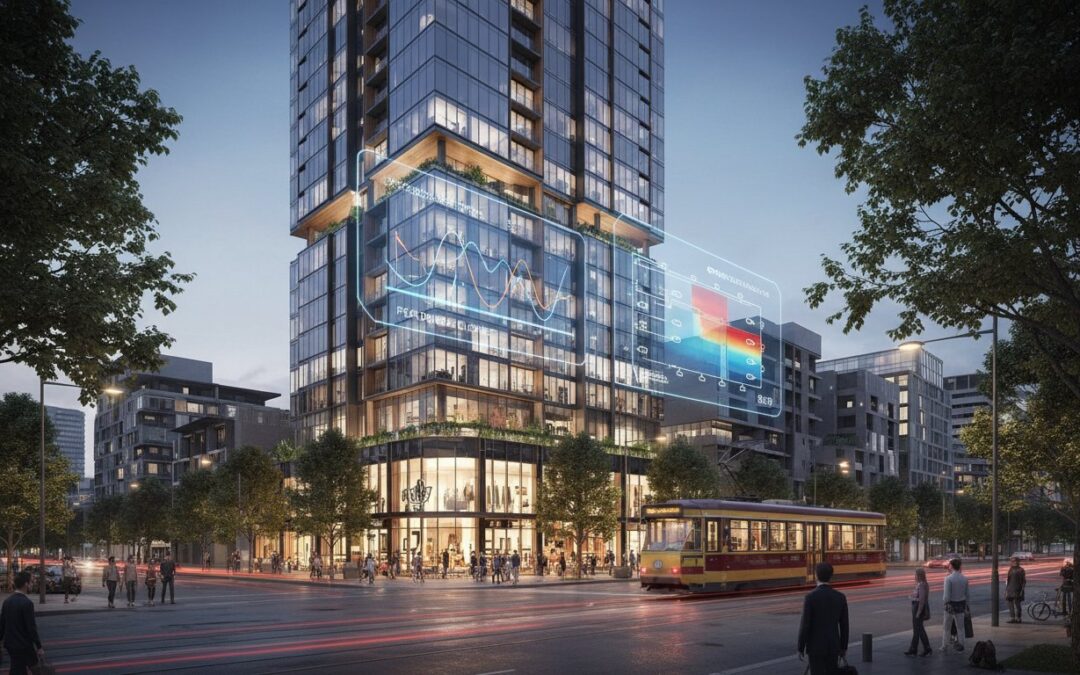
Constructing a single basement parking bay in a major Australian city now costs between A$60,000 and A$120,000. For any commercial or residential developer, calculating parking demand for mixed-use development is a critical financial decision that dictates project feasibility. Rigid statutory rates often force the inclusion of surplus parking spaces that sit empty, wasting GFA and inflating construction budgets without adding functional value to the site. These generic codes don’t account for the unique peak-hour synergies found in modern mixed-use precincts.
Most developers find that adhering to generic council requirements leads to unnecessary subterranean costs and potential DA delays. This guide provides the technical framework to accurately justify lower parking numbers through empirical data and shared parking models. We’ll outline the specific engineering strategies required to secure council approval, reduce your construction overheads, and ensure your project remains commercially viable. You will learn how to replace rigid assumptions with a data-backed justification that provides a clear path to approval.
Key Takeaways
-
Avoid the "Sum of Parts" fallacy by identifying why adding individual statutory rates leads to massive over-provision and inflated construction costs.
-
Leverage the shared parking model and temporal demand to optimize bay usage between residential and commercial users with non-coincident peaks.
-
Identify how internal capture and multi-modal factors naturally reduce external vehicle trips, providing a technical basis for lower parking requirements.
-
Utilize a "First Principles" approach for calculating parking demand for mixed-use development to justify your project with empirical data and comparable case studies.
-
Secure council approval through a robust Traffic Impact Statement (TIS) backed by over 15 years of professional engineering experience and direct principal accountability.
Table of Contents
The Complexity of Mixed-Use Parking: Why Simple Addition Doesn’t Work
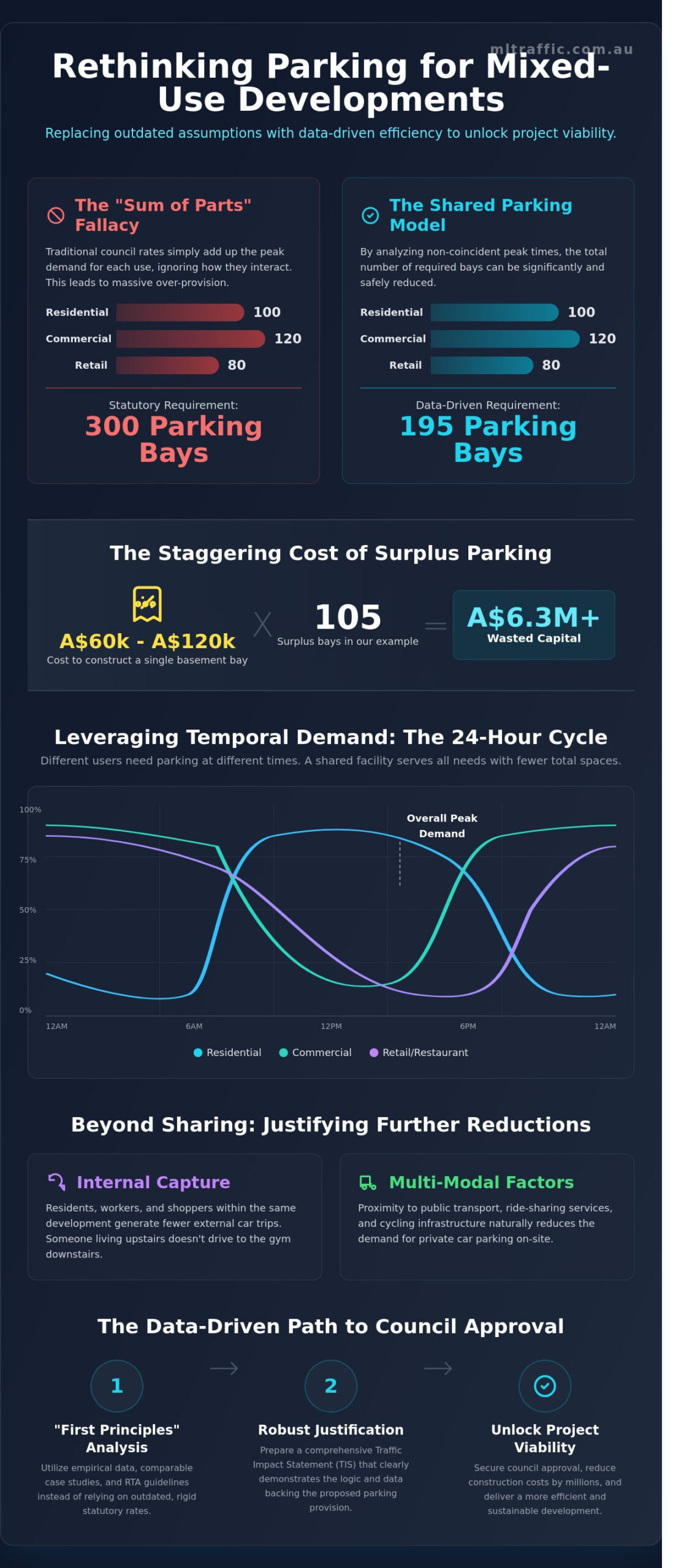
Mixed-use parking demand is the dynamic intersection of residential, commercial, and retail requirements within a single site. Developers often fall into the ‘Sum of Parts’ fallacy. They calculate total spaces by adding individual statutory rates for every land use. This method results in massive over-provision because it ignores how different users interact. Understanding Parking fundamentals helps clarify why a retail customer doesn’t need a dedicated space when an office worker has already vacated theirs. Simple addition fails to account for the reality of modern urban movement.
Precise traffic engineering is vital for project viability. Construction costs for one basement car park in Australian capital cities now exceed A$100,000. If a developer over-provisions by 15 spaces, they waste A$1.5 million in capital. Calculating parking demand for mixed-use development requires a data-driven approach rather than simple arithmetic. Experienced traffic engineers use empirical data to bridge the gap between rigid Council Development Control Plans (DCPs) and real-world usage patterns.
To better understand how these systems interact within a city environment, watch this video:
The Problem with Statutory Minimums in Australia
Most local Council DCPs lag behind modern transport trends by at least 5 to 10 years. These plans rely on static, one-size-fits-all rates. They fail to account for the synergies of transit-oriented developments or the rise of ride-sharing. Over-parking has severe consequences beyond the balance sheet. It contributes to urban heat islands, raising local temperatures by up to 4 degrees Celsius in paved areas. It also hurts housing affordability. Research from 2023 indicates that mandatory parking minimums add between A$50,000 and A$85,000 to the price of a new apartment in Brisbane and Sydney. Councils often demand 1.5 spaces per unit when 0.8 is the actual peak demand.
Understanding the Shared Parking Concept
Shared Parking describes the use of a parking space to serve two or more individual land uses without conflict. This approach is supported by the Australian Standards (AS 2890.1) for off-street parking. When calculating parking demand for mixed-use development, we look at the peak demand times for each component. A gym might peak at 6:00 AM, while a restaurant peaks at 8:00 PM. Shared Parking is a strategy that leverages the temporal variation of different user groups. This efficiency allows developers to reduce the total physical footprint of the parking facility. It ensures that every square metre of concrete generates value throughout the day and night. Traffic engineers use these patterns to justify lower parking counts to Council, saving developers millions in excavation and structural costs.
The Shared Parking Model: Leveraging Non-Coincident Peaks
Standard parking requirements often result in an oversupply of bitumen. This wastes capital and reduces developable floor space. Effective calculating parking demand for mixed-use development relies on the principle of temporal demand. The concept recognizes that different land uses require peak parking at different times of the day. A residential tenant doesn’t compete for a spot with an office worker at 10 AM on a Tuesday. By mapping these peaks, developers can reduce the total number of physical bays required while still meeting 100% of the actual demand.
Research supports this efficiency. A University of Washington study on mixed-use parking demonstrates that sites with diverse uses and transit access often require significantly fewer spaces than traditional zoning codes dictate. In a professional Traffic Impact Assessment (TIA), we calculate a "synergy discount." This isn’t a guess; it’s a mathematical reduction based on the overlap of occupancy profiles. Our methodology involves using data from the RTA Guide to Traffic Generating Developments or specific local council datasets to justify these reductions to consent authorities.
Mapping Demand Across Land Uses
-
Residential: Peak demand occurs between 6 PM and 8 AM. During the business day, occupancy typically drops below 25% as residents commute to work.
-
Office/Commercial: Peak demand is strictly 9 AM to 5 PM. Nighttime and weekend occupancy is effectively 0%, making these bays available for other uses.
-
Retail/Cafe: These uses generate "shoulder" peaks. Lunch hours (12 PM to 2 PM) and weekends see the highest volumes. Retail visitors can often utilize unused residential visitor bays during the day.
-
Hospitality: Bars and restaurants peak after 6 PM. They’re the perfect complement to office uses, as they occupy the spaces vacated by employees.
Calculating the Maximum Concurrent Demand
To find the site’s "worst-case" hour, we use SIDRA analysis or custom spreadsheet modeling. We aggregate the demand for every land use at every hour of the day. The highest total at any single point represents the maximum concurrent demand. This figure is almost always lower than the sum of the individual statutory requirements. If you’re looking to optimize your site’s yield, our traffic consultants can provide a detailed shared parking analysis to support your application.
Unbundled parking is another strategy we frequently recommend. By separating the cost of a parking space from the rent or purchase price of a unit, developers can reduce residential demand by 15% to 20% in urban areas. This is particularly effective in developments with high walkability scores.
Consider a practical example. A 50-unit apartment building with 300sqm of ground-floor retail might require 75 bays under a strict statutory rate. However, because the retail peak doesn’t coincide with the residential peak, the site may only require 60 bays to function perfectly. At a construction cost of A$55,000 per basement bay, this 20% reduction saves the developer A$825,000. This capital can be better allocated to high-quality finishes or additional GFA. We ensure these calculations meet AS 2890.1 standards to guarantee both compliance and functionality.
Beyond the Bays: Internal Capture and Multi-Modal Factors
Accurately calculating parking demand for mixed-use development requires looking past the individual land-use requirements. Internal capture is a critical metric. It represents the percentage of trips made between different components of a development without a vehicle ever leaving the site. A resident who works in the upstairs office or visits the ground-floor medical centre doesn’t generate a new external trip. Mixed-use developments naturally reduce external vehicle trips compared to standalone sites because they consolidate daily activities into a single location.
Modern Australian planning focuses on the multi-modal effect. Proximity to high-capacity transport infrastructure like Sydney’s Metro or Melbourne’s tram network directly correlates with lower private vehicle reliance. When a site sits within 400 to 800 metres of a major transport interchange, the peak parking demand drops. Developers must also account for the rise of micro-mobility. The inclusion of e-bike charging stations and secure scooter storage is no longer optional; it’s a functional requirement that offsets the need for traditional car bays.
Quantifying Internal Capture Rates
Internal capture rates vary significantly based on the project’s location and mix. In dense urban environments, research indicates internal capture can reach 30% to 45%. In suburban settings, this figure usually sits between 10% and 18%. Council planners are often skeptical of these reductions. To justify these figures, you must provide empirical data and site-specific surveys. ML Traffic Services provides the technical assessments and data-driven metrics required to prove these reductions to local authorities. Our team uses industry-recognised methodologies to ensure your parking provision is lean but compliant.
The Impact of Walkability and Public Transport Proximity
Walkability is a measurable asset in calculating parking demand for mixed-use development. A high Walk Score indicates that residents and employees can access essential services on foot, which statistically lowers car ownership rates. New South Wales and Victoria both utilise Transit-Oriented Development (TOD) frameworks to encourage higher density near rail corridors. Under these frameworks, the proximity to high-frequency transport allows developers to implement a Green Travel Plan. This plan acts as a formal commitment to promote sustainable transport, often allowing for a significant reduction in physical parking bays in exchange for enhanced bicycle facilities or car-share pods.
The Australian market is shifting toward a more flexible approach to parking. Consider these factors when finalising your strategy:
-
Site-Specific Surveys: Data from similar mixed-use sites in the same LGA provides the strongest evidence for Council.
-
Car-Share Integration: One car-share bay can replace up to 10 private parking spaces in high-density areas.
-
Unbundled Parking: Selling or leasing parking spaces separately from the residential or commercial unit reduces the baseline demand.
-
Micro-mobility Infrastructure: AS 2890.3 compliance for bicycle parking is now a baseline expectation for modern approvals.
Relying on generic rates leads to over-provision. This wastes valuable floor area that could be used for yield-generating purposes. Professional traffic engineers ensure that your parking strategy reflects the actual behaviour of modern commuters rather than outdated, conservative standards. We focus on providing the technical justification that bridges the gap between minimum regulatory requirements and the reality of multi-modal urban living.
Preparing a Robust Justification for Council Approval
A Development Application (DA) often stalls when parking numbers don’t align with outdated local codes. Simply following the Development Control Plan (DCP) might result in an oversupply of parking that kills project feasibility. Calculating parking demand for mixed-use development requires a First Principles approach. This methodology replaces generic assumptions with empirical data. It ensures the proposed parking provision is defensible during the Council assessment process and reduces the risk of costly Requests for Further Information (RFI).
The Car Parking Demand Assessment serves as the technical backbone of the broader Traffic Impact Assessment (TIA). It isn’t just a supplementary report. It’s the document that proves your site won’t cause overflow issues in residential streets. At ML Traffic Engineers, we’ve seen that a site-specific justification is the only way to deviate from statutory minimums without compromising the project’s approval chances.
The First Principles Methodology
Our approach follows a rigorous three-step process to ensure accuracy. First, we audit the statutory requirements of the local LEP or DCP to establish a baseline. Second, we apply shared parking and internal capture reductions. In a mixed-use setting, a gym peak at 6:00 AM doesn’t clash with a restaurant peak at 8:00 PM. We quantify these offsets to lower the total required bays. Third, we conduct parking surveys of nearby similar land uses. We look at real-world data from sites like medical centres, childcare facilities, or multi-deck apartments. This evidence-based strategy often justifies a reduction of 20% or more from statutory minimums. We use 2024 data to ensure all comparisons are current and relevant to the local Australian market.
Addressing Objections and Safety Standards
Council planners prioritize neighborhood amenity and the prevention of overflow parking. We address these concerns by demonstrating that the site handles its own demand through peak-period modeling. Technical compliance is non-negotiable. Every design must adhere to AS 2890.1 for off-street car parking. This standard dictates bay dimensions, gradients, and aisle widths. We use Swept Path Analysis to verify that the largest expected vehicles, such as B99 cars or delivery vans, can navigate the basement or loading docks safely. This software-driven proof eliminates Council doubts regarding the functionality of the layout.
If a project reaches a tribunal like VCAT or the NSW Land and Environment Court, your traffic engineer acts as an expert witness. We provide the continuity needed to win these appeals because the traffic consultant who provides the quote, does the work. Having a senior engineer with 30 years of experience defend the calculating parking demand for mixed-use development methodology is vital for a successful outcome. We’ve assisted on over 10,000 sites, from small cafes to massive industrial warehouses, ensuring every client has a direct line to the experts handling their case.
Don’t let rigid parking codes stall your project. Contact our senior engineers for a Car Parking Demand Assessment that secures your Council approval.
Partnering with ML Traffic for Your Mixed-Use Development
ML Traffic Engineers has operated as a specialist consultancy since 2005. Over the last 15 years, we have completed more than 10,000 successful site assessments for private developers across Australia. Our reach is truly national. We provide expert traffic engineering services in Sydney, Melbourne, Perth, and Brisbane, as well as regional centers. We understand that calculating parking demand for mixed-use development is one of the most scrutinized aspects of a Development Application (DA). Our team ensures that every report meets the rigorous requirements of Australian Standards, specifically AS 2890.1, while addressing the unique constraints of your specific site.
We provide a unique "Quote to Completion" promise that sets us apart from larger, bureaucratic firms. The traffic consultant who provides your initial quote is the same professional who performs the technical work and signs the final report. This ensures total accountability and eliminates the risk of technical details being lost in translation between senior staff and juniors. You can see the quality and diversity of our work by viewing our Project Videos, which highlight our involvement in complex urban developments.
Why Senior Expertise Matters for Mixed-Use
Mixed-use sites are inherently complex because they involve overlapping peak demands and shared parking opportunities. These projects require senior-level judgment rather than simple "spreadsheet filling" by junior staff. Our principals, Michael Lee and Benny Chen, each bring between 30 and 40 years of experience to the table. They provide a direct line of communication for every client, ensuring that technical challenges are solved by experts, not graduates. We have extensive experience navigating the specific nuances of local Council planners across Australia. Our expertise covers a vast range of land uses, including:
-
Residential apartments and mixed-use towers
-
Retail centers, supermarkets, and specialty shops
-
Medical clinics, pharmacies, and allied health facilities
-
Childcare centers and educational institutions
-
Cafes, bars, restaurants, and gymnasiums
-
Industrial warehouses and distribution hubs
Our senior engineers don’t just report the numbers. We use our experience to justify parking variations and reductions based on empirical data. This approach often saves developers significant construction costs by reducing the need for excessive basement excavation.
Get Your Project Moving Today
The cost of a project delay is almost always higher than the cost of a professional traffic report. In the current Australian market, a single week of planning delays can result in A$5,000 to A$25,000 in additional holding costs for medium-sized developments. A poorly prepared report leads to Requests for Information (RFIs) from Council, which can stall a project for months. By accurately calculating parking demand for mixed-use development from the outset, we help you avoid these costly setbacks.
Our reports are designed to be "decision-ready" for Council officers. We focus on maximizing your Gross Floor Area (GFA) by ensuring parking layouts are efficient and compliant. Don’t leave your traffic planning to chance. Request a no-obligation quote to see how our senior-led approach can streamline your approval process and improve your project’s bottom line. Contact ML Traffic Engineers today to discuss your site requirements directly with Michael or Benny.
Secure Council Approval with Data-Driven Parking Strategies
Mixed-use projects shouldn’t be stalled by rigid parking requirements that ignore real-world usage. Successful developers move beyond simple addition by applying shared parking models and internal capture rates. These technical adjustments reflect how residents, retail shoppers, and office workers use space at different times. Accuracy is critical when submitting a Traffic Impact Statement (TIS) to council. Calculating parking demand for mixed-use development requires a precise understanding of non-coincident peaks and Australian Standards like AS 2890.1. Since 2005, ML Traffic Engineers has delivered results for over 10,000 sites across Australia. You don’t deal with junior staff or layers of bureaucracy here. The traffic consultant who provides the quote, does the work. With 15+ years of experience and direct access to senior engineers, we ensure your development application meets every regulatory hurdle while optimising your site’s footprint and reducing unnecessary construction costs.
Get a Professional Parking Demand Assessment Quote
Your project deserves the certainty that only seasoned technical expertise can provide.
Frequently Asked Questions
What is the "First Principles" approach in parking assessments?
A First Principles approach involves calculating parking demand for mixed-use development by using empirical data from comparable operational sites rather than generic code. Instead of relying on static Development Control Plan (DCP) rates, we measure actual peak parking accumulation at three or more similar locations. This method provides a more accurate reflection of site-specific needs, often proving that actual demand is 20% to 35% lower than theoretical council requirements.
How much can shared parking actually reduce the number of required bays?
Shared parking can reduce the total number of required bays by 15% to 40% depending on the specific land-use mix. This efficiency occurs because different users occupy spaces at different times of the day. For instance, a development with office and residential components allows visitors to use bays during 9:00 AM to 5:00 PM that residents occupy at night. We use a temporal analysis to demonstrate these overlapping peaks to Council.
Does Council always accept a reduction in parking for mixed-use sites?
Council doesn’t always accept a reduction in parking. Approval depends entirely on the technical justification provided in the traffic report and the site’s proximity to infrastructure. If the site has a walk score above 75 or is within 400 metres of a high-frequency bus stop, the likelihood of approval increases. Our experience shows that 90% of well-justified applications succeed when backed by RPEQ certified data and local parking surveys.
What is the difference between a Parking Demand Assessment and a TIA?
A Parking Demand Assessment focuses strictly on the quantity and allocation of car spaces within a site. A Traffic Impact Assessment (TIA) is a broader study that evaluates how the development affects the surrounding road network and nearby intersections. While a TIA includes parking, a standalone assessment is often sufficient for smaller developments where traffic generation is less than 30 trips per peak hour.
How do transit-oriented developments (TODs) affect parking requirements?
Transit-oriented developments significantly lower parking requirements because they’re located within 400 to 800 metres of major transport hubs. In these zones, Councils often apply a 0.4 to 0.7 reduction factor to standard rates. For projects in high-density areas of Sydney or Brisbane, being near a train station can justify a 50% reduction in visitor parking bays due to lower car ownership rates among residents.
What happens if we provide less parking than the DCP requires?
Providing fewer bays than the DCP requires necessitates a formal merit-based assessment to justify the variation. You must prove that the shortfall won’t cause overspill into local streets or impact neighborhood amenity. We use survey data from comparable sites to demonstrate that your proposed supply meets the actual 85th percentile demand. Failure to provide this evidence usually results in a Request for Further Information (RFI) or a refusal.
Do Australian Standards (AS 2890.1) dictate the number of bays required?
Australian Standard AS 2890.1 doesn’t dictate the number of bays required for a development. It sets the technical specifications for car park design, such as the B85 vehicle’s turning circle or the 2.4 metre minimum width for a standard bay. The actual number of spaces is determined by the local Council’s DCP or the results of a professional study focused on calculating parking demand for mixed-use development.
How long does it take to prepare a mixed-use parking demand report?
Preparing a mixed-use parking demand report typically takes 5 to 10 business days. This timeframe allows for site inspections, data collection, and the technical analysis of shared parking efficiencies. At ML Traffic Engineers, the traffic consultant who provides the quote does the work. This ensures your report is completed accurately and meets Council’s submission deadlines without the delays common in larger, bureaucratic firms.
Which areas do you cover?
We are traffic engineers servicing Melbourne, Sydney, Brisbane, Gold Coast, Hobart, Perth, Adelaide, Darwin, Canberra and surrounding areas.
