

Saving on consultancy fees by drafting your own traffic documentation often results in the exact project delays and council rejections you’re trying to avoid. It’s understandable why many developers ask, “can I prepare my own traffic impact statement” when managing a small-scale project budget. You want to maintain momentum without overspending on technical assessments that seem straightforward on the surface.
However, the difference between a simple Statement and a comprehensive Traffic Impact Assessment (TIA) involves more than just descriptive text. This guide outlines the regulatory requirements, technical risks, and compliance hurdles associated with DIY traffic reports compared to professional engineering submissions. You’ll discover the specific thresholds where a certified professional becomes mandatory and how to identify the technical gaps that lead to a Request for Information (RFI).
We provide a clear framework to help you determine if you can realistically handle the documentation yourself or if the lack of a formal Vehicle Swept Path Analysis will stall your application at the council desk. Understanding these professional standards allows you to make an informed decision that protects your project timeline and avoids unnecessary bureaucracy.
Key Takeaways
- Understand the legal standing of self-prepared documents and find the answer to “can I prepare my own traffic impact statement” based on Australian planning schemes.
- Learn why technical accuracy and adherence to mandatory Australian Standards are the primary metrics for council approval.
- Identify the financial risks of DIY submissions, including how councils use Requests for Information (RFI) to pause approval timelines.
- Use our 5-step framework to evaluate your specific project scale against local council thresholds for professional traffic services.
- Discover how direct access to senior principals ensures your documentation meets rigorous compliance standards from the initial submission.
Can You Prepare Your Own Traffic Impact Statement? The Regulatory Reality
A Traffic Impact Statement (TIS) serves as a technical assessment of how a proposed development affects the existing road network. For small-scale projects, developers often ask, “can I prepare my own traffic impact statement” to reduce preliminary costs. While Australian planning schemes don’t strictly prohibit self-drafting in every instance, the legal standing of such documents is precarious. Councils prioritize technical compliance and risk mitigation above all else.
The regulatory requirements vary significantly between local government areas. A minor residential extension might only require a basic letter of justification. Conversely, any development involving increased trip generation or changes to site access typically triggers the need for a professional report. The distinction between a qualified traffic engineer and a general planning consultant is critical here. Engineers provide certified data, whereas generalists often lack the technical software and accreditation to back their claims.
To better understand this concept, watch this helpful video:
Understanding the Difference Between a Statement and a Report
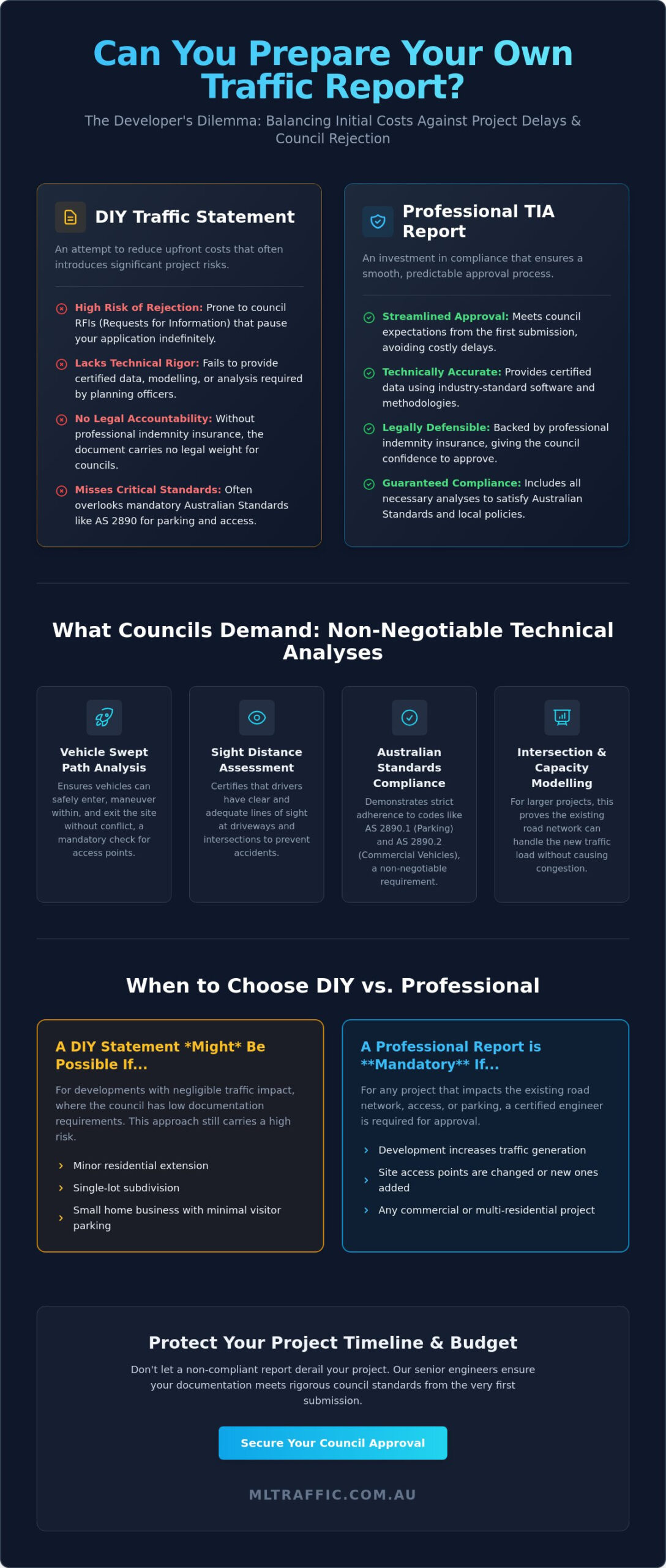
Terminology is vital when reviewing a council’s Request for Information (RFI). A Traffic Impact Statement (TIS) is generally reserved for low-impact, small-scale residential or commercial works where traffic changes are negligible. A Traffic Impact Assessment (TIA) Report is a comprehensive technical document required for larger developments. TIAs require detailed modelling of Intersection Capacity Utilization to prove the surrounding infrastructure can handle the new load. Using the wrong format often leads to immediate administrative delays.
When Councils Permit Non-Professional Submissions
Councils occasionally permit non-professional submissions for “minor impact” developments. These typically include single-lot subdivisions or small home-based businesses with minimal visitor parking requirements. However, submitting a DIY statement carries high risks. Without professional indemnity insurance, your document lacks the legal weight councils require to approve higher-risk access points. Most planning officers will reject a self-prepared statement if it lacks a formal Vehicle Swept Path Analysis or a certified Sight Distance Assessment. Professional engineering reports provide the accountability and technical rigour that streamline the approval process and prevent costly project stalls.
Technical Requirements and Australian Standards for Traffic Submissions
Technical accuracy is the primary metric by which councils evaluate development applications. When developers ask, “can I prepare my own traffic impact statement,” they often underestimate the rigorous data collection required for a successful submission. Every statement must address specific Australian Standards and local planning policies to avoid immediate rejection. This involves conducting precise traffic counts and parking surveys to establish a baseline of existing conditions.
Regulatory bodies rely on frameworks like Queensland’s Guide to Traffic Impact Assessment to ensure consistency across submissions. These documents outline how to assess traffic generation and intersection performance. If your self-prepared statement lacks this technical depth, it will likely fail the initial assessment phase.
Compliance with AS 2890.1 and AS 2890.2
Adherence to the AS 2890 series is non-negotiable for off-street parking and commercial vehicle facilities. AS 2890.1 serves as the industry benchmark for car park design, specifying exact dimensions for parking spaces, aisle widths, and driveway gradients. AS 2890.2 provides the equivalent standards for heavy vehicle facilities. Common DIY errors include:
- Incorrectly calculating ramp grades, which leads to vehicle scraping.
- Inadequate parking space widths that don’t meet specific user class requirements.
- Failure to account for vertical clearance in basement car parks.
Precision in these measurements is essential. A single error in a Driveway Ramp Grade Assessment can necessitate a complete redesign of your site entry, adding months to your timeline.
The Necessity of Swept Path Analysis and Specialized Software
Proving vehicle maneuverability is a core requirement of any traffic submission. A Swept Path Analysis demonstrates that the largest expected vehicle can safely navigate the site. This can’t be done accurately by hand. Professional engineers use specialized software like AutoTURN to simulate vehicle movements with high precision. This is particularly vital for:
- Ensuring waste collection vehicles can access bins and exit in a forward motion.
- Confirming that delivery trucks can navigate tight loading bays without striking infrastructure.
- Verifying that emergency vehicles have sufficient clearance during a fire event.
Attempting to estimate these paths manually is a significant risk. If you’re unsure about meeting these technical benchmarks, reviewing our full range of traffic services can help you identify the specific technical gaps in your current application.
The Risks of DIY Traffic Impact Statements in Development Applications
Submitting a flawed technical document is a high-stakes gamble with your development timeline. Developers frequently ask, “can I prepare my own traffic impact statement” in an attempt to bypass consultancy fees, but this choice often triggers the very delays they hope to avoid. When a council planning officer receives a self-prepared statement that lacks rigorous engineering data, it signals a lack of professional oversight. This immediately diminishes your project’s credibility and invites closer scrutiny of every other technical aspect of your application.
Underestimating traffic generation is more than an administrative error; it’s a significant safety risk. If your documentation fails to accurately predict trip increases or ignores the impact on local intersection safety, you’re creating long-term infrastructure problems. Councils are acutely aware of these risks and will not approve a development that presents a potential liability to public road users. Proving your project’s safety requires a level of technical depth that DIY efforts rarely achieve.
Project Delays and Request for Information (RFI)
An incomplete or amateur traffic statement is the most common trigger for a formal Request for Information (RFI). When a council issues an RFI, the statutory approval clock stops immediately. This process doesn’t just add a few days to your schedule; it typically adds months. You’ll face the compounding costs of land holding, interest on financing, and potential builder price escalations while your application sits in limbo. Councils often insist that you engage a professional traffic engineer after a DIY attempt fails, meaning you’ll pay the professional fees anyway, but with the added burden of project delays.
Lack of Professional Indemnity and Liability Issues
A certified signature on a traffic report provides more than just council compliance; it provides legal accountability. Professional engineers carry significant professional indemnity insurance that covers their design work and technical advice. If a DIY-designed driveway or parking layout leads to a traffic accident or property damage after construction, the developer bears the full weight of the liability. There’s no professional “shield” to protect you in a legal dispute. Professional consultants act as a buffer, ensuring that all designs meet national safety standards and providing a robust defense during planning disputes or Land and Environment Court proceedings. If you’re concerned about these technical risks, you can contact our senior principals for a direct assessment of your project’s requirements.
Determining If Your Project Requires a Qualified Traffic Engineer
Deciding whether you can I prepare my own traffic impact statement requires an objective assessment of your project’s technical parameters. Local councils across Australia utilize specific thresholds within their Development Control Plans (DCPs) to determine when a professional report is mandatory. If your proposal exceeds these benchmarks, a self-prepared statement will be deemed insufficient during the initial lodgement phase. Use the following 5-step framework to evaluate your project’s requirements:
- Quantify Peak Hour Trip Generation: Calculate the expected vehicle movements during the busiest hours of the day.
- Identify Road Classification: Determine if the fronting road is a local, collector, or arterial road managed by a state authority.
- Assess Parking Requirements: Evaluate if the proposed land use meets or exceeds the minimum parking rates specified in the DCP.
- Check Proximity to Intersections: Measure if your site access is within 100 metres of a signalised intersection or major roundabout.
- Verify Heavy Vehicle Needs: Confirm if the development requires access for waste collection trucks or large delivery vehicles.
Technical complexity dictates authorship. If your project triggers any of these steps, the risk of a council rejection increases significantly without professional sign-off. If your project meets any of the “major” criteria listed above, contact our senior engineering team to secure a compliant technical report before your council submission.
Criteria for Minor vs. Major Traffic Impacts
Trip generation is the primary metric used to separate minor works from major developments. While thresholds vary by council, a project that generates more than 10 to 20 vehicle movements in a single peak hour often requires a formal report. Change of use applications are particularly deceptive in this regard. A shift from a low-intensity warehouse to a high-turnover gym or medical centre significantly alters the parking demand profile. Even if you aren’t changing the building’s footprint, the increased pressure on local street parking often necessitates a professional Car Parking Demand Assessment. Projects located on state-controlled arterial roads face even stricter scrutiny, as state transport agencies rarely accept documentation not prepared by a certified engineer.
Assessing Site-Specific Constraints and Safety Risks
Safety is the non-negotiable core of any traffic submission. A Traffic Impact Assessment must rigorously evaluate sight distances and driveway safety according to national standards. If your site has limited street frontage or requires a complex internal car park layout, a DIY statement cannot provide the necessary level of detail. These constraints require a precise Sight Distance Assessment to ensure that vehicles can enter and exit the site without creating hazards for through-traffic or pedestrians. Furthermore, ensuring that waste vehicles can navigate the site without reversing into public roads is a common council requirement that necessitates a formal Vehicle Swept Path Analysis. Professional engineers use specialized software to prove these movements, providing the technical assurance that council planning officers require for approval.
How ML Traffic Engineers Ensures Council Approval Success
ML Traffic Engineers provides the technical certainty required to secure council approval for diverse development projects. While you may still consider the question, “can I prepare my own traffic impact statement,” our 15 years of professional experience suggests that certified engineering reports are the most reliable path to a successful outcome. We streamline the DA process by proactively negotiating with councils and road authorities to resolve potential issues before they become formal objections. Our team focuses on eliminating the technical ambiguities that typically trigger a Request for Information (RFI).
Our approach is built on meticulous data collection and adherence to national regulatory frameworks. We don’t just provide a document; we provide a robust technical defense of your project’s traffic and parking merits. By involving senior leadership in every assessment, we ensure that the documentation submitted to the council is accurate, compliant, and defensible in a planning environment. This level of professional oversight is impossible to replicate in a self-prepared statement.
Technical Expertise and National Compliance
We apply rigorous national standards to ensure your project is compliant in every Australian jurisdiction. Our traffic engineering services integrate complex regulatory requirements into a clear, actionable format for planning officers. We use industry-standard software to provide undeniable proof of site functionality. Our comprehensive assessments include:
- Precise Vehicle Swept Path Analysis for waste, delivery, and emergency vehicles.
- Compliant Car Park Design in accordance with AS 2890.1 and AS 2890.2.
- Detailed Intersection Analysis and Sight Distance Assessments to ensure public safety.
- Comprehensive Waste Management Plans for residential and commercial sites.
This technical rigour reduces overall project risk. It ensures your site layout is functional from the outset, preventing the need for expensive structural changes after the DA has been lodged.
A Direct Line to Experienced Principals
Our firm operates with a “no-gatekeepers” philosophy that distinguishes us from larger, impersonal consultancies. The senior principal who initiates your project is the same expert who performs the technical work and signs the final report. This personnel continuity ensures that technical nuances aren’t lost in communication. It also leads to faster report turnaround times, as you have a direct line to the experts responsible for your project’s success. We have extensive experience across a vast range of project environments, including:
- Childcare centres and educational facilities.
- Medical clinics and allied health hubs.
- Industrial warehouses and distribution centres.
- Multi-unit residential developments and mixed-use towers.
Protect your project timeline by ensuring your traffic documentation is prepared correctly the first time. You can get started by contacting our senior engineers today for a direct assessment of your development’s requirements.
Secure Your Development Approval with Technical Certainty
Submitting a Development Application requires technical precision that DIY documentation rarely achieves. Councils prioritize safety and infrastructure capacity, making professional certification a necessity for most projects. Technical standards like AS 2890 and the requirement for software-based Swept Path Analysis serve as the primary benchmarks for successful approval. While you might still ask, “can I prepare my own traffic impact statement,” the financial cost of a council rejection far exceeds the initial investment in a professional engineering report.
ML Traffic Engineers leverages over 15 years of Australian consultancy experience to navigate these regulatory hurdles. We provide direct access to senior principals who perform the technical work themselves, ensuring your project benefits from deep-seated expertise. Our specialists focus on AS 2890 compliance and precise Vehicle Swept Path Analysis to eliminate the risk of an RFI. Ensure your application is compliant from the first lodgement. Get a Professional Traffic Impact Statement for Your DA and move your project forward with confidence.
Frequently Asked Questions
Is a Traffic Impact Statement legally required for every Development Application?
No, a Traffic Impact Statement is not mandatory for every submission. Requirements depend on the scale of the development and the potential for increased trip generation. Minor internal renovations usually don’t require one; however, any project involving a change of land use, new access points, or increased parking demand will typically trigger a council requirement for a professional assessment.
Can a general civil engineer prepare a traffic impact statement instead of a specialist?
While a general civil engineer may technically draft the document, it carries significant technical risks. Specialist traffic engineers possess the specific software and accreditation required for complex intersection modelling and parking demand assessments. Many developers ask, “can I prepare my own traffic impact statement” only to find that generalist reports lack the rigorous data required to satisfy strict council engineering departments.
How much does it cost to have a professional prepare a traffic statement?
Professional fees are determined by the project’s technical complexity and the required scope of work. Factors influencing the total investment include the number of intersections requiring analysis, the necessity for physical traffic counts, and whether the council demands a basic Statement or a comprehensive Traffic Impact Assessment (TIA). Engaging a specialist early often prevents the compounding costs of project delays.
What happens if the council rejects my self-prepared traffic report?
Council will issue a formal Request for Information (RFI), which immediately pauses the statutory approval clock. You’ll then be required to address the technical deficiencies, which almost always necessitates hiring a professional engineer to redo the work. This results in lost time and a potential loss of credibility with the planning officers assessing your application.
How long does it take for a traffic engineer to complete a TIS?
Completion times vary based on project scale and the availability of existing traffic data. A standard Traffic Impact Statement for a minor development can typically be completed within one to two weeks. More complex projects involving intersection modelling or extensive parking surveys require additional time to ensure all technical standards and Australian Standards are met.
Does a small residential subdivision need a Swept Path Analysis?
Yes, most councils require a Swept Path Analysis for subdivisions to confirm that service vehicles can operate safely. You must prove that the largest expected vehicle, such as a heavy rigid waste truck, can enter and exit the site in a forward motion. This analysis must adhere to AS 2890.2 standards to ensure long-term infrastructure functionality.
Can I use a previous traffic report as a template for my own project?
Using a previous report as a template is highly discouraged due to site-specific variables. Every development features unique road geometry, sight distances, and surrounding traffic volumes. Planning officers easily identify templated content that fails to address local site constraints, leading to immediate RFIs and project momentum loss.
What is the difference between a Traffic Management Plan and a Traffic Impact Statement?
A Traffic Impact Statement (TIS) assesses the permanent, long-term effects of a new development on the road network during the DA stage. A Traffic Management Plan (TMP), or Traffic Guidance Scheme (TGS), focuses on the temporary management of vehicles and pedestrians during the construction phase. Both documents serve different regulatory purposes and are required at different stages of the development lifecycle.

Disclaimer
The content on www.mltraffic.com.au, including all technical articles, guides, and resources, is provided for general informational and educational purposes only. It is not intended to constitute professional advice in traffic engineering, transportation planning, development approvals, or any other technical or legal field.
While ML Traffic Engineers makes every reasonable effort to ensure the accuracy, completeness, and timeliness of the information published, we do not provide any warranties or representations (express or implied) regarding its reliability, suitability, or availability for any particular purpose. Any reliance you place on the content is strictly at your own risk.
In no event shall ML Traffic Engineers, its directors, employees, authors, or affiliates be liable for any direct, indirect, incidental, special, consequential, or punitive damages (including, without limitation, loss of profits, data, or business opportunities) arising out of or in connection with the use of, or inability to use, any information provided on this website.
The articles and guides on this site are not a substitute for engaging a qualified, registered professional traffic engineer (such as an NPER or RPEQ engineer) to assess your specific project requirements. For tailored advice, compliance assessments, or traffic engineering services, please contact a competent professional.
This disclaimer may be updated from time to time without notice. By accessing or using this website, you agree to be bound by the most current version of this disclaimer.
