
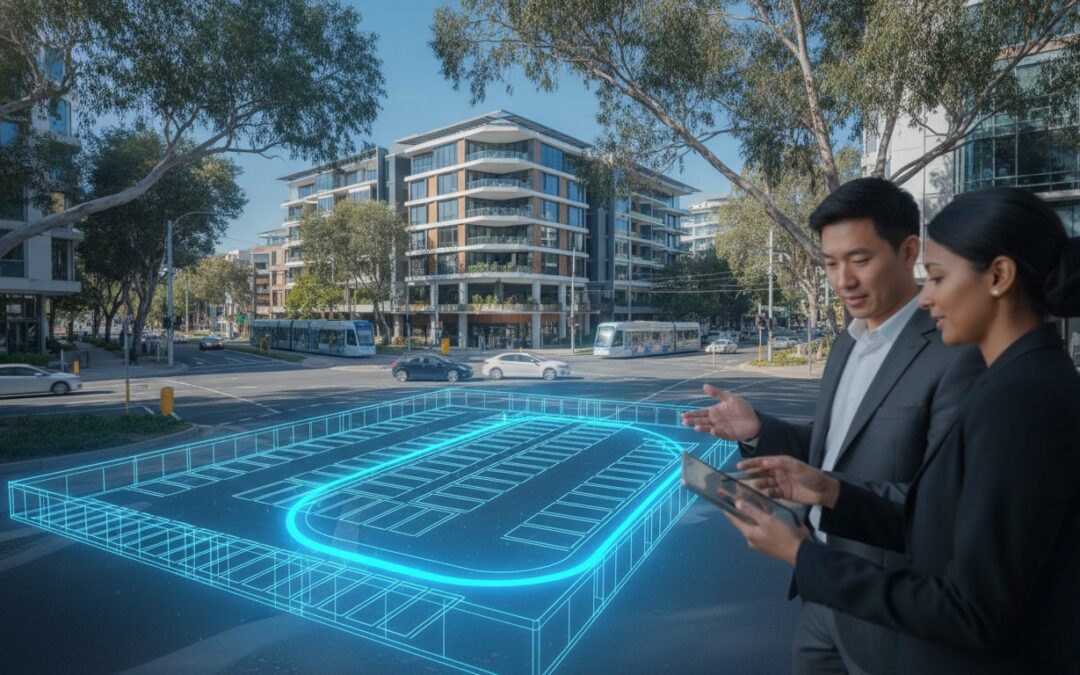
A single non-compliant ramp gradient or a missed 3D model requirement can stall your Canterbury-Bankstown development for months. Under the Canterbury-Bankstown Development Control Plan 2023, the margin for error in technical submissions has effectively disappeared. It’s common to feel frustrated by opaque council requirements and the risk of approval delays due to non-compliant car park designs. You require a Traffic and Parking Assessment for DA in Canterbury-Bankstown Council that addresses these complexities while protecting your project’s commercial yield.
We understand that navigating the intersection of AS 2890.1:2021 standards and specific council mandates is a significant hurdle for developers and architects. This article provides a clear roadmap to securing your approval with ease by aligning your engineering reports with the latest 2026 regulatory updates. We will examine the critical role of vehicle swept path analysis, the necessity of the new 3D model submissions for larger developments, and how to maximise parking yield while maintaining compliance with AS 2890.1 and AS 2890.2.
Key Takeaways
- Understand how the Canterbury-Bankstown DCP 2023 differentiates between ‘Centres’ and ‘Suburban’ parking rates to ensure your project meets specific local benchmarks.
- Learn why a comprehensive Traffic and Parking Assessment for DA in Canterbury-Bankstown Council is essential for commercial and multi-residential projects to avoid costly approval delays.
- Master technical compliance by integrating AS 2890.1 and AS 2890.2 standards with Vehicle Swept Path Analysis, particularly for constrained urban sites.
- Identify the critical steps in the DA submission workflow, including the benefits of engaging in pre-DA consultations to resolve potential ‘red flags’ early.
- Discover the advantages of partnering with senior engineering principals who provide direct oversight and technical accountability throughout the entire assessment process.
What is a Canterbury-Bankstown DA Traffic Assessment?
A Traffic and Parking Assessment for DA in Canterbury-Bankstown Council is a formal technical report that quantifies how a proposed development will influence the surrounding transport infrastructure. This document is not merely a formality; it serves as a technical subset of the broader Environmental Impact Assessment (EIA) framework. By evaluating predicted traffic volumes and parking demand, the report ensures that new projects don’t compromise road safety or lead to unsustainable levels of street congestion. The Canterbury-Bankstown Council mandates these assessments to maintain the functionality of local precincts and to address community concerns regarding urban density.
To better understand the practical implications of parking and vehicle manoeuvres in commercial settings, watch this helpful video:
Distinguishing between a full Traffic Impact Assessment (TIA) and a simple Traffic Statement is vital for project budgeting and timelines. A TIA is an exhaustive study required for high-impact developments, involving detailed intersection modelling and long-term network analysis. Conversely, a Traffic Statement is often sufficient for smaller-scale projects where the impact on the existing road network is negligible. Both documents aim to mitigate community friction by proving that the development can operate safely within the existing urban fabric. A professional Traffic and Parking Assessment for DA in Canterbury-Bankstown Council provides the data necessary to satisfy council planners and local residents alike.
The Purpose of Traffic Reports in the Planning Process
Traffic reports provide the evidentiary basis for a council’s planning decisions. They perform several key functions:
- Traffic Generation: Calculating the exact number of daily and peak-hour vehicle trips based on the proposed land use.
- Safety and Access: Ensuring that vehicle ingress and egress points meet sight distance requirements and don’t create hazards for pedestrians.
- Factual Substantiation: Supporting the ‘Statement of Environmental Effects’ with data-driven engineering conclusions rather than assumptions.
When Does Council Trigger a Formal Assessment?
The requirement for a formal assessment depends on the scale and nature of the development. Canterbury-Bankstown Council typically triggers these requirements for residential flat buildings, childcare centres, and large-scale industrial sheds. Even minor ‘Change of Use’ applications may require a parking demand study if the new business type has a higher parking requirement than the previous occupant. For a comprehensive list of specific report types and technical requirements, refer to the ML Traffic Engineers Australia Services page.
Navigating the Canterbury-Bankstown Development Control Plan (DCP)
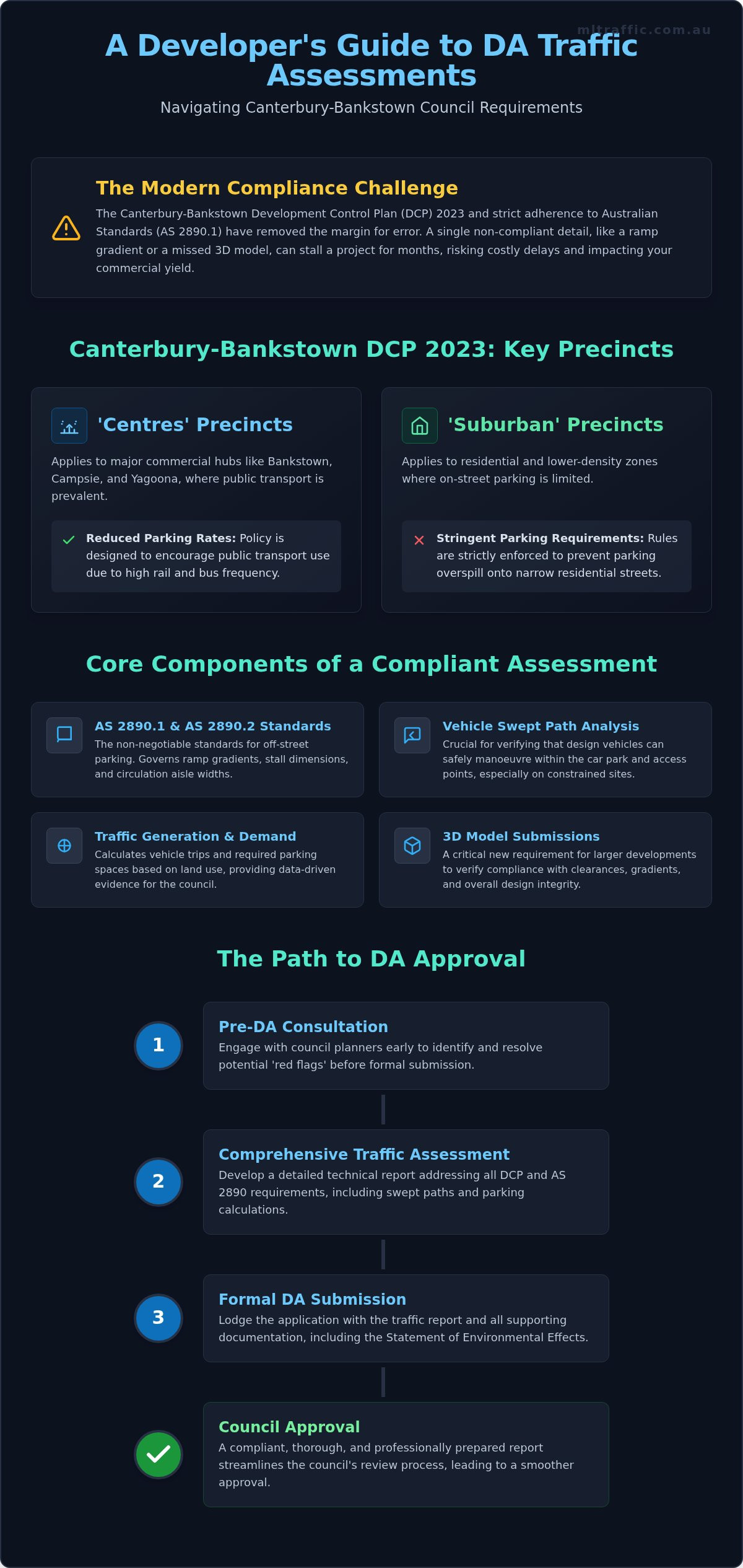
The Canterbury-Bankstown Development Control Plan (DCP) 2023 is the primary regulatory document governing parking and access requirements across the local government area. While the Local Environmental Plan (LEP) dictates broad land-use and height restrictions, the DCP provides the specific engineering metrics required for a successful Traffic and Parking Assessment for DA in Canterbury-Bankstown Council. A central feature of this plan is the distinction between ‘Centres’ and ‘Suburban’ precincts. Developments within major commercial hubs, such as Bankstown, Campsie, or Yagoona, often benefit from reduced parking rates. This is because council policy aims to encourage public transport use in areas with high rail and bus frequency. Conversely, projects in suburban zones face more stringent requirements. These rules prevent vehicle overspill from burdening narrow residential streets.
Developers frequently overlook the specific allocation ratios between resident and visitor parking required by the council. Council planners scrutinise these figures to ensure visitor demand does not burden the public domain. Failing to account for these nuances often leads to formal Requests for Information (RFIs) that delay project timelines. Ensuring that every bay is correctly classified and designed according to the DCP is a non-negotiable step in the planning process.
Parking Demand and Supply Analysis
Calculating minimum parking requirements involves a detailed analysis of floor space or bedroom counts for residential flat buildings. Council requires strict adherence to these benchmarks. However, engineers can often justify a parking shortfall by providing empirical evidence from similar developments or conducting local parking surveys. If a site sits within 800 metres of a major transit hub, a specialised assessment can demonstrate that actual demand is lower than the DCP’s default rates. This evidence-based approach is critical for maximising building yield without compromising safety. Consulting with a senior traffic engineer early in the design phase helps identify these opportunities before the design is finalised.
Bicycle and Motorcycle Parking Provisions
Sustainable transport is a priority for the council. The DCP 2023 mandates specific quotas for bicycle racks and motorcycle bays to reduce reliance on private cars. For commercial projects, this includes end-of-trip facilities such as secure lockers and change rooms. These must align with current NSW planning circulars regarding active transport. Designing these spaces correctly from the outset ensures the DA is not rejected on sustainability grounds. Meticulous attention to these provisions reflects a project’s commitment to modern urban planning standards and ensures compliance with the latest environmental mandates.
Technical Compliance: Swept Paths and Car Park Design
Technical compliance is the backbone of any successful application. Canterbury-Bankstown Council mandates strict adherence to Australian Standards. AS 2890.1 (Off-street car parking) and AS 2890.2 (Off-street commercial vehicle facilities) provide the framework for every parking layout. A compliant Traffic and Parking Assessment for DA in Canterbury-Bankstown Council must demonstrate that every parking bay, aisle, and ramp meets these specific dimensions. Council planners don’t accept reports that fail to address these fundamental engineering benchmarks.
Waste management is a frequent point of failure in DA submissions. Council requires that service vehicles, such as heavy rigid vehicles (HRVs) for garbage collection, can enter and exit the site in a forward direction. This often necessitates complex internal manoeuvring areas. Additionally, driveway ramp grades are a critical focus on steep Canterbury-Bankstown sites. Engineers must calculate transitions and grade changes to prevent vehicle undercarriages from scraping, ensuring functional access for all residents and visitors.
AS 2890.1 and AS 2890.2 Compliance
Standard parking bay dimensions and aisle widths are regulatory requirements. Designers must account for specific vehicle profiles to guarantee accessibility:
- B85 Vehicle: The 85th percentile vehicle used for standard parking space and aisle design.
- B99 Vehicle: The 99th percentile vehicle used to determine critical clearances at turn points and ramp transitions.
- Aisle Widths: Ensuring sufficient space for two-way traffic or single-entry manoeuvres based on the parking angle.
Ensuring these metrics are accurate prevents the need for redesigns after council assessment. For a deeper look at these requirements, read our article on AS 2890.1 Explained: The Ultimate Guide to Compliant Car Park Design.
Swept Path Analysis using AutoTURN
Tight urban sites in areas like Bankstown or Campsie leave little room for error. Vehicle swept path analysis is a mandatory component for any Traffic and Parking Assessment for DA in Canterbury-Bankstown Council where standard layouts are not feasible. By using specialised AutoTURN software, engineers can visualise the exact path a vehicle takes during a turn. This proof is essential for satisfying council engineers that heavy vehicles or standard cars won’t strike pillars or kerbs.
Loading dock efficiency is equally important for industrial and retail projects. A swept path analysis demonstrates that delivery vehicles can access loading bays without obstructing traffic flow on public roads. This level of technical detail reduces the risk of council rejection and maximises the usable area of the site. To understand the full scope of this process, see our Swept Path Analysis: A Complete Guide for Australian Developments.
The DA Submission Process for Canterbury-Bankstown Council
The path to obtaining approval involves a structured workflow that integrates engineering precision with local planning policy. A successful Traffic and Parking Assessment for DA in Canterbury-Bankstown Council begins with a detailed site survey and a review of the Canterbury-Bankstown DCP 2023. Coordination between your traffic engineer, architect, and civil designer is vital at this stage. If the traffic report contradicts the architectural site plan or the civil drainage levels, council planners will issue an immediate deferral. Ensuring all technical drawings align prevents conflicting data from stalling your application.
Council assessment officers frequently issue ‘Requests for Further Information’ (RFI) when technical details are missing or unclear. These requests often focus on vehicle manoeuvrability or parking shortfall justifications. Responding to an RFI requires a factual, data-driven approach rather than a speculative one. Providing revised swept path diagrams or updated parking surveys can resolve these issues quickly. Effective coordination ensures that the final submission addresses all potential council concerns before they become formal objections.
Pre-DA Consultation and Strategy
Engaging with council during a pre-DA consultation is a strategic move that can save thousands in redesign costs. This phase allows you to identify ‘red flags’ such as heritage constraints in narrow lanes or access restrictions on busy arterial roads. For developments fronting state roads, you must also consult with Transport for NSW (TfNSW). Identifying these requirements early allows your engineer to incorporate necessary design changes, such as specific driveway placements or deceleration lanes, into the initial proposal. This proactive strategy is particularly important given the mandatory 3D model submission requirement for larger DAs effective from 1 July 2026.
Finalising the Traffic Impact Assessment (TIA)
The final TIA report must be a comprehensive document that synthesises traffic data, SIDRA modelling results, and design certifications. Council requires that these reports are prepared and signed by qualified professional traffic engineers from a firm like ML Traffic Engineers Australia. A senior-level review ensures that the report adheres to both the Canterbury-Bankstown DCP 2023 and national standards like AS 2890.1:2021. For a detailed breakdown of what a complete report should include, see our Traffic Impact Assessment: The Definitive Guide for Australian Developers.
To ensure your technical report passes council scrutiny on the first submission, you can contact our senior principals directly for an authoritative assessment of your project site.
Why Partner with ML Traffic Engineers Australia for Your Project?
ML Traffic Engineers Australia provides a specialised consultancy service backed by more than 15 years of industry experience. We’ve developed a robust reputation for delivering high-quality technical reports that facilitate development application approvals throughout New South Wales. Our firm operates on a principal-led model. This means you have direct access to senior leadership for every technical query. We don’t employ junior gatekeepers to manage client relationships. The expert who initiates your project is the same professional who performs the technical work and signs the final report. This personnel continuity promise is a core pillar of our professional identity.
Our history of successful submissions to Canterbury-Bankstown Council demonstrates our deep understanding of the local planning environment. We provide a comprehensive range of services tailored to meet specific council triggers, including:
- Traffic Impact Assessment (TIA) Reports
- Vehicle Swept Path Analysis using specialised AutoTURN software
- Car Parking Demand Assessments
- Driveway Ramp Grade Assessments
- Waste Management Plans
- Intersection and Sight Distance Assessments
When commissioning a Traffic and Parking Assessment for DA in Canterbury-Bankstown Council, the lead engineer’s qualifications are the primary factor in report acceptance. Our meticulous approach to AS 2890.1 and AS 2890.2 compliance ensures your car park design is functional and regulatory-compliant from the first submission. We focus on results-oriented engineering that avoids the costly redesigns and approval delays discussed in previous sections.
National Expertise with a Local Focus
Our engineers maintain a national perspective while applying precise local knowledge to the Canterbury-Bankstown DCP 2023. We understand how local officers interpret parking rates and access requirements in both high-density centres and suburban zones. This local focus ensures that your Traffic and Parking Assessment for DA in Canterbury-Bankstown Council aligns perfectly with council expectations. You can learn more about our team and professional background on our About Us page.
Get Started on Your Canterbury-Bankstown DA
Time is a critical factor in any development project. We offer fast turnaround times and fixed-fee quotes for standard traffic and parking assessments. This transparency allows you to budget accurately and keep your development timeline on track. Our senior team is ready to provide the authoritative engineering support your project requires. Contact us today via our Contact Page to discuss your specific site requirements and secure a professional fee proposal.
Secure Your Canterbury-Bankstown DA Approval
Securing a development approval in the Canterbury-Bankstown LGA requires a precise alignment of architectural vision and engineering standards. We’ve explored how technical compliance with AS 2890.1:2021 and the Canterbury-Bankstown DCP 2023 forms the foundation of a successful submission. Recognising the distinction between parking rates for major centres and suburban zones is critical for maximising your project’s yield while avoiding costly redesigns.
Obtaining a compliant Traffic and Parking Assessment for DA in Canterbury-Bankstown Council is a technical necessity for any successful development. With over 15 years of consultancy experience and direct principal involvement in every project, we ensure your report withstands rigorous council scrutiny. We utilise certified AutoTURN software to provide accurate swept path analysis, eliminating the guesswork from tight urban site designs. This hands-on approach ensures that the expert who starts your project is the one who finishes it.
Our senior engineers are ready to help you move past the planning stage and into construction. Contact our Senior Traffic Engineers for a Canterbury-Bankstown DA Quote to secure professional oversight for your next project. We look forward to facilitating your development’s success with reliable engineering expertise.
Frequently Asked Questions
Does Canterbury-Bankstown Council require a traffic report for a small dual occupancy?
Canterbury-Bankstown Council typically requires a basic traffic and access statement for dual occupancies if the site involves narrow street frontages or complex driveway placements. While a full TIA is rarely mandated for small residential projects, you must still demonstrate that vehicle ingress and egress comply with safety standards. This ensures the proposed development doesn’t create hazards for pedestrians or passing motorists.
How much does a Traffic Impact Assessment (TIA) cost for a DA?
The cost of a Traffic and Parking Assessment for DA in Canterbury-Bankstown Council depends on the project’s specific scale and technical complexity. Fees are influenced by variables such as the requirement for SIDRA intersection modelling, the number of vehicle swept path simulations, and whether on-site parking surveys are needed to justify a shortfall. We provide fixed-fee quotes based on the specific requirements of your project site.
What is a Swept Path Analysis, and is it always required?
Swept Path Analysis is a digital simulation that tracks the path of a vehicle’s tyres and body during a turn. Council requires this analysis for most developments where waste collection occurs on-site or where the car park layout is constrained. It’s an essential tool to prove that B99 cars or heavy rigid vehicles can manoeuvre safely without striking kerbs, columns, or other vehicles.
Can I use a general civil engineer for my traffic and parking report?
Council planners generally prefer reports prepared by specialist traffic engineers who possess specific expertise in transport modelling and DCP nuances. While some civil engineers offer these services, they often lack the specialised AutoTURN software and deep knowledge of the Canterbury-Bankstown DCP 2023 required for complex justifications. Engaging a specialist reduces the risk of receiving a formal Request for Further Information (RFI).
How long does it take to prepare a traffic assessment for a DA?
A standard traffic assessment usually takes between one and two weeks to complete. This timeframe depends on the complexity of the development and whether we need to conduct manual traffic counts or parking accumulation surveys. Providing finalised architectural and civil plans at the start of the process helps us maintain an efficient delivery schedule for your submission.
What happens if my proposed parking doesn’t meet the DCP requirements?
If your development cannot meet the minimum parking rates, you must submit a Parking Demand Assessment to justify the shortfall. This report uses empirical data from similar land uses and local parking surveys to prove that the project won’t negatively impact street parking availability. Council assesses these justifications based on technical merit and proximity to public transport hubs like Bankstown or Campsie stations.
Will council accept a report if it’s not based on the latest AS 2890 standards?
No, Canterbury-Bankstown Council requires all assessments to adhere to the most current Australian Standards. This includes AS 2890.1:2021 for off-street car parking and AS 2890.2 for commercial vehicle facilities. Reports based on superseded standards are technically non-compliant and will likely be rejected during the initial assessment phase, leading to significant project delays.
Do I need a separate Construction Traffic Management Plan (CTMP) for my DA?
A CTMP is usually required as a condition of consent after your DA is approved but before works begin. However, for high-impact developments on major arterial roads or near sensitive zones, council may request a preliminary CTMP during the DA stage. This demonstrates that construction vehicle movements are feasible and won’t cause unsustainable levels of local traffic congestion during the build.

Disclaimer
The content on www.mltraffic.com.au, including all technical articles, guides, and resources, is provided for general informational and educational purposes only. It is not intended to constitute professional advice in traffic engineering, transportation planning, development approvals, or any other technical or legal field.
While ML Traffic Engineers makes every reasonable effort to ensure the accuracy, completeness, and timeliness of the information published, we do not provide any warranties or representations (express or implied) regarding its reliability, suitability, or availability for any particular purpose. Any reliance you place on the content is strictly at your own risk.
In no event shall ML Traffic Engineers, its directors, employees, authors, or affiliates be liable for any direct, indirect, incidental, special, consequential, or punitive damages (including, without limitation, loss of profits, data, or business opportunities) arising out of or in connection with the use of, or inability to use, any information provided on this website.
The articles and guides on this site are not a substitute for engaging a qualified, registered professional traffic engineer (such as an NPER or RPEQ engineer) to assess your specific project requirements. For tailored advice, compliance assessments, or traffic engineering services, please contact a competent professional.
This disclaimer may be updated from time to time without notice. By accessing or using this website, you agree to be bound by the most current version of this disclaimer.
