
A single non-compliant barrier design can delay a multi-million dollar development approval by several months and expose your firm to significant liability risks. You likely understand that meeting the precise specifications of AS 2890.1 while maintaining an efficient floor plan is a complex technical challenge. As experienced traffic engineering consultants in Adelaide, we see developers frequently struggle with the conflict between architectural vision and the 30kN impact loading requirements mandated by local councils. It’s a high-stakes balance where technical errors result in costly redesigns.
Mastering these technical requirements ensures your car park is safe, compliant, and ready for immediate approval. This guide provides a direct breakdown of the Australian Standards for barrier height, edge protection, and sight-line assessments. We’ll examine the specific criteria for both rigid and flexible barrier systems to help you mitigate risk and maximize your usable car park space. You’ll gain the clarity needed to navigate the DA process without the fear of council rejection or safety failures. Our focus is providing the technical certainty required for successful project delivery.
Key Takeaways
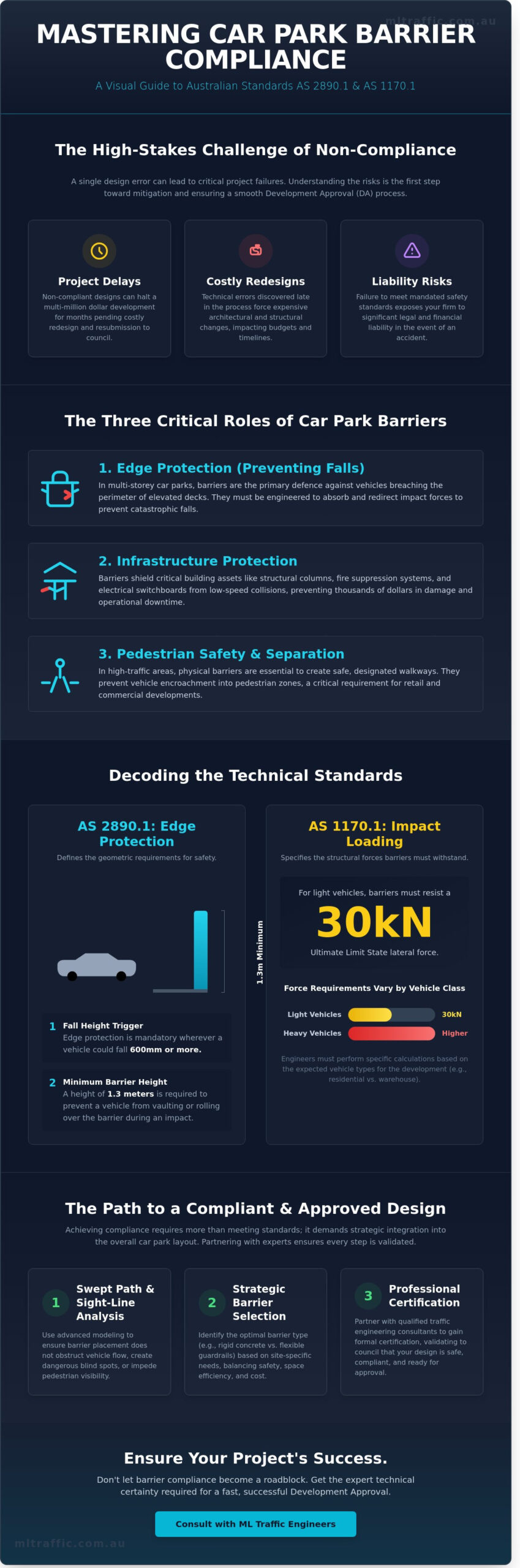
- Master the technical specifications of AS 2890.1 and AS 1170.1 to ensure your barrier designs withstand specific vehicle impact forces and structural loading.
- Identify the optimal barrier type for your development by comparing the performance and site-specific benefits of bollards, guardrails, and concrete kerbs.
- Use swept path analysis and sight-line assessments to strategically place barriers without creating dangerous blind spots or obstructing vehicle flow.
- Partnering with qualified traffic engineering consultants in Adelaide ensures your project meets all regulatory requirements for a successful Car Park Design Certification.
- Gain insights into the DA approval process and the critical role professional certification plays in validating the safety and compliance of your car park.
##Table of Contents
##Understanding Car Park Barrier Design and Safety
Car park barrier design serves a function far beyond simple vehicle containment. These systems act as the primary interface between moving vehicles and the fixed structural elements of a building. Effective barrier design manages the kinetic energy of an impact, redirecting or absorbing force to prevent catastrophic structural failure. For developers, engaging traffic engineering consultants in Adelaide ensures that these systems meet the rigorous requirements of Australian Standard AS 2890.1 and local council expectations.
Modern barrier systems distinguish between three critical roles: edge protection, pedestrian separation, and impact barriers. Edge protection prevents vehicles from departing the trafficable surface. Pedestrian separation creates physical boundaries to keep foot traffic away from vehicle swept paths. Impact barriers are specifically engineered to protect the building’s core infrastructure. Without these clear distinctions, a parking facility remains a high-risk environment for both owners and users.
Primary Functions of Modern Barriers
-
Preventing vehicle falls: In a multi-storey car park design, barriers must withstand specific horizontal loads to ensure vehicles cannot breach the perimeter of elevated decks.
-
Infrastructure protection: Barriers shield critical assets such as structural columns, fire sprinkler pipes, and electrical boards from low-speed collisions that could cause thousands of dollars in damage.
-
Pedestrian safety: Designated walkways must be separated by physical barriers that prevent vehicle encroachment, especially in high-turnover retail or commercial environments where pedestrian activity is dense.
The Risk of Non-Compliant Design
Non-compliance with safety standards introduces severe liability risks for property owners. If a vehicle breaches a barrier because the design didn’t account for the required impact loads specified in AS 1170.1, the developer faces significant legal exposure. Councils frequently reject Development Applications (DA) when parking plans lack detailed barrier specifications or fail to provide adequate sight-line assessments. It’s common for projects to stall when barrier height or material strength doesn’t align with the specific land-use type, whether it’s an apartment complex or a heavy-vehicle warehouse. Professional traffic engineering consultants in Adelaide provide the technical validation needed to avoid these costly delays.
Developers hold a legal duty of care to implement safety measures that reasonably foresee and mitigate the risk of vehicle-to-pedestrian or vehicle-to-structure impacts within the facility.
By consulting with experienced professionals, project owners can secure council approval while ensuring the long-term safety of their assets. Meticulous assessment guarantees that every barrier serves its intended purpose without compromising the facility’s operational efficiency or structural integrity.
##Technical Standards: AS 2890.1 and Impact Loading
Compliance in car park design relies on two primary Australian Standards. AS 2890.1 dictates the geometric layout and safety requirements for off-street parking. AS 1170.1 specifies the structural design actions, including the lateral forces barriers must withstand. Professional traffic engineering consultants in Adelaide use these figures to ensure every installation protects both the structure and the public. Accuracy in these calculations prevents structural failure during a collision.
AS 2890.1 Compliance for Edge Protection
AS 2890.1 requires edge protection wherever a vehicle could fall 600mm or more. For standard car parks, the minimum barrier height is typically 1.3 meters to prevent vehicle vaulting. This height is critical because a lower rail might act as a ramp for a vehicle tire during a collision, leading to a roll-over. Design must also account for visibility. Barriers should feature high-contrast finishes to assist driver depth perception in low-light environments. You can find a deeper dive into these requirements in our AS 2890.1 Explained guide.
Impact Load Calculations
AS 1170.1 Table 3.1 defines the ultimate lateral limit state floor traffic loads. Engineers must distinguish between different vehicle classes to determine the necessary resistance:
-
Light Vehicles: For cars under 2,500kg, barriers must resist a concentrated load of 30kN.
-
Heavy Vehicles: Areas for trucks or buses require significantly higher resistance, often reaching 240kN or more based on vehicle mass and velocity.
-
Angle of Impact: A perpendicular hit delivers 100% of the kinetic energy to the barrier. A glancing blow distributes force along the rail, which changes the stress profile on anchor points.
Engineers choose between rigid containment and energy-absorbing systems. Rigid concrete barriers stop vehicles instantly. However, they transfer high G-forces to the occupants and the building slab. Energy-absorbing systems, such as spring-steel buffers, deflect upon impact. This reduces the peak force on the anchor bolts and minimizes vehicle damage. Most modern designs favor these flexible systems for their ability to protect the building’s longevity.
If you’re designing a new facility, consulting with traffic engineering consultants in Adelaide early in the process prevents costly structural retrofits. We ensure your barrier selection meets the specific physics of your site layout.
##Comparing Barrier Types for Australian Developments
Selecting the correct barrier depends on the specific risk profile and site layout of a project. Experienced traffic engineering consultants in Adelaide assess whether a rigid or flexible system meets AS 2890.1 requirements for a given development. Rigid barriers, such as reinforced concrete, offer zero deflection. These are necessary where space is limited and structural protection is critical. Flexible systems, often made of high-density polymers or spring-tempered steel, absorb energy. They reduce damage to both the vehicle and the floor substrate during low-speed impacts common in tight parking environments.
Material selection impacts long-term maintenance costs and compliance. Galvanised steel remains the industry standard for durability in Australian coastal environments. High-density polymers are increasingly used in mixed-use developments where aesthetics are a priority. These materials can be color-matched to building facades without compromising the safety ratings required by local councils. Reinforced concrete is the default for high-impact zones, though it requires more intensive installation than modular alternatives.
Bollards vs. Continuous Guardrails
-
Bollards: Use these for targeted protection of equipment like fire hydrants, ticket machines, or pedestrian exits. They allow for porous movement while blocking vehicle access.
-
W-Beam Guardrails: These are more efficient for long perimeters, such as ramps or multi-deck edges. They provide a continuous line of defense.
-
Modular Systems: Often more cost-effective than cast-in-place concrete for retrofitting existing sites. Industry data from 2022 suggests modular installations can reduce on-site labor time by 30% compared to traditional formwork.
Specialised Barrier Solutions
Height clearance bars are mandatory for any structure with a ceiling lower than 2.2 metres. These prevent overhead damage from delivery vans and SUVs. Wheel stops function as secondary measures only. They don’t replace primary barriers. AS 2890.1:2004 specifies wheel stops must be 90mm to 100mm high to prevent tripping while stopping a standard tyre. For loading docks, heavy-duty steel barriers or concrete "pillboxes" are required to withstand the kinetic energy of vehicles exceeding 4.5 tonnes.
Professional traffic engineering consultants in Adelaide ensure these specifications align with the heavy vehicle swept path requirements of the site. We focus on providing direct, technical advice to ensure your development application meets all safety criteria. The right barrier choice balances initial capital expenditure with long-term durability and safety compliance.
##Strategic Placement and Integration
Effective barrier placement requires a balance between structural protection and functional traffic flow. Barriers positioned incorrectly don’t just fail to protect assets; they create new hazards by restricting vehicle maneuvers or narrowing required aisle widths. Professional traffic engineering consultants in Adelaide use precise modeling to ensure every safety element integrates with the car park’s geometry without compromising compliance or capacity.
The Role of Swept Path Analysis
Designers use Swept Path Analysis to identify high-risk impact zones where vehicle overhangs or wheels are most likely to strike infrastructure. This analysis is critical when placing barriers near tight turns or ramp entries. We model the movement of the B99 design vehicle, which represents 99.8% of passenger cars on Australian roads, to ensure barriers don’t impede standard traffic. In commercial environments, this modeling extends to Service Vehicles (SRV) or Heavy Rigid Vehicles (HRV) to prevent barrier damage during routine deliveries.
-
Identify "clipping points" at 90-degree turns and ramp transitions.
-
Ensure barrier setbacks don’t reduce the 5.8-metre minimum aisle width required for AS 2890.1 compliance.
-
Account for the 300mm additional width often required for base plate fixings and structural supports.
Sight Lines and Gradient Considerations
Barriers must never compromise the visibility of pedestrians or oncoming traffic. At driveway exits, designers must maintain a clear sight-line triangle, typically measuring 2.0 metres by 2.5 metres, as per Australian Standards. If a barrier is too high or constructed from opaque materials, it creates a dangerous blind spot for exiting drivers. Drivers seated in standard passenger vehicles have an average eye height of 1.15 metres, so barrier transparency or height limits are critical to maintaining safety at eye level.
Ramp gradients add another layer of complexity. On a 1:20 or steeper gradient, the vertical profile of the barrier must follow the slope to maintain consistent protection. If the barrier height isn’t adjusted for the incline, it may fail to catch a vehicle’s bumper at the correct height or obscure the view of drivers cresting the ramp.
Coordination with other infrastructure is the final step in strategic placement. Barriers shouldn’t block drainage grates or interfere with fire hydrant boosters. A poorly placed bollard can prevent a fire truck from accessing a connection point during an emergency. Meticulous planning ensures that safety hardware works in tandem with fire safety and stormwater systems rather than against them. For expert guidance on your site layout, contact our senior engineers today.
##Professional Certification and DA Approval
Compliance with Australian Standard AS 2890.1 is mandatory for any commercial or multi-deck parking facility. A certified traffic engineering report provides the technical evidence required by local councils to ensure barrier systems withstand specific vehicle impact loads. Developers seeking traffic engineering consultants in Adelaide often find that early involvement saves months of back-and-forth during the Development Application (DA) process. Council planners prioritize submissions that include detailed certifications, as these documents mitigate the risk of future structural failures or safety litigation.
ML Traffic Engineers streamlines this process by providing comprehensive Car Park Design Certifications that address both structural integrity and operational flow. We don’t just look at the barrier itself; we analyze how its placement affects vehicle circulation and pedestrian sight-lines. This holistic approach ensures your project moves through the approval phase without the delays typical of incomplete technical documentation.
The Value of Specialist Engineering
Standard drawings are rarely sufficient for modern developments. Site-specific engineered solutions are necessary to account for unique ramp grades, tight turning circles, and varied vehicle types. Relying on generic designs often leads to expensive construction rework. In some cases, modifying a non-compliant barrier system after installation can cost developers upwards of A$12,000 in additional labor and materials. Professional Traffic Engineering identifies these conflicts on paper before the first slab is poured.
Our firm operates with a distinct philosophy: the traffic consultant who provides the quote, does the work. You get direct access to principals who understand the nuances of your specific site. This hands-on accountability eliminates the communication gaps common in larger firms where junior staff handle the technical heavy lifting. It’s a results-oriented approach that focuses on achieving compliance while maintaining the project’s commercial viability.
Getting Started with Your Assessment
To begin a formal review, our team requires architectural site plans, floor levels, and any existing council correspondence. A standard Traffic Impact Assessment involving barrier design typically takes between 5 to 10 business days to complete. This timeline allows for rigorous Vehicle Swept Path Assessments and impact load calculations per AS 1170.1. If you’re working with traffic engineering consultants in Adelaide, ensure they provide a clear roadmap for these assessments early in the design phase.
Before submitting your final parking plans to the council, use this checklist to verify readiness:
-
Structural Certification: Ensure barriers are rated for a minimum 30kN impact load for light vehicles.
-
Height Compliance: Verify barriers meet the 1.3m height requirement in areas with significant pedestrian activity.
-
Clearance Zones: Confirm that barrier placement doesn’t encroach on the required 300mm clearance from structural columns.
-
Lighting and Visibility: Check that barrier locations don’t create blind spots for drivers exiting the facility.
-
Material Durability: Document the use of corrosion-resistant materials suitable for the local climate.
##Secure Your Development Approval with Compliant Barrier Design
Meeting the technical requirements of AS 2890.1 is essential for any successful car park development. Strategic barrier placement and accurate impact loading calculations ensure your site remains safe and compliant with Australian law. Professional certification isn’t a step you can skip if you want to avoid delays in the DA approval process. As leading traffic engineering consultants in Adelaide, we provide the technical rigor required for complex site assessments and transport planning.
ML Traffic Engineers brings over 15 years of experience in Australian traffic consultancy to your project. We’ve successfully completed more than 10,000 site assessments across various industries and land-use types. You’ll get direct access to senior engineers with over 30 years of expertise. We operate on a simple principle: the consultant who provides the quote, does the work. This hands-on approach guarantees that your car park design is handled by a seasoned expert from start to finish.
Get a Professional Traffic Engineering Quote for Your Car Park Design and move your project forward with confidence.
##Frequently Asked Questions
Is a car park barrier mandatory for all off-street parking developments?
Car park barriers aren’t mandatory for every single off-street development, but they’re required by AS 2890.1:2004 when a vertical drop exceeds 600mm. If your site presents a risk of vehicles falling or striking pedestrians, a barrier is essential for compliance. Our traffic engineering consultants in Adelaide assess specific site layouts to determine if structural protection is necessary for your Development Application.
What is the minimum height for a car park barrier according to AS 2890.1?
AS 2890.1:2004 requires a minimum barrier height of 1.3 metres where the barrier also serves as a pedestrian balustrade. For sections solely intended for vehicle impact at the end of a parking space, the structural element must be at least 600mm high. These heights ensure the barrier captures the vehicle’s bumper and prevents it from vaulting over the edge during an incident.
Can I use wheel stops instead of a structural barrier for edge protection?
You can’t use wheel stops as a substitute for structural barriers where edge protection is required. AS 2890.1:2004 explicitly states that wheel stops don’t provide sufficient resistance to stop a moving vehicle from falling over an edge. They’re designed to assist with vehicle positioning, not to withstand high-velocity impacts or prevent structural failure during a collision event.
How much impact force must a car park barrier be able to withstand?
A car park barrier must withstand a minimum ultimate limit state longitudinal force of 30kN for light vehicles under AS 1170.1. This force is applied at a height of 0.5 metres above the floor level. For ramps or areas where speeds exceed 10km/h, engineers often specify higher load ratings to account for increased kinetic energy during an accidental impact.
Do barriers in residential car parks have different requirements than commercial ones?
Residential and commercial car parks follow the same core requirements under AS 2890.1, but commercial sites often require higher durability due to 24-hour usage cycles. In residential developments, barriers must also comply with NCC requirements for balustrades if the drop exceeds 1 metre. Our traffic engineering consultants in Adelaide ensure that residential designs balance these safety standards with specific aesthetic requirements.
What happens if my car park barrier design does not meet Australian Standards?
Failure to meet Australian Standards can result in the rejection of your Certificate of Occupancy or Council approval. If an accident occurs, non-compliant barriers expose property owners to significant legal liability and may void professional indemnity insurance policies. Rectifying these issues after construction often costs 3 to 4 times more than implementing a compliant design during the initial planning phase.
How does swept path analysis affect where I can install bollards?
Swept path analysis dictates bollard placement by mapping the exact arc a vehicle’s body travels during a turn. We use software like AutoTURN to ensure bollards don’t encroach on the required 300mm clearance envelope. If bollards are placed without this assessment, they often become high-frequency impact points that damage vehicles and require constant, expensive maintenance for the building manager.
Can barriers be integrated into the architectural design of a building facade?
Barriers can be integrated into a building facade as long as they meet the structural load requirements of AS 1170.1. Architects frequently use perforated metal screens or reinforced concrete planters that serve as both aesthetic elements and safety barriers. These designs must be certified by a structural engineer to ensure they can absorb the 30kN impact force required for car park safety.
Which areas do you service?
We are traffic engineers servicing Aberfoyle Park, Adelaide, Adelaide Airport, Albert Park, Alberton, Aldinga, Aldinga Beach, Allenby Gardens, Angle Park, Ascot Park, Athelstone, Auldana, Beaumont, Belair, Bellevue Heights, Blackwood, Brighton, Broadview, Burnside, Camden Park, Campbelltown, Christie Downs, Christies Beach, Clarence Park, Clearview, Clovelly Park, Coromandel Valley, Croydon, Daw Park, Dernancourt, Dulwich, Eden Hills, Edwardstown, Elizabeth, Enfield, Felixstow, Findon, Flagstaff Hill, Fulham, Gawler, Gepps Cross, Gilles Plains, Gillman, Glen Osmond, Glenelg, Glenelg North, Glengowrie, Glenunga, Golden Grove, Goodwood, Grange, Greenacres, Hackham, Hackney, Hallett Cove, Happy Valley, Hawthorn, Henley Beach, Highbury, Hindmarsh, Hope Valley, Ingle Farm, Kensington, Kent Town, Keswick, Kilburn, Kilkenny, Kingswood, Kurralta Park, Largs Bay, Linden Park, Lockleys, Magill, Malvern, Marion, Mawson Lakes, Melrose Park, Mile End, Mitcham, Modbury, Morphett Vale, Mount Barker, Mount Osmond, Myrtle Bank, Nailsworth, Netherby, Newton, Noarlunga Centre, North Adelaide, North Plympton, Norwood, Oaklands Park, Panorama, Para Hills, Parafield Gardens, Paralowie, Parkside, Pasadena, Payneham, Pennington, Plympton, Pooraka, Port Adelaide, Port Noarlunga, Prospect, Regency Park, Reynella, Richmond, Rose Park, Rostrevor, Salisbury, Seacliff, Seaton, Semaphore, Somerton Park, St Marys, St Peters, Stepney, Stonyfell, Sturt, Tea Tree Gully, Tennyson, Toorak Gardens, Torrensville, Tranmere, Tusmore, Unley, Vale Park, Walkerville, Warradale, Wayville, West Beach, West Lakes, Woodville, Wynn Vale.

Disclaimer
The content on www.mltraffic.com.au, including all technical articles, guides, and resources, is provided for general informational and educational purposes only. It is not intended to constitute professional advice in traffic engineering, transportation planning, development approvals, or any other technical or legal field.
While ML Traffic Engineers makes every reasonable effort to ensure the accuracy, completeness, and timeliness of the information published, we do not provide any warranties or representations (express or implied) regarding its reliability, suitability, or availability for any particular purpose. Any reliance you place on the content is strictly at your own risk.
In no event shall ML Traffic Engineers, its directors, employees, authors, or affiliates be liable for any direct, indirect, incidental, special, consequential, or punitive damages (including, without limitation, loss of profits, data, or business opportunities) arising out of or in connection with the use of, or inability to use, any information provided on this website.
The articles and guides on this site are not a substitute for engaging a qualified, registered professional traffic engineer (such as an NPER or RPEQ engineer) to assess your specific project requirements. For tailored advice, compliance assessments, or traffic engineering services, please contact a competent professional.
This disclaimer may be updated from time to time without notice. By accessing or using this website, you agree to be bound by the most current version of this disclaimer.
