

A single bollard placed 100mm outside the AS 2890.1 specifications can be the sole reason a local council rejects your entire car park certification. In our experience across 10,000 sites, non-compliant safety barriers remain a leading cause of avoidable planning delays and RFI requests. Adhering to the latest car park bollard placement guidelines isn’t just about pedestrian safety; it’s about ensuring your development application passes the first time without the need for costly redesigns or the risk of vehicle damage claims.
You’ve likely found that interpreting the technical overlap between AS 2890.1 and specific council codes is a significant project bottleneck. This guide provides the technical framework you need to master compliant bollard placement and secure rapid council approval for your Australian development. We’ll examine specific setback requirements, clearance zones, and the 2026 standards that ensure maximum safety with minimal vehicle obstruction.
Key Takeaways
- Adhere to AS 2890.1:2004 standards to ensure your off-street parking design meets mandatory Australian safety and regulatory benchmarks.
- Master the technical spacing and setback requirements needed to prevent vehicle encroachment while maintaining clear pedestrian access.
- Apply car park bollard placement guidelines backed by Swept Path Analysis to eliminate vehicle scraping and ensure operational efficiency in tight turning areas.
- Implement strategic positioning strategies that protect critical structural assets from vehicle impacts without obstructing shared zones or accessibility paths.
- Secure council approval by including professionally certified bollard layouts within your Traffic Impact Assessment (TIA) and development application.
Table of Contents
-
Understanding Australian Car Park Bollard Placement Standards
-
Strategic Positioning: Asset Protection vs. Pedestrian Accessibility
-
Navigating Council Approvals with Professional Traffic Engineering
Understanding Australian Car Park Bollard Placement Standards
A Traffic bollard serves as a critical vertical architectural element within modern transport environments. These structures manage vehicle movement and provide physical protection for structural columns, utility points, and pedestrian zones. For developers and property owners, adhering to specific car park bollard placement guidelines isn’t optional. It’s a mandatory component of securing planning approvals from local Australian councils. Compliance ensures that a facility balances robust physical protection with necessary vehicle clearance.
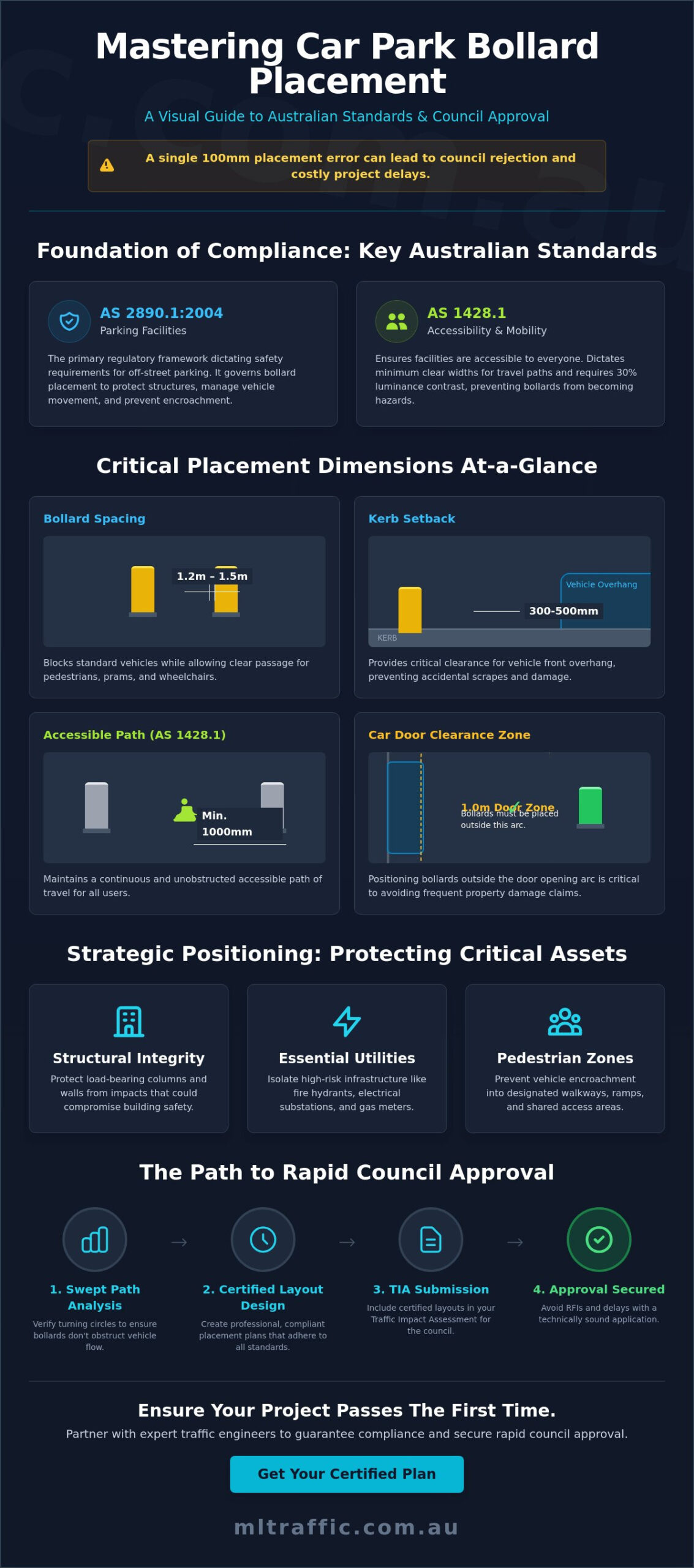
The primary regulatory framework for these installations is AS 2890.1:2004, which dictates the design and layout of off-street parking. Failure to align with these standards can lead to significant liability risks and project delays. Our engineers focus on technical precision to ensure every installation meets these rigorous bureaucratic requirements. By 2026, council scrutiny regarding safety barrier compliance is expected to intensify, making early adherence to these standards vital for long-term asset protection.
To better understand the practical application of these standards, watch this bollard installation guide:
The Role of AS 2890.1 in Safety Barrier Design
AS 2890.1:2004 specifies the requirements for protecting structural elements within a parking facility. Barriers are required where a vehicle impact could compromise the integrity of the building or pose a high risk to occupants. We assess impact load requirements based on vehicle mass and speed vectors. Key considerations include:
-
Protection of load-bearing structural columns and walls.
-
Isolation of fire hydrants, electrical substations, and gas meters.
-
Prevention of vehicle encroachment into designated pedestrian walkways.
-
Maintaining minimum clearance distances from driveways and ramps.
Effective safety barrier design requires a professional assessment of vehicle swept paths to ensure bollards don’t obstruct necessary turning circles. Our traffic engineering services provide the technical data needed to verify these clearances before construction begins.
Accessibility and Mobility Standards (AS 1428.1)
Placement must also comply with AS 1428.1 to ensure continuous accessible paths of travel remain unobstructed. Bollards shouldn’t become hazards for users with limited mobility. Standards require a minimum 1000mm clear width between bollards to accommodate wheelchairs and prams. Additionally, bollards must provide a minimum 30% luminance contrast against their background. This assists vision-impaired users in identifying obstacles in various lighting conditions. We ensure car park bollard placement guidelines integrate these accessibility requirements without compromising the safety of the vehicle-pedestrian interface. Meticulous planning at the design phase prevents costly retrofitting after council inspections.
Key Placement Guidelines for Compliance and Safety
Adhering to strict car park bollard placement guidelines ensures that facilities meet local council requirements and insurance obligations. Professional placement prevents vehicle incursions while maintaining the flow of pedestrian traffic. For engineers and developers, the focus remains on technical compliance with AS 2890.1 and the specific safety needs of the site.
Optimal Spacing and Setback Rules
Bollard spacing is a critical factor in site safety. Standard spacing ranges from 1.2m to 1.5m between posts. This distance is narrow enough to block standard passenger vehicles but wide enough to allow free movement for wheelchairs, prams, and pedestrians. If spacing exceeds 1.5m, the risk of a vehicle squeezing through increases significantly.
Setbacks are equally vital for preventing damage to both the bollard and the vehicle. Most Australian parking bays require a setback of 300mm to 500mm from the kerb or the front of the parking line. This distance accounts for the common front-end overhang of modern vehicles. Placement must also respect the clear zone for car doors. A bollard positioned within the 1.0m door opening arc defined in AS 2890.1 will lead to frequent property damage claims. Designers should consult the Austroads Guide to Traffic Management to ensure these physical barriers align with broader site traffic flow and accessibility requirements.
Visibility and Reflective Requirements
Visibility is the primary defense against accidental low-speed collisions. High-contrast colour selection is mandatory. Bollards must stand out against grey concrete or black asphalt. Under AS 1906.1, retroreflective materials must be applied to the top section of the bollard to ensure they’re visible to drivers using low-beam headlights.
Safety bollards in 2026 must provide a minimum 30% luminance contrast against the surrounding pavement to ensure they’re detectable by pedestrians with low vision. Height also dictates safety outcomes. Bollards should stand at a minimum of 900mm to 1000mm. This height ensures the post remains visible in the side mirrors of SUVs and light trucks during reversing maneuvers.
Correct car park bollard placement guidelines also dictate the protection of high-value infrastructure. Assets like fire hydrants and EV chargers require specific alignment. Bollards should be positioned at least 500mm from the asset to create a buffer zone. This prevents the bollard from striking the equipment if it’s slightly displaced during a minor impact. For developers who need a precise
[Vehicle Swept Path Assessment
](https://www.mltraffic.com.au/services/)
Strategic Positioning: Asset Protection vs. Pedestrian Accessibility
Effective car park bollard placement guidelines prioritize a balance between structural integrity and user mobility. Bollards serve as the primary defense for structural columns and perimeter walls against low-speed vehicle impacts. In typical basement environments, a vehicle traveling at just 5 km/h can cause significant spalling or structural fatigue to reinforced concrete over time. Engineers position these barriers to absorb energy before the vehicle contacts the building’s load-bearing elements.
Shared zones within a facility require specific configurations to signal pedestrian priority. Instead of continuous fencing, strategically spaced bollards allow pedestrians to move freely while preventing vehicle encroachment. Loading docks present a higher risk profile and must adhere to AS 2890.2 for heavy vehicle traffic. In these zones, bollards must account for the wider swept paths and tail swings of Medium Rigid Vehicles (MRV) and Heavy Rigid Vehicles (HRV).
Poorly planned layouts often lead to "bollard clutter," which creates dangerous blind spots. If drivers cannot see pedestrians emerging from behind a row of oversized posts, the safety benefit is negated. Layouts should maintain clear sightlines at all intersections and pedestrian crossing points.
Accessible Parking and Shared Zones (AS 2890.6)
Compliance with AS 2890.6 is mandatory for all accessible parking installations. Bollards must be placed strictly outside the dedicated shared area, which typically measures 2.4 metres by 5.4 metres. This ensures that the space remains clear for the deployment of wheelchair ramps and the movement of mobility aids.
Standard bollards often fail visibility requirements in these zones. AS 2890.6 specifies that bollards used in accessible shared spaces must reach a minimum height of 1300mm. They also require a 30% luminance contrast against their background to assist vision-impaired users. Placement must never obstruct the path of travel from the vehicle to the nearest accessible entry point or lift motor room.
Protecting Critical Infrastructure
Infrastructure protection focuses on high-consequence impact zones. This includes positioning heavy-duty barriers around gas meters, electrical substations, and fire control equipment. A single vehicle impact on a fire hydrant booster can disable a building’s entire suppression system, leading to total asset loss during an emergency.
For high-risk zones where vehicle speeds may exceed 10 km/h, engineers specify surface-mounted or deep-set bollards with high shear strength. Integrating these safety elements into professional
[Car Park Design
](https://www.mltraffic.com.au/services/)
The Role of Swept Path Analysis in Bollard Placement
Swept Path Analysis (SPA) calculates the dynamic envelope of a vehicle during low-speed maneuvers. It identifies the exact footprint required for a vehicle to turn without striking infrastructure. Bollards installed based on static measurements often fail to account for front or rear overhang. This oversight results in scraped panels, structural damage, and costly repairs for facility managers. We use professional software like AutoTURN to verify every bollard location against the physical capabilities of the design vehicle. This simulation ensures that the "swept area" remains completely unobstructed. Relying on 2D site plans without movement data creates a high risk of non-compliance with car park bollard placement guidelines.
-
SPA determines the actual space a vehicle requires to turn, not just the track width.
-
Bollards placed without swept path data frequently lead to vehicle impact.
-
Data-driven placement ensures clearance for the largest expected vehicle on site.
-
Software verification provides a digital audit trail for safety compliance.
Preventing Vehicle Damage Through Precision Design
Standard car parks must accommodate B85 and B99 vehicles as defined by AS 2890.1. The B99 vehicle represents the 99th percentile of cars on Australian roads, including large SUVs and 4WDs. These vehicles require significantly more room to maneuver than a standard sedan. Designers should consult this Swept Path Analysis Guide to understand how these dimensions impact bollard positioning. In tight corners or narrow ramps, bollards must sit outside the maximum arc of the vehicle body. If a bollard sits exactly on the curb line in a sharp turn, it’s likely to be hit. Precision design shifts these bollards by 300mm or more based on specific turning data.
Heavy Vehicle Considerations in Commercial Sites
Commercial and industrial sites require car park bollard placement guidelines that account for Small Rigid Vehicles (SRVs) and Medium Rigid Vehicles (MRVs). A 12.5-meter MRV has a drastically different turning radius than a passenger car. We must also account for trailer swing, where the rear of a vehicle moves outside the path of the front wheels during a turn. Bollards in loading docks or warehouse entries must protect assets while allowing 3.5-meter wide clearance paths. We verify these locations to ensure waste collection trucks and emergency service vehicles don’t get stuck. Meticulous planning prevents the need to relocate bollards after the concrete has set.
Ensure your site meets Australian Standards with a professional assessment. Contact ML Traffic Engineers today for accurate swept path analysis and bollard positioning.
Navigating Council Approvals with Professional Traffic Engineering
Council assessors require professional certification for all car park safety elements before granting development consent. A generic layout provided by a bollard manufacturer rarely satisfies site-specific council conditions. These off-the-shelf drawings often fail because they don’t account for unique vehicle swept paths, specific driveway ramp grades, or the nuanced requirements of AS 2890.1. Since 2005, ML Traffic Engineers has provided expert guidance across more than 10,000 sites. We ensure that your car park bollard placement guidelines are technically sound and compliant with current Australian Standards.
Direct principal involvement is a hallmark of our service. We don’t pass work down to junior staff or offshore teams. When a senior engineer assesses your site, they identify potential conflict points between vehicles and pedestrians that automated software might miss. This meticulous approach is necessary to secure approval in competitive development environments where council scrutiny is high.
-
Professional certification of all safety barriers and bollards.
-
Custom layouts that reflect actual site constraints rather than theoretical models.
-
Direct accountability from senior traffic consultants.
-
Alignment with local government engineering specifications.
The Importance of a TIA for Development Approval
Bollard compliance is a fundamental component of a comprehensive Traffic Impact Assessment (TIA). This report serves as the technical backbone of your Statement of Environmental Effects. It demonstrates to the council that the proposed car park bollard placement guidelines protect both the public and the built environment. We document how each physical barrier functions within the broader traffic flow. Our reports address specific council concerns regarding pedestrian safety zones and the protection of essential services like fire hydrants or electrical substations.
Why Professional Certification Matters
Expert-verified safety designs significantly reduce long-term liability for developers. If a car park layout doesn’t meet Australian Standards, the developer remains legally exposed in the event of an accident. We mitigate this risk by providing RPEQ-certified or professionally endorsed assessments that stand up to legal and insurance scrutiny. Our firm operates on a simple principle: the traffic consultant who provides the quote is the one who does the work. This ensures that the expertise you pay for is exactly what is applied to your project. Contact ML Traffic Engineers for a compliant car park assessment that meets 2026 standards.
Secure Your Development Approval with Precise Bollard Placement
Adhering to the latest car park bollard placement guidelines is essential for AS 2890.1 compliance and successful Council DA outcomes. Precise placement balances asset protection with pedestrian accessibility while ensuring vehicle swept paths remain unobstructed. Misalignment often leads to costly site revisions and avoidable safety risks. ML Traffic Engineers brings technical precision to every project, having assessed over 10,000 sites across Australia since 2005. You’ll have direct access to senior engineers who possess between 30 and 40 years of experience each. We ensure your design meets rigorous Australian Standards and local council requirements from the first draft.
The traffic consultant who provides the quote is the expert who does the work. This hands-on approach eliminates unnecessary bureaucracy and guarantees accountability for your development application. Our team specializes in navigating complex traffic engineering requirements to keep your project on schedule and fully compliant. Get a Professional Traffic Engineering Quote for Your Development. We look forward to helping you secure a seamless approval for your next development project.
Frequently Asked Questions
What is the standard spacing for bollards in an Australian car park?
The standard spacing for bollards typically ranges between 1.2 and 1.5 metres to prevent vehicle penetration while maintaining pedestrian permeability. AS 2890.1 outlines these requirements to ensure compliance with safety and access protocols. Engineers must assess the specific site risk to determine if tighter spacing’s required for high-security areas or utility protection.
Do I need bollards for every structural column in my parking garage?
Bollards aren’t required for every structural column, but they’re mandatory where columns are vulnerable to vehicle impact according to AS 2890.1. If a column sits within 300mm of a designated traffic lane or parking space, it requires physical protection. We evaluate these risks during a Traffic Impact Assessment to ensure structural integrity isn’t compromised by accidental collisions.
What are the height requirements for bollards under AS 1428.1?
Under AS 1428.1, bollards must have a minimum height of 850mm and a maximum height of 1000mm to ensure visibility for all users. This standard specifically addresses access and mobility, ensuring that bollards don’t become trip hazards for people with vision impairment. Adhering to car park bollard placement guidelines requires this specific height range to maintain safety in high-pedestrian zones.
Can bollards be placed inside the shared zone of an accessible parking space?
You can place bollards inside the shared zone of an accessible parking space, provided they don’t obstruct the 2.4 metre wide clearance required for wheelchair ramps. AS 2890.6 specifies that a single bollard is often placed at the head of the shared zone to prevent unauthorized parking. It’s vital to position these units so they don’t impede the path of travel to the accessible entry point.
What is the difference between fixed and removable bollards for council compliance?
Fixed bollards provide permanent structural protection, while removable bollards are required by councils for areas needing intermittent vehicle access, such as fire lanes or maintenance zones. Removable units must feature a locking mechanism that complies with local council fire brigade access keys. Choosing the wrong type can lead to a failure in obtaining a Certificate of Occupancy during final inspections.
How does swept path analysis affect where I can install bollards?
Swept path analysis determines the exact arc a vehicle takes when turning, which dictates where bollards can be installed without causing collisions. We use software like AutoTURN to map these paths for B85 and B99 vehicles. If a bollard’s placed within this calculated swept path, it’ll likely be struck, leading to constant maintenance costs and potential legal liability for the property owner.
Are there specific colour or reflective requirements for car park bollards?
Bollards must provide a minimum 30% luminance contrast against their background to comply with AS 1428.1. Most Australian car parks use safety yellow powder coating or include a 50mm reflective band at the top for night-time visibility. These requirements ensure drivers and pedestrians can identify the hazard in low-light conditions or heavy rain, reducing the risk of low-speed impacts.
What happens if my car park bollards do not meet Australian Standards?
Non-compliant bollards can result in the denial of a Compliance Certificate or heavy fines from local councils. If an accident occurs, your insurance provider might void your coverage because the site doesn’t meet AS 2890.1 safety standards. Rectifying these issues after installation is expensive, often costing 200% more than a correct initial installation based on professional car park bollard placement guidelines.
Which areas do you cover?
We are traffic engineers servicing Melbourne, Sydney, Brisbane, Gold Coast, Hobart, Perth, Adelaide, Darwin, Canberra and surrounding areas.

Disclaimer
The content on www.mltraffic.com.au, including all technical articles, guides, and resources, is provided for general informational and educational purposes only. It is not intended to constitute professional advice in traffic engineering, transportation planning, development approvals, or any other technical or legal field.
While ML Traffic Engineers makes every reasonable effort to ensure the accuracy, completeness, and timeliness of the information published, we do not provide any warranties or representations (express or implied) regarding its reliability, suitability, or availability for any particular purpose. Any reliance you place on the content is strictly at your own risk.
In no event shall ML Traffic Engineers, its directors, employees, authors, or affiliates be liable for any direct, indirect, incidental, special, consequential, or punitive damages (including, without limitation, loss of profits, data, or business opportunities) arising out of or in connection with the use of, or inability to use, any information provided on this website.
The articles and guides on this site are not a substitute for engaging a qualified, registered professional traffic engineer (such as an NPER or RPEQ engineer) to assess your specific project requirements. For tailored advice, compliance assessments, or traffic engineering services, please contact a competent professional.
This disclaimer may be updated from time to time without notice. By accessing or using this website, you agree to be bound by the most current version of this disclaimer.
