
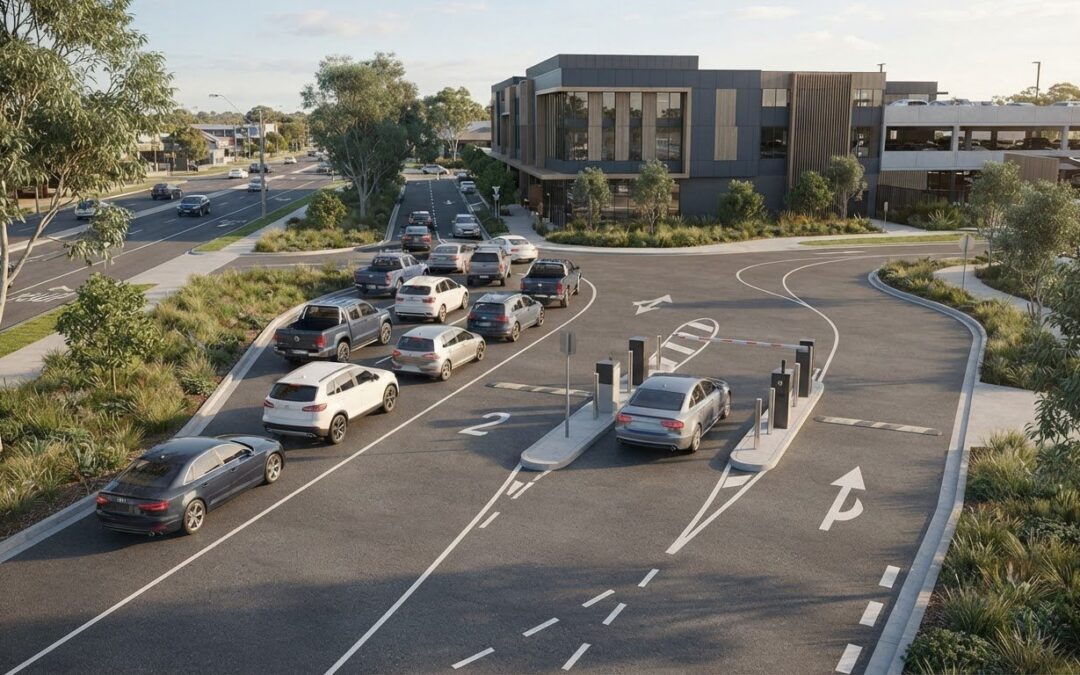
A fast boom gate can still create a long queue. A car park boom gate queuing assessment looks beyond barrier operating speed to the full entry process: vehicle arrivals, credential checks, payment or intercom use, and the space available for waiting vehicles. At peak periods, a delay at any point can push queues into internal circulation areas or towards a public road.
It’s understandable to focus first on the gate and payment technology. But choosing equipment before testing demand and site layout can leave a development with an access arrangement that doesn’t work when it’s busiest. Queue storage, vehicle manoeuvring and continued access for other users need to be considered together.
This guide explains what an assessment should examine and how parking demand, payment arrangements and site conditions inform the options. You’ll learn what evidence to gather, how vehicle swept paths and circulation affect the design, and which assumptions to confirm with the project traffic engineer before design, approval or implementation. A parking demand assessment and car park design can help connect the operational question to the development’s broader access requirements.
Key Takeaways
- A car park boom gate queuing assessment examines how an access proposal may affect vehicle storage and circulation at your site.
- Assess parking demand separately from queue performance, then identify where their evidence and assumptions need to align.
- Compare access approaches against your site layout, user process and operating assumptions before settling on a system.
- Gather plans, demand evidence, access details and relevant approval information to support a site-specific assessment.
- ML Traffic Engineers Australia’s parking demand assessment, car park design and traffic impact capabilities can inform planning decisions without supplying or operating parking systems.
What a car park boom gate queuing assessment tells you before introducing paid parking
A car park boom gate queuing assessment examines how vehicles arrive, wait, pass through an entry point and circulate within a proposed or existing site. It helps determine whether the available queue storage and access layout can accommodate the assessed demand, rather than assuming a gate or payment system will work the same way at every car park.
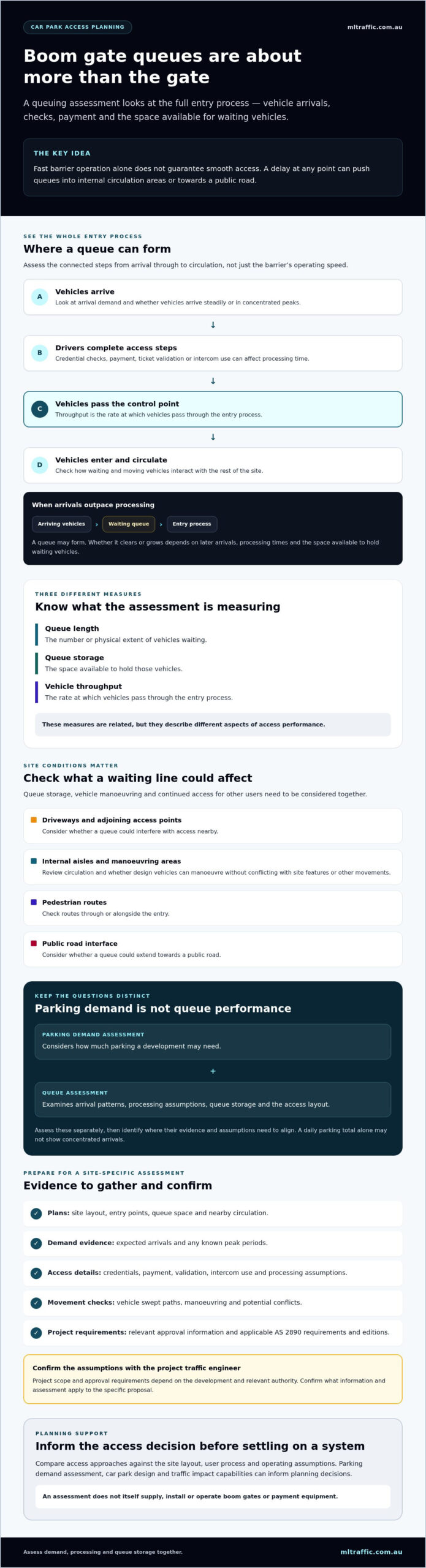
The assessment considers the whole entry process. A boom gate’s operating speed is only one factor: drivers may also need to present a credential, make a payment, validate parking or use an intercom. These steps affect processing time, but their effect depends on the access arrangement, user behaviour and site conditions. The principles of Queueing theory help explain how arrival patterns and service times contribute to waiting lines.
For a visual example of vehicle access equipment, watch the video below. It illustrates the type of system being assessed, not a site-specific engineering recommendation.
Queue length describes the number or physical extent of vehicles waiting; queue storage is the space available to hold them; and vehicle throughput is the rate at which vehicles pass through the entry process. These measures are related, but describe different aspects of access performance.
When does paid parking make a queue assessment relevant?
Consider an assessment when proposing paid parking, changing entry controls or materially altering payment, validation or access checks. A daily parking total alone may not show whether vehicles arrive in concentrated peaks. Arrival timing, the time each vehicle takes to complete the entry process and constraints near the site entrance can be more important to queue formation.
Project scope and approval requirements depend on the development and relevant authority. Confirm what information and assessment are required for the specific proposal rather than relying on a general approach.
What does the assessment examine?
Inputs typically include arrival demand, vehicle processing assumptions, available queue storage and the layout of nearby circulation paths. The analysis considers whether a queue could interact with:
- Driveways or adjoining access points
- Internal aisles and vehicle manoeuvring areas
- Pedestrian routes through or alongside the entry
Results depend on the quality of the project data, stated assumptions and physical layout. Vehicle swept paths may also help test whether the design vehicles can manoeuvre without conflicting with site features or other movements. Check the applicable AS 2890 requirements and editions for the project. A queue assessment does not itself supply, install or operate boom gates or payment equipment.
How paid parking demand, processing time and queue storage shape the assessment
Queue formation depends on how quickly vehicles arrive compared with how quickly they can complete the entry process. If several vehicles reach the control point while an earlier driver is still paying, validating a ticket or resolving an access issue, a queue may form. Whether it clears or grows depends on subsequent arrivals, processing times and the space available to hold waiting vehicles.
For example, a project team might expect most users to enter steadily, but a shift change or scheduled activity could concentrate arrivals into a shorter period. If the payment process also takes longer than assumed, demand and processing can combine to create a queue that a daily parking total alone wouldn’t reveal. This is an illustration, not a forecast or industry benchmark.
Demand assessment and queue assessment answer different questions
A Car Parking Demand Assessment considers how much parking a development may need, based on factors such as its proposed supply, users and operating conditions. A queue assessment focuses on how vehicles access that parking and whether the entry process and available storage can manage arrivals. The assessments may share inputs, including user patterns and peak periods, but one doesn’t replace the other.
Forecasts and operating assumptions can be uncertain. Confirm expected peak periods, arrival patterns, payment and validation steps, and how visitors or other user groups will access the site. Treat these as assumptions to test. If existing traffic or parking surveys don’t represent the proposed operation, the project traffic engineer can advise whether further data is needed.
Which demand and operating inputs should the project team provide?
Useful starting information includes the proposed parking supply, intended user groups, operating hours and relevant peak arrival periods. Provide available traffic counts, parking surveys and records of current access conditions, noting when and how the data was collected. The project team should also describe the proposed payment, validation, access-control and visitor processes so their likely effects can be assessed.
How do layout and vehicle movement affect queue storage?
The position of the site entry, control point and internal aisle determines where vehicles can wait and how a queue may interact with the rest of the layout. Check whether waiting vehicles could obstruct an aisle, pedestrian route, driveway or another site access point. Storage that appears sufficient in isolation may be impractical if it blocks circulation or prevents other vehicles from manoeuvring.
Where layout geometry or vehicle size warrants it, Vehicle Swept Path Analysis can test manoeuvring movements against the proposed arrangement. Confirm the design vehicles and analysis scope with the project traffic engineer. ML Traffic Engineers’ parking demand assessment services can help inform the demand inputs used in access planning.
Comparing paid parking access options through a boom gate queuing assessment
A car park boom gate queuing assessment can help compare access arrangements before a system is selected. The aim is not to nominate a supplier. It’s to understand how each option’s vehicle process may perform alongside the site’s demand, layout and operating objectives.
Payment method alone doesn’t determine queue performance. A quick transaction may still be affected by concentrated arrivals or limited storage, while a controlled entry process may work differently depending on user familiarity and how exceptions are handled. Compare the complete journey, including entry and exit, rather than considering payment equipment in isolation.
| Access arrangement | Queue implications to test | User process and site constraints | Information needed |
|---|---|---|---|
| Boom gate with payment or validation at entry | Consider transaction time, credential checks and the effect of exceptions at the control point. | Drivers may need to stop before entering. Check available storage and whether waiting vehicles affect nearby circulation. | Payment and validation steps, user types, expected processing assumptions and exception handling. |
| Boom gate with payment or validation at exit | Test whether transactions could create queues near the exit or interfere with internal vehicle movements. | Consider how vehicles reach the payment point and whether entry and exit paths interact. | Exit procedure, payment options, expected user familiarity and access arrangements for visitors. |
| Access process without a physical barrier | Assess how vehicles are identified or authorised, and whether checks or assistance could slow movement. | Review the location of decision points and how drivers find the correct route through the site. | Credential or identification process, enforcement assumptions, exception handling and operating responsibilities. |
What should a comparison include?
For each option, document the steps a driver must complete, likely points of delay and what happens if a credential or payment fails. The owner or system provider should confirm operating assumptions, such as how assistance is provided and exceptions are resolved. Entry and exit may follow different processes, so assess each separately and check whether their movements compete for space or disrupt internal circulation.
When might the arrangement need further design review?
Closer review is warranted where entry storage is constrained, nearby driveways or pedestrian routes could be affected, or queues may extend beyond the site. Test scenarios such as higher peak arrivals, a different mix of users or additional payment steps. These are scenarios to assess, not predictions. Don’t declare an option compliant or non-compliant without project evidence and confirmation of the requirements that apply.
The preferred arrangement depends on tested site conditions and project objectives. Demand patterns, transaction steps, storage, circulation, user needs and operational assumptions must be considered together.
How to prepare a car park boom gate queuing assessment
A useful car park boom gate queuing assessment starts with a defined proposal and reliable site information. The traffic engineer can then consider the access arrangement alongside expected demand, queue storage and circulation, and explain where further confirmation is needed.
Assessment workflow
- 1. Define the proposal. Confirm whether the project involves new paid parking, changed entry controls or a revised payment process. Identify the project stage, intended users and decisions the assessment needs to inform.
- 2. Provide current plans. Supply site layouts showing driveways, entry and exit points, proposed control locations, parking aisles, pedestrian routes and any space intended for queue storage. Flag proposed changes and known constraints.
- 3. Assemble demand and operating evidence. Share available parking or traffic surveys, proposed parking supply, operating hours, peak periods and user information. Describe payment, validation, visitor and access processes as assumptions for assessment, not confirmed performance.
- 4. Confirm project and approval context. Provide relevant authority feedback and identify approvals already obtained or being sought. Requirements depend on the development and authority, so confirm the applicable scope rather than relying on a general checklist.
- 5. Analyse the arrangement. The traffic engineer reviews the supplied evidence and assumptions against the layout, considers relevant scenarios and assesses potential queue effects on site access and circulation. Where vehicle movements or geometry require it, confirm whether swept path analysis forms part of the scope.
- 6. Document findings and recommendations. The report should present queue findings in relation to the plan and identify practical design or operational considerations, limitations and matters that require confirmation.
What information should be ready?
Provide the clearest available current or proposed plans, along with demand evidence and a description of intended users and operating patterns. Note when survey data was collected and whether it reflects the proposed paid parking arrangement. Include project-stage constraints, authority comments and any known changes to access or payment. Missing or outdated information may affect the assumptions and the conclusions that can reasonably be drawn.
What should the assessment report explain?
A clear report identifies its data sources, scope, assumptions and scenarios. It should relate queue findings to the site layout and explain potential effects on aisles, pedestrian movements and other access points. It should also state limitations, recommended considerations and items that need confirmation by the owner, system provider or relevant authority.
Parking layout should be considered in the context of AS 2890.1, where applicable. Confirm the current edition, relevant clauses and project-specific requirements before citing them or using them to support a compliance conclusion.
For help assessing parking demand and car park access as part of your project, review ML Traffic Engineers’ traffic engineering services.
How ML Traffic Engineers Australia can support paid parking and queue assessment decisions
Paid parking decisions involve more than selecting an access or payment arrangement. The proposed process needs to be considered alongside parking demand, site layout, vehicle movements and potential effects on surrounding roads. ML Traffic Engineers is an Australian traffic engineering and transport planning consultancy with more than 15 years of experience. Its traffic and design assessment capabilities can help project teams understand these considerations when planning access and parking.
The consultancy assesses traffic and design matters. It doesn’t supply, install or operate boom gates, payment equipment or physical traffic controls. Any consideration of queue implications should therefore relate to the evidence and site conditions assessed, not to the supply or operation of a particular system.
Which traffic engineering services may be relevant?
The appropriate scope depends on the development and the questions the project team needs answered. Relevant services may include:
- Traffic Impact Assessment: considers potential effects of a development on the surrounding road network where the proposal may change traffic movements.
- Car Park Design: addresses the site layout, including how access, parking and internal circulation are arranged.
- Car Parking Demand Assessment: helps establish anticipated parking needs based on the development and its intended use. Demand information can inform the assumptions considered in access planning.
- Vehicle Swept Path Analysis: can test whether relevant vehicles can manoeuvre through the proposed layout where vehicle size or geometry makes this necessary.
These services can inform access planning, but the required assessment and its scope should be confirmed against the project details and relevant authority requirements. Visit the traffic engineering services page for information about the consultancy’s service scope.
What to include in an initial project enquiry
A clear enquiry helps establish what information is available and which assessment capabilities may be relevant. Include:
- The development’s use, project stage and proposed paid parking arrangement.
- Available site plans, including access points, internal circulation and proposed control locations.
- Parking demand or traffic information, along with operating assumptions and intended user groups.
- Known access constraints, proposed changes and any relevant authority correspondence.
ML Traffic Engineers can review the project information and discuss potential assessment requirements. That discussion isn’t a promise of approval or a particular outcome; applicable requirements depend on the development and relevant authority. To raise an enquiry, share your project plans and available demand information through the contact page.
Plan paid parking around tested site conditions
Paid parking access should be assessed against the development’s demand, operating assumptions and physical layout before a system is selected. A car park boom gate queuing assessment can help project teams understand how vehicle arrivals and processing steps may affect queue storage, circulation and access.
Parking demand and queue performance are related, but they answer different questions. Consider both, and check that the evidence and assumptions reflect the proposed users and peak periods. Vehicle movement and the position of access points also matter when testing whether queues can be accommodated without disrupting the site.
ML Traffic Engineers brings more than 15 years of traffic engineering and transport planning experience. Relevant services include Traffic Impact Assessments, car park design and Vehicle Swept Path Analysis. The consultancy assesses traffic and design matters, but doesn’t supply or operate boom gates or payment systems.
To discuss your project plans, available demand information and assessment requirements, contact ML Traffic Engineers. Share your available plans and project information to start a discussion about the assessment scope.
Frequently Asked Questions
What is a car park boom gate queuing assessment?
A car park boom gate queuing assessment examines how vehicles arrive, complete entry or exit checks and wait at a car park. It considers arrival patterns, processing assumptions, available queue storage and the surrounding layout to identify potential effects on circulation or site access. The assessment may also consider payment, validation or intercom steps. Its findings depend on the project information and assumptions, which should be confirmed with the traffic engineer.
When should a private development assess boom gate queues?
Consider assessing queues when proposing paid parking, changing entry controls or materially altering payment or access steps. An assessment can help test whether the proposed arrangement suits expected peak arrivals and the available space at the entry. A daily parking total alone may not show how concentrated arrivals affect queues. The required scope and any approval needs depend on the development and relevant authority, so confirm these for the specific project.
How is a boom gate queue assessed?
A traffic engineer reviews vehicle arrival demand, the time and steps involved in processing vehicles, and the storage space available on site. They compare these inputs with the layout to assess possible queue formation and effects on driveways, aisles, pedestrian routes or other access points. The assessment may test different operating scenarios. Applicable design requirements, including relevant AS 2890 provisions, should be verified for the project and current edition.
What information is needed for a car park queuing assessment?
Provide current or proposed site plans showing driveways, entry and exit points, control locations, parking aisles and potential queue storage. Include available traffic or parking surveys, proposed parking supply, intended users, operating hours and peak arrival periods. Describe the payment, validation and access process, including how exceptions are handled. Authority feedback and known design changes are also useful. The traffic engineer can identify gaps and advise whether further data is needed.
Can a boom gate cause queues to extend onto a road?
Yes, a queue could extend beyond the site if arrivals exceed the rate vehicles can complete the entry process and on-site storage is insufficient. The outcome depends on demand, transaction or access steps, layout and available storage, so it can’t be determined from gate speed alone. An assessment considers whether queues could affect a driveway or adjoining road and identifies assumptions that need checking before the arrangement is implemented.
Does ML Traffic Engineers install or operate boom gates?
No. ML Traffic Engineers is an Australian traffic engineering and transport planning consultancy. It assesses traffic and design matters, but doesn’t supply, install or operate boom gates, payment equipment or physical traffic controls. Relevant services include Traffic Impact Assessments, Car Park Design, Car Parking Demand Assessments and Vehicle Swept Path Analysis. These services can inform access and layout decisions, but the project team must confirm the system’s operating details with its supplier or operator.
Does every paid car park need a formal queuing assessment?
Not necessarily. Whether a formal assessment is needed depends on the development, proposed access changes, site constraints and requirements of the relevant authority. A new payment process or limited entry storage may warrant closer review, while another site may have different considerations. Confirm the project scope and approval requirements rather than assuming one rule applies to every car park. A traffic engineer can review the available plans and information to clarify what assessment is appropriate.

Disclaimer
The content on www.mltraffic.com.au, including all technical articles, guides, and resources, is provided for general informational and educational purposes only. It is not intended to constitute professional advice in traffic engineering, transportation planning, development approvals, or any other technical or legal field.
While ML Traffic Engineers makes every reasonable effort to ensure the accuracy, completeness, and timeliness of the information published, we do not provide any warranties or representations (express or implied) regarding its reliability, suitability, or availability for any particular purpose. Any reliance you place on the content is strictly at your own risk.
In no event shall ML Traffic Engineers, its directors, employees, authors, or affiliates be liable for any direct, indirect, incidental, special, consequential, or punitive damages (including, without limitation, loss of profits, data, or business opportunities) arising out of or in connection with the use of, or inability to use, any information provided on this website.
The articles and guides on this site are not a substitute for engaging a qualified, registered professional traffic engineer (such as an NPER or RPEQ engineer) to assess your specific project requirements. For tailored advice, compliance assessments, or traffic engineering services, please contact a competent professional.
This disclaimer may be updated from time to time without notice. By accessing or using this website, you agree to be bound by the most current version of this disclaimer.
