

Planning Application / Development Application (DA) delays due to car parking disputes represent a commercial risk for developers and project managers across Australia. The challenge is twofold: over-provisioning car spaces is an expensive use of valuable land, while under-provisioning leads to council objections and costly project stalls. Navigating the complex and often seemingly arbitrary requirements of planning requirements is critical for project viability. A core element of proficient car park design and engineering is the ability to accurately forecast and justify parking demand from the outset.
This guide provides a definitive, step-by-step process for conducting a robust Car Parking Demand Assessment (CPDA). We detail the methodology required to produce a data-driven report that substantiates your proposed parking supply, aligns with Australian Standards, and satisfies council assessors. By following these procedures, you will gain the technical knowledge to optimise your site layout, prevent unnecessary objections, and secure timely project approval.
What is a Car Parking Demand Assessment (CPDA) and Why is it Critical for Your Planning Application / Development Application (DA)?
A Car Parking Demand Assessment is a specialised technical report that calculates and justifies the amount of on-site parking required for a proposed development. Its primary purpose within a Planning Application / Development Application (DA) is to demonstrate to the local council that the proposed parking provision is adequate for the site’s intended use and will not negatively impact the surrounding road network by causing on-street parking overflow.
This assessment forms a crucial component of any successful project, providing the evidence-based foundation for your car park design. For a visual overview of key design considerations, the following video is a useful resource.
Getting a car parking demand assessment (CPDA) wrong carries significant risks, including council Requests for Further Information (RFIs), substantial project delays, costly redesigns, or even an outright DA rejection. It is distinct from a full Traffic Impact Assessment (TIA), which analyses the broader effects of a development’s traffic on local intersections and roads. A parking assessment is specifically focused on quantifying the on-site parking demand.
Ultimately, a professional assessment balances council compliance with commercial viability. It ensures you meet regulatory requirements without over-providing expensive parking spaces that undermine your project’s financial return. An accurate assessment is the first step in successful car park design and engineering (car park d & e).
The Role of Australian Standards and Council Controls
Local councils in Australia rely on specific documents to evaluate parking provisions. The design and layout of parking spaces, aisles, and accessways are governed by Australian Standard AS 2890.1 or Clause 52.06 in Victoria. However, the quantity of parking spaces required is typically dictated by Council’s regulations such as Development Control Plan (DCP) in New South Wales, or Clause 52.06 in Victoria. These DCP or Clause 52.06 set out parking rates based on land use, such as spaces per dwelling depending on the number of bedrooms, per 100sqm of gross floor area, or space per number of people.
When is a Formal Assessment Required?
A formal Car Parking Demand Assessment (CPDA) or a simpler Parking Statement is required in most development scenarios that alter a site’s use or intensity. Common triggers include:
-
New Builds: All new developments, from a residential apartment building to a commercial office or industrial warehouse.
-
Change of Use: When a property’s function changes, such as a retail shop converting into a restaurant or a warehouse converting to a gym, as parking rates differ significantly between uses. In addition, different uses peak at different times. Gym is busiest between 4pm and 8pm, and between 6am and 8am, but quiet between 9am and 4pm. Warehouse is busiest between 7am and 3pm. Office is busiest between 9am and 5pm. Shop is busiest between 10am and 4pm.
-
Significant Extensions or Alterations: Additions that increase the floor area or operational capacity of a site, thereby generating more demand for parking.
Even minor planning applications / DAs may require a statement from a qualified traffic engineer to confirm to the council that the existing car park d & e arrangements remain compliant and sufficient for the proposed changes.
Step 1: Understanding Key Methodologies for Calculating Parking Demand
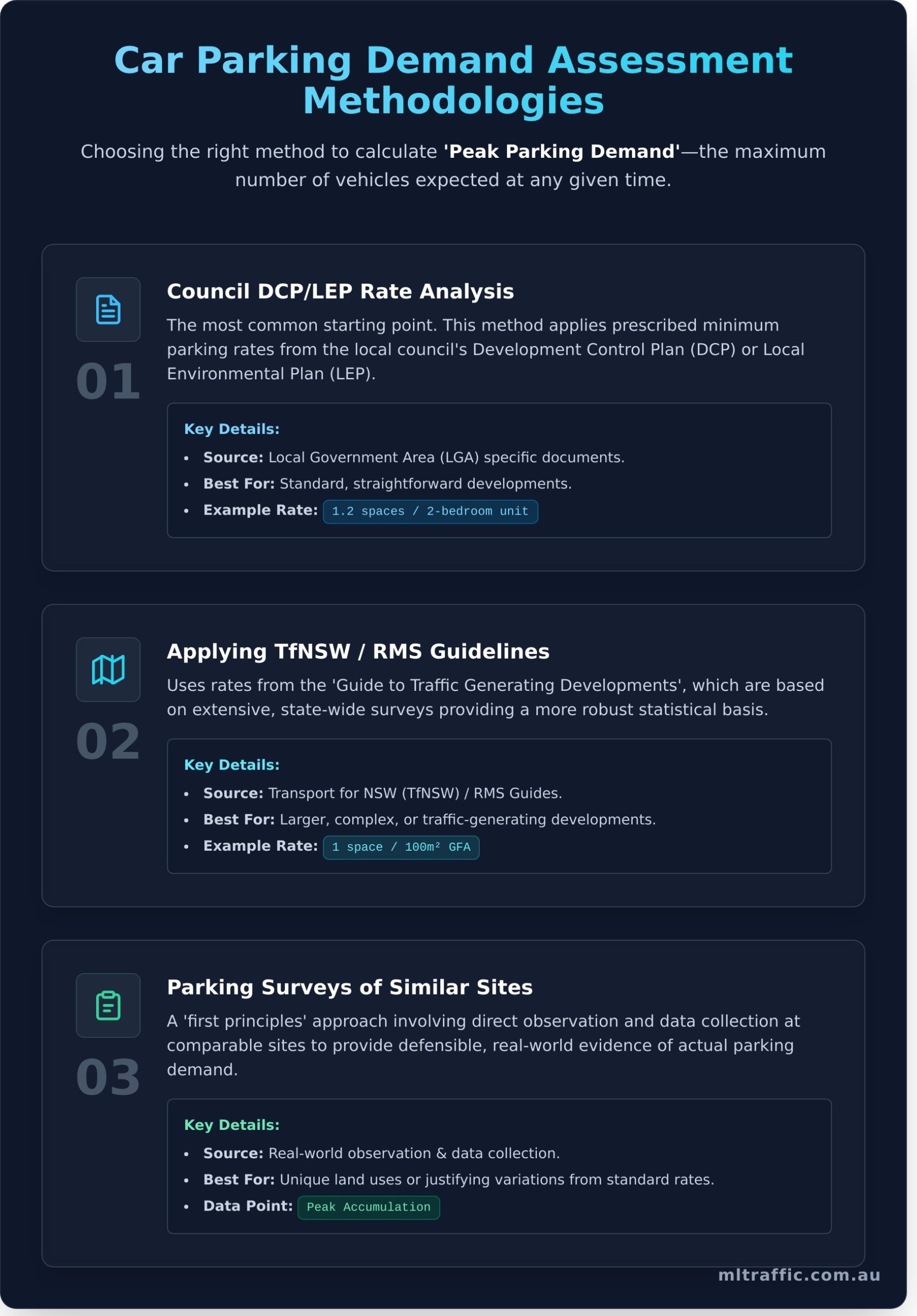
A fundamental component of professional car park d & e is accurately calculating the required number of parking spaces. The objective is to determine the ‘peak parking demand’-the maximum number of vehicles expected at the site at any given time. This assessment prevents both costly oversupply and disruptive undersupply. In Australia, the approach falls into two categories: applying prescribed rates or using a ‘first principles’ analysis based on direct observation. The most appropriate methodology depends entirely on the project’s scale, land use, and local council requirements.
The three primary methods used by traffic engineering consultants are:
-
Council DCP/LEP Parking Rate Analysis
-
TfNSW / RMS Guideline Application
-
Parking Surveys of Similar, Proximate Sites
Method 1: Council DCP/LEP Parking Rate Analysis
The most common starting point is to consult the local council’s Development Control Plan (DCP) or Local Environmental Plan (LEP). These documents prescribe minimum parking rates for various land uses within that specific Local Government Area (LGA). For example, a DCP might state a requirement of ‘1.2 spaces per 2-bedroom residential unit’. For standard, straightforward developments, simply applying these rates is often sufficient to satisfy council assessment criteria. It is critical to note that these rates can vary significantly between different councils and even between different zones within the same council.
Method 2: Applying TfNSW / RMS Guidelines
For larger or more complex sites, particularly those classified as Traffic Generating Developments, the rates specified in the Transport for NSW (TfNSW) / Roads and Maritime Services (RMS) ‘Guide to Traffic Generating Developments’ are often more appropriate. These rates are derived from extensive, state-wide surveys and provide a more robust statistical basis than some local DCPs. They are often based on more detailed metrics (e.g., per 100m² of gross floor area) and reflect data collection principles similar to those found in international resources like the ITE Parking Generation Manual. This method is essential when a development’s impact extends beyond the local street network.
Method 3: Parking Surveys of Similar Sites
When a development involves a unique land use for which no standard rate exists, or when seeking a variation from prescribed rates, a ‘first principles’ approach is required. This involves conducting parking occupancy surveys at comparable, existing sites. This process provides defensible, real-world evidence of actual parking demand. It is essential for projects like mixed-use developments, specialised retail, or places of public worship. The key data collected includes:
-
Parking occupancy counted at regular intervals (e.g., every 30-60 minutes).
-
Peak accumulation (the highest number of parked cars observed).
-
Parking duration (turnover).
Step 2: Gathering Essential Data for Your Assessment
The accuracy of a car park demand assessment (CPDA) is fundamentally dependent on the quality of the input data. A rigorous analysis cannot proceed without a comprehensive and precise understanding of the project’s parameters and its local context. The success of any car park d & e project hinges on this foundational step.
This information is typically collated by the project developer and their architect, sourced directly from official plans and site analysis. It is the traffic engineering consultant’s role to then apply this data to the chosen calculation methodology, whether using council planning scheme rates or a first-principles assessment.
Defining the Proposed Development
The primary source for defining the development is the official set of architectural plans. These documents provide the objective metrics required to apply relevant parking rates. Your traffic consultant will require a clear breakdown of the following, as applicable to your specific land use:
-
Gross Floor Area (GFA): The total floor area, crucial for retail, commercial, and industrial developments.
-
Dwelling Mix: The number of studio, 1, 2, and 3+ bedroom units for residential projects.
-
Operational Metrics: This includes the number of beds (aged care, hospitals), practitioners (medical centres), seats (restaurants, theatres), or employees (offices).
Analysing the Site and Surrounding Area
A development does not exist in isolation. A thorough assessment must consider the site’s context to justify any proposed parking provision, particularly if seeking a variation from standard rates. A comprehensive car park d & e process always considers these external factors. Key points for analysis include:
-
Public Transport Accessibility: Identify the proximity and frequency of services like train stations, bus stops, and ferry terminals.
-
On-Street Parking Conditions: Document the availability, time restrictions, and typical occupancy of kerbside parking in the immediate vicinity.
-
Local Demographics: Review local car ownership trends using Australian Bureau of Statistics (ABS) data to understand likely travel behaviour.
Ensuring this data is accurately compiled from the outset prevents delays and challenges during the Planning Application / Development Application (DA) process. For expert assistance in collating and interpreting this information for your project, contact the professionals at ML Traffic Engineers.
Step 3: Structuring the Car Parking Demand Assessment (CPDA) Report
The Car Parking Demand Assessment (CPDA) is more than an internal calculation; it is a formal technical document prepared for submission to the local council. Its purpose is to present a clear, logical, and defensible argument for the proposed parking provision. A professional structure is essential for demonstrating due diligence and facilitating a smooth assessment by council officers. This final stage of analysis is a critical component of the overall car park d & e process, translating data into a compelling case for your development application.
Essential Report Components
A high-quality report must be structured logically to guide the reader through the assessment process. While specifics may vary, the core components remain consistent. Every robust report should include:
-
Introduction: A clear description of the proposed development, including the site address, land use, and the scope of the assessment.
-
Parking Demand Calculation: This section presents the full workings of the chosen methodology, whether using council rates, survey data, or a first-principles approach. Transparency is paramount.
-
Proposed Parking Supply: A concise statement detailing the total number of car parking spaces provided on the proposed architectural plans, including accessible spaces.
-
Conclusion: An unambiguous summary that clearly states whether the proposed parking supply meets the calculated demand.
Justifying a Variation from Council Rates
In many cases, a development’s unique characteristics justify a parking provision lower than the council’s prescribed rates. This section of the report is crucial for optimising development yield. An argument for a variation must be evidence-based, referencing factors such as excellent access to public transport, the provision of end-of-trip facilities like bicycle parking and showers, or local parking survey data that demonstrates lower actual demand in the area. A well-argued variation can significantly improve a project’s financial viability.
Connecting Demand to Design Compliance
Finally, the report must confirm that the proposed parking supply is physically achievable and compliant. A statement confirming the car park layout adheres to Australian Standard AS 2890.1 is required. This confirms that key design elements like parking space dimensions, aisle widths, ramp grades, and vehicle access arrangements meet mandatory standards. This step ensures the theoretical number of spaces in your car park d & e plan can be delivered in practice.
A professionally structured report is non-negotiable for a successful development application. If you need an expert assessment that builds a robust case for your project, contact our traffic engineers.
Secure Your Development Approval with an Expert Assessment
A robust Car Parking Demand Assessment (CPDA), when required by Council, is a key component for any successful Planning Application / Development Application. As we have outlined, its effectiveness hinges on selecting the appropriate calculation methodology, meticulous data collection, and structuring a report that clearly justifies your parking strategy to council authorities.
Navigating the complexities of car park d & e requires specialist knowledge. For over 20 years, ML Traffic has provided this expertise, delivering compliant assessments for projects across all Australian states and councils. When you partner with us, you gain direct access to senior traffic engineers who will manage your project with the highest level of professional oversight from start to finish.
Let us handle the technical details so you can proceed with confidence. Ensure your project’s success with a compliant Car Parking Demand Assessment. Contact us today.
Frequently Asked Questions About Car Park Demand Assessment (CPDA)
What is the difference between a Car Parking Demand Assessment (CPDA) and a Traffic Impact Assessment (TIA)?
A Car Parking Demand Assessment quantifies the number of parking spaces required for a specific development, focusing on the site’s internal needs based on land use and council codes. In contrast, a Traffic Impact Assessment (TIA) evaluates the external effects of the development’s generated traffic on the surrounding road network, including intersection performance and traffic flow. A TIA is a more comprehensive report typically required for larger-scale developments that have a significant external traffic impact.
What happens if my site cannot physically accommodate the council’s required number of parking spaces?
If a site has physical constraints preventing it from meeting the council’s prescriptive parking rates, a detailed parking demand assessment is required. This report provides a robust, evidence-based justification for a lower parking provision, or a "parking shortfall." It analyses factors like public transport access and site-specific characteristics to argue that the council’s standard rate is excessive for the proposed development. This technical justification is crucial for gaining council approval for the shortfall.
How does proximity to a train station or bus stop affect the parking demand calculation?
Proximity to high-frequency public transport is a critical factor that can significantly reduce on-site parking demand. Our assessments analyse the site’s location within the public transport catchment area, typically within 400m of walking distance. This data is used to justify a reduction from the council’s standard parking rates, as a portion of staff, visitors, or residents will utilise these alternative transport modes instead of private vehicles.
Can I use tandem parking spaces or car stackers to meet the required parking numbers?
Yes, tandem spaces and mechanical car stackers can often be used to meet parking requirements, subject to specific council approval. However, their use is typically restricted. Tandem spaces are generally only permitted where both spaces are allocated to the same dwelling or tenancy. All such solutions must comply with Australian Standards (AS 2890.1) and require careful consideration in the overall car park d & e process to ensure functionality and safety.
How much does a professional car parking demand assessment (CPDA) report typically cost in Australia?
The cost for a professional car parking demand assessment report in Australia varies based on project complexity. For a straightforward development, such as a small residential block or a simple change of use, fees typically range from A$1,800 to A$3,600 plus GST. Larger, more complex projects that require detailed survey work, extensive data analysis, or significant council negotiation will incur higher professional fees. We recommend obtaining a site-specific quote for an accurate cost estimate.
Are the parking requirements different for accessible (disabled) parking spaces?
Yes, the requirements for accessible parking spaces are entirely distinct and non-negotiable. The provision rate for these spaces is mandated by the Building Code of Australia (BCA) and is not subject to the same demand-based reductions as general parking. Furthermore, the design, dimensions, and location of accessible spaces must strictly adhere to Australian Standard AS 2890.6. A compliant car park d & e plan must demonstrate full adherence to these standards.
Which areas do you service?
We are traffic engineers covering Melbourne, Sydney, Brisbane, Gold Coast, Hobart, Perth, Adelaide, Darwin and surrounding areas.
