

Automated parking systems can reduce required parking areas by up to 50% compared to conventional ramps and aisles, yet many Australian developers remain trapped by the high cost of deep basement excavation. You understand that on a limited site footprint, every square metre counts toward your final yield. However, the technical complexity of car park design for automated vehicle retrieval systems often leads to council skepticism regarding peak period throughput and vehicle retrieval times.
We agree that the mechanical hardware is only half the battle. Success depends on a compliant Traffic Impact Assessment (TIA) and a design that satisfies the rigorous Fire and Rescue NSW guidelines updated on April 29, 2024. This engineering guide provides the technical framework to master these requirements, from NCC 2022 compliance for EV charging to the performance solutions required for systems with three or more vertically stacked cars. You’ll learn how to integrate AS 2890.1 standards with modern robotic throughput needs to ensure a seamless approval process and reduced construction costs.
Key Takeaways
- Define the critical vehicle dimension envelopes required for modern SUVs and heavy electric vehicles to ensure long-term facility viability.
- Evaluate the operational differences between puzzle, stacker, and robotic systems to select the most cost-effective mechanical solution for your specific site footprint.
- Navigate the complex intersection of AS 2890.1 and specialized fire safety engineering required for car park design for automated vehicle retrieval systems.
- Learn how to model peak-hour throughput and transition zone queuing to produce a Traffic Impact Assessment (TIA) that withstands council scrutiny.
What is an Automated Vehicle Retrieval System (AVRS)?
An Automated Vehicle Retrieval System (AVRS) is a mechanical infrastructure that eliminates the need for human drivers within the storage area. It functions as a precision grid where vehicles are moved from an entry cabin to a designated bay via a network of lifts and shuttles. When considering What is an Automated Vehicle Retrieval System (AVRS)?, it’s vital to distinguish between fully automated systems and semi-automated stackers. Fully automated solutions require no human presence beyond the transfer cabin, whereas semi-automated stackers typically require a driver to position the vehicle on a platform before the mechanical lift engages.
In high-density precincts across Australia, the shift toward these systems is accelerating as we move into May 2026. Developers use this technology to bypass the high cost of deep basement excavation, which can often make a project unviable. By utilizing sophisticated car park design for automated vehicle retrieval systems, sites with a limited footprint can achieve a 50% reduction in required parking area compared to traditional 90-degree layouts. This efficiency allows for increased Gross Floor Area (GFA) for residential or commercial use.
To better understand this concept, watch this helpful video:
The Core Components of Automated Parking
- Entry/Exit Transfer Cabins: These serve as the primary interface. Drivers leave their vehicles in a safe, well-lit room. Sensors verify the vehicle’s dimensions to ensure they fit within the system’s “envelope,” particularly for larger SUVs and heavy electric vehicles.
- Vertical Lifts and Horizontal Shuttles: These components act as the mechanical heart. They transport the car through a vertical shaft and along horizontal rails to a storage slot. Modern Car Park Design must account for the weight of EVs, which often exceed traditional combustion engine weights.
- Management Software: The system’s “brain” optimizes retrieval times by predicting peak demand and pre-staging vehicles near the exit cabins. This software is critical for maintaining the throughput speeds required by local councils.
Space Efficiency: Beyond Traditional Ramps
Traditional car parks waste significant volume on drive aisles, pedestrian walkways, and concrete ramps. An AVRS removes these requirements entirely. Because the storage area is strictly off-limits to pedestrians, the system removes the 2.1m clear height requirement for human access, allowing for ceiling heights determined solely by the vehicle’s height and mechanical tolerances. This vertical compaction is a primary advantage in car park design for automated vehicle retrieval systems.
The global automated parking system market is expected to reach $3.02 billion by 2026, reflecting a 16.4% CAGR. This growth is driven by the need for sustainable, modular designs that can be retrofitted into existing structures or integrated into new builds with minimal land use. By eliminating human-centric design elements like stairs and elevators in the parking zone, developers can maximize their yield while adhering to strict site constraints.
Key Design Parameters for High-Performance Automated Parking
High-performance car park design for automated vehicle retrieval systems requires a shift from static spatial planning to dynamic throughput modeling. Engineers must define the vehicle dimension envelope during the initial concept phase. By May 2026, SUV market dominance and the increasing weight of electric vehicles, which frequently exceed 2,500kg, dictate the structural and mechanical load requirements. Designing for a standard sedan is no longer sufficient. A failure to account for these larger envelopes results in a system that’s obsolete before the building is even occupied.
Redundancy planning is a critical pillar of a reliable system. A single mechanical failure shouldn’t paralyze the entire development. We recommend systems that include dual lift paths or independent horizontal shuttles to maintain operation during scheduled maintenance or power failures. The “Transition Zone” is the most critical area for traffic engineering success. This zone is where the vehicle transitions from the public road network to the private mechanical system. If this area is undersized, vehicle queuing will spill onto public streets, almost certainly leading to a council rejection of your development application.
Calculating Throughput and Retrieval Times
Mean Retrieval Time (MRT) is the average duration for a vehicle to be delivered to the user. User satisfaction drops significantly when MRT exceeds three minutes. For residential buildings, morning peaks involve high exit demand, while commercial sites face evening surges. We simulate these scenarios to ensure the system can handle the 85th percentile of peak demand without excessive wait times. Research from the Mineta Transportation Institute suggests that Integrating AVRS into Your Traffic Impact Assessment (TIA) requires a deep dive into these simulations to avoid local network congestion. If you need a professional assessment of your site’s capacity, our team provides detailed Car Parking Demand Assessments to justify your design to the consent authority.
Swept Path Analysis for Transfer Cabins
The entry and exit cabins are the primary bottlenecks of any automated facility. We use AutoTURN software to perform a comprehensive Vehicle Swept Path Analysis for both B85 and B99 vehicles. This ensures the largest expected vehicles can enter the transfer cabin without multiple maneuvers. Unlike traditional parking where a driver might tolerate a tight turn, an automated system requires precise alignment for the sensors to engage correctly. Our analysis verifies that the driveway ramp grade and sight distances meet AS 2890.1 standards while accommodating the specific approach angles required by the AVRS hardware. We focus on ensuring the “first-time” entry success rate is maximized to prevent congestion at the site boundary.
- Queuing Capacity: Entry cabins must have enough internal queuing space to prevent external traffic flow disruption.
- B85/B99 Compliance: Verification that the design accommodates the 85th and 99.8th percentile of Australian vehicles.
- Sensor Alignment: Swept paths must align with the docking tolerances of the robotic shuttle.
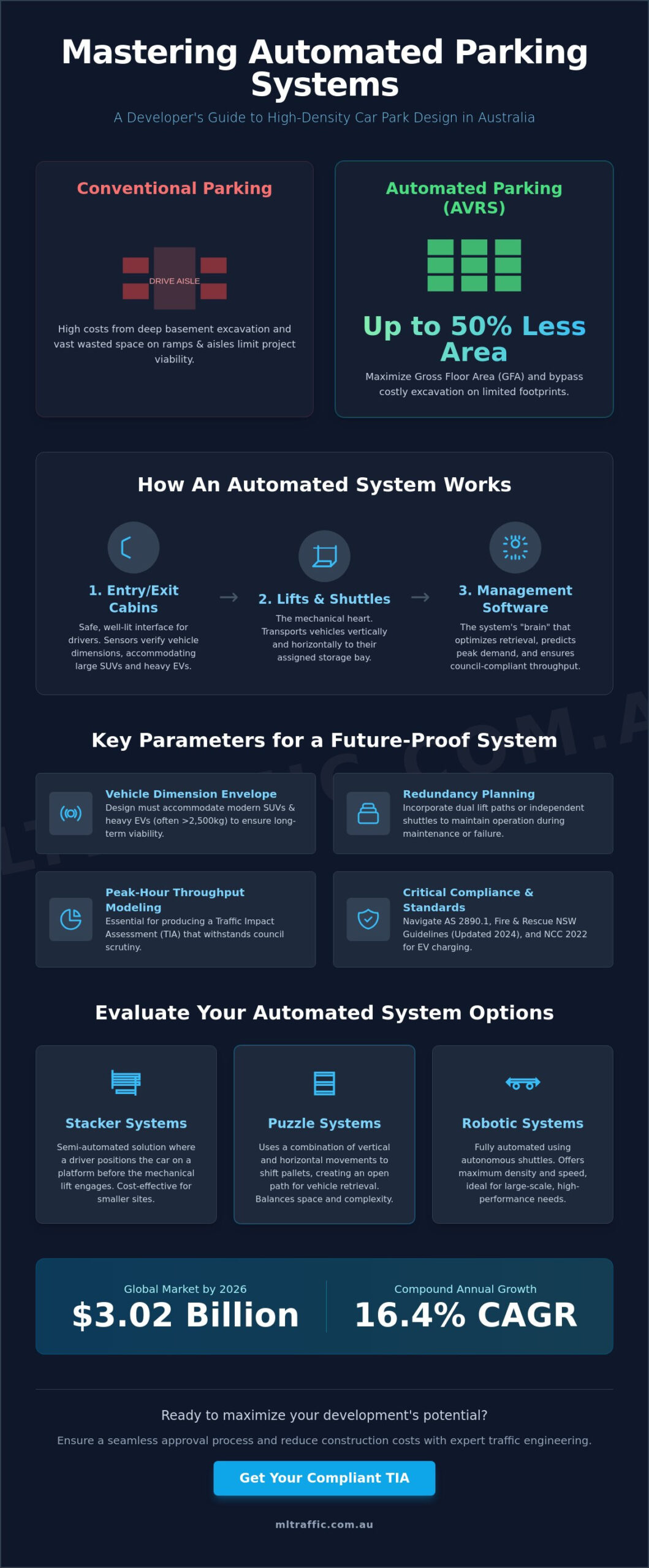
Comparing Automated Parking System Types: Puzzle, Stacker, and Robotic
Selecting the appropriate mechanical configuration is a central pillar of car park design for automated vehicle retrieval systems. Developers must balance upfront capital expenditure against long-term throughput requirements and council-mandated retrieval times. While basic stackers serve boutique residential builds, larger precincts require sophisticated robotic or puzzle-based grids to avoid peak-hour congestion at the site boundary. Each system carries distinct implications for the structural design and the ultimate parking yield of the development.
Stacker systems represent the entry-level mechanical solution. These are typically hydraulic or electric lifts that stack two to three vehicles vertically. They’re most effective in small-scale residential projects where the user base is consistent and retrieval frequency is low. However, they’re often limited by “dependent” configurations, where the lower car must be moved to access the upper car. For any professional Car Park Design, we recommend independent stackers that allow for autonomous retrieval, though these require deeper pits or higher ceilings.
Research regarding Texas roadway and parking infrastructure highlights how geometric design must evolve to accommodate these automated footprints. As we move into 2026, the focus has shifted from simple storage to high-throughput integration with the surrounding road network.
Puzzle Parking: Pros and Cons
Puzzle systems utilize a “missing space” strategy to move pallets both horizontally and vertically. This allows any car to be retrieved without moving others. As of March 2024, these systems cost between $10,000 and $15,000 per space. They’re ideal for medium-density infill projects. The primary limitation is retrieval speed during high-occupancy periods. Because the pallets must “shuffle” to create a path, the Mean Retrieval Time (MRT) increases as the system reaches capacity. This can lead to queuing issues if the transition zone isn’t properly modeled in the Traffic Impact Assessment (TIA).
Robotic Valet Systems
Robotic shuttles are the gold standard for large-scale developments. These systems use Automated Guided Vehicles (AGVs) to lift cars and move them across flat floor plates. This provides immense flexibility in odd-shaped basements where traditional grids or puzzle rails fail. The upfront investment for robotic systems can exceed $50,000 per parking space as of May 2026. Despite the cost, they offer the highest throughput and easiest integration with EV charging stations. Since the AGV can transport a vehicle to a centralized charging bay within the grid, developers can meet NCC 2022 requirements without installing chargers at every individual bay. This centralized approach reduces electrical infrastructure costs and simplifies fire safety compliance for special hazard zones.
- Maintenance: Robotic systems require specialized software support but have fewer fixed mechanical rails than puzzle systems.
- Reliability: Multiple AGVs provide inherent redundancy; if one unit fails, others continue the retrieval process.
- Operational Costs: Higher energy consumption is a factor, though this is often offset by reduced ventilation and lighting needs in the storage vault.
Navigating Australian Standards and Council Compliance for AVRS
Australian regulatory frameworks were originally drafted for human drivers, creating a gap when certifying car park design for automated vehicle retrieval systems. AS 2890.1:2004 remains the legally enforceable standard for council assessments as of early 2026. Because an AVRS does not utilize standard stall and aisle dimensions, it cannot meet the “Deemed-to-Satisfy” provisions of the National Construction Code (NCC). Instead, engineers must treat the entire facility as a Performance Solution. This requires a rigorous evidence-based approach to prove that the mechanical system provides equivalent safety and functionality to a traditional car park.
Fire safety is the most scrutinized aspect of compliance. Fire and Rescue NSW (FRNSW) endorsed the AFAC “Fire Safety Requirements for Automated Vehicle Parking Systems” guideline on April 29, 2024. Under NCC 2022 clauses E1D17 and E2D21, any AVRS with three or more vertically stacked cars is classified as a “special hazard.” This classification mandates specific fire suppression systems and emergency access protocols that differ significantly from standard basement requirements. QFES in Queensland also requires any AVRS proposal to be referred to them as a performance solution, ensuring that high-density fuel loads are managed in these enclosed, human-free environments.
Disability access must also be integrated into the design according to AS 2890.6:2022. Accessible parking spaces must be provided either within the transfer cabin itself or as dedicated traditional bays that interface with the retrieval system. Acoustic considerations are equally vital. The mechanical noise from vertical lifts and horizontal shuttles must be mitigated to prevent disturbance to neighboring properties. We recommend obtaining an acoustic report during the design phase to verify that late-night vehicle retrievals won’t violate local council noise ordinances.
Applying AS 2890.1 to Automated Systems
Certifying a system that lacks traditional drive aisles requires an expert interpretation of the AS 2890.1 Guide for compliance. The Alternative Solution pathway under the NCC for AVRS allows designers to bypass traditional aisle width and stall length requirements by demonstrating that the mechanical retrieval process maintains safe vehicle movement and structural integrity. Our team focuses on documenting these deviations to ensure your Car Park Design passes the certification process without costly redesigns.
Council Requirements for Traffic Reports
Councils are primarily concerned with how an automated system interacts with the public road network. You must provide clear proof of queuing capacity within the site boundary to prevent street-level congestion during peak periods. A standard Traffic Impact Assessment (TIA) is often insufficient; you need a Car Parking Demand Assessment to justify reduced parking counts or non-standard layouts. Presenting detailed throughput data and Mean Retrieval Times (MRT) to planning officers is the only way to build confidence in the system’s ability to handle high-volume residential or commercial traffic. If your project requires a compliant Traffic Impact Assessment, our senior engineers provide the technical data necessary to secure a smooth approval.
Integrating AVRS into Your Traffic Impact Assessment (TIA)
Standard Traffic Impact Assessments focus on intersection delays for human drivers, but these reports are insufficient for mechanical parking. The core challenge lies in the fixed service rate of the machinery. If the system processes vehicles slower than they arrive from the public road network during peak hours, the queue will inevitably spill onto the street. This results in a failed TIA and a likely refusal of your development application. Successful car park design for automated vehicle retrieval systems requires a dynamic model that balances arrival rates against mechanical throughput to maintain site boundary integrity.
Modeling this interaction requires a deep understanding of both mechanical tolerances and local traffic network conditions. We analyze the transition zone to ensure there is enough internal storage to accommodate the 85th percentile of peak hour arrivals. This prevents external congestion and satisfies council requirements for on-site queuing. Decisions made during the initial layout phase dictate whether the system will comply with AS 2890.1 or require an expensive and complex Performance Solution to meet NCC 2022 standards. Senior engineer involvement at the concept stage is the only way to ensure the mechanical throughput aligns with the traffic demand.
The TIA and Automated Throughput
We use stochastic modeling to compare the arrival rate against the system’s service rate. This analysis accounts for worst-case scenarios, such as multiple residents arriving simultaneously during the evening peak. Councils often demand proof that the queue won’t exceed the site boundary, especially in high-density precincts where street parking is limited. Mitigating the impact of system downtime is another critical factor. The TIA must demonstrate a contingency plan for vehicle access if the primary mechanical lift fails or if there is a total power loss. For a broader look at how these assessments integrate into your project, see The Role of a Traffic Engineer in modern developments.
Professional Certification and Council Approval
ML Traffic Engineers Australia provides a “quote-to-work” guarantee. The consultant who assesses your site and provides the initial advice is the same senior engineer who signs the final report. This level of accountability is vital for complex car park design for automated vehicle retrieval systems where technical details often get lost between junior staff and senior reviewers. We certify your design for council submission by providing the empirical data needed to justify the automated retrieval speeds. This hands-on approach ensures that the traffic consultant who designs the system also signs the report, preventing discrepancies during the DA assessment phase. If you are planning a high-density project, Contact ML Traffic Engineers Australia for a TIA including specialized automated parking design.
Secure Your Development Approval with Expert AVRS Design
Efficient car park design for automated vehicle retrieval systems transforms constrained sites into high-yield developments. This guide has detailed the necessity of precision throughput modeling, adherence to the April 2024 fire safety guidelines, and the critical role of swept path analysis for transfer cabins. Navigating these requirements requires a traffic engineering partner who understands the bureaucratic nuances of local council assessments and the technical demands of the NCC 2022.
ML Traffic Engineers Australia provides the seasoned expertise necessary to move your project from concept to approval. With over 15 years in the industry and a portfolio of over 10,000 successfully assessed sites, we deliver the technical reliability your project demands. You deal directly with our senior principals, Michael Lee and Benny Chen, ensuring the consultant who quotes the job is the one performing the work. Get a Traffic Impact Assessment for your AVRS project and ensure your development satisfies every compliance framework while maximizing your parking yield. We provide the technical certainty required for a seamless planning outcome.
Frequently Asked Questions
Is automated parking compliant with Australian Standard AS 2890.1?
Automated systems don’t meet the Deemed-to-Satisfy provisions of AS 2890.1 because they lack traditional drive aisles and stall dimensions. You must utilize the Performance Solution pathway under the National Construction Code (NCC). This requires a traffic engineer to certify that the mechanical retrieval process provides equivalent safety and functionality to a conventional layout.
How much space can an automated vehicle retrieval system actually save?
A precision-engineered system can reduce your required parking area by up to 50% compared to traditional 90-degree parking configurations. By removing the need for ramps, pedestrian walkways, and internal drive aisles, developers can significantly increase their Gross Floor Area. This efficiency is the primary driver for car park design for automated vehicle retrieval systems in constrained urban sites.
What happens to the cars if the automated parking system loses power?
Professional designs incorporate redundancy measures like backup generators or manual override protocols to ensure continuous operation. Robotic systems often utilize multiple independent shuttles, so a single mechanical failure doesn’t disable the entire facility. We prioritize redundancy planning during the initial engineering phase to guarantee vehicle accessibility during power outages or maintenance cycles.
How long does it take to retrieve a car from an automated system?
Mean Retrieval Time (MRT) is generally between 120 and 180 seconds in a high-performance system. User satisfaction levels drop if retrieval exceeds the three-minute mark. Modern software optimizes these times by pre-staging vehicles near exit cabins based on historical peak demand data, which we verify through detailed throughput modeling.
Does an automated car park require a different fire safety strategy?
Yes, these facilities are classified as a special hazard under NCC 2022 clauses E1D17 and E2D21. Since April 29, 2024, Fire and Rescue NSW has mandated compliance with specific AFAC guidelines for automated parking. You’ll need a performance-based fire engineering report to manage the high-density fuel loads associated with vertically stacked vehicles.
Can automated parking systems accommodate large SUVs and 4WDs?
Systems can accommodate B99 vehicle envelopes if the hardware is specified for these dimensions during the design phase. We use AutoTURN to verify that transfer cabins and lifts can manage vehicle weights exceeding 2,500kg. It’s vital to design for these larger envelopes to ensure the system remains compatible with the 30% of Australian buyers who prefer larger vehicles.
Do councils accept automated parking for residential development applications?
Councils accept these systems provided your Traffic Impact Assessment (TIA) proves that vehicle queuing won’t disrupt the public road network. You must demonstrate that the system’s service rate can handle the expected arrival rate during peak periods. We provide the empirical data and senior engineer certification necessary to build council confidence in your development’s traffic performance.
What is the minimum ceiling height for an automated parking level?
Storage levels can operate with clear heights as low as 1.8 meters because human access is prohibited within the mechanical grid. This removes the standard NCC 2.1 meter clear height requirement for pedestrian areas. These vertical savings allow developers to stack more parking levels within the same building height, maximizing the total parking yield.

Disclaimer
The content on www.mltraffic.com.au, including all technical articles, guides, and resources, is provided for general informational and educational purposes only. It is not intended to constitute professional advice in traffic engineering, transportation planning, development approvals, or any other technical or legal field.
While ML Traffic Engineers makes every reasonable effort to ensure the accuracy, completeness, and timeliness of the information published, we do not provide any warranties or representations (express or implied) regarding its reliability, suitability, or availability for any particular purpose. Any reliance you place on the content is strictly at your own risk.
In no event shall ML Traffic Engineers, its directors, employees, authors, or affiliates be liable for any direct, indirect, incidental, special, consequential, or punitive damages (including, without limitation, loss of profits, data, or business opportunities) arising out of or in connection with the use of, or inability to use, any information provided on this website.
The articles and guides on this site are not a substitute for engaging a qualified, registered professional traffic engineer (such as an NPER or RPEQ engineer) to assess your specific project requirements. For tailored advice, compliance assessments, or traffic engineering services, please contact a competent professional.
This disclaimer may be updated from time to time without notice. By accessing or using this website, you agree to be bound by the most current version of this disclaimer.
