

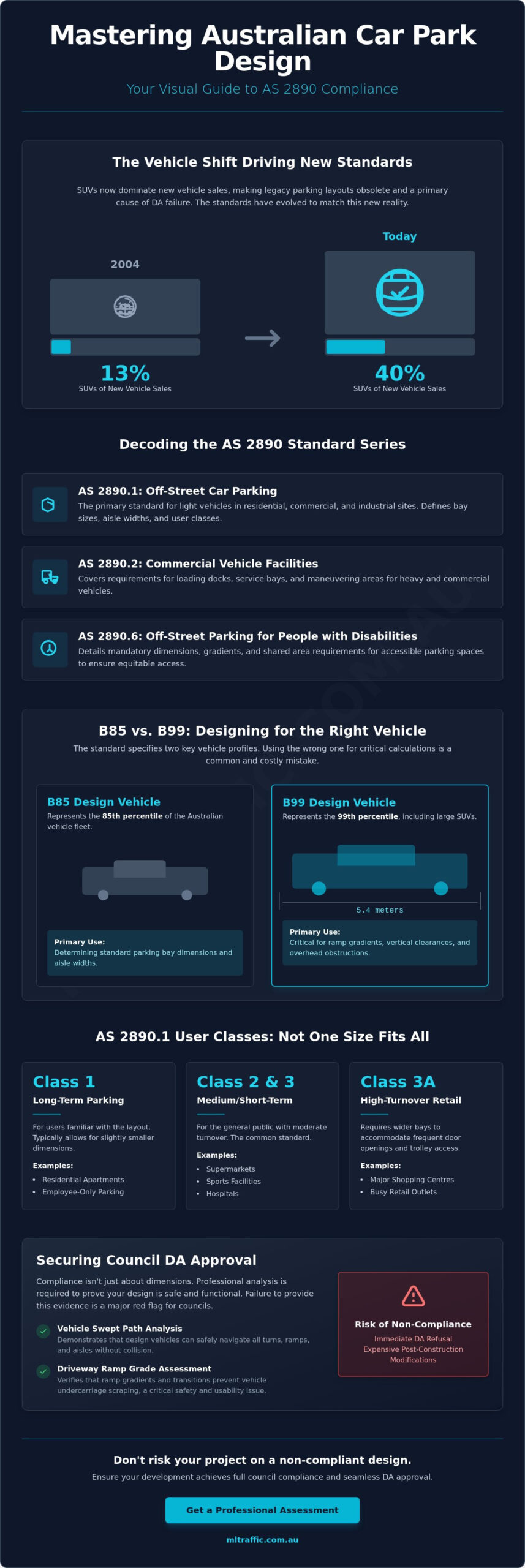
SUVs now represent approximately 40% of new vehicle sales in Australia, a sharp increase from just 13% in 2004. This shift in the national fleet has forced major updates to technical requirements, making legacy layouts a primary cause for development application failure. You likely recognize that the dense technical jargon within official Standards Australia documents creates significant risk for costly redesigns if council rejects your parking layout. Confusion between different parts of the code can stall a project before it even begins.
This guide provides a professional framework to master the complexities of car park design standards australia AS 2890. Our objective is to ensure your development achieves full council compliance and seamless DA approval. We will clarify the specific differences between AS 2890.1:2021 for off-street parking and AS 2890.2 for commercial vehicles, while detailing the mandatory requirements of AS 2890.6:2022 for accessible spaces. This overview delivers the technical clarity required to translate complex regulations into a compliant, high-performing parking design.
Key Takeaways
- Master the core components of the AS 2890 series to ensure all off-street parking facilities meet mandatory national safety and accessibility benchmarks.
- Learn how to apply car park design standards australia AS 2890 across different user classes, from long-term residential parking to high-turnover retail spaces.
- Identify the critical technical requirements for ramp gradients and transition grades to maintain vehicle clearance and prevent structural scraping.
- Differentiate between AS 2890.1 for light vehicles and AS 2890.2 for commercial loading docks to ensure comprehensive site compliance.
- Secure Council DA approval by utilizing professional Vehicle Swept Path Analysis and Driveway Ramp Grade Assessments to validate your layout.
Table of Contents
-
Understanding the AS 2890 Series: The Foundation of Australian Parking Design
-
Technical Design Challenges: Ramps, Gradients, and Sight Lines
-
Achieving Council Approval: The Role of the Traffic Engineer
Understanding the AS 2890 Series: The Foundation of Australian Parking Design
The AS 2890 series serves as the definitive technical suite for off-street parking facilities in Australia. These standards establish the minimum dimensions, gradients, and safety protocols required for functional site access. While AS 2877 governs on-street parking layouts, the car park design standards australia AS 2890 apply to all private and public off-street developments. This distinction is critical for developers. You must apply the correct standard to avoid fundamental design errors early in the planning stage.
The role of Standards Australia is to maintain these benchmarks through rigorous industry consultation. Their work ensures that parking facilities accommodate the evolving vehicle fleet while prioritizing pedestrian safety. Councils rely on these documents as the primary assessment tool for Development Applications. If your plans don’t meet these specifications, your DA will likely face significant traffic-related setbacks.
To better understand how these standards apply to your project, watch this technical overview:
The Core Objectives of the Standard
The primary goal of the AS 2890 series is to create a predictable and safe environment for all road users. This involves several key technical priorities:
-
Safe ingress and egress: Designing entry and exit points that provide adequate sight distance and clear vehicle paths to prevent collisions.
-
Minimizing impact: Ensuring that vehicle queuing and maneuvering occur within the site boundaries rather than spilling onto the public road network.
-
Equitable access: Integrating mandatory requirements for accessible parking to ensure compliance with disability access regulations.
The Legal Weight of AS 2890 in Development
State Planning Policies and Local Environmental Plans (LEPs) frequently incorporate these standards by reference. This gives the documents legal standing during the planning process. If a project fails to comply, the consequences are severe. You may face an immediate DA refusal or be forced into expensive post-construction modifications to fix non-compliant ramps or bays. Professional certification of your car park design standards australia AS 2890 compliance is often a mandatory condition of consent.
The AS 2890 series is the mandatory technical benchmark for all Australian site access and infrastructure design.
AS 2890.1: Off-Street Car Parking for Light Vehicles
AS 2890.1:2021 is the primary standard governing light vehicle parking in residential, commercial, and industrial settings. It establishes the technical baseline for bay sizes and aisle widths. Compliance is not universal; dimensions vary significantly based on the intended user classification. Identifying the correct class is the first step in any professional design process.
The standard categorizes facilities into specific User Classes. Class 1 applies to long-term parking, such as residential apartments or employee-only bays. Class 2 and 3 cover medium to short-term parking, including sports facilities and standard supermarkets. Class 3A is reserved for high-turnover retail environments that require wider bays to accommodate door openings and trolley access. Failure to correctly apply these classifications often results in non-compliant layouts and subsequent DA rejection.
The B85 and B99 Design Vehicles
Engineering a compliant layout requires understanding the specific design vehicles defined in car park design standards australia AS 2890. The B85 vehicle represents the 85th percentile of the Australian light vehicle fleet. It serves as the basis for standard parking bay dimensions. However, for critical clearances, ramp designs, and overhead obstructions, engineers must utilize the B99 vehicle profile.
The B99 vehicle represents the 99th percentile, accounting for the largest SUVs and light commercial vehicles. Current standards recognize the B99 vehicle length at 5.4 meters and width at 2.1 meters. Because SUVs now represent approximately 40% of new vehicle sales in Australia, designing for these dimensions is no longer optional for functional sites. Professional Vehicle Swept Path Analysis ensures these larger vehicles can navigate your site without property damage or traffic congestion.
Aisle Widths and Circulation Roadways
Aisle width is directly influenced by the parking angle and the design vehicle’s turning circle. For a standard 90-degree parking layout, a minimum aisle width of 5.8 meters is often required for Class 1 facilities, though this increases for higher user classes. Angled parking, such as 45 or 60 degrees, allows for narrower aisles but typically mandates one-way circulation flow.
Circulation roadways must provide sufficient clearance for two-way traffic or clearly marked one-way paths. Dead-end aisles are generally discouraged by the standard. If they are unavoidable, you must include a dedicated turn-around area at the end of the aisle. This prevents vehicles from reversing over long distances, which is a major safety risk. Meticulous calculation of these geometries is essential for achieving a compliant and functional car park design.
Beyond Cars: AS 2890.2, AS 2890.3, and AS 2890.6
Light vehicle dimensions are only one component of a compliant site. Mixed-use and commercial developments must integrate multiple parts of the car park design standards australia AS 2890 series to satisfy Council requirements. A failure to account for commercial vehicle clearances or disability access mandates often leads to fundamental layout failures. These errors are difficult and expensive to rectify once a building’s structural footprint is established.
Modern developments require a multi-disciplinary approach. You must balance the spatial needs of delivery trucks, bicycle commuters, and accessible parking users within a single, cohesive plan. Each section of the AS 2890 series carries specific legal weight under the National Construction Code (NCC). Adherence ensures your development remains accessible and functional for all user groups while avoiding traffic-related setbacks during the DA process.
Commercial Vehicle Access (AS 2890.2)
AS 2890.2 governs the design of loading docks and service areas. It focuses on larger vehicles, specifically Small Rigid Vehicles (SRVs) and Medium Rigid Vehicles (MRVs). Engineering these spaces requires precise height clearance calculations, particularly for basement facilities. You must ensure that the lowest overhead obstruction accounts for the vehicle’s maximum height plus a safety margin. To validate these complex movements, a professional Swept Path Analysis is essential. This assessment proves to Council that heavy vehicles can enter, maneuver, and exit the site in a forward direction without impacting structural columns or other parked cars.
Accessible Parking Compliance (AS 2890.6)
Compliance with AS 2890.6:2022 is mandatory for obtaining DA approval. This standard outlines strict requirements for off-street parking for people with disabilities. A compliant accessible space must be at least 2.4 meters wide and 5.4 meters long. It also requires an adjacent 2.4-meter wide shared zone, resulting in a total width of 4.8 meters. These zones must include bollards to prevent encroachment by other vehicles.
Vertical clearance is another critical factor. The standard mandates a minimum clearance of 2.5 meters above the accessible parking space and 2.2 meters along the entire path of travel to the space. Gradients must be kept to a minimum, typically not exceeding 1:40 in any direction, or 1:33 for outdoor bituminous surfaces. These meticulous details ensure equitable access and are non-negotiable during Council assessments.
Bicycle Parking and End-of-Trip Facilities (AS 2890.3)
Sustainable transport initiatives have increased the importance of AS 2890.3. This part of the series dictates the dimensions and spacing for bicycle racks and lockers. Modern developments often require dedicated end-of-trip facilities, including showers and changing areas, to meet Green Star or local planning requirements. Integrating these early in the design phase prevents the loss of valuable car parking spaces later in the project.
Technical Design Challenges: Ramps, Gradients, and Sight Lines
Technical geometry is often where development applications fail during the engineering review. While basic bay dimensions are straightforward, the vertical and horizontal transitions required by car park design standards australia AS 2890 demand meticulous calculation. These standards prevent vehicle damage and ensure that site access doesn’t compromise the safety of the surrounding public infrastructure.
Ramp gradients are strictly regulated based on the length and purpose of the incline. For short residential ramps, a maximum gradient of 1:4 is sometimes permissible, while longer or commercial ramps typically require 1:5 or 1:8 ratios. However, a single gradient is rarely sufficient. You must account for the change in grade between the ramp and the connecting floor. If the sum of two adjacent grades is too high, vehicles will scrape their undercarriages or bumpers. Professional Driveway Ramp Grade Assessment is the only way to certify that these transitions function correctly for the modern vehicle fleet.
Mastering Ramp Design and Transitions
Transition zones are a mandatory requirement for any ramp steeper than 1:8. These 2-metre zones at the top and bottom of the ramp act as a buffer, using a gradient that is approximately half the main ramp grade. For example, a 1:5 ramp requires 2-metre transitions at 1:10 to ensure a smooth change in pitch. Without these, even a B85 vehicle may bottom out, leading to property damage and potential liability. Parking areas themselves must maintain a maximum gradient of 1:20 to ensure vehicle stability and pedestrian safety.
Sight Lines and Pedestrian Safety
Sight distance at the property boundary is a non-negotiable safety benchmark. The standard mandates a 2.0m x 2.5m sight triangle at the exit point of any driveway. This area must remain clear of all obstructions, including fencing, dense landscaping, and signage, to allow drivers to see approaching pedestrians and cyclists. Managing these constraints is a common challenge in dense urban environments where every square metre of land is valuable.
Queueing requirements also play a critical role in site safety. Your design must provide enough internal storage space to prevent vehicles from idling across footpaths or spilling back into the public road network. This is particularly vital for sites with boom gates or intercoms. We use Traffic Impact Assessments to model these demands and validate that your site entry remains safe and efficient under peak load conditions. Proper integration of these technical sight lines and queueing zones ensures your project meets the highest safety standards required for council approval.
Ensure your project meets all technical requirements by booking a professional Driveway Ramp Grade Assessment today.
Achieving Council Approval: The Role of the Traffic Engineer
Self-designing a parking layout to meet the car park design standards australia AS 2890 often leads to immediate DA rejection. While the previous sections detailed the necessary dimensions and technical gradients, they don’t account for the complex site interactions or the specific technical scrutiny applied by council traffic engineers. A professional assessment bridges the gap between theoretical compliance and practical site feasibility. Our role is to ensure your project moves through the approval process without the setbacks caused by non-compliant parking layouts.
ML Traffic Engineers Australia provides more than just a layout; we provide the technical accountability required by regulatory bodies. Councils often mandate professional certification for ramp grades, swept paths, and sight distances as a condition of consent. We justify the design choices made on your site, proving that every maneuver is safe and every gradient is functional. This authoritative approach minimizes the risk of costly redesigns after you’ve already submitted your application.
The Certification Process
Council submissions require a formal Car Park Design Certification to proceed. This document acts as a technical validation of your proposed parking and access layout. We use specialized software, such as AutoTURN, to simulate vehicle movements and prove compliance with the car park design standards australia AS 2890. This software allows us to perform precise Vehicle Swept Path Analysis for both light vehicles and heavy rigid trucks. Our team at ML Traffic Engineers Australia brings over 15 years of experience to every project, ensuring that senior experts personally oversee the certification of your site access and parking geometry.
Maximizing Efficiency and Compliance
Maximizing parking yield while maintaining compliant aisle widths is a primary challenge for any development. Early-stage design input allows us to identify spatial efficiencies that standard templates often miss. We solve common site constraints, such as narrow frontages and steep topography, by applying advanced engineering principles to the layout. If a site requires a minor deviation from the standard due to physical limitations, we provide the technical justification required for Council to accept the alternative. This ensures you maintain the maximum number of spaces without compromising safety or regulatory requirements.
Meticulous planning at the start of your project prevents the need for expensive post-DA redesigns. For a professional review of your site plans and to ensure your development meets all regulatory benchmarks, contact ML Traffic Engineers Australia for a compliant car park design assessment.
Secure Your Development Approval with Technical Precision
Mastering the car park design standards australia AS 2890 is essential for any successful development application. You’ve seen how specific dimensions for light vehicles, commercial loading docks, and accessible spaces must intersect with complex ramp geometries and sight line requirements. A single error in these technical calculations can lead to a costly DA rejection or structural rectification. Professional certification isn’t just a council requirement; it’s a safeguard for your project’s viability.
ML Traffic Engineers Australia brings over 15 years of experience in Australian traffic engineering to every site assessment. We specialize in AS 2890.1 and AS 2890.2 certification, ensuring your design meets the highest regulatory benchmarks. Every report we produce features direct principal involvement, providing you with a high level of accountability and expertise. Don’t leave your parking layout to chance.
Get a Compliant Car Park Design Assessment for Your DA to ensure your site is functional, compliant, and ready for approval. We look forward to helping you achieve a seamless transition from design to construction.
Frequently Asked Questions
What is the standard size of a car parking space in Australia?
A standard parking space for a light vehicle is typically 2.4 metres wide and 5.4 metres long under current car park design standards australia AS 2890. These dimensions vary based on the specific User Class of the facility. For instance, high-turnover retail environments often require wider bays of 2.6 or 2.7 metres to facilitate easier door openings and trolley access for shoppers.
Are wheel stops mandatory under AS 2890.1?
Wheel stops aren’t mandatory for every parking space but are required where vehicle travel must be limited to protect pedestrians or structural elements. They are commonly installed to prevent vehicles from overhanging onto footpaths or impacting basement walls. If you use them, they must comply with specific height and placement requirements to avoid becoming a trip hazard for users.
What is the maximum allowable gradient for a driveway ramp?
The maximum allowable gradient for a driveway ramp is 1:4 for residential developments and 1:5 for other types of facilities, provided the ramp is relatively short. Longer ramps typically require a more gradual 1:8 ratio to ensure safe operation. All steep ramps must include 2-metre transition zones at the top and bottom to prevent vehicle scraping or bottoming out.
How do I know if my site needs a Swept Path Analysis?
Your site needs a Vehicle Swept Path Analysis if it involves tight maneuvering areas, heavy vehicle access, or non-standard intersection geometries. Council often mandates this analysis for any commercial loading dock or basement car park design. It provides technical proof that the design vehicle can navigate the site safely without property damage or impacting structural columns.
What is the difference between AS 2890.1 and AS 2890.6?
AS 2890.1 governs off-street parking for standard light vehicles, while AS 2890.6 specifically addresses requirements for people with disabilities. The primary difference lies in the mandatory shared zones and increased vertical clearances required by AS 2890.6. Both parts of the car park design standards australia AS 2890 must be integrated into a single cohesive design to satisfy modern council compliance requirements.
Can a council reject my DA if I meet the minimum space dimensions but not the aisle width?
Yes, a council can reject your DA if the aisle width doesn’t meet the minimum requirements, even if your bay dimensions are compliant. Aisle width is a critical component of the standard because it dictates whether a vehicle can enter or exit a space in a single turn. Insufficient width leads to traffic congestion and increased safety hazards within the facility.
How much vertical clearance is required in a basement car park?
Standard vertical clearance in a basement car park is a minimum of 2.2 metres from the floor to the lowest overhead obstruction, such as pipes or cable trays. This requirement increases to 2.5 metres above any parking space designated for people with disabilities and along the path of travel to those spaces. You must account for all overhead services when calculating these clearances for compliance.
Do I need a traffic engineer to certify my car park design?
Most councils require a qualified traffic engineer to certify your car park design as a formal condition of the DA approval process. This certification involves validating the ramp grades, swept paths, and sight distances in a technical report. Professional involvement ensures the layout is legally compliant and functionally sound, which reduces the risk of expensive redesigns during the construction phase.
Which areas do you cover?
We are traffic engineers servicing Melbourne, Sydney, Brisbane, Gold Coast, Hobart, Perth, Adelaide, Darwin, Canberra and surrounding areas.

Disclaimer
The content on www.mltraffic.com.au, including all technical articles, guides, and resources, is provided for general informational and educational purposes only. It is not intended to constitute professional advice in traffic engineering, transportation planning, development approvals, or any other technical or legal field.
While ML Traffic Engineers makes every reasonable effort to ensure the accuracy, completeness, and timeliness of the information published, we do not provide any warranties or representations (express or implied) regarding its reliability, suitability, or availability for any particular purpose. Any reliance you place on the content is strictly at your own risk.
In no event shall ML Traffic Engineers, its directors, employees, authors, or affiliates be liable for any direct, indirect, incidental, special, consequential, or punitive damages (including, without limitation, loss of profits, data, or business opportunities) arising out of or in connection with the use of, or inability to use, any information provided on this website.
The articles and guides on this site are not a substitute for engaging a qualified, registered professional traffic engineer (such as an NPER or RPEQ engineer) to assess your specific project requirements. For tailored advice, compliance assessments, or traffic engineering services, please contact a competent professional.
This disclaimer may be updated from time to time without notice. By accessing or using this website, you agree to be bound by the most current version of this disclaimer.
