
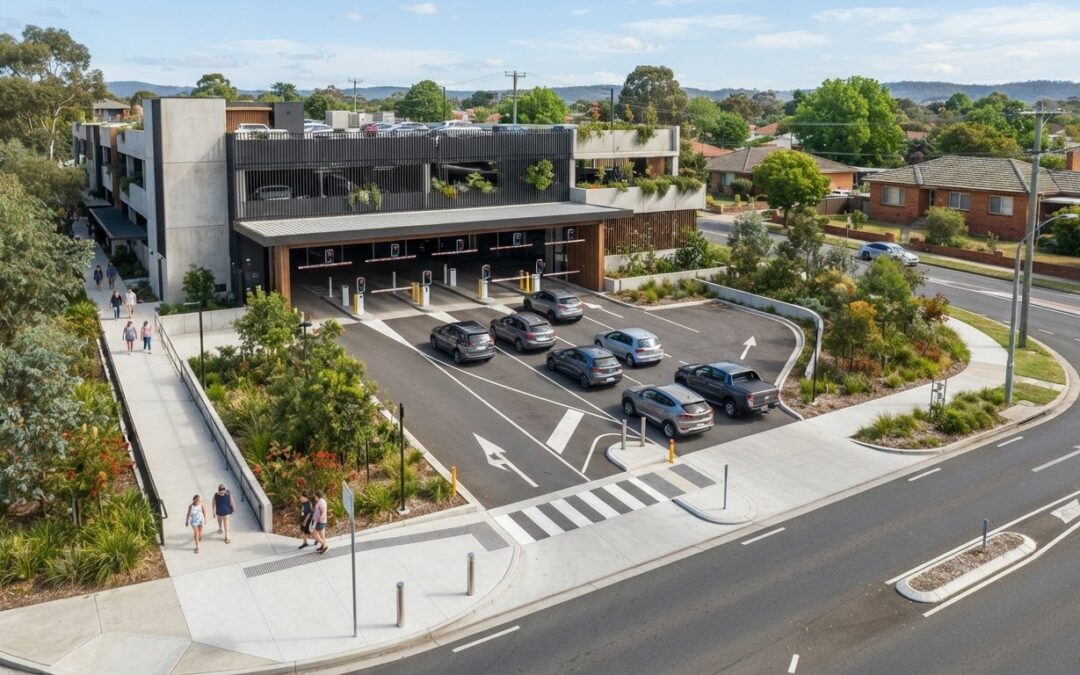
A car park entry queue can result from the way vehicles are processed, not just a lack of space. Assessing car park entry queuing requirements means considering peak arrival demand, available queue storage and the route vehicles take through the site. If these factors aren’t considered together, vehicles may block a footpath or queue back onto the public road.
The key questions are how much queue storage the car park needs and what entry arrangement will keep vehicles moving. The answers depend on when vehicles arrive, how long each vehicle takes to enter and whether the layout can hold a queue without obstructing other movements.
This guide explains what information is needed to assess demand, how layout, vehicle processing and access control interact, and how to distinguish a design issue from an operational one. It also explains how traffic engineering input, including car park design, a Traffic Impact Assessment and vehicle swept path analysis, can help test and document a proposed arrangement.
Key Takeaways
- Assess car park entry queuing requirements by considering peak arrival demand, vehicle processing and available on-site storage together.
- Use project-specific arrival information to test likely queue conditions, and clearly identify assumptions and data gaps.
- Compare entry controls by the steps drivers must complete and the operational factors that can affect processing time.
- Check whether queues can be contained without obstructing pedestrian routes, internal circulation or access points.
- Traffic engineering input can help assess uncertain demand, constrained access and potential road spillback. A Traffic Impact Assessment considers site access alongside the surrounding road network.
Car park entry queuing requirements: what the assessment needs to establish
Car park entry queuing requirements aren’t established by selecting a standard queue length. The assessment needs to show how arriving vehicles will be accommodated and processed under the project’s expected conditions. The result depends on demand, the entry layout and how drivers gain access.
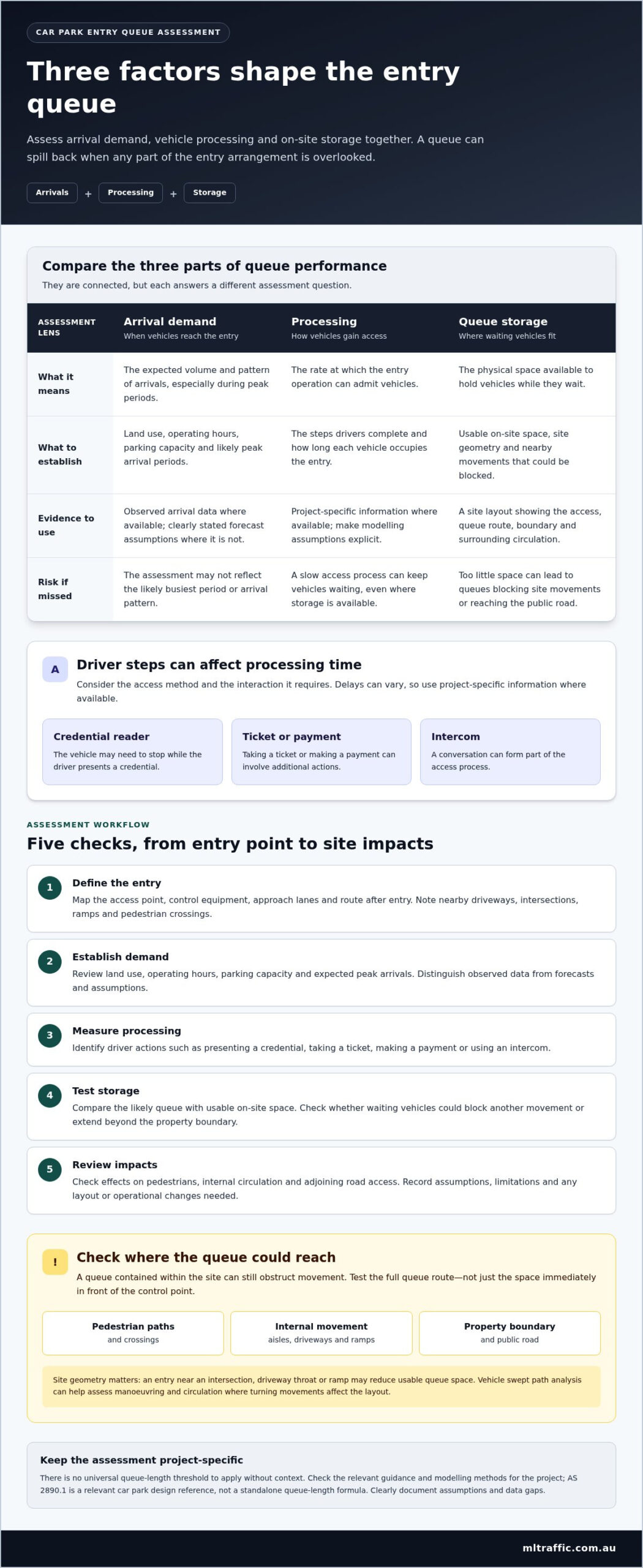
Queue storage is the physical space available to hold waiting vehicles; processing capacity is the rate at which the entry operation can admit them. These are related but distinct. A long storage lane won’t resolve a slow access process, while fast processing won’t prevent spillback if the layout offers too little space.
The principles of queueing theory help explain why both arrival patterns and processing times matter when assessing a waiting line. The video below shows vehicles approaching a controlled entry.
What counts as an entry queue at a car park?
An entry queue forms when vehicles wait for access processing at a boom gate, ticket machine, intercom, credential reader or other controlled entry. This differs from ordinary internal circulation, where vehicles move through aisles or manoeuvre towards parking spaces.
Assess where the waiting line forms and how far it could extend. A queue contained within the site may still block an internal aisle, driveway or pedestrian path. If it reaches the property boundary, it may extend onto the public road and affect through traffic. Review these interactions across the site, not just the space directly in front of the control point.
Which requirements and guidance should the project consider?
AS 2890.1 is a relevant reference for car park design. Verify the applicable edition and provisions for the project, and don’t treat the standard as a standalone queue-length formula. The assessment also needs to consider expected vehicle movements, the entry arrangement and available on-site storage.
Planning conditions and relevant state, territory or local authority guidance may set project-specific assessment expectations. Requirements can vary, so one authority guideline or dimension shouldn’t be presented as a universal Australian rule. Document the guidance used, assumptions made and any data gaps. Where demand or access constraints are uncertain, a Traffic Impact Assessment can consider site access, expected vehicle movements and the surrounding road network together.
How to assess queue storage: demand, processing and site layout
A sound assessment connects how vehicles arrive with how quickly they can enter and where they can wait. Use this workflow to identify constraints before settling on a queue-storage arrangement.
- 1. Define the entry. Map the access point, control equipment, approach lanes and the route vehicles take after entry. Identify nearby driveways, intersections, ramps and pedestrian crossings.
- 2. Establish demand. Review the land use, operating hours, parking capacity and expected peak arrival periods. Use observed arrival data where available, and state the basis of forecasts where it isn’t.
- 3. Measure processing. Identify the steps drivers must complete, such as presenting a credential, taking a ticket, making a payment or using an intercom. Assess how those steps affect the time each vehicle occupies the entry.
- 4. Test storage. Compare the likely queue with the usable space on site. Check whether stopped vehicles can be accommodated without blocking another movement or extending beyond the property boundary.
- 5. Review impacts. Check how queueing could affect pedestrians, internal circulation and access to adjoining roads. Record assumptions, limitations and any changes needed to the layout or operation.
What information is needed to estimate queue demand?
Start with the development’s land use, operating hours and parking capacity, then identify when arrivals are likely to concentrate. Consider who can enter, whether access is restricted to particular users and which vehicle types need to manoeuvre through the entry. A car parking demand assessment can help inform expected parking activity as part of the project review.
Separate evidence from assumptions. Label measured traffic counts, forecast arrival profiles and sensitivity scenarios clearly. If data doesn’t cover the likely busiest period, state that gap rather than presenting an estimate as an observed result. Test how a different arrival pattern or longer transaction time could affect the queue.
How do processing time and layout change queue performance?
Each driver interaction can add time at the entry. A credential reader may require a vehicle to stop while the driver presents a credential. A ticket or payment process may involve additional actions, and an intercom can require a conversation. Delays can vary, so use project-specific information where available and make modelling assumptions explicit.
Test the queue against the actual site geometry. A gate near an internal intersection, driveway throat or ramp may leave less usable storage than the plan suggests. Check whether queued vehicles could block aisles, crossings or other access points. Where turning movements affect the available space, vehicle swept path analysis can help assess manoeuvring and circulation.
There is no universal queue-length threshold to apply without context. Verify modelling methods, any proposed numerical criteria and relevant authority guidance for the project. Support the car park entry queuing requirements with evidence and reviewable assumptions, rather than treating a single dimension as suitable for every site.
Compare car park access control technologies by their queueing effect
Access control affects how long each vehicle spends at the entry, but it doesn’t determine how many vehicles the approach can physically hold. The suitable arrangement depends on who uses the car park, what drivers must do before entry and how the system operates if a transaction or device fails. Compare the complete entry process, not just the equipment.
The options below involve different processing steps. Their actual effect on queues depends on system configuration, demand and site conditions.
| Entry option | Driver interaction | Processing dependencies and operational needs | Likely queue considerations |
|---|---|---|---|
| Barrier gate | Driver stops while the barrier opens, often after an access check. | Needs a functioning barrier and a method to authorise entry. A barrier alone doesn’t verify permission. | Vehicles may wait if authorisation is delayed or the barrier doesn’t operate. The approach must provide space for stopped vehicles. |
| Ticket or payment system | Driver may take a ticket, validate parking or pay before the barrier opens. | Relies on working ticketing or payment equipment and clear instructions. Payment or ticket issues may require assistance. | Extra steps can extend the time vehicles occupy the entry, particularly if drivers need to resolve a transaction problem. |
| Credential reader | Driver presents a card, tag or other credential for access. | Requires valid credentials, a functioning reader and a clear process for failed or unreadable credentials. | Unsuccessful reads or drivers searching for credentials can delay following vehicles. |
| Intercom | Driver requests access and may need to speak with an operator. | Depends on communication equipment and a response process. Unclear instructions or delayed responses can hold a vehicle at the entry. | Processing time may vary between vehicles, so queue storage should account for the interaction and a fallback procedure. |
| Number plate recognition | Driver approaches while the system reads the vehicle’s registration plate. | Operation depends on system setup, access permissions and a process for plates that aren’t recognised. | Reading or authorisation issues may require another access step. Site-specific operation should inform the queue assessment. |
Which access control options suit different entry operations?
A barrier paired with a credential reader may suit a defined user group with established access permissions. Ticketing or payment systems introduce additional driver actions. An intercom adds a communication step, while number plate recognition may suit sites where its configuration fits the access arrangements. No option is automatically suitable for every car park.
Can access control technology prevent queues?
Technology can streamline processing, but it can’t create more physical storage. Unreadable credentials, payment delays or equipment downtime can interrupt entry, so the operating plan should explain how drivers proceed when the normal process fails. Clear signage and well-defined access permissions can reduce avoidable confusion.
Car park entry queuing requirements depend on peak arrivals, processing steps, site layout and contingency procedures working together. A faster access method won’t prevent a queue from obstructing a driveway or reaching the road if the approach can’t contain the vehicles.
Design a safer, more workable car park entry queue
A workable entry layout must contain expected queues without compromising pedestrian access or the movement of vehicles already inside the car park. Review the full approach, not only the space beside the gate. Consider where a queue could extend during peak arrivals and which driveways, aisles, ramps or access points it might affect.
Use this checklist to test the arrangement against the project drawings and operating assumptions:
- Queue containment: Identify the usable waiting area and check whether vehicles can queue clear of the public road and adjoining access points.
- Entry visibility: Review whether approaching drivers can see the entry, lane allocation and instructions in time to respond safely.
- Gate position: Check the gate setback and available space for a vehicle to stop without obstructing the footpath, driveway or internal intersection.
- Vehicle circulation: Confirm that a queue won’t block aisles, ramps or turning movements needed by other vehicles.
- Pedestrian separation: Identify pedestrian desire lines and check that waiting vehicles don’t obstruct paths, ramps or crossings.
- Operating contingencies: Record how the entry is intended to operate during equipment faults, unusual arrival peaks or temporary changes to access arrangements.
How should entry queues interact with pedestrians and circulation?
Plot pedestrian routes alongside vehicle paths. A queue that crosses a route to a building entrance or blocks a path near a ramp can create conflicts even when all vehicles remain on site. Review sight lines and turning movements using project-specific drawings. Where manoeuvring affects the available queue space, vehicle swept path analysis can help test how vehicles move through the entry and internal circulation area.
Consider more than typical operating conditions. An equipment fault or a concentrated arrival period may change where vehicles wait. Identify which access points would be affected and document the intended operational response, rather than relying on drivers to find an informal alternative.
What should the entry design checklist cover?
Keep a clear record of design demand, data sources, assumptions, available queue storage and the intended access-control sequence. Include lane allocation, gate position, signage and how waiting vehicles will be kept clear of pedestrian routes and the road. Note relevant planning conditions and authority guidance for the project. AS 2890.1 provides broader car park design context; verify the applicable edition and provisions rather than treating a single detail as a universal queue rule.
For a project-specific review of car park layout and vehicle movements, explore car park design and traffic engineering services.
When traffic engineering input can resolve car park entry queue risks
A traffic engineer’s review is useful when arrival demand is uncertain, the site has limited space for waiting vehicles or a queue could reach the public road. It can also help when the access-control process and site layout have been designed separately, leaving uncertainty about how they will work together during busy periods.
The assessment should connect expected development traffic with entry operation and the surrounding road network. A Traffic Impact Assessment (TIA) can document the assumptions used, review access arrangements and consider potential network impacts. This gives project teams and decision-makers a clearer basis for understanding how the proposed entry may perform and identifying constraints that need further consideration.
What can a traffic assessment contribute?
A coordinated review can test whether proposed queue storage works with internal circulation, site constraints and the entry process. Car park design can assess layout options, while vehicle swept path analysis can examine manoeuvring where turning movements affect the usable approach or nearby aisles. Together, these inputs help distinguish a physical layout constraint from a processing or operational issue.
Traffic engineering services can support the assessment of site access, vehicle movements and car park layout. The scope should reflect the project’s demand, available evidence and relevant planning or authority guidance. Document queue assumptions and conclusions clearly, rather than relying on a generic storage dimension.
What project information helps start the review?
Bring together the available material describing both the development and its proposed access arrangement. Useful information includes:
- Current site plans showing the driveway, entry control, internal aisles, pedestrian routes and nearby access points.
- Proposed land use, parking numbers and operating hours, including known periods of concentrated arrivals.
- Available traffic counts, forecast arrival information and assumptions used to estimate peak demand.
- Details of the proposed access-control sequence, such as ticketing, payment, credential checks or intercom use.
- Known constraints, including limited queue storage, nearby intersections or the possibility of vehicles waiting beyond the site boundary.
Label measured data, forecasts and assumptions separately. If information is incomplete, identifying the gap helps define what the assessment can reliably conclude and what may need further analysis. This matters particularly where car park entry queuing requirements could affect public-road access or pedestrian movement.
Discuss your project with ML Traffic Engineers Australia for a coordinated review of entry operation, site layout and vehicle movements.
Plan an entry that works under peak demand
Reliable car park entry queuing requirements depend on more than the length of the driveway. Assess expected arrivals alongside access processing, available queue storage and the way vehicles, pedestrians and internal circulation interact. Access control can affect how quickly vehicles enter, but it can’t make up for a layout with nowhere to hold waiting vehicles.
Use project-specific evidence and clearly stated assumptions to test the proposed arrangement. Where demand is uncertain, access is constrained or queues could affect the public road, traffic engineering input can connect site access with development traffic and the surrounding network.
ML Traffic Engineers Pty Ltd brings over 15 years of traffic engineering and transport planning experience. Its relevant work includes Traffic Impact Assessments, car park design and vehicle swept path analysis, which can help assess entry operation, layout and manoeuvring together.
Discuss your car park access and queue assessment and take a practical next step towards a well-considered entry design.
Frequently Asked Questions
What are the car park entry queuing requirements in Australia?
There isn’t one queue length that applies to every Australian car park. Car park entry queuing requirements depend on expected arrival demand, how vehicles are processed, the site layout and relevant planning conditions or authority guidance. Assess how many vehicles may arrive during peak periods, where they can wait and whether a queue could affect pedestrians, internal circulation or the public road. Document project assumptions and verify the applicable guidance.
How do you calculate queue storage for a car park entrance?
Estimate queue demand using project-specific arrival information for the relevant peak period, then assess how long each vehicle occupies the entry during access processing. Consider the likely number of vehicles waiting at once and compare it with the usable on-site storage shown on the plans. Test assumptions about arrival patterns and processing delays, identify data gaps, and check whether the queue would block aisles, pedestrian routes or access points.
Can a car park access control system prevent vehicle queues?
No access control system can guarantee that queues won’t form. A reader, ticket machine, payment system or number plate recognition setup may streamline entry, but processing delays or equipment faults can still hold vehicles. The system also doesn’t increase the physical space available for waiting. Assess the control process alongside peak demand, queue storage and site layout, and plan how the entry will operate if the usual process is interrupted.
Which technology is best for controlling car park entry queues?
There’s no universally best technology; the suitable option depends on the users, access permissions and entry process. A credential reader may suit a defined user group, while ticketing or payment introduces extra driver steps. An intercom depends on communication and response, and number plate recognition depends on system setup and a process for unrecognised plates. Compare these operational factors and test likely delays against the site’s queue storage.
Can a car park queue extend onto a public road?
Yes. If arriving vehicles exceed the available on-site queue storage, a queue may reach the driveway boundary and extend onto the public road. This can affect through traffic, nearby intersections or other access movements. Assess where the queue could extend during peak arrivals and whether the entry layout can contain it. Consider relevant planning conditions and authority guidance, and use traffic engineering input if road spillback is a possible outcome.
Does AS 2890.1 specify car park entry queue lengths?
AS 2890.1 is a relevant Australian reference for car park design, but don’t assume it provides one queue length suitable for every entry. Assess queue storage against project demand, access arrangements, layout and relevant authority guidance. Verify the applicable edition and provisions for the project, along with any planning conditions. Document the evidence and assumptions rather than relying on a generic dimension.
When should a traffic engineer assess car park entry queues?
Involve a traffic engineer when arrival demand is uncertain, site access is constrained, or queues could affect pedestrians, internal circulation or the public road. A Traffic Impact Assessment can consider development traffic, site access and the surrounding road network together. Car park design and vehicle swept path analysis can also help assess layout and manoeuvring constraints. ML Traffic Engineers Pty Ltd has over 15 years of traffic engineering and transport planning experience supporting development applications.

Disclaimer
The content on www.mltraffic.com.au, including all technical articles, guides, and resources, is provided for general informational and educational purposes only. It is not intended to constitute professional advice in traffic engineering, transportation planning, development approvals, or any other technical or legal field.
While ML Traffic Engineers makes every reasonable effort to ensure the accuracy, completeness, and timeliness of the information published, we do not provide any warranties or representations (express or implied) regarding its reliability, suitability, or availability for any particular purpose. Any reliance you place on the content is strictly at your own risk.
In no event shall ML Traffic Engineers, its directors, employees, authors, or affiliates be liable for any direct, indirect, incidental, special, consequential, or punitive damages (including, without limitation, loss of profits, data, or business opportunities) arising out of or in connection with the use of, or inability to use, any information provided on this website.
The articles and guides on this site are not a substitute for engaging a qualified, registered professional traffic engineer (such as an NPER or RPEQ engineer) to assess your specific project requirements. For tailored advice, compliance assessments, or traffic engineering services, please contact a competent professional.
This disclaimer may be updated from time to time without notice. By accessing or using this website, you agree to be bound by the most current version of this disclaimer.
