

A car park designed strictly to Australian Standards on paper can still become an operational failure on opening day if the underlying management logic is flawed. While physical dimensions matter, the difference between a seamless development and a site plagued by misappropriated spaces often comes down to a single document. For many Australian developers, a vague council condition requiring a car park operational management plan is the final hurdle standing between a project and its Development Application approval.
We understand that navigating the technicalities of AS/NZS 2890.1:2004 while trying to satisfy diverse tenant needs is a significant source of project friction. This guide explains how a comprehensive car park operational management plan ensures council compliance, reduces liability through proper signage, and maintains long-term site efficiency. We will examine the essential components of a compliant plan, including swept path requirements and parking allocation strategies, providing a clear path to securing your DA and protecting your asset.
Key Takeaways
- Understand how a car park operational management plan serves as a functional roadmap for facility managers and strata bodies to maintain site efficiency post-construction.
- Learn to establish clear parking allocations for residential, commercial, and visitor users to prevent space misappropriation and reduce tenant conflict.
- Discover how a professionally drafted plan can justify parking shortfalls and address council concerns regarding street parking overflow during the DA assessment phase.
- Ensure your management procedures align with AS 2890.1 standards to maintain safety compliance without compromising operational flexibility.
- Recognise why senior principal involvement is essential for navigating complex swept path requirements and specific local council terminology.
What is a Car Park Operational Management Plan (CPOMP)?
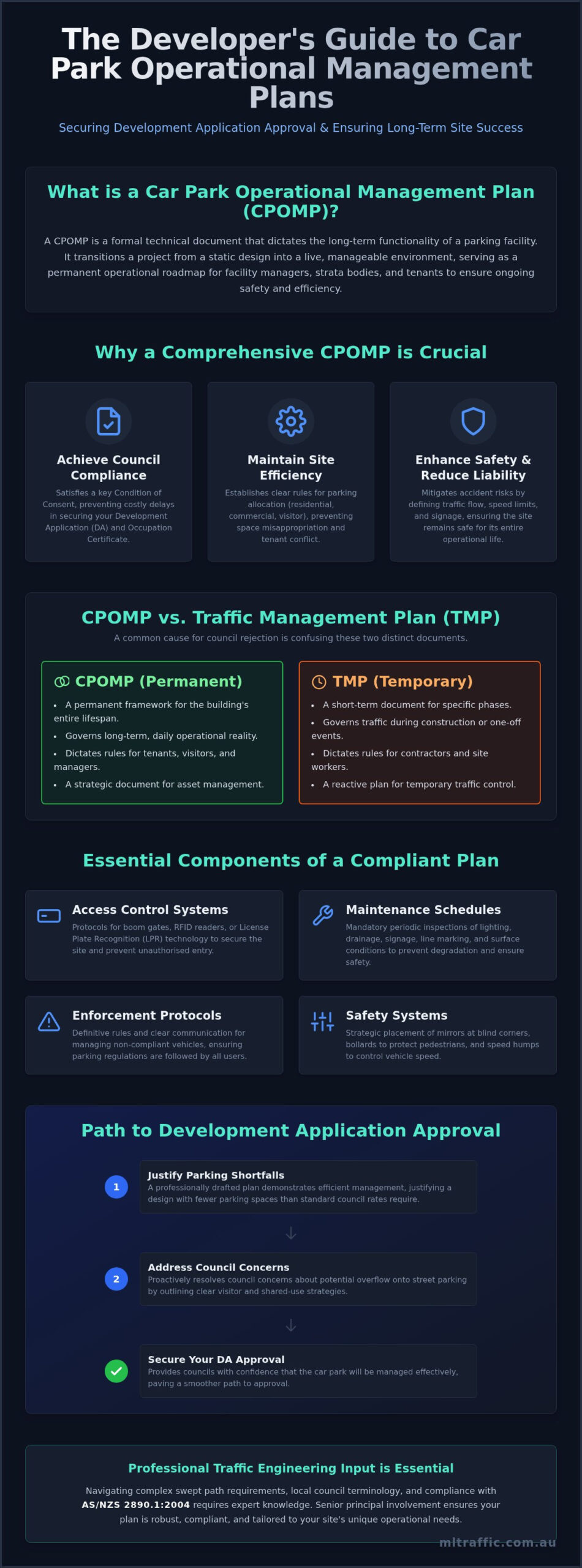
A car park operational management plan is a formal technical document that dictates the long-term functionality of a parking facility. It transitions a project from a static design concept into a live, manageable environment. While a Traffic Impact Assessment (TIA) predicts vehicle movements, the CPOMP manages them. Local councils across Australia, including the City of Sydney and Brisbane City Council, typically mandate these plans as a specific Condition of Consent. Without a compliant document, developers risk significant delays in obtaining their Occupation Certificate. Expert traffic engineering services are required to bridge the gap between architectural plans and a functional site.
The document acts as a permanent roadmap for facility managers, strata bodies, and tenants. It provides the protocols necessary to maintain site efficiency and safety. The evolution of parking lot design and technology has made these spaces increasingly complex. Modern developments now require integrated systems for access control and space sharing that a simple floor plan cannot address. A robust car park operational management plan ensures the site operates safely within its approved traffic parameters for years to come.
The Core Purpose of Operational Planning
The primary objective of this planning is to regulate the daily ebb and flow of vehicle movements. In mixed-use developments, this involves segregating residential and commercial traffic to prevent operational friction. A well-drafted plan prevents unauthorised parking by establishing clear rules for space usage. It ensures that visitor spots remain available and that delivery vehicles don’t block essential access routes. It’s about maintaining order in a high-turnover environment.
Safety is the other critical pillar. The plan must address shared zones where pedestrians and vehicles interact. By defining clear priority rules and speed limits, the CPOMP mitigates the risk of on-site accidents. It provides a framework for the long-term maintenance of line marking and signage. This ensures the car park remains compliant with safety standards throughout its entire operational life rather than just at the point of construction.
CPOMP vs. Traffic Management Plan (TMP)
Confusion between a CPOMP and a Traffic Management Plan (TMP) is a common cause of council rejection. A TMP is generally a short-term document. It governs traffic control during construction phases or for specific one-off events. It’s reactive and temporary. If you submit a TMP when a permanent operational framework is required, your application will likely be sent back for revision.
In contrast, a car park operational management plan is a permanent framework. It’s intended to last for the life of the building. Mistaking a temporary traffic control scheme for a permanent management plan demonstrates a lack of technical foresight. Councils reject applications that fail to distinguish between these two distinct requirements. You must ensure your consultant provides a document that addresses the enduring operational reality of the site.
Essential Components of an Effective Management Plan
An effective car park operational management plan requires a granular level of detail to satisfy both local council requirements and the practical needs of end-users. It must provide a definitive framework for how the facility functions once the builders have left the site. A plan that lacks specific operational protocols often leads to site congestion and resident complaints. The following components are mandatory for a robust plan:
- Access control systems: Implementation of boom gates, RFID readers, or License Plate Recognition (LPR) technology to secure the site and prevent unauthorised entry.
- Maintenance schedules: Mandatory periodic inspections of lighting, drainage, and surface conditions to prevent site degradation and ensure ongoing safety.
- Enforcement protocols: Definitive rules for managing non-compliant vehicles, ensuring that parking rules are followed and penalties are clearly communicated to all users.
- Safety systems: Strategic placement of mirrors, bollards, and speed humps to control vehicle speed and improve visibility at blind corners.
These elements must be integrated into a cohesive document that serves as a manual for the building’s management. For complex sites, engaging an expert traffic engineering consultancy ensures these systems are designed to handle peak demand periods without failure.
Allocation Strategies for Mixed-Use Sites
Mixed-use developments present the highest risk of parking conflict. The plan must specify the exact number of bays reserved for residential, commercial, and visitor users. Shared parking arrangements should be supported by technical data to ensure peak usage times for different groups don’t overlap. Accessible parking bays and electric vehicle (EV) charging spots must be placed in high-visibility, high-accessibility areas to meet compliance and user demand. Protecting visitor bays is paramount; they should be clearly marked and monitored to prevent permanent occupation by staff or residents. Our engineers often include specific swept path analysis for delivery vehicles to ensure commercial operations don’t interfere with residential access.
Signage, Linemarking, and Wayfinding
Standardised signage is not merely a suggestion; it is a requirement for legal enforceability under Australian Standards. Linemarking must define clear pedestrian crossings and ‘no parking’ zones to maintain sight distances and safety. All markings should use high-visibility, slip-resistant materials to reduce liability. Effective wayfinding is critical for reducing internal site congestion by guiding drivers directly to their allocated zones without unnecessary circulation. Clear, logical directions prevent drivers from wandering into restricted areas or performing dangerous U-turns within the facility. This structured approach to visual communication is a core requirement of any professional car park operational management plan.
Ensuring Compliance with Australian Standards
A car park operational management plan must be grounded in the physical geometry of the site. It must reflect the constraints identified in the AS 2890.1 guide. Operational rules cannot override the safety requirements of national standards. If a design requires a specific turning area to maintain safety, the management plan cannot allow that space to be used for storage or overflow parking. Compliance is an ongoing obligation. It requires constant adherence to the geometric limits of the facility to prevent accidents and structural damage.
Developments with commercial components must also address AS 2890.2. This standard governs heavy vehicle loading and service docks. Your management plan must dictate the timing and frequency of deliveries to ensure heavy vehicles do not conflict with passenger cars in shared driveways. Regular auditing is necessary. As tenants change, vehicle types and usage patterns evolve. A site that was compliant at the time of the Occupation Certificate may become non-compliant if the management framework fails to adapt to these changes.
Integrating Swept Path Analysis
Operational protocols must account for the largest vehicles expected on-site. Detailed swept path analysis informs waste collection schedules by proving exactly where a truck can and cannot turn. This technical data ensures that waste contractors do not block essential thoroughfares during peak traffic periods. In height-restricted basement car parks, the car park operational management plan must specify clearance limits for delivery vans. Providing this information to contractors before they arrive prevents overhead collisions and site gridlock. Our engineers ensure these technical requirements are translated into clear, actionable rules for site managers.
Safety and Pedestrian Interface
Adhering to sight distance requirements at entries and exits is a critical safety obligation. The plan must specify the maintenance of “clear zones” to prevent landscaping or temporary signage from obstructing a driver’s line of sight. Internal traffic speed is regulated through the implementation of speed humps, convex mirrors, and clear priority markings. These measures are essential in shared zones where pedestrians and vehicles interact. Additionally, the plan must include protocols for emergency vehicle access. Unimpeded egress for fire, police, and ambulance services is a mandatory requirement for every Australian development.
The Role of CPOMPs in the Development Application (DA) Process
Local councils across Australia use a car park operational management plan to verify that a proposed development will not result in illegal parking or excessive overflow into the surrounding street network. This document serves as a formal commitment from the developer that the site will be managed according to the parameters set out during the planning phase. It’s the primary mechanism councils use to ensure that a project’s internal traffic doesn’t become a public nuisance. When a development cannot meet the minimum parking rates specified in a Local Environmental Plan (LEP) or Development Control Plan (DCP), a robust management plan becomes a critical negotiation tool. It provides the technical justification for a parking shortfall by demonstrating how the available spaces will be utilised with maximum efficiency through sharing or allocation strategies.
This document should not be viewed in isolation. It works in tandem with a Traffic Impact Assessment to provide a complete picture of site movement. While the assessment identifies the volume of traffic, the management plan outlines the specific rules that govern that volume. Additionally, a compliant plan ensures the development satisfies Section 88B instruments or other legal covenants on the land title. These covenants often dictate specific access rights or maintenance obligations that must be formally managed for the life of the asset.
Responding to Council Conditions of Consent
Councils frequently issue a ‘Notice of Determination’ with complex conditions regarding parking management. Identifying exactly what the council is asking for is the first step in clearing these conditions. The danger of submitting a generic plan that fails to address specific site issues, such as narrow driveway ramps or limited turning circles, is that it leads to further requests for information (RFIs) and project delays. Professional traffic engineering input speeds up the ‘clearing’ of these conditions by providing site-specific solutions that satisfy council officers on the first submission. To ensure your project meets all council requirements and progresses to the construction phase without delay, contact our senior principals for a site-specific assessment.
Future-Proofing Your Development
Future-proofing is essential for modern developments. Plans should account for emerging trends like car-sharing schemes and the increased requirement for secure bicycle parking. Designing an adaptable plan ensures it can be updated as the building’s tenancy evolves, allowing for changes in how commercial and residential spaces interact. A well-drafted car park operational management plan protects the developer from future liability claims by providing a clear, documented record of safety protocols and operational rules. This proactive approach ensures the facility remains functional and compliant as transport habits change over the coming decades.
Why Professional Traffic Engineering Input is Essential
Professional engineering input is the final safeguard against council rejection and operational failure. Expert traffic engineers ensure that a car park operational management plan is both technically sound and compliant with local government requirements. ML Traffic Engineers Australia provides a hands-on approach that prioritises senior principal involvement in every report. This direct involvement eliminates the bureaucratic gatekeepers and communication delays often found in larger, more impersonal consultancies. Our traffic engineering services cover the full lifecycle of a project, from the initial design phase to the finalisation of the operational framework.
A poorly drafted plan can lead to long-term site friction and legal liability. Engaging a qualified consultant ensures that every technical detail, from swept path requirements to signage placement, is verified against national standards. This meticulous approach protects the developer’s asset and ensures the site functions as intended from day one. We focus on delivering results that satisfy council officers while maintaining the practical needs of the building’s future occupants.
The Value of Senior-Level Accountability
Senior-level accountability is a core pillar of our professional philosophy. Clients have direct access to the experts who actually perform the technical work on their project. ML Traffic Engineers Australia promises that the same engineer who initiates the client relationship will be the one performing the technical assessments and drafting the plan. This continuity prevents the errors that occur when information is filtered through multiple layers of junior staff. We leverage over 15 years of industry experience to navigate the specific terminology and requirements of councils nationwide, whether they require a CPMP or a CPOMP. This deep-seated expertise is vital for negotiating complex conditions and securing approvals efficiently.
Getting Started with Your Management Plan
The process of developing a car park operational management plan begins with an initial consultation to review your specific council conditions and site plans. We identify any potential operational bottlenecks early in the process. Our team then develops a comprehensive draft for review by both the client and the project architect. This collaborative phase ensures the management protocols align perfectly with the architectural design and the intended use of the site. Once the draft is refined, we finalise the document for formal council submission. Our structured approach ensures the finalised plan meets all regulatory requirements, providing a clear path to DA approval and site implementation.
Securing Your Development’s Operational Future
A professionally drafted car park operational management plan is the final link between theoretical design and a functional, compliant asset. It ensures your development satisfies council conditions while protecting the site from long-term operational friction and liability. By establishing clear protocols for parking allocation and strictly adhering to AS 2890 standards, you create a safe environment for all users. This proactive approach prevents the common pitfalls of site congestion and unauthorised space usage that often plague unmanaged facilities. It transforms a static parking area into a dynamic, well-regulated component of your building’s infrastructure.
ML Traffic Engineers Australia brings over 15 years of industry expertise to every project. We guarantee direct senior principal involvement in every report, ensuring the technical work is performed by the same expert who initiates the relationship. This meticulous approach guarantees compliance with Australian Standards and eliminates the bureaucratic delays common in larger, less accountable firms. Our commitment to personnel continuity means you receive consistent, high-level advice from inception to final approval. Request a technical consultation for your car park management plan to ensure your project remains on schedule and fully compliant. We look forward to securing your development’s operational success.
Frequently Asked Questions
Is a car park operational management plan legally binding?
A car park operational management plan is legally binding because it is typically incorporated into the Conditions of Consent for a Development Application. Failure to adhere to the approved plan constitutes a breach of the planning permit. Local councils have the authority to issue fines or rectification orders to ensure the site operates according to the agreed technical framework.
When should I engage a traffic engineer to write my CPOMP?
You should engage a traffic engineer during the design phase or immediately upon receiving a Notice of Determination. Early engagement ensures that the physical geometry of the site supports the intended operational rules. Waiting until the Occupation Certificate stage often leads to project delays if the physical layout cannot accommodate the council’s specific management requirements.
What happens if a developer doesn’t follow the approved management plan?
Non-compliance exposes developers and owners’ corporations to significant legal liability and council enforcement actions. Councils can issue substantial financial penalties and orders to cease operations if the car park doesn’t function as approved. Furthermore, deviations from the plan can lead to site gridlock and increased accident rates, which complicates insurance claims and tenant relations.
Can a car park management plan be updated after the building is occupied?
The plan can be updated through a formal modification application to the local council. This process is often necessary when building tenancies change or when initial traffic volume projections require adjustment. Any revision must be drafted by a qualified professional to ensure continued adherence to AS 2890 standards and current council regulations.
How much detail does council require for visitor parking allocation?
Councils require precise data regarding the number, location, and dimensions of visitor bays. The car park operational management plan must specify exactly how these spaces are signed and what technology is used to prevent long-term occupation by residents or staff. Vague descriptions are insufficient; councils expect a definitive strategy for monitoring and enforcing visitor parking limits.
Does a CPOMP need to include waste management and loading dock rules?
A comprehensive plan must integrate waste collection and loading dock protocols for all mixed-use and commercial developments. It specifies vehicle sizes, collection windows, and specific swept paths to prevent heavy vehicles from obstructing residential access. This integration ensures that servicing the building doesn’t compromise the safety or efficiency of the primary parking areas.
What is the difference between a CPMP and a CPOMP?
The difference is purely a matter of local council terminology. A Car Park Management Plan (CPMP) and a Car Park Operational Management Plan (CPOMP) refer to the same technical document. Our senior engineers are experienced in navigating these regional variations to ensure your documentation uses the specific language required by your local planning authority.
Will a car park management plan help reduce strata disputes?
A professionally drafted plan provides a definitive legal framework that significantly reduces strata and tenant disputes. By clearly defining parking allocations and usage rules, it removes the ambiguity that leads to conflict over misappropriated spaces. Strata managers use the plan as an authoritative manual to resolve disagreements and enforce site-wide parking compliance.

Disclaimer
The content on www.mltraffic.com.au, including all technical articles, guides, and resources, is provided for general informational and educational purposes only. It is not intended to constitute professional advice in traffic engineering, transportation planning, development approvals, or any other technical or legal field.
While ML Traffic Engineers makes every reasonable effort to ensure the accuracy, completeness, and timeliness of the information published, we do not provide any warranties or representations (express or implied) regarding its reliability, suitability, or availability for any particular purpose. Any reliance you place on the content is strictly at your own risk.
In no event shall ML Traffic Engineers, its directors, employees, authors, or affiliates be liable for any direct, indirect, incidental, special, consequential, or punitive damages (including, without limitation, loss of profits, data, or business opportunities) arising out of or in connection with the use of, or inability to use, any information provided on this website.
The articles and guides on this site are not a substitute for engaging a qualified, registered professional traffic engineer (such as an NPER or RPEQ engineer) to assess your specific project requirements. For tailored advice, compliance assessments, or traffic engineering services, please contact a competent professional.
This disclaimer may be updated from time to time without notice. By accessing or using this website, you agree to be bound by the most current version of this disclaimer.
