
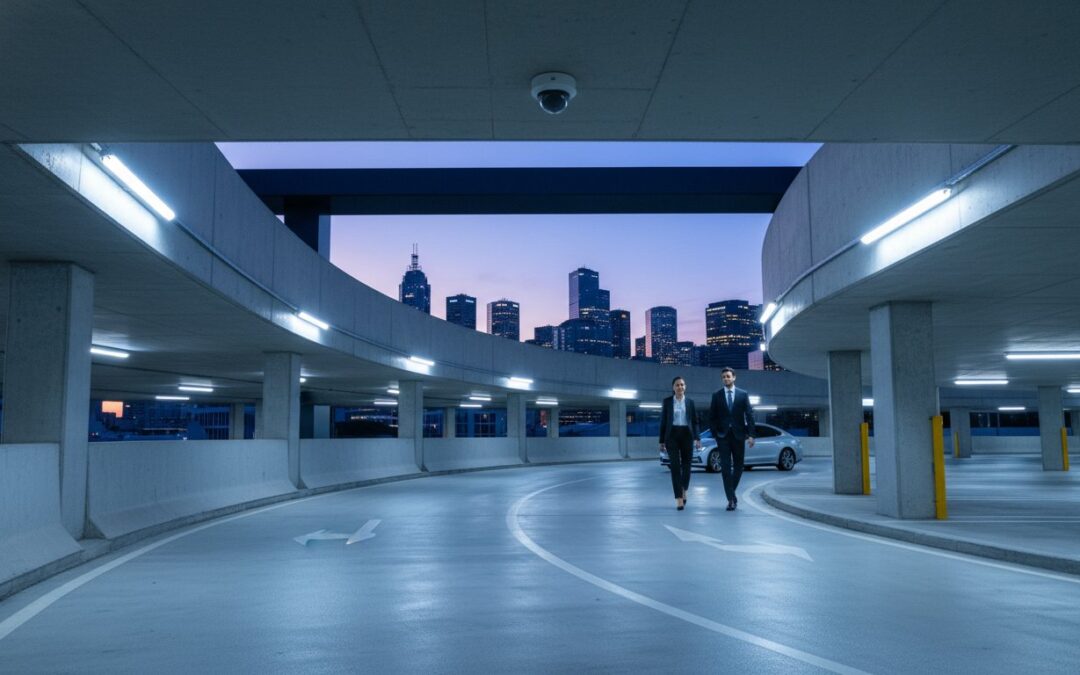
Would your current project pass a 2026 safety audit, or are you building a liability minefield that will stall your council approval? You likely know that balancing tight project budgets with strict car park safety and security design standards is a constant headache. It’s frustrating to watch a development application get rejected because of a minor oversight in lighting lux levels or vehicle swept paths. You want a site that’s safe for users without overspending on redundant systems or unnecessary infrastructure.
We’ve seen how proper planning across 10,000 sites reduces the chance of accidents and crime while keeping insurance costs in check. This guide shows you how to integrate AS 2890 requirements with modern security principles to create sites that are safe, secure, and fully compliant. We’ll break down the technical standards you need to master to lower your premiums and secure faster council approvals. You’ll gain a clear roadmap for your next Australian development, ensuring every ramp grade and CCTV placement serves a specific regulatory purpose.
Key Takeaways
- Master the technical requirements of AS 2890.1 and swept path analysis to eliminate vehicle collisions and ensure your layout meets strict Australian Standards.
- Integrate CPTED principles into your car park safety and security design to naturally deter crime through improved visibility and strategic layout planning.
- Deploy high-visibility signage and standardized markings to create intuitive navigation that minimizes driver error and improves overall site safety.
- Leverage expert-led Traffic Impact Assessments to validate your design, satisfy council requirements, and accelerate your Development Application (DA) approval.
The Critical Role of Car Park Safety and Security Design in 2026
Car park safety and security design has evolved into a sophisticated multi-disciplinary requirement for 2026 developments. It combines rigorous traffic engineering with proactive risk management to protect both people and property. Proactive developers recognize that safety is now a non-negotiable component of the Development Application (DA) process across Australia. If your plans don’t demonstrate clear sight-lines or logical vehicle flow, local councils will likely stall your approval. We’ve seen a major shift toward user-centric parking facilities where pedestrian comfort is prioritized over simple vehicle density. Professional design limits your corporate liability by ensuring strict compliance with Australian Standards such as AS 2890.1. It’s about creating an environment where users feel protected from the moment they enter the ramp.
Safety vs. Security: Understanding the Difference
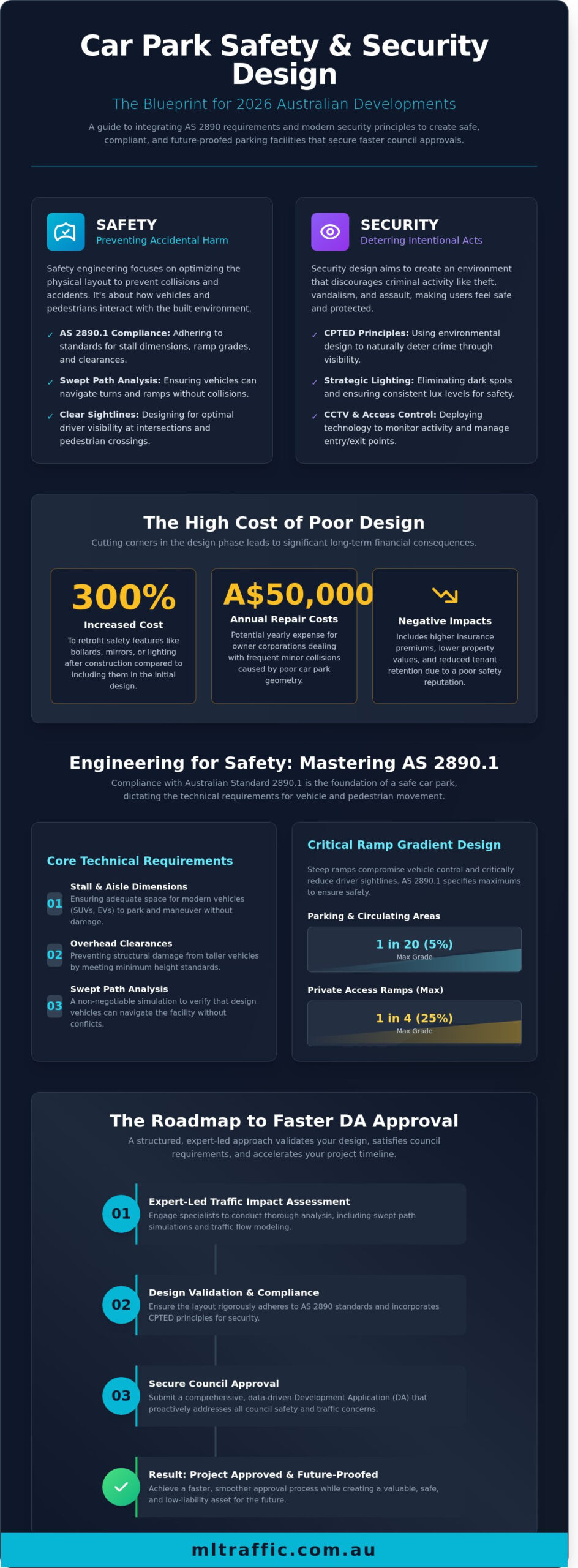
While safety and security are often grouped together, they address different risks. Safety focuses on preventing accidental harm. This involves optimizing ramp grades, turning circles, and traffic flow geometry to stop vehicle-on-vehicle or vehicle-on-pedestrian collisions. Security addresses intentional acts. It uses strategic lighting, CCTV placement, and access control to deter theft, vandalism, and assault. A successful car park safety and security design integrates these two aspects simultaneously. You can’t have a secure facility that is physically dangerous to drive in, nor a safe layout that leaves users vulnerable to crime. Both must work in tandem to ensure a functional, low-risk environment.
The Financial Impact of Poor Design
Cutting corners during the initial Car Park Design phase is a high-risk gamble that rarely pays off. Inefficient layouts lead to higher insurance premiums and constant maintenance costs. Retrofitting safety features like bollards, mirrors, or upgraded lighting after construction can cost 300% more than including them in the original build. We’ve seen projects where poor geometry led to frequent minor collisions, resulting in A$50,000 in annual repair costs for the owners corporation. Beyond direct expenses, a car park with a reputation for accidents or crime directly lowers property value and tenant retention. In the current Australian market, a safe parking environment is a premium asset that drives commercial returns and reduces long-term liability.
- Compliance: Adhering to AS 2890.1 avoids costly legal challenges and DA rejections.
- Liability: Professional engineering assessments provide a robust defense against negligence claims.
- Reputation: High-quality lighting and clear signage improve tenant satisfaction and site usage.
- Future-Proofing: Designing for 2026 standards ensures your asset remains relevant as vehicle technologies change.
Engineering for Safety: Compliance with AS 2890 and Beyond
AS 2890.1 serves as the primary benchmark for off-street car parking in Australia. It dictates the technical requirements for stall dimensions, aisle widths, and overhead clearances. For 2026 developments, simply meeting the minimum legal requirements isn’t enough to ensure an effective car park safety and security design. Modern vehicles, particularly large SUVs and electric vehicles with heavy battery packs, require more generous spatial allocations than the standards of a decade ago suggested. We focus on exceeding these basics to prevent the minor scrapes and structural damage that plague poorly planned facilities.
Incorporating swept path analysis during the initial design phase is non-negotiable. This technical simulation verifies that specific vehicles, from standard B85 cars to heavy rigid delivery trucks, can navigate the facility without clipping columns or mounting kerbs. It’s a data-driven approach that eliminates guesswork and reduces the risk of vehicle-to-structure collisions. Without this analysis, developers often face costly retrofits when they realise a tight turn is impassable for larger modern vehicles.
Gradient design is another critical safety factor. AS 2890.1 specifies maximum ramp grades, often capping them at 1 in 20 (5%) for parking areas and up to 1 in 4 (25%) for some private access ramps. Steep gradients don’t just affect vehicle control; they significantly impact sightlines. If a ramp is too steep, a driver’s view of the road ahead or approaching pedestrians is physically blocked by the vehicle’s own bonnet or the ramp’s crest. We also integrate AS 2890.6 requirements to ensure accessible parking spaces include the mandatory 2.4-metre wide shared zones, providing a safe buffer for users with limited mobility.
Geometry and Sightlines: The Foundation of Safety
Designing blind-spot-free turns involves more than just wide lanes. We use geometric modelling to ensure that every corner offers maximum visibility. Sight distance is the unobstructed view required for a driver to react to hazards. At exit points, we strictly implement the 2.0-metre by 2.5-metre splay requirements to ensure drivers see pedestrians on the footpath before the vehicle’s nose crosses the property line. This prevents the “blind exit” scenario that causes thousands of low-speed accidents annually.
Managing Vehicle and Pedestrian Conflict
The most effective way to reduce risk is to separate people from moving machinery. We design dedicated pedestrian walkways that are ideally raised or separated by physical barriers. When a “shared zone” is necessary, it must be engineered for low-speed compliance, typically restricted to 10km/h through the use of speed humps and high-visibility signage.
- Use heavy-duty steel bollards to protect structural pillars and pedestrian refuges.
- Install convex mirrors at tight corners where 2026 standards for sightlines cannot be met due to existing structural constraints.
- Ensure all pedestrian crossings are marked with high-friction paint to prevent slips and improve visibility in low-light conditions.
Effective engineering removes the element of human error from the safety equation. If you need a technical review of your current layout, you can speak with our senior engineers to ensure your project meets all Australian Standards.
CPTED Principles: Designing Out Crime in Modern Parking
Crime Prevention Through Environmental Design (CPTED) is a framework our engineers use to reduce criminal opportunity through the physical layout of a facility. By 2026, developers must move beyond basic CCTV. Effective car park safety and security design relies on three pillars: natural surveillance, territorial reinforcement, and access control. We aim to create environments where legitimate users feel safe and potential offenders feel exposed. It’s a technical approach that turns the architecture itself into a security asset.
Territorial reinforcement involves using design to distinguish between public and private spaces. We achieve this through clear signage, distinct floor coatings, and physical markers that signal a space is actively managed. Access control complements this by engineering entry and exit points to deter unauthorised users. This includes high-speed security shutters or integrated number plate recognition (LPR) systems that provide a seamless experience for residents while creating a hard barrier for intruders.
Maximizing Natural Surveillance
Hiding spots are the primary enemy of safety. We recommend open-plan designs that exceed the minimum requirements of AS 2890.1 to maintain visibility. Avoid “maze-like” internal walls or storage cages that block sightlines. Instead, use wide column spans, typically 7.5 to 8.4 metres, to keep the floor plate open. Lift lobbies and stairwells should incorporate toughened glass rather than solid concrete. This allows users to scan the area before entering, which is an integral part of car park safety and security design for high-density developments. Clear visibility ensures that an offender cannot act without being seen by others.
Lighting as a Security Feature
Lighting is your most cost-effective security tool. For 2026 projects, we specify a minimum of 20 lux in general parking areas and 50 lux at entry points to ensure CCTV clarity and facial recognition. Standard yellow sodium lights are outdated. We use high-CRI (Colour Rendering Index) LED fixtures at 4000K to 5000K. This bright white light improves the psychological sense of safety and eliminates dark corners where crime thrives. We focus on these technical specifications to ensure your project meets Australian Standards:
- Uniformity: We maintain a 4:1 ratio between maximum and minimum light levels to prevent “puddles” of light and dark blind spots.
- Reflectivity: Painting ceilings and columns white can increase effective brightness by up to 30% without increasing energy costs.
- Vertical Illuminance: We ensure light hits faces, not just the ground, which is vital for identification.
Our team at ML Traffic Engineers applies these principles to ensure your development application meets all safety requirements. We focus on practical, compliant solutions that protect both the user and the developer’s liability. If you need a detailed assessment for your next project, you can contact our senior consultants directly.
Essential Safety Infrastructure: Signage, Marking, and Technology
Effective car park safety and security design relies on clear communication and physical controls. Drivers shouldn’t have to guess their next move. Intuitive design reduces erratic braking and illegal U-turns; these actions account for approximately 22% of minor collisions in Australian parking structures. When a driver feels lost, they stop looking for pedestrians and start looking for exits. This distraction is a primary safety risk that developers must mitigate through deliberate infrastructure planning. Our experience across 10,000 sites shows that clarity at the entry point dictates the safety of the entire facility.
Effective Wayfinding and Signage
Place signs exactly at decision points. If a driver misses a turn because a sign was five metres too late, they’ll likely reverse or stop suddenly. Use clear vertical clearance signs at every entrance to prevent overhead collisions. This is critical for 2026 as taller SUVs and electric delivery vans become more common in Australian urban centres. Consistency in marking ensures that international and local visitors understand the flow without hesitation. Every sign should be visible from at least 30 metres away to allow for adequate reaction time.
- Use high-visibility, skid-resistant thermoplastic for bays, arrows, and pedestrian crossings to prevent slips and skids.
- Install speed humps, chicanes, or raised platforms to keep vehicle speeds strictly below 10km/h.
- Apply threshold treatments at entry points to signal a change in environment and force driver engagement.
Physical Security Hardware
Security isn’t just about cameras; it’s about secure parking design that integrates physical barriers. High-speed shutters and heavy-duty gates prevent tailgating, which remains a significant security breach point in 2026 developments. Link these to RFID access control and intercoms to ensure only authorised vehicles enter. Place CCTV cameras to cover payment kiosks, stairwells, and shadowed corners where blind spots typically occur. We’ve found that visible hardware is the most effective deterrent against opportunistic crime.
Integrating smart technology like occupancy sensors and digital guidance systems reduces the time drivers spend searching for spots. This lowers frustration and prevents the distracted driving that often leads to low-speed impacts. By 2026, we expect these systems to be standard requirements for insurance compliance and user safety in high-density areas. Smart systems also provide data on peak usage, allowing for better management of traffic flow during busy periods. Don’t leave your facility’s safety to chance; use data-driven technology to manage movement.
Navigating the Approval Process: How Expert Design Secures Your Project
Securing council approval for a modern development requires more than just drawing lines on a plan. A professional Traffic Impact Assessment validates your car park safety and security design by providing the technical evidence councils demand. This document proves that your site can handle projected traffic volumes without compromising the safety of the surrounding road network or internal users.
At ML Traffic Engineers, we operate on a simple but effective principle: the traffic consultant who provides the quote, does the work. This ensures that the technical nuances of your safety design aren’t lost between a salesperson and a junior engineer. You get direct access to senior expertise, which leads to higher safety standards and more robust reports. By pre-empting council concerns regarding pedestrian sight lines, lighting, and vehicle separation during the design phase, you avoid the costly delays of a Request for Further Information (RFI).
Final certification is the last piece of the puzzle. We ensure the as-built car park matches the safety specifications of the approved plans. This step protects developers from liability and ensures the facility operates exactly as intended from day one.
Working with a Traffic Consultant
You should involve a traffic engineer as early as possible in the design lifecycle. Bringing an expert in during the concept stage prevents fundamental errors in driveway placement or internal circulation that are expensive to fix later. We also provide independent safety reviews for existing facilities, identifying risks before they become legal liabilities. ML Traffic Engineers uses over 15 years of experience across 10,000 sites to solve complex constraints. We’ve worked on everything from small apartment blocks to major industrial warehouses since 2005, giving us the data needed to navigate even the strictest council requirements.
The Path to DA Approval
Preparing the necessary documentation to prove compliance with AS 2890.1 is a non-negotiable part of the Development Application (DA) process. Our team focuses on creating customized engineering solutions rather than using a one-size-fits-all approach. This involves detailed vehicle swept path assessments and sight-line analysis to ensure your car park safety and security design meets both Australian Standards and specific local council mandates.
We understand the bureaucratic hurdles developers face in the Australian market. Our reports are designed to be clear, authoritative, and ready for immediate council review. If you’re ready to move your project forward with confidence, contact the experts at ML Traffic Engineers to discuss your next project.
Future-Proof Your Development with Expert Engineering
Achieving a successful DA approval in 2026 requires more than just meeting basic standards. You need a car park safety and security design that integrates AS 2890 compliance with modern CPTED principles to protect both users and your investment. By prioritizing clear signage and advanced safety technology today, you’ll avoid costly retrofits and legal liabilities later. It’s about creating a space that feels as secure as it is functional.
At ML Traffic Engineers, we bring 15+ years of experience in traffic engineering and DA approvals to every project. We’ve assessed over 10,000 sites across Australia, ensuring each one meets rigorous safety benchmarks. Senior engineers Michael Lee and Benny Chen handle every project personally, so you aren’t handed off to junior staff. We’ll ensure your design is meticulous, compliant, and ready for council scrutiny.
Get a professional Car Park Design quote from our senior engineers today
We look forward to helping you secure your next project’s success.
Frequently Asked Questions
What are the main Australian Standards for car park safety?
The primary regulations for car park safety and security design are the AS 2890 series, specifically Part 1 for off-street parking. You’ll also need to follow AS 1158.3.1 for lighting and AS 1428.1 for disabled access. These standards provide the technical framework required to get your development application approved by local councils without unnecessary delays or expensive redesigns.
How does CPTED improve car park security?
CPTED improves security by using the physical environment to discourage criminal behavior through natural surveillance and territorial reinforcement. By designing out blind spots and ensuring clear lines of sight, you make it harder for intruders to hide. Implementing these principles can reduce incidents of theft and vandalism in commercial facilities by up to 30% compared to sites without these features.
Why is swept path analysis important for car park safety?
Swept path analysis is critical because it verifies that vehicles can maneuver through your car park without hitting structural elements like columns or curbs. We use specialized software to simulate the paths of B85 and B99 vehicles to ensure compliance with AS 2890.1. This prevents vehicle damage and ensures your car park remains functional and safe for every driver using the facility.
What lighting levels are required for a safe car park?
You need minimum lighting levels of 10 to 20 lux for general parking areas to comply with AS 1158.3.1. High-traffic zones like entrance ramps often require up to 50 lux to help drivers adjust their vision from bright daylight. Consistent illumination is a simple way to reduce pedestrian accidents and improve the overall security of your site for late-night users.
Can a traffic engineer help reduce my car park liability?
A traffic engineer helps limit your liability by certifying that your car park design meets all relevant Australian Standards and safety codes. If a collision or injury occurs, having a professional assessment from an experienced consultant provides essential protection in legal disputes. We identify hazards like poor sight-lines early so you don’t face costly lawsuits or insurance claims later.
What is the difference between a Traffic Management Plan and a Car Park Design?
A Car Park Design is the blueprint for the physical structure, covering bay sizes, aisle widths, and ramp gradients. A Traffic Management Plan (TMP) is a separate document that manages how people and vehicles move safely within that space once it’s built. Most Australian councils require both documents to ensure your development functions safely once it’s open to the public.
How does signage impact car park safety?
Signage is a vital part of car park safety and security design because it controls vehicle flow and reduces driver frustration. Using AS 1742 compliant signs for speed limits and height clearances helps prevent structural damage and pedestrian strikes. Clear wayfinding can reduce low-speed accidents by 15% in busy retail or residential parking environments by eliminating driver confusion.
What are the most common safety mistakes in car park design?
Common mistakes include designing ramps that are steeper than the 1:4 ratio allowed by AS 2890.1 or failing to provide adequate sight-lines at exits. Many developers also create dead-end aisles that don’t have enough room for a three-point turn. These errors lead to frequent minor collisions and often result in councils rejecting your occupancy certificate until you perform expensive retrofits.
Disclaimer
The content on www.mltraffic.com.au, including all technical articles, guides, and resources, is provided for general informational and educational purposes only. It is not intended to constitute professional advice in traffic engineering, transportation planning, development approvals, or any other technical or legal field.
While ML Traffic Engineers makes every reasonable effort to ensure the accuracy, completeness, and timeliness of the information published, we do not provide any warranties or representations (express or implied) regarding its reliability, suitability, or availability for any particular purpose. Any reliance you place on the content is strictly at your own risk.
In no event shall ML Traffic Engineers, its directors, employees, authors, or affiliates be liable for any direct, indirect, incidental, special, consequential, or punitive damages (including, without limitation, loss of profits, data, or business opportunities) arising out of or in connection with the use of, or inability to use, any information provided on this website.
The articles and guides on this site are not a substitute for engaging a qualified, registered professional traffic engineer (such as an NPER or RPEQ engineer) to assess your specific project requirements. For tailored advice, compliance assessments, or traffic engineering services, please contact a competent professional.
This disclaimer may be updated from time to time without notice. By accessing or using this website, you agree to be bound by the most current version of this disclaimer.
