
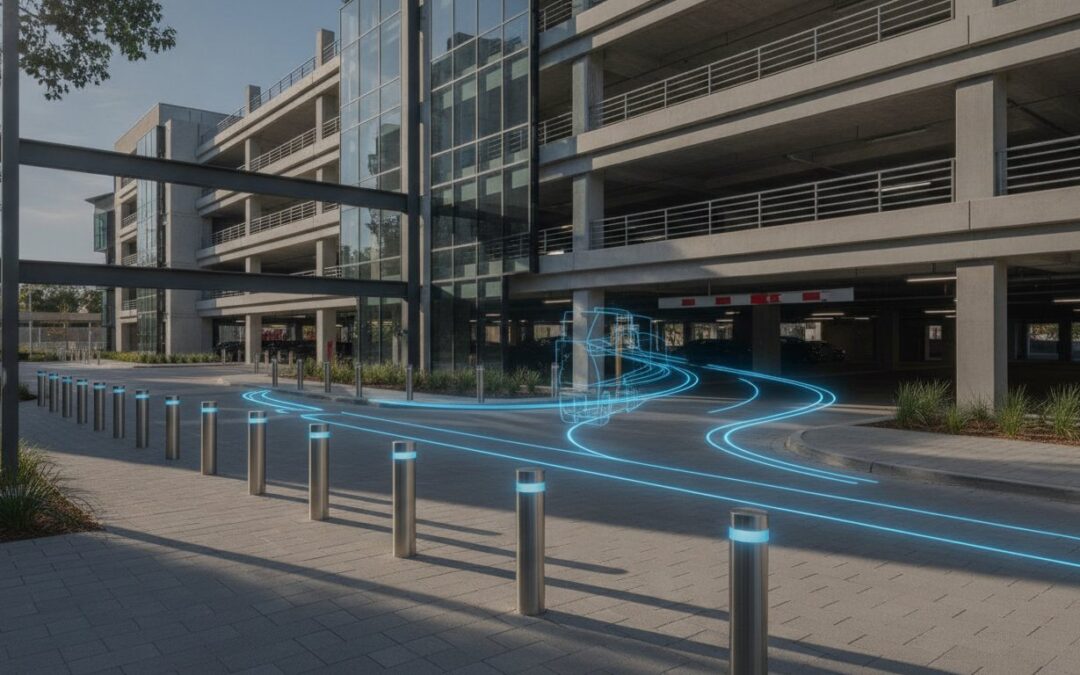
Simply meeting the minimum AS 2890.1 car park design requirements is no longer enough to guarantee development approval for high-traffic Australian precincts. With the 2026 updates to standards mandating larger 5.6-metre parking bays, a basic compliance checklist often fails to account for modern security threats. You likely recognise the difficulty of balancing maximum parking yield with the technicalities of civil design, only to face a DA rejection because security bollard placement wasn’t integrated into your initial swept path modelling. It’s a common frustration when standard safety measures do not satisfy the counter-terrorism obligations required for modern urban infrastructure.
This article will teach you how to bridge the gap between standard AS 2890 compliance and advanced Hostile Vehicle Mitigation (HVM) to secure your development approval. We provide a technical breakdown of IWA 14-1 and the new ISO 22343-1:2023 standards, explaining how to implement security hardware without compromising vehicle movement or council certification. You’ll gain a clear understanding of how to satisfy both safety and security standards through meticulous design. This ensures your project moves through the planning phase without the need for expensive technical rework or redesigns.
Key Takeaways
- Understand why modern Australian developments require a dual-layer strategy that balances operational safety with robust Hostile Vehicle Mitigation (HVM).
- Ensure your project meets the latest AS 2890.1 car park design requirements while integrating international security standards such as IWA 14-1 and ISO 22343.
- Evaluate the benefits of passive versus active mitigation hardware to maintain parking yield without compromising structural security.
- Identify the critical steps in a site-specific risk assessment, including the determination of required stand-off distances for effective asset protection.
- Use expert Traffic Impact Assessments (TIA) and Swept Path Analysis to justify security-driven design choices and secure Council approval without technical rework.
Beyond the Basics: Defining Car Park Safety in the Modern Australian Context
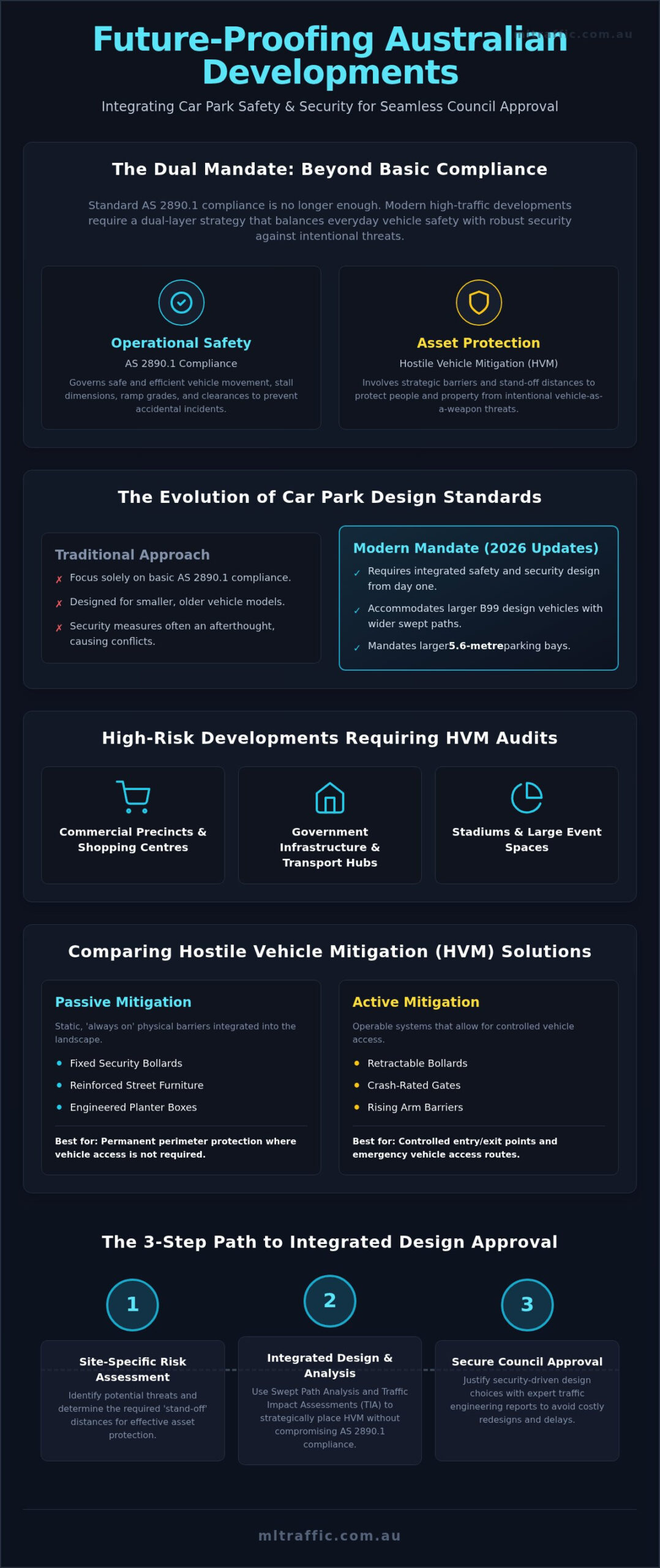
Modern Australian car park design has moved beyond simple stall dimensions and ramp grades. While meeting the technical AS 2890.1 car park design requirements remains the legal baseline, developers of high-profile precincts must now address a dual-layer safety concept. This involves integrating operational safety, governed by the Australian Standards, with robust asset protection through Hostile Vehicle Mitigation (HVM). Relying solely on standard compliance often leads to DA rejections in the current planning environment, as councils increasingly demand security measures that protect high-pedestrian zones within commercial centres. A failure to account for these security layers early in the design phase can result in costly redesigns when the security bollard placement interferes with required vehicle swept paths.
To better understand how these standards apply to your project, watch this helpful video:
The Evolution of Safety Design Standards
The shift towards larger B99 design vehicles, as outlined in the 2021 and 2026 updates to the standards, has direct implications for security barrier placement. These larger vehicles require wider swept paths and increased turning radii, which complicates the positioning of heavy-duty bollards or reinforced street furniture. In 2026, HVM in Australian civil engineering is defined as the strategic integration of physical barriers and landscape elements designed to prevent, decelerate, or stop a vehicle being used as a weapon. This marks a significant move from protecting against “accidental impact” to mitigating “intentional threats” in public spaces. Designers must now ensure that security hardware doesn’t impede the movement of the very vehicles the car park is intended to serve.
Identifying High-Risk Development Categories
Certain development categories now face mandatory security audits as part of their specialist traffic engineering services. Commercial precincts and shopping centres with major public assembly areas are primary targets for these requirements due to the high density of pedestrians. Government infrastructure and transport hubs require integrated safety reports that detail how commuters are shielded from vehicle-ramming risks at entry points. Stadiums and large event spaces must treat HVM as a non-negotiable DA condition. In these environments, the traffic engineer’s role is to verify that the AS 2890.1 car park design requirements are met without obstructing emergency vehicle access or creating bottlenecks that compromise pedestrian evacuation routes.
Navigating Regulatory Frameworks: AS 2890 and HVM Integration
Successful car park design requires a clear understanding of the hierarchy between standard safety regulations and security frameworks. AS 2890.1 governs off-street parking for light vehicles, while AS 2890.2 handles the specific requirements for commercial vehicle facilities. To achieve full AS 2890.1 car park compliance, developers must now integrate these rules with HVM-specific frameworks recognised in Australia, such as PAS 68, IWA 14-1, and the recently adopted ISO 22343. Security bollards and barriers must respect the “clearance zones” mandated by Australian Standards. If security hardware encroaches on these zones, it creates a traffic hazard, potentially leading to project delays or liability issues. A traffic engineer’s role is to certify that security hardware provides protection without compromising the functional safety of the vehicle environment.
AS 2890.1 vs. Hostile Vehicle Mitigation Standards
The primary conflict in modern design often stems from the physical footprint of security hardware. While AS 2890.1 car park design requirements dictate precise stall widths, heavy-duty anti-ram bollards require significant space for both their surface diameter and subterranean foundations. If these are placed without professional oversight, they can easily obstruct the swept paths required for B99 vehicles. Engineers must also verify that HVM equipment doesn’t block critical sight lines for drivers. This is especially vital near accessible parking spaces governed by AS 2890.6, where clear paths of travel for pedestrians with mobility aids must be maintained alongside security perimeters. Meticulous modelling ensures that a security barrier doesn’t become an operational bottleneck.
Regulatory Compliance and Council Expectations
Australian councils are increasingly prioritising public safety by requesting formal HVM plans during the Development Application (DA) phase. It’s no longer enough to add security as an afterthought. You must integrate these security design choices directly into your Traffic Impact Assessment (TIA) report to justify how they affect traffic flow and parking yield. This documentation proves to assessors that the AS 2890.1 car park design requirements are met despite the inclusion of heavy-duty security infrastructure. Our senior principals perform the technical audits for every project to ensure this integration is seamless. If you are preparing a DA for a high-risk precinct, you can Learn more about our TIA services to see how we assist in navigating these complex council expectations.
Comparing Hostile Vehicle Mitigation (HVM) Solutions: Passive vs. Active
Selecting the correct Hostile Vehicle Mitigation (HVM) hardware requires a precise balance between security efficacy and operational efficiency. We categorise these solutions into two primary types: passive and active. Passive mitigation involves fixed, non-moving elements that provide constant protection. Active mitigation includes mechanical systems that can be lowered or retracted to allow authorised vehicle access. Crime Prevention Through Environmental Design (CPTED) principles influence these layouts by ensuring security measures don’t create hidden pockets or reduce natural surveillance. A cost-benefit analysis usually reveals that while active systems have higher capital and maintenance costs, they are indispensable for industrial sites or government hubs with high vehicle throughput. Conversely, commercial developments often favour passive measures to reduce long-term operational expenditure.
Passive Mitigation: Security Through Design
Passive solutions are the foundation of most urban car park designs. We often utilise heavy-duty planters, reinforced walls, and structural landscaping as “hidden” security features that blend into the architectural fabric. This approach maintains the aesthetic appeal of a precinct while providing robust protection against vehicle-ramming threats. In basement environments, slab depth is a primary engineering constraint. Standard deep-set bollards are often unsuitable because they require deep excavations that can compromise the structural integrity of the floor. Shallow-mount bollards are the professional alternative, requiring minimal depth while maintaining high impact ratings. Because these elements are permanent, they must be positioned meticulously during the initial audit of AS 2890.1 car park design requirements to ensure they don’t obstruct vehicle swept paths.
Active Mitigation: Controlling Site Access
Active mitigation provides the flexibility needed for sites that must distinguish between authorised and unauthorised vehicles. Rising bollards, wedge barriers, and gated access centres allow for seamless entry for staff or deliveries while maintaining a hard perimeter. However, these systems have a direct impact on traffic flow. If the deployment speed or cycle time of a rising bollard is too slow, it can cause significant queuing on public roads, which may lead to a breach of council DA conditions. We integrate these systems with Parking Control Management to ensure authorised users experience minimal delay. It is also a mandatory requirement for Australian fire and rescue services to have emergency override capabilities. All active barriers must be designed to fail-safe or provide immediate access for emergency responders during a critical incident. Proper integration ensures that AS 2890.1 car park design requirements are met without creating operational bottlenecks at the site entry.
Implementation Guide: Integrating HVM into Your Car Park Design
Integrating security hardware into a functional traffic environment requires a systematic approach. You cannot simply place bollards at an entrance and expect the design to remain compliant. The implementation process must follow these five technical steps to ensure your project satisfies both security objectives and AS 2890.1 car park design requirements:
- Step 1: Conduct a site-specific risk assessment. Identify the likely vehicle threats and approach speeds to determine the required impact rating for your hardware.
- Step 2: Determine the “stand-off” distance. Establish the necessary gap between the mitigation barrier and the protected asset or pedestrian zone to account for vehicle penetration depth upon impact.
- Step 3: Overlay HVM hardware onto compliant layouts. Map your bollards or barriers against the standard stall dimensions, ensuring they don’t encroach on the updated 5.6-metre bay lengths or mandatory aisle widths.
- Step 4: Perform Swept Path Analysis. Use technical modelling to verify that the physical presence of HVM hardware doesn’t create operational hazards or bottlenecks.
- Step 5: Finalise the Traffic Management Plan (TMP). Document the security protocols and emergency override procedures for council review.
The Critical Role of Swept Path Analysis in Security
Security chicanes and tight entry perimeters are effective at slowing down hostile vehicles, but they often become impassable for legitimate service vehicles. We use AutoTURN software to simulate the movement of B99 vehicles and heavy rigid vehicles (AS 2890.2) through these restricted spaces. If a bollard is placed even a few centimetres out of alignment, it can impede the turning circle of a modern SUV or delivery truck. This leads to property damage and traffic congestion. You must verify that your security design allows for “first-time” turn success without requiring complex multi-point manoeuvres. For a deeper look at this process, Read our definitive guide to swept path analysis.
Aesthetics vs. Functionality
Modern HVM design shouldn’t make a commercial precinct look like a fortress. We select materials and hardware that blend into the urban centre environment, such as reinforced seating, heavy-duty planters, or architecturally finished bollards. These elements must meet high durability standards while allowing for efficient pedestrian flow through security perimeters. Poorly planned barriers often create “pinch points” that frustrate commuters and create safety risks during emergency evacuations. Meticulous planning ensures that your AS 2890.1 car park design requirements are met while maintaining the visual and functional integrity of the development. If you need a technical audit of your current site plan, contact our senior principals directly to ensure your security integration is both compliant and efficient.
Securing Approval: The Role of Expert Traffic Engineering
A traffic engineer provides the final technical certification required to prove that security-driven design choices don’t compromise the safety of the vehicle environment. For high-risk developments, this involves a formal attestation that HVM hardware is strategically positioned to meet both anti-terrorism objectives and AS 2890.1 car park design requirements. Councils rarely approve complex security layouts without a professional audit that accounts for vehicle swept paths, pedestrian sight lines, and emergency access. By engaging a specialist consultant, you ensure that every bollard and barrier is justified within the broader traffic framework. This technical oversight is essential for navigating the bureaucratic requirements of modern Development Applications (DAs).
The Traffic Impact Assessment (TIA) as a Compliance Tool
A Traffic Impact Assessment (TIA) Report serves as the primary document for communicating HVM strategies to Council planners. We use the TIA to detail how security checkpoints or chicanes will affect the local road network, specifically addressing potential traffic congestion. If a security-driven layout reduces the efficiency of vehicle entry, the TIA must provide a technical solution to mitigate queuing. This documentation proves that the development remains functional under peak load. For a comprehensive look at how these reports facilitate project success, Traffic Impact Assessment: A Guide for Developers offers a detailed technical breakdown of the process.
Why Technical Precision Prevents Costly Rework
The financial risk of non-compliant HVM installation in 2026 is substantial. If a security barrier is installed without verifying it against the updated 5.6-metre bay lengths, the entire car park may require expensive structural remediation. We eliminate this risk through our “no-gatekeepers” approach. This ensures that the senior principal who initiates your project is the same expert performing the technical work and swept path audits. This professional continuity distinguishes our consultancy from larger firms where junior staff often handle complex modelling. ML Traffic Engineers Australia maintains a 100% compliance record across national projects by ensuring that every design is meticulously checked against current Australian Standards. This results-oriented methodology provides the reliability needed for successful DA approval without the need for technical rework or redundant consultancy fees. You can speak with our senior team directly by visiting our contact page to discuss your specific site requirements.
Securing Your Development Approval with Integrated Design
Achieving a compliant car park design requires more than a basic understanding of stall dimensions. You must integrate the latest AS 2890.1 car park design requirements with robust Hostile Vehicle Mitigation (HVM) frameworks to satisfy modern council expectations. This dual-layer approach ensures that your development provides operational safety while maintaining a hard perimeter against vehicle-ramming threats. Meticulous technical precision through Swept Path Analysis is the only way to verify that security hardware doesn’t create traffic hazards or operational bottlenecks. Failing to account for these variables early in the design phase often leads to costly redesigns and delayed approvals.
With over 15 years of specialist traffic engineering experience, our team provides the technical audits and Traffic Impact Assessments needed for complex national projects. You receive direct access to senior principals who perform the technical work, ensuring professional continuity from the initial concept to final DA approval. We specialise in bridging the gap between standard compliance and advanced security infrastructure. Contact our senior traffic engineers today for a compliant car park design that meets all Australian safety and security benchmarks. We look forward to assisting you in securing a successful and efficient outcome for your next development project.
Frequently Asked Questions
What is Hostile Vehicle Mitigation (HVM) in car park design?
HVM refers to a suite of physical and operational measures designed to prevent, decelerate, or stop a vehicle being used as a weapon. In car park design, this includes the strategic placement of crash-rated bollards, reinforced planters, and active barriers to protect high-pedestrian zones. These measures ensure that the site remains secure against vehicle-ramming attacks while still allowing for the functional movement of legitimate vehicles and pedestrians through the precinct.
Does AS 2890.1 cover anti-terrorism and security measures?
No, AS 2890.1 primarily focuses on operational safety, stall dimensions, and ramp grades. While it ensures a car park is safe for daily use, it does not mandate specific anti-terrorism or HVM protocols. Developers must look to separate frameworks such as IWA 14-1 or the new ISO 22343-1:2023 to address security. Integrating these security layers requires careful planning to ensure you still meet all AS 2890.1 car park design requirements without conflict.
How do I know if my development requires HVM design?
Requirement for HVM design is typically determined through a site-specific risk assessment or as a mandatory condition of your Development Application (DA). High-risk categories usually include shopping centres, transport hubs, stadiums, and government infrastructure. Councils frequently request these measures for projects located in areas of high public assembly. A professional traffic engineer can conduct a security audit to determine if your specific land-use type necessitates integrated vehicle mitigation hardware.
Can I use standard bollards for anti-terrorism protection?
Standard safety bollards are generally insufficient for anti-terrorism protection because they lack the required impact ratings to stop a heavy vehicle at speed. True HVM bollards are engineered and crash-tested to international standards like PAS 68 or IWA 14-1. These specialised bollards often require deeper foundations or shallow-mount technology to dissipate the energy of a deliberate impact. Using non-rated hardware may lead to DA rejection if the site is classified as a high-risk precinct.
How does HVM affect vehicle swept path analysis?
HVM hardware can significantly restrict the available manoeuvring space within a car park entry or aisle. Because security bollards are often larger and positioned at critical pinch points, they can impede the turning circles of B99 vehicles or delivery trucks. We perform a detailed Vehicle Swept Path Analysis using AutoTURN to ensure that all security barriers are placed in locations that don’t cause property damage or traffic bottlenecks. This step is vital for maintaining functional flow.
What are PAS 68 and IWA 14-1 standards in Australia?
PAS 68 and IWA 14-1 are international crash-test specifications used in Australia to certify the performance of HVM equipment. PAS 68 is a UK standard, while IWA 14-1 is an international agreement that provides a common language for impact testing. These standards define the vehicle weight, impact speed, and penetration distance a barrier can withstand. In 2026, the industry is also adopting ISO 22343-1:2023 as a comprehensive global benchmark for vehicle security barriers.
Will HVM measures reduce the number of parking spaces in my design?
Poorly planned security integration can reduce parking yield, but meticulous engineering minimises this impact. The physical footprint of heavy-duty bollards and their foundations must be mapped against the updated 5.6-metre bay lengths required in modern designs. By using shallow-mount technology or integrating barriers into existing structural elements, we can often maintain compliance with AS 2890.1 car park design requirements while preserving the maximum number of parking spaces for the developer.
How do I integrate security barriers without creating traffic congestion?
Integration without congestion requires a Traffic Impact Assessment (TIA) that models vehicle arrival rates against the cycle times of active security barriers. If rising bollards or gates operate too slowly, they cause queuing on public roads. We design security perimeters with sufficient stand-off distances and queuing lanes to prevent bottlenecks. Proper placement ensures that security checks don’t interfere with the functional entry and exit speeds required by local road authorities.

Disclaimer
The content on www.mltraffic.com.au, including all technical articles, guides, and resources, is provided for general informational and educational purposes only. It is not intended to constitute professional advice in traffic engineering, transportation planning, development approvals, or any other technical or legal field.
While ML Traffic Engineers makes every reasonable effort to ensure the accuracy, completeness, and timeliness of the information published, we do not provide any warranties or representations (express or implied) regarding its reliability, suitability, or availability for any particular purpose. Any reliance you place on the content is strictly at your own risk.
In no event shall ML Traffic Engineers, its directors, employees, authors, or affiliates be liable for any direct, indirect, incidental, special, consequential, or punitive damages (including, without limitation, loss of profits, data, or business opportunities) arising out of or in connection with the use of, or inability to use, any information provided on this website.
The articles and guides on this site are not a substitute for engaging a qualified, registered professional traffic engineer (such as an NPER or RPEQ engineer) to assess your specific project requirements. For tailored advice, compliance assessments, or traffic engineering services, please contact a competent professional.
This disclaimer may be updated from time to time without notice. By accessing or using this website, you agree to be bound by the most current version of this disclaimer.
