
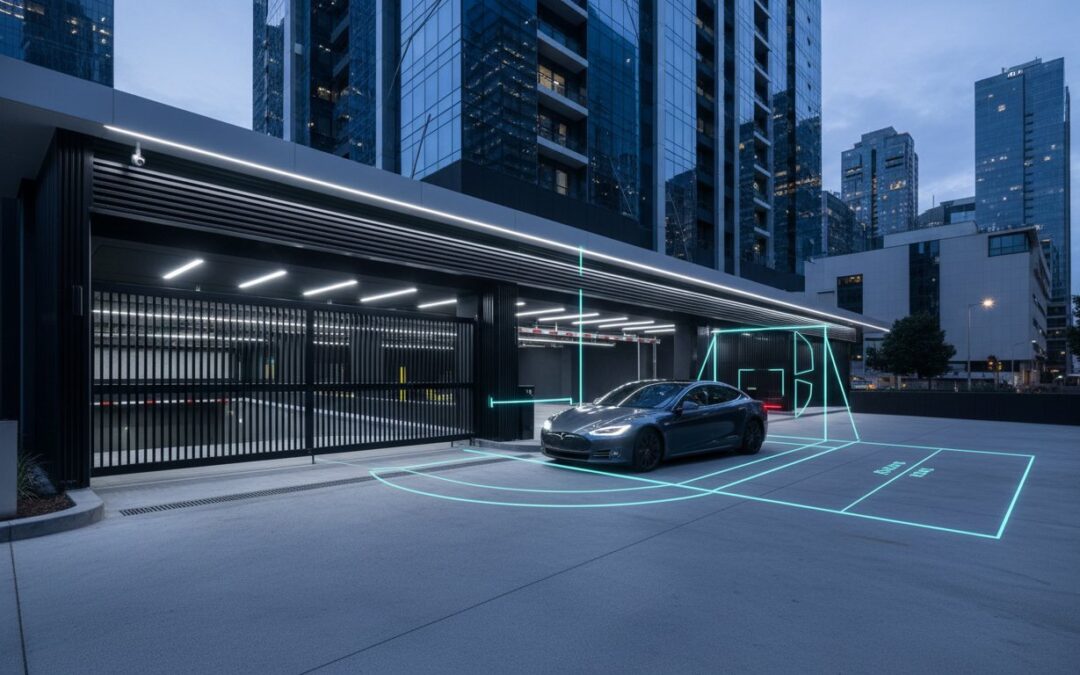
A car park security gate is the single most common point of failure in a Development Application (DA), yet it’s frequently treated as a minor detail during the initial planning phase. You likely recognize that a gate is far more than a simple barrier; it’s a technical bottleneck that can either facilitate or frustrate site access. When queuing space is insufficient or gate speeds are miscalculated, vehicles inevitably back up onto public roads, leading to immediate council rejection and potential safety hazards.
This guide provides the engineering framework for car park security gate design that ensures your project remains fully compliant with AS 2890.1. Drawing on experience from over 10,000 sites, we’ll demonstrate how to balance site security with efficient vehicle throughput, using data-driven methods to eliminate common errors like poor swept path planning. You’ll learn the specific technical requirements for queuing areas and gate selection that keep your project on track and your site secure.
Key Takeaways
- Effective car park security gate design requires a strategic balance between robust site security and maintaining efficient traffic flow.
- Understand how to select optimal gate mechanisms by evaluating spatial constraints, required opening speeds, and driveway ramp grades.
- Avoid costly construction redesigns by ensuring your access barriers meet the mandatory requirements of Australian Standard AS 2890.1.
- Learn how queuing analysis and swept path assessments are used to verify vehicle clearance and prevent traffic congestion at your site’s entrance.
- Discover the advantages of a hands-on engineering model where senior consultants manage your car park design from initial quote to final delivery.
Table of Contents
- What is Car Park Security Gate Design?
- Comparing Security Gate Mechanisms for Car Parks
- Compliance with AS 2890.1 and Australian Standards
- Practical Design Considerations: Queuing and Access
- Expert Engineering for Car Park Access Solutions
What is Car Park Security Gate Design?
Car park security gate design is the strategic selection and spatial arrangement of physical barriers used to regulate vehicle entry and exit. It involves more than just hardware. It requires a detailed assessment of site geometry, anticipated traffic volumes, and compliance with Australian Standards, specifically AS 2890.1. Effective design ensures that unauthorized vehicles stay out while residents, staff, or customers move through the facility without delay.
To better understand this concept, watch this helpful video:
The design process integrates three critical elements: the gate mechanism, the access control technology, and the physical setback from the property boundary. Choosing between boom barrier gate mechanisms, sliding gates, or high-speed bi-fold doors depends on the available space and the required security level. Poorly planned designs create bottlenecks that force vehicles to idle on public footpaths or roads, creating safety hazards and liability issues. This often results in expensive retrofitting costs if the initial installation doesn’t meet local traffic requirements.
The Role of Gate Design in Development Applications
Councils scrutinize car park security gate design during the Development Application (DA) process to prevent traffic congestion on public infrastructure. If a gate’s positioned too close to the street, a single vehicle waiting for the mechanism to open can block the public right-of-way. This is why a traffic engineering perspective is vital during the early design phase. We calculate the required queue length based on expected arrival rates to ensure the site remains compliant. A slow gate operation speed or inadequate storage space for waiting vehicles can lead to council refusal if the resulting traffic tailback disrupts local road safety or pedestrian movement.
Security vs. Operational Efficiency
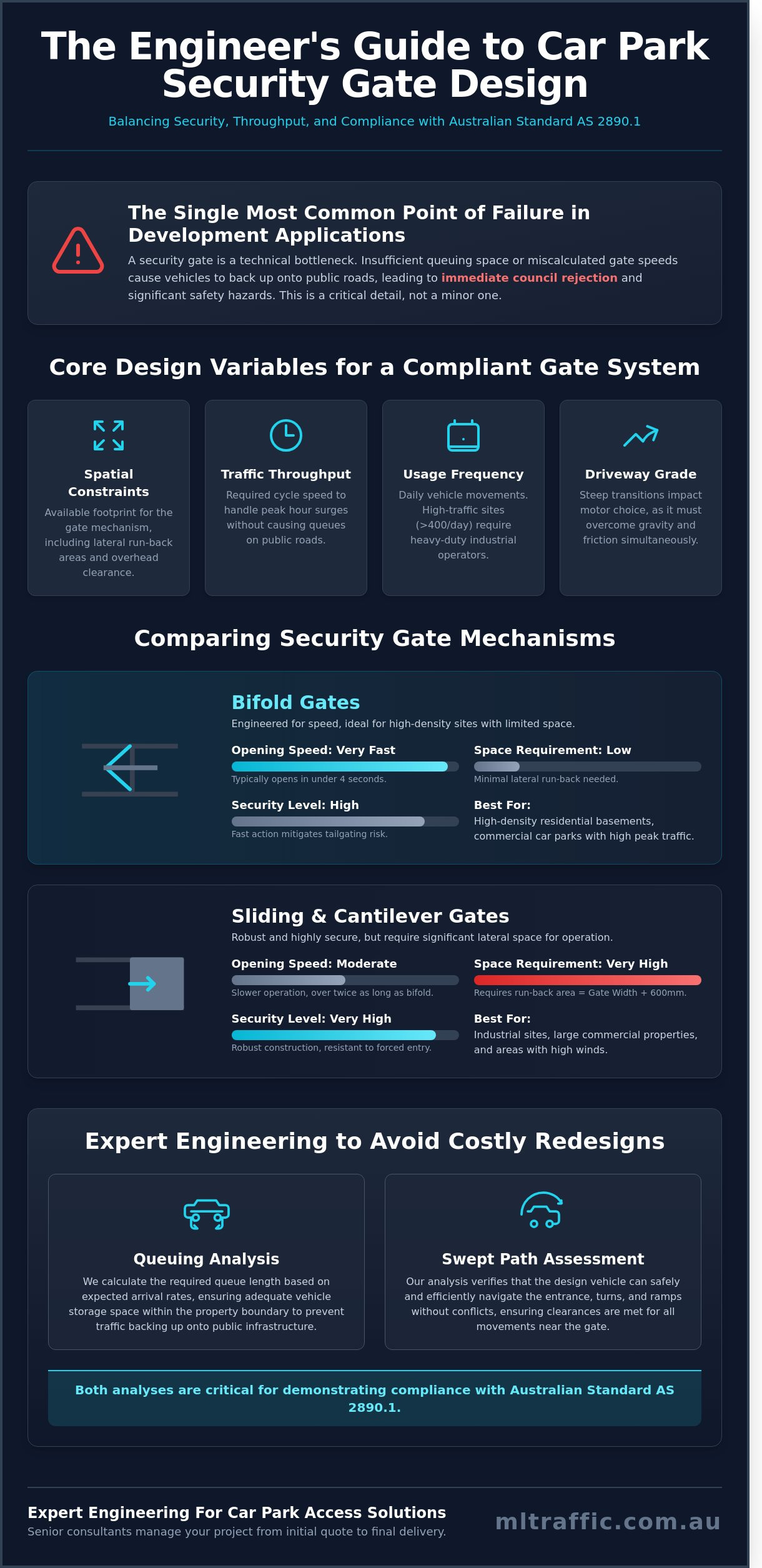
Balancing high-level security with throughput is a common challenge in Australian developments. High-security gates, like heavy sliding doors, often operate slower than lightweight barriers. If your facility experiences peak hour surges, such as an office car park at 8:30 AM, a slow gate will fail. We identify these peak demands before recommending a specific mechanism. Designers must also address the risk of tailgating, where a second vehicle follows an authorized one through an open gate. Using fast-acting bi-fold gates with operation speeds under 4 seconds or secondary induction loops can mitigate this risk without stopping legitimate traffic flow. It’s about finding the point where the site is secure but doesn’t become a source of frustration for users.
Comparing Security Gate Mechanisms for Car Parks
Selecting a specific mechanism for car park security gate design depends on three primary variables: available footprint, required cycle speed, and daily frequency of use. High-traffic sites exceeding 400 movements per day require heavy-duty industrial operators. Standard residential hardware will fail under these loads within 12 months. Driveway ramp grades also dictate hardware choice. Steep transitions often preclude certain sliding tracks, as the motor must overcome gravity and friction simultaneously. Mechanical reliability directly impacts long-term operational costs. While a basic gate system might save A$6,000 in initial capital expenditure, the maintenance on low-duty motors often offsets those savings through frequent breakdowns. Effective Parking facility design principles prioritize the seamless integration of access control hardware. Systems must support RFID, License Plate Recognition (LPR), or mobile credentials to maintain vehicle flow and prevent queuing on public roads. If you’re unsure which hardware suits your site, reviewing our traffic engineering services can provide clarity on compliance requirements.
Sliding and Cantilever Gates
Sliding gates offer high security and remain robust in high-wind areas. They don’t have overhead height restrictions, which is beneficial for mixed-use developments. However, they require significant lateral space. The run-back area must equal the gate width plus an additional 600mm for the motor and stops. Cantilever designs are preferred where the driveway surface is uneven, as they suspended the gate above the ground. These are best for industrial sites and large commercial car parks with wide boundaries.
Bifold and Swing Gates
Bifold gates are engineered for speed. They often clear a lane in under 4 seconds, which is twice as fast as most sliding alternatives. This rapid operation is essential for high-density residential basements. Swing gates offer a traditional aesthetic but require large arc clearances. Engineers must perform a vehicle swept path assessment during the car park security gate design phase. This ensures swinging leaves don’t strike vehicles or force drivers to wait in dangerous positions on the street. Bifold systems use complex hinges that require monthly lubrication to prevent seizing.
Vertical Lift and Roller Shutters
Vertical systems are the standard for basement entries with zero lateral clearance. They maximize the usable width of the driveway. The main constraint is vertical clearance. Service vehicles, such as medium rigid trucks or waste collection units, often require 3.5m to 4.5m of height. Designers must ensure the installed vertical clearance meets AS 2890.1 requirements. Failure to account for the shutter drum size can reduce the effective clearance by 400mm, leading to structural damage and non-compliance.
Compliance with AS 2890.1 and Australian Standards
AS 2890.1 sets the strict minimum requirements for all off-street parking facilities in Australia. Every car park security gate design must align with these technical specifications to ensure safety and legal compliance. Ignoring these standards during the planning phase leads to expensive redesigns. We’ve seen projects where gate installation was halted because the driveway gradient exceeded the 1:20 limit at the property boundary. Gate hardware and motors often interfere with vehicle clearance if not factored into the initial swept path assessment. Professional certification by an RPEQ or qualified traffic consultant is mandatory for most development applications to verify that the gate placement doesn’t compromise public safety. Detailed information on the Australian Standard AS 2890.1 provides the framework for these safety requirements.
Minimum Setback Requirements
The setback distance is the gap between the property boundary and the gate. It’s calculated based on the 85th percentile vehicle length, typically 4.9 metres, plus a safety buffer. For most commercial sites, a minimum setback of 6.0 metres is necessary. This ensures the longest expected vehicle pulls completely off the road while waiting for the gate to open. Proper setbacks prevent dangerous queuing onto pedestrian footpaths or public lanes. If a vehicle hangs over the boundary by even 300mm, it creates a liability for the property owner. We use precise measurements to ensure every car park security gate design accounts for these physical constraints and prevents traffic congestion on local roads.
Sight Distance and Safety Zones
Safety zones are non-negotiable for any compliant facility. Clause 3.2.4 of AS 2890.1 requires specific sight triangles at the exit point. Drivers must see pedestrians at least 2.5 metres from the driveway edge when the vehicle is 2.0 metres back from the boundary. Gate transparency plays a critical role here. Solid gates are often rejected by councils because they block these sightlines. Using 50% transparent materials or slatted designs improves safety outcomes significantly. Our team at ML Traffic Engineers evaluates these sightlines during the traffic impact assessment phase. This prevents collisions and ensures the design meets local council requirements for visibility and pedestrian protection.
Compliance isn’t just about ticking boxes. It’s about engineering a system that works under peak load. When a gate fails to open quickly or is positioned poorly on a steep ramp, the risk of vehicle damage increases. We review the interaction between the gate motor speed and the driveway ramp grade to ensure smooth operation. Most councils require a formal certification of these elements before they issue a final occupancy certificate. Getting the engineering right the first time saves thousands in remedial construction costs.
Practical Design Considerations: Queuing and Access
Effective car park security gate design requires precise queuing analysis to prevent traffic spilling onto public roads. If your design fails to account for peak arrival rates, the gate becomes a bottleneck rather than a security asset. This leads to frustrated drivers and potential safety hazards on the external road network. Our engineers focus on the technical relationship between gate speed, access control technology, and vehicle storage space.
Queuing Area Demand Assessment
We calculate the 95th percentile queue length during peak periods to determine the required reservoir space. This calculation represents the maximum number of vehicles expected to be waiting 95% of the time. Several factors increase service time and expand these queues. An intercom system typically adds 20 to 45 seconds per vehicle. Card readers and remote validation are faster, often averaging 6 to 10 seconds. If your site has high turnover, we often recommend dual-entry lanes. This configuration doubles the throughput capacity and provides a contingency if one gate fails.
- Intercom Ergonomics: Placement is critical. If a driver has to open their door to reach the unit, service time increases by 12 seconds.
- Peak Flow Rates: Designs must handle the 15-minute peak demand, not just the hourly average.
- Remote Validation: Pre-cleared vehicles using RFID or LPR (License Plate Recognition) significantly reduce queue tailbacks.
Vehicle Manoeuvrability and Gate Clearance
Clearance involves more than just lane width. We use AutoTURN software to conduct a swept path analysis. This verifies that the “worst-case scenario” vehicle, such as a B99 car or a Small Rigid Vehicle (SRV), can enter without striking the gate hardware or kerbs. In mixed-use developments, the design must accommodate the 6.4-metre length of an SRV to ensure delivery access isn’t compromised. Gates must also be timed to prevent strikes. If a gate starts its closing cycle too early, it’ll strike the rear of the vehicle. We ensure all designs comply with AS 2890.1 to maintain safety and operational efficiency.
Ensuring your car park security gate design meets Australian Standards is essential for DA approval. Contact our traffic engineering consultants to review your site layout and prevent queuing issues.
Expert Engineering for Car Park Access Solutions
ML Traffic Engineers provides comprehensive car park design services for private clients throughout Australia. Since our establishment in 2005, we’ve completed over 10,000 site assessments across every conceivable land-use type, from high-density apartments and medical centres to complex industrial warehouses. Our firm operates on a principle of direct accountability. The senior engineer who quotes your project is the same professional who conducts the technical analysis and signs the final certification. This hands-on approach ensures that technical nuances in car park security gate design are never lost in delegation. We understand the specific requirements of local councils and state road authorities, helping you avoid the costly delays of multiple revision cycles.
Our Design and Certification Process
Our workflow is designed to secure approvals quickly. We start by reviewing your initial architectural plans against site-specific constraints and local planning schemes. We then prepare a detailed Vehicle Swept Path Assessment using industry-standard software to confirm that vehicles can navigate entry points without conflict. A critical component of this process is the Queuing Report. This assessment calculates the required storage distance between the property boundary and the security gate. It prevents vehicle tail-backs from obstructing pedestrian footpaths or public traffic lanes. Finally, we provide formal certification of compliance with Australian Standards (AS 2890), giving you a design that is safe, functional, and legally sound.
Get Started with Your Traffic Assessment
Involving a traffic consultant at the concept stage saves significant time and money. When you work with us, you get direct access to our senior principals. Michael Lee and Benny Chen oversee every project, bringing between 30 and 40 years of individual experience to the table. This high-level oversight ensures your car park security gate design integrates seamlessly with the broader traffic network. Our reports are authoritative and data-heavy, designed to satisfy the most stringent council planning requirements. To move your project forward, request a quote for your car park design through our contact page. We deliver the technical results needed to turn a complex site plan into a compliant, high-flow reality.
Optimise Your Facility with Compliant Access Engineering
Effective car park security gate design balances physical site protection with efficient vehicle throughput. You must align gate mechanisms with specific queuing requirements and sight-line assessments to ensure full compliance with AS 2890.1 and AS 2890.2. Neglecting these technical specifications often results in dangerous traffic tailbacks or expensive council compliance orders. Professional engineering ensures your entry points function correctly from day one. It’s about avoiding the bottlenecks that compromise safety and user experience.
ML Traffic Engineers brings over 30 years of specialized experience to every project. We’ve assessed over 10,000 sites across Australia, providing data-driven solutions for developers and private clients. You won’t deal with junior staff or administrative gatekeepers. You get direct access to senior principals Michael Lee and Benny Chen. They personally manage the technical work and certification process from the initial quote to the final assessment. It’s a hands-on, accountable approach that delivers results and simplifies the development application process.
Get a compliant car park design from our senior engineers
Secure your site’s operational efficiency today.
Frequently Asked Questions
How far should a security gate be set back from the road?
Security gates must be set back to accommodate the longest vehicle expected at the site without obstructing public footpaths or road traffic. AS 2890.1 Clause 3.4 requires a minimum 6.0m setback for standard residential and commercial developments to prevent queuing on the street. For sites servicing 12.5m Heavy Rigid Vehicles, this distance increases significantly to ensure the vehicle is completely off the public road before stopping at the gate.
Does my car park gate need to comply with AS 2890.1?
Yes, every car park security gate design in Australia must adhere to AS 2890.1:2004 (Off-street car parking) to receive council approval. This standard specifies requirements for driveway gradients, sight lines, and gate positioning to ensure safety and functional traffic flow. Failure to meet these standards usually results in the rejection of your Development Application or costly site modifications during the construction phase.
What is the fastest opening car park gate for high-traffic areas?
Bi-folding speed gates are the most efficient choice for high-traffic environments, providing opening speeds of approximately 1.0m per second. While a standard sliding gate takes 20 to 30 seconds to clear a 6.0m driveway, a bi-folding system completes the cycle in under 7 seconds. This rapid operation reduces vehicle idling time and minimizes the risk of tailgating in busy commercial or multi-residential basements.
How do I calculate the queuing space needed for a security gate?
You calculate queuing space by multiplying the peak hourly arrival rate by the gate’s total service time. For a 150-unit apartment building with a peak arrival rate of 45 vehicles per hour and a 15-second gate cycle, we typically require a minimum of two queuing spaces. We use Poisson distribution models to ensure there’s a 95% probability that queues won’t spill over onto the public roadway or block pedestrian access.
Can a security gate be installed on a sloped driveway ramp?
Gates can be installed on slopes, but they’re subject to AS 2890.1 gradient limits which restrict grades to 1 in 20 (5%) within 6.0m of the property line. If the ramp is steeper, such as a 1 in 4 (25%) grade, the gate hardware must be specifically engineered to handle the gravitational load and prevent motor failure. We often recommend cantilever or overhead sectional gates for these scenarios to avoid track issues caused by debris or drainage.
What happens if my gate design doesn’t meet council requirements?
Non-compliant gate designs lead to the refusal of Development Applications or the issuance of expensive RFI notices. Rectifying a poorly positioned gate after construction can cost between A$15,000 and A$50,000 depending on the structural changes and utility relocations required. Councils prioritize pedestrian safety and road through-flow, so they won’t approve designs that cause vehicles to stall across footpaths or cycle lanes.
Is a swept path analysis required for all car park gates?
A swept path analysis is mandatory for any car park security gate design where the driveway involves tight turns or non-standard approach angles. Using software like AutoTURN, we simulate the turning circle of B85 or B99 vehicles to ensure they don’t strike gate posts or kerbs. This assessment provides the technical proof required by local councils that the proposed layout is physically functional for the intended vehicle classes.
How does gate speed affect traffic impact assessments?
Gate speed is a critical variable in a Traffic Impact Assessment because it determines the service rate of the entrance. A slow-moving gate reduces the capacity of the driveway, which can lead to traffic congestion on surrounding arterial roads. Increasing gate speed from 0.2m/s to 0.8m/s can improve entrance capacity by 40%, which often reduces the required queuing length and saves valuable floor space within the development.
Which areas do you cover?
We are traffic engineers servicing Melbourne, Sydney, Brisbane, Gold Coast, Hobart, Perth, Adelaide, Darwin, Canberra and surrounding areas.
Disclaimer
The content on www.mltraffic.com.au, including all technical articles, guides, and resources, is provided for general informational and educational purposes only. It is not intended to constitute professional advice in traffic engineering, transportation planning, development approvals, or any other technical or legal field.
While ML Traffic Engineers makes every reasonable effort to ensure the accuracy, completeness, and timeliness of the information published, we do not provide any warranties or representations (express or implied) regarding its reliability, suitability, or availability for any particular purpose. Any reliance you place on the content is strictly at your own risk.
In no event shall ML Traffic Engineers, its directors, employees, authors, or affiliates be liable for any direct, indirect, incidental, special, consequential, or punitive damages (including, without limitation, loss of profits, data, or business opportunities) arising out of or in connection with the use of, or inability to use, any information provided on this website.
The articles and guides on this site are not a substitute for engaging a qualified, registered professional traffic engineer (such as an NPER or RPEQ engineer) to assess your specific project requirements. For tailored advice, compliance assessments, or traffic engineering services, please contact a competent professional.
This disclaimer may be updated from time to time without notice. By accessing or using this website, you agree to be bound by the most current version of this disclaimer.
