
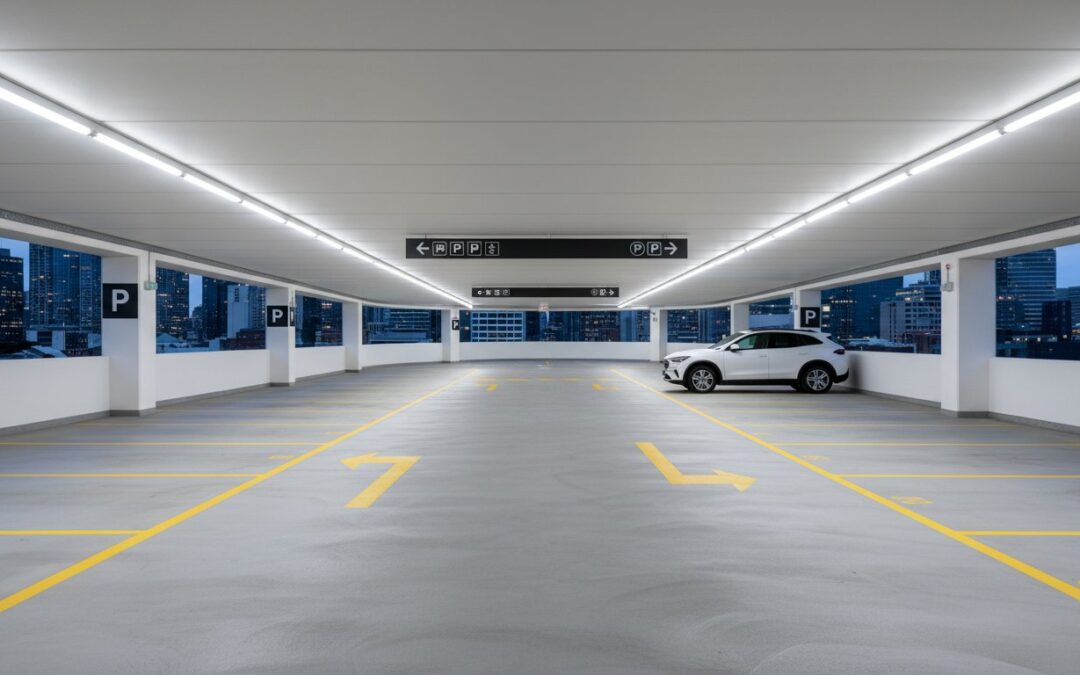
An inefficient car park isn’t just a nuisance for drivers; it’s a significant liability that can stall a development approval for 6 months or more. You likely recognize that confused drivers cause immediate congestion, and poor visibility increases the risk of preventable accidents on your site. Most developers realize that poor car park signage and wayfinding design leads to clutter that users simply ignore, yet achieving full compliance with AS 2890.1 remains a complex technical hurdle for many projects.
This guide shows you how to implement a system that meets Australian Standards and streamlines the council approval process. Since 2005, ML Traffic Engineers has optimized over 10,000 sites, and we’ve seen how precise engineering reduces liability and improves safety. You’ll discover how to design a system that flows logically without staff intervention. We will break down the essential requirements for AS 1742 and AS 2890.1 to ensure your next project is both compliant and intuitive for every user.
Key Takeaways
- Ensure technical compliance with AS 2890.1 and AS 1742 to streamline development approvals and meet mandatory Australian Standards.
- Implement a structured four-tier hierarchy to manage driver cognitive load and improve safety within confined parking environments.
- Optimize sign placement through integrated car park signage and wayfinding design that accounts for Swept Path Analysis and sight distance requirements.
- Establish a clear entry sequence to manage driver expectations and prevent navigational errors from the point of ingress.
- Benefit from a principal-led approach where experienced traffic engineers manage your design from the initial quote to final implementation.
The Psychology of Navigation: Why Car Park Wayfinding Design Matters
Effective car park signage and wayfinding design is a comprehensive engineering system, not a collection of isolated placards. It integrates spatial architecture, graphic communication, and lighting to guide users through complex multi-deck or basement environments. When we design these systems, we prioritize the driver’s psychological state to ensure safety and efficiency. A well-engineered car park doesn’t just hold vehicles; it directs human behavior through intuitive visual cues.
Drivers in confined spaces face a high cognitive load. They must manage vehicle dimensions, watch for pedestrians, and navigate tight turns simultaneously. A 2019 study by the Insurance Institute for Highway Safety indicated that approximately 20% of vehicle accidents occur in parking facilities. Poorly placed information forces the brain to process too much data at once, leading to decision paralysis. This delay increases the risk of collisions at critical junctions like ramp entries or blind corners where reaction times are already compressed.
Understanding the Driver’s Mental Map
Drivers lose their sense of direction quickly in underground structures where external landmarks are absent. We use internal landmarks and consistent color-coding to help users build a reliable mental map of the facility. For instance, assigning specific colors to levels B1 through B4 reduces search time and lowers driver anxiety. Progressive disclosure is the strategy of giving drivers only the information they need at their current decision point.
Reducing Friction in High-Stress Environments
Friction points often occur at steep ramps or narrow exits where visibility is limited. Engineering-led wayfinding mitigates these risks by placing signage within the driver’s natural sight-line, as defined by AS 2890.1 standards. This clarity has environmental benefits too. Research suggests that intuitive navigation can reduce cruising time by 2 minutes per trip, which lowers vehicle emissions by roughly 15% in enclosed spaces due to reduced idling.
For retail and commercial developments, the parking experience is the first and last touchpoint for a visitor. A seamless transition from the street to a parking bay increases the likelihood of return visits. Professional car park signage and wayfinding design ensures the facility reflects the quality of the entire development. It turns a functional necessity into a commercial asset. If you’re planning a new development, our traffic engineering services can help optimize your layout for maximum flow and safety.
- Reduces vehicle-to-pedestrian conflict points.
- Decreases average time-to-park by 25% in high-occupancy periods.
- Enhances brand perception through professional, compliant aesthetics.
- Lowers operational costs by reducing minor property damage from navigation errors.
Technical Compliance: AS 2890 and Australian Standards for Signage
AS 2890.1:2004 dictates the technical requirements for off-street parking facilities. This standard ensures that car park signage and wayfinding design provides clear, unambiguous instructions to drivers to prevent collisions and congestion. AS 1742 provides the framework for uniform traffic control devices, ensuring symbols like "No Entry" or "Left Turn Only" are identical across all Australian jurisdictions. Consistency across the road network reduces driver cognitive load and improves safety.
Local councils scrutinize these technical details during the Development Application (DA) process. A non-compliant Car Park Design often leads to RFI (Request for Information) delays or outright project rejection. Beyond the planning phase, legal liability is a major factor for property owners. If an accident occurs in a private facility where regulatory signage fails to meet AS 2890 standards, the owner faces significant litigation risk. It’s not just about aesthetics; it’s about meeting a professional engineering benchmark. At ML Traffic Engineers, the consultant who provides your quote is the one who does the work, ensuring these standards are met without compromise.
Mandatory Regulatory and Warning Signs
Regulatory signs must follow specific sizing and reflectivity standards to be effective. In basement environments with limited ambient light, Class 1 retro-reflective material is mandatory to maintain visibility. Height clearance warnings are critical. Any structure with a clearance less than 2.2 metres must have a visible warning sign at the entry and at the point of obstruction. Speed limit signs, typically set at 10 km/h for shared zones, must be placed at intervals that maintain driver awareness. We ensure sign placement does not encroach on the vehicle swept path of a B99 vehicle, which prevents physical damage to the signage from turning cars.
Pavement Markings as Wayfinding Tools
Effective car park signage and wayfinding design relies on redundant information systems. Pavement markings provide immediate guidance when vertical signs are obscured by larger vehicles like vans or SUVs. Compliance involves several key elements:
- Directional arrows to define traffic flow and prevent head-on conflicts.
- Bay numbering and ‘Keep Clear’ zones for fire exits and hydrants.
- High-slip-resistance paint to prevent pedestrian accidents.
- AS 2890.6 compliance for disabled parking, including specific blue hatchings and the International Symbol of Access (ISA).
Integrating these markings with vertical signage creates a high-reliability system that minimizes driver confusion. If you’re preparing a DA, our team provides a professional assessment of your signage requirements to ensure full compliance with Australian Standards.
The Wayfinding Hierarchy: From Entry to Destination
Effective car park signage and wayfinding design relies on a rigorous four-tier hierarchy. This structure manages driver cognitive load and ensures traffic flows without hesitation. At ML Traffic Engineers, we categorise every sign into one of four functional groups:
- Identification: Defines the facility, specific levels, and individual zones.
- Directional: Guides vehicles through decision points using arrows and clear destination text.
- Informational: Provides data on opening hours, height clearances, and payment methods.
- Regulatory: Enforces legal requirements, including speed limits, "No Entry" zones, and accessible parking mandates under AS 2890.6.
The "Entry Sequence" is the most critical phase for driver orientation. Within the first 20 metres of entering a facility, a driver must understand the height restrictions, the direction of flow, and the availability of spaces. We design these sequences to set immediate expectations, reducing the likelihood of erratic braking or sudden lane changes. Once a driver makes a turn, we place "Confirmation Signage" within 15 metres to reassure them they’re on the correct path. This prevents "U-turn" manoeuvres that cause 25% of internal car park collisions.
Clear exit strategy design is equally vital. During peak discharge periods, such as the end of a major sporting event or office hours, congestion often stems from poor exit visibility. We ensure "Way Out" signage is high-contrast and positioned at every possible line of sight to maintain a steady flow toward the property boundary.
Directional Signage and Decision Points
We map every decision point within the car park to eliminate "dead zones" in information. A decision point is any location where a driver can choose between two or more paths. At these junctions, we use "heads-up" positioning. Because modern SUVs often reach heights of 1.9 to 2.1 metres, signs must hang at a minimum of 2.2 metres to remain visible over the vehicle ahead. We limit information density to a maximum of three destinations per sign. Providing four or more options increases processing time by 40%, which leads to traffic queuing at junctions.
Identification and Level Coding
Multi-level facilities require a robust alpha-numeric and color-coded system to assist with pedestrian return. We use distinct palettes for each level, such as Level 1 (Blue) and Level 2 (Red), to create strong visual anchors. This identification must integrate directly with lift lobbies and stairwell exits. If a driver parks in "Zone 3B," that exact nomenclature must appear on the pedestrian side of the door. Consistency is the priority. When clients use digital "bay finding" systems, we ensure the physical car park signage and wayfinding design mirrors the digital interface. Discrepancies between a mobile app and a physical sign increase vehicle dwell time by up to 15%. For more technical specifications on site-specific requirements, view our traffic engineering services.
Integrating Signage with Traffic Engineering and Safety
Effective car park signage and wayfinding design isn’t just about aesthetics; it’s a critical safety component. Signage must be integrated with the physical geometry of the facility to prevent collisions and ensure smooth traffic flow. We use Swept Path Analysis to determine the exact spatial requirements of turning vehicles. This ensures that signs, especially those mounted on columns or hanging from ceilings, are placed outside the dynamic envelope of a vehicle’s path. A sign placed 200mm too low or too close to a tight turn can lead to repeated vehicle strikes, increasing maintenance costs and liability risks.
Lighting conditions drastically change how signage performs. In basement levels, we specify high-contrast, internally illuminated, or high-grade retro-reflective materials to combat low ambient light. On rooftop levels, glare from the sun can wash out information. We position signs to minimize solar interference and ensure they remain legible during peak afternoon hours when glare is most intense.
Sight Lines and Obstruction Management
Signs must never compromise the visibility of other road users. We conduct sight distance assessments to ensure that a sign providing directions doesn’t simultaneously hide a pedestrian or a vehicle approaching from a side aisle. We calculate the legibility distance based on typical internal speeds of 10-20km/h. At 20km/h, a driver needs at least 15 to 20 meters of clear visibility to process information and react safely. Under the requirements of AS 2890.1, a specific sight triangle must remain clear of all obstructions, including signage, to provide adequate visibility at property boundaries and internal intersections.
Pedestrian Wayfinding in Shared Zones
The ‘last mile’ of a driver’s journey begins the moment they step out of their vehicle. Wayfinding must provide a clear, logical path from the parking bay to the lift core or building entrance. This reduces the time pedestrians spend in active traffic lanes, lowering the risk of incidents.
- Designated walking corridors using contrasting pavement colors, typically safety yellow or white.
- Zebra crossings at high-conflict points to establish clear pedestrian right-of-way.
- Strategic use of bollards to physically separate foot traffic from vehicle aisles.
Effective design also accounts for the return journey. Large structures require level-specific color coding and alphanumeric bay numbering to help users locate their vehicles quickly. When users don’t have to search for their cars, they spend less time wandering through shared zones where visibility might be limited. This structured approach to car park signage and wayfinding design creates a predictable environment for both drivers and walkers.
If your development requires a compliant and safe layout, our team provides comprehensive traffic engineering services to ensure your project meets all regulatory standards.
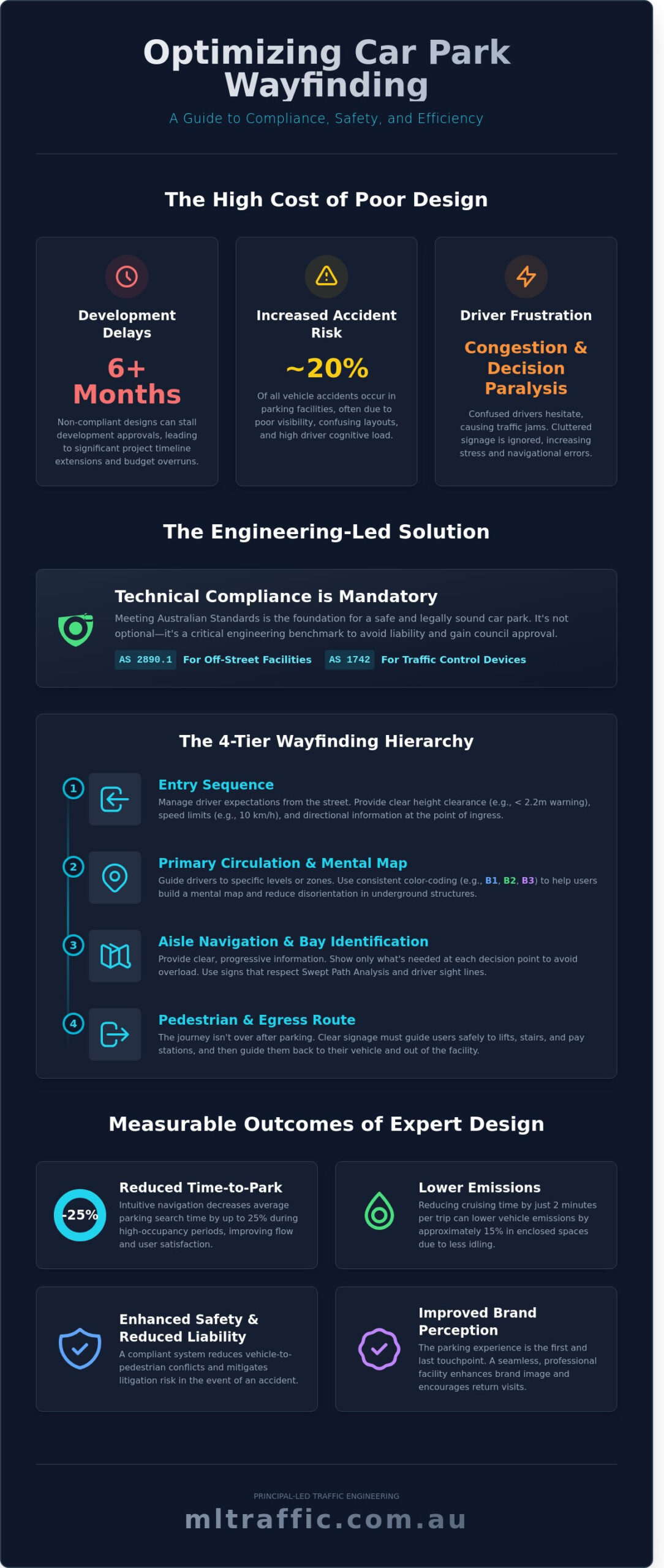
Professional Implementation: How ML Traffic Engineers Optimise Your Design
Engaging a qualified traffic engineer during the early architectural phase prevents expensive design failures. ML Traffic Engineers operates on a principal-led model. The traffic consultant who provides the quote, does the work. This ensures that the senior professional who understands your project’s specific constraints is the one performing the technical analysis. It eliminates the risk of junior staff overlooking critical site details or complex council requirements.
Effective car park signage and wayfinding design reduces long-term operational costs for developers and facility managers. A self-explanatory layout minimizes the need for on-site traffic marshals and reduces the frequency of minor vehicle collisions. Our team focuses on creating a seamless flow that guides drivers intuitively. This approach has been proven across more than 10,000 sites, ranging from small residential blocks to massive industrial warehouses.
- Direct access to senior engineers with over 30 years of experience.
- Strict technical compliance with AS 2890.1 and local government codes.
- Reduction in liability through RPEQ-certified assessments and certifications.
- Optimized space utilization to maximize your site’s parking yield.
From Concept to Council Approval
Our technical reports address specific council concerns regarding parking, access, and safety. We use specialized software to perform Vehicle Swept Path Assessments. This verifies that car park signage and wayfinding design elements don’t interfere with vehicle movements or sight lines. We prepare car park certification documents that meet all national standards. This proactive approach prevents costly retrofits and ensures your development application moves through the approval process without technical objections or requests for further information.
Custom Solutions for Complex Sites
Mixed-use developments present unique challenges that require distinct wayfinding strategies. We tailor designs to separate retail, residential, and commercial traffic flows effectively. Our engineers solve difficult site issues like steep driveway ramp grades exceeding 15% or restricted loading dock access in high-density urban areas. We provide practical solutions that balance regulatory compliance with the commercial realities of your project. Ready to ensure your project is compliant? Contact our senior engineers today.
Optimising Your Facility for Safety and Compliance
Effective car park signage and wayfinding design is a technical requirement, not a decorative choice. Strict compliance with AS 2890 standards ensures your facility meets Australian legal obligations while maintaining peak traffic flow. A clear hierarchy of information prevents driver confusion and reduces the risk of low-speed collisions. ML Traffic Engineers has provided expert assessments for over 10,000 sites across Australia since 2005. Our team brings 15 years of traffic engineering experience to every project. You won’t deal with junior staff or administrative gatekeepers. The traffic consultant who provides your quote is the person who does the work. You’ll have direct access to our senior principals, Michael Lee and Benny Chen, throughout the entire process. We ensure your signage integrates seamlessly with vehicle swept paths and sight-line requirements. This level of technical precision protects your liability and improves the user experience for every visitor. We look forward to helping you achieve a compliant, high-performing design.
Request a Professional Car Park Design Assessment
Frequently Asked Questions
What are the primary Australian Standards for car park signage?
The primary standards are AS 2890.1:2004 for off-street parking and AS 1742.11 for parking control. These documents specify the exact dimensions, colors, and placement for every sign used in a facility. We use these standards to ensure 100% compliance during the design phase so your project meets all regulatory requirements.
How many signs are actually necessary for a small basement car park?
A small basement with 15 to 20 spaces typically requires 5 specific signs to meet safety minimums. You’ll need a height clearance sign at the entry, a 10km/h speed limit sign, an exit directional sign, and two pedestrian warning signs. This setup covers the basic safety requirements mandated by AS 2890.1 without cluttering the space.
Is pavement marking considered part of a wayfinding system?
Pavement markings are a core element of car park signage and wayfinding design because they provide immediate ground-level instruction. They guide drivers when vertical signs are obscured by pillars or other vehicles. We specify R11 slip-resistance rated paint for all arrows and bay markings to ensure they’re safe for both vehicles and pedestrians.
Can poor wayfinding design lead to legal liability for property owners?
Property owners face direct legal liability for damages if signage doesn’t meet the Civil Liability Act requirements. If a 2.3m tall vehicle hits a 2.1m ceiling because a height clearance sign was missing, the owner is often 100% responsible for the repair costs. Expert engineering prevents these expensive legal disputes and insurance claims.
What is the difference between directional and regulatory signage?
Directional signs provide navigation while regulatory signs enforce specific traffic laws. A sign pointing to "Level 1" helps a driver find their car, but a "No Entry" sign is a legal instruction that must be followed. Regulatory signs must follow AS 1742 standards for shape and color to be legally enforceable in Australia.
How does swept path analysis affect where I can place signs?
Swept path analysis identifies the physical space a vehicle occupies while turning, including a 300mm safety margin. We use this data to place signs where they won’t be hit by a B99 vehicle’s tail swing. This is critical in tight basement ramps where clearance is less than 500mm and columns are frequent.
Do I need a traffic engineer for a simple car park signage upgrade?
You should engage a traffic engineer if your upgrade involves more than 10 parking spaces or changes to existing traffic flow. We’ve seen owners waste $5,000 on incorrect signs that didn’t meet council requirements. Our engineers ensure your car park signage and wayfinding design is compliant the first time, saving you from costly retrofits.
What are the requirements for accessible parking signage under AS 2890.6?
AS 2890.6:2009 mandates a dedicated sign at least 300mm wide for every accessible bay. The sign must be mounted between 1.5m and 2.5m above the ground to ensure it’s visible over parked cars. It has to show the white International Symbol of Access on a blue background to be legally compliant for your facility.
Which areas do you cover?
We are traffic engineers servicing Melbourne, Sydney, Brisbane, Gold Coast, Hobart, Perth, Adelaide, Darwin, Canberra and surrounding areas.

Disclaimer
The content on www.mltraffic.com.au, including all technical articles, guides, and resources, is provided for general informational and educational purposes only. It is not intended to constitute professional advice in traffic engineering, transportation planning, development approvals, or any other technical or legal field.
While ML Traffic Engineers makes every reasonable effort to ensure the accuracy, completeness, and timeliness of the information published, we do not provide any warranties or representations (express or implied) regarding its reliability, suitability, or availability for any particular purpose. Any reliance you place on the content is strictly at your own risk.
In no event shall ML Traffic Engineers, its directors, employees, authors, or affiliates be liable for any direct, indirect, incidental, special, consequential, or punitive damages (including, without limitation, loss of profits, data, or business opportunities) arising out of or in connection with the use of, or inability to use, any information provided on this website.
The articles and guides on this site are not a substitute for engaging a qualified, registered professional traffic engineer (such as an NPER or RPEQ engineer) to assess your specific project requirements. For tailored advice, compliance assessments, or traffic engineering services, please contact a competent professional.
This disclaimer may be updated from time to time without notice. By accessing or using this website, you agree to be bound by the most current version of this disclaimer.
