
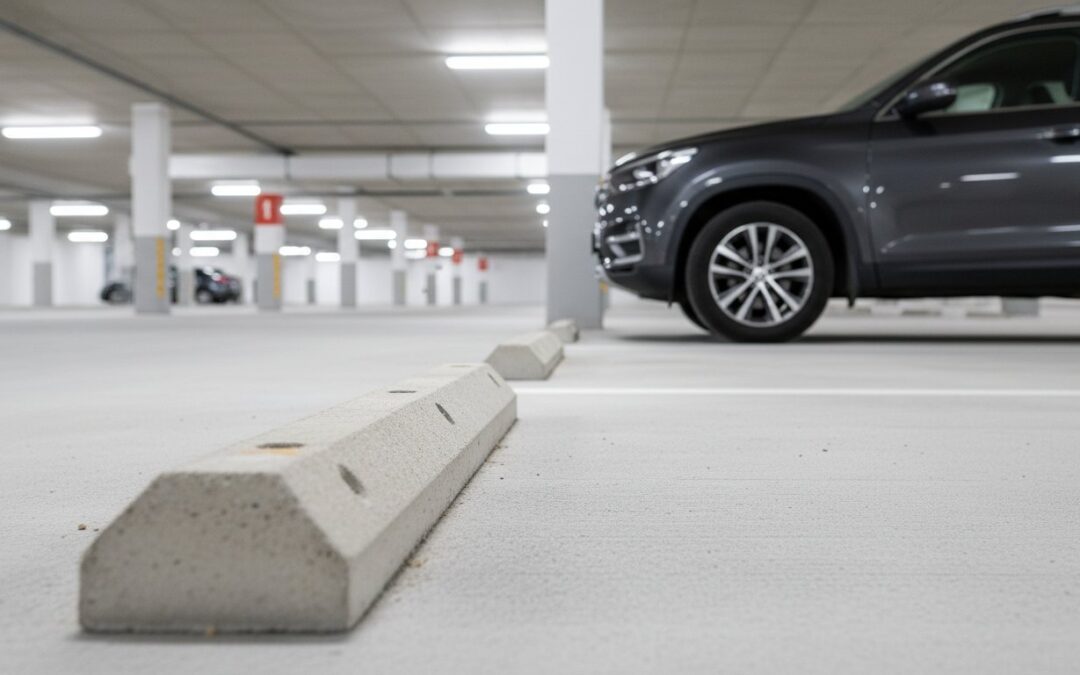
Did you know that properly installed wheel stops can reduce minor car park accidents by up to 30% according to the Institute of Transportation Engineers? While the safety benefits are clear, many developers face significant hurdles during the DA process due to technical errors in car park wheel stop requirements australia. It’s common to feel overwhelmed by the conflicting details between AS 2890.1 and AS 2890.6, or to fear a council rejection that stalls your project. You need precise data to avoid creating pedestrian trip hazards that lead to litigation.
This guide ensures you master the technical specifications and Australian Standards required for a compliant car park design. You’ll learn the exact height and width mandates, such as the 90mm to 100mm height limit, and the specific setback distances for various kerb heights. We provide the professional clarity needed to achieve DA approval, ensure site safety, and mitigate legal liability for vehicle damage. From front-in parking setbacks to material selection, this overview covers the essential requirements for 2026.
Key Takeaways
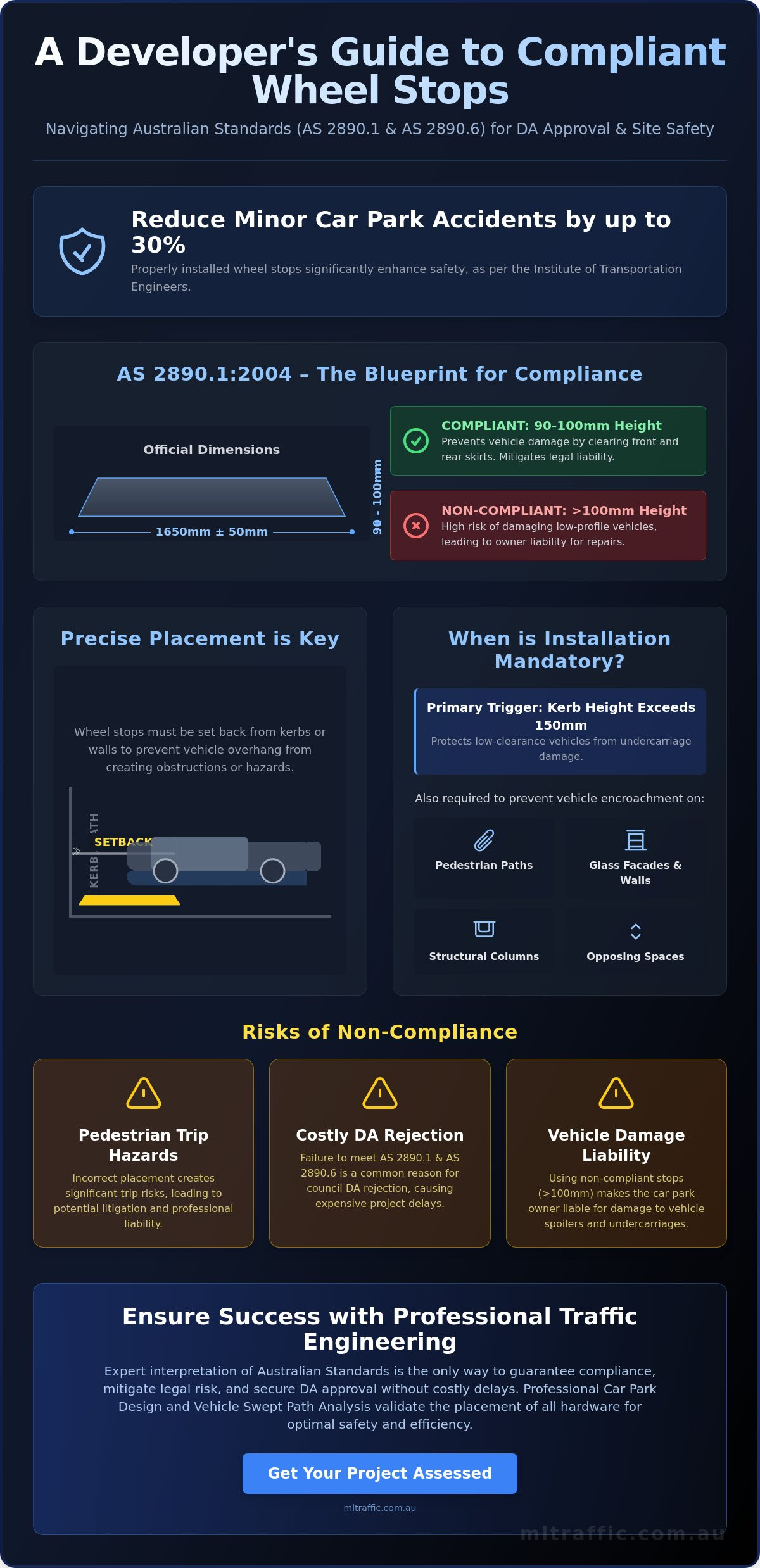
- Identify the mandatory physical specifications under AS 2890.1:2004, focusing on the critical 90mm to 100mm height range to prevent vehicle damage.
- Calculate exact setback distances for car park wheel stop requirements australia to accommodate both front-in and rear-in parking maneuvers.
- Assess the strategic placement of wheel stops to mitigate pedestrian trip hazards and protect against professional liability and litigation.
- Discover how professional car park design and Vehicle Swept Path Analysis validate the placement of hardware within complex site layouts.
- Understand the intersection of AS 2890.1 and AS 2890.6 to ensure your facility meets both general and accessible parking standards for DA approval.
Table of Contents
-
Mandatory Physical Specifications for Australian Wheel Stops
-
Risks of Non-Compliance: Pedestrian Hazards and Legal Liability
Understanding AS 2890.1:2004 and Wheel Stop Necessity
Australian Standard AS 2890.1:2004 defines wheel stops as physical barriers designed to limit the travel of a vehicle within a parking space. These devices serve three primary functions. They protect building walls from impact. They prevent vehicle encroachment into pedestrian thoroughfares. They manage the overhang of vehicles over kerbs or landscaped areas. Professional traffic engineering firms prioritize these installations to secure council DA approval. Inconsistent application of car park wheel stop requirements australia often leads to project delays or costly retrofitting. Compliance ensures that vehicle movement remains within the designated parking envelope.
To better understand this concept, watch this helpful video:
Mandatory vs. Optional Installation
Installation becomes mandatory when a kerb exceeds 150mm in height. This prevents low-clearance vehicles from sustaining damage to undercarriages or front spoilers. Standard concrete kerbs often fail to provide sufficient protection for modern vehicle designs. Engineers must balance this against pedestrian safety. Wheel stops are frequently cited as trip hazards. They should be avoided in primary pedestrian corridors unless necessary to protect infrastructure. Common triggers for mandatory installation include:
-
Proximity to pedestrian paths where vehicle overhang would restrict path width.
-
Protection of glass facades or structural columns.
-
Prevention of vehicle encroachment into opposing parking spaces in high-density layouts.
The Legal Framework: AS 2890.1 and AS 2890.6
AS 2890.1:2004 governs general off-street parking. AS 2890.6:2022 details requirements for people with disabilities. Integrating these standards is essential for Disability Discrimination Act (DDA) compliance. Professional Car Park Design ensures that wheel stops don’t obstruct accessible paths. Many developers utilize Vehicle Swept Path Analysis to determine the precise placement needed to satisfy both safety and regulatory demands. These assessments integrate with modern parking guidance systems to create efficient, high-performing facilities. Expert interpretation of car park wheel stop requirements australia is the only way to mitigate long-term legal liability for vehicle damage or pedestrian injury.
Mandatory Physical Specifications for Australian Wheel Stops
Compliance with AS 2890.1:2004 requires strict adherence to physical dimensions. The standard dictates a height between 90mm and 100mm. This specific range ensures the stop is high enough to be felt by the driver but low enough to clear the front and rear skirts of modern passenger vehicles. For width, the device must measure 1650mm ± 50mm. This ensures consistent tyre contact across the vehicle’s axle. Technical documentation from Standards Australia provides the baseline for these measurements, which are essential for engineering certification. Precise manufacturing is required because even a 10mm deviation can result in non-compliance.
Height Compliance: The 100mm Rule
Exceeding the 100mm maximum height creates significant legal liability for car park operators. Many legacy concrete wheel stops sold in the Australian market actually measure 110mm to 120mm. While seemingly minor, this extra height leads to front spoiler damage on low-profile vehicles. When a vehicle sustains damage from a non-compliant stop, the car park owner is often held responsible for repair costs. During the construction phase, verifying these heights is a critical step for project managers. We recommend conducting a site-wide audit to confirm that every installed unit meets the car park wheel stop requirements australia.
Material Selection: Concrete, Rubber, or Poly?
Material choice impacts both durability and maintenance schedules. Concrete remains the traditional choice for high-traffic commercial environments due to its mass and compression strength. However, it’s prone to chipping and cracking over time. Recycled rubber and high-density polyethylene (poly) options have gained market share in 2026. These materials are weather-resistant and don’t corrode. Rubber stops are often preferred for multi-deck car parks because they dampen noise and vibration. They also offer better impact absorption, which reduces the risk of bolt shear under heavy use.
Installation methods vary by material and surface. Concrete typically requires heavy mechanical fixings or integrated rebar. Rubber and poly units often use simpler mechanical bolts or high-strength adhesives on smooth surfaces. Visibility is another mandatory factor. All units must feature a contrasting color to the surrounding pavement. Yellow, white, or blue (for accessible spaces) are industry standards. Reflective panels are necessary for low-light safety in underground facilities. If you’re unsure which material fits your specific site constraints, a professional Car Park Design assessment can clarify the most cost-effective and compliant path.
Calculating Precise Placement and Setback Distances
Accuracy in placement is non-negotiable for engineering certification. car park wheel stop requirements australia specify setback distances based on the direction of entry and the nature of the obstruction. For standard front-in parking where the kerb is 150mm or lower, the setback must be 620mm. This is measured from the front boundary of the parking space to the point of tyre contact on the wheel stop. If the entry is rear-in, this distance increases to 900mm. These measurements ensure the vehicle’s bumper doesn’t strike a low kerb while maximizing the available space within the 5.4m standard bay length.
Front-In vs. Rear-In Requirements
Vehicle geometry dictates these variations. Front overhangs are generally shorter than rear overhangs on the B85 critical vehicle defined by AS 2890.1. When designing for high kerbs over 150mm or solid walls, you must add a 200mm buffer to the standard setback. This adjustment brings the front-in requirement to 820mm and the rear-in requirement to 1100mm. Failing to account for these buffers results in vehicle damage and potential insurance claims against the facility owner. We use these precise metrics to ensure every Car Park Design remains compliant under rigorous site inspections.
Managing Pedestrian Overhang
Improperly placed stops often lead to vehicles encroaching on footpaths. This narrows the clear width required for wheelchairs and prams. AS 2890.1 requires that parked vehicles don’t obstruct these essential corridors. By calculating the exact tyre contact point, engineers prevent the vehicle nose or tail from protruding into the path of travel. This technical coordination is often validated through a Swept Path Analysis. This analysis simulates vehicle movements to ensure that the physical hardware doesn’t interfere with circulation or accessibility.
Precision matters during the installation phase. Measuring from the edge of the stop rather than the tyre contact point is a frequent error. Most compliant stops have a specific profile where the tyre meets the vertical face. Contractors must use the contact point as the datum for all site markings. This level of detail separates professional infrastructure from DIY installations that fail council audits. It’s the difference between a project that passes the DA process and one that requires expensive remedial work.
Risks of Non-Compliance: Pedestrian Hazards and Legal Liability
Non-compliance with car park wheel stop requirements australia exposes facility owners to substantial legal and financial risks. While these devices protect assets, they are notorious trip hazards. Australian courts have historically favored plaintiffs in personal injury cases where wheel stops were installed in primary pedestrian corridors or exceeded the 100mm height limit. If a stop is loose or the fixings protrude, it becomes a negligence liability. Professional Car Park Design proactively identifies these risks by ensuring stops are only placed where absolutely necessary and never across a clear path of travel. It’s not just about vehicle protection; it’s about managing the safety of every site user.
Maintenance is a critical component of risk mitigation. Over time, mechanical fixings can shear or back out due to repeated vehicle impact. A protruding bolt is a severe hazard that can cause significant injury. Facility managers must implement a regular inspection regime to ensure every unit remains flush with the pavement. Visibility also degrades as paint fades or reflective panels collect grime. If a pedestrian cannot see the obstacle in low-light conditions, the car park operator’s defense against a claim is significantly weakened. We often see litigation arise from simple maintenance failures that were entirely preventable.
Pedestrian Safety and Visibility
Visibility standards are precise. Units must provide a high level of contrast against the surrounding surface. For standard bays, safety yellow is the industry benchmark. For accessible parking, blue is required to align with AS 2890.6. In underground facilities, illumination must meet minimum lux levels to ensure obstacles are clearly defined. When a risk assessment suggests that a wheel stop creates an unacceptable trip hazard, we recommend alternative protection methods. Bollards or heavy-duty kerbing are often superior choices for protecting pedestrians without introducing a stumbling block.
Council Rejection and DA Delays
Council planners scrutinize car park layouts for compliance with the AS 2890 series. A common reason for DA rejection is the inclusion of wheel stops that obstruct accessible routes or fail to meet setback distances. Retrofitting a site after a failed inspection is significantly more expensive than getting the design right initially. It involves core drilling, patching, and often a complete redesign of the line marking. Commissioning a Traffic Impact Assessment early in the planning stage ensures that your project adheres to car park wheel stop requirements australia from the outset. This professional oversight prevents the bureaucratic delays that stall commercial developments and helps you avoid the high costs of remedial construction work.
To ensure your project meets all regulatory safety standards and avoids costly delays, contact our senior traffic engineering team for a comprehensive design review.
Integrating Wheel Stops into Professional Car Park Design
Professional car park design requires more than just placing hardware. It involves the technical synthesis of civil constraints and regulatory mandates. We utilize AutoTURN software to perform Vehicle Swept Path Analysis, ensuring that wheel stop placement doesn’t interfere with the turning movements of the B85 or B99 design vehicles. This validation is critical in multi-deck or basement facilities where space is at a premium. Every installation must be coordinated with several site elements:
-
Drainage grates and surface runoff flow paths.
-
Lighting columns and structural support pillars.
-
Line marking plans and directional signage.
-
Pedestrian crossing points and accessible ramps.
Integrating car park wheel stop requirements australia into the initial design phase prevents field adjustments that compromise site safety. A Traffic Engineer ensures that the physical placement of each stop aligns with the intended vehicle circulation. This coordination is essential for achieving a high-performing facility that meets all engineering certification standards.
Optimizing Tight Car Park Layouts
Maximizing parking yield often tempts developers to reduce aisle widths or bay sizes. However, a Traffic Engineer balances these commercial goals with safety standards. Senior leadership involvement ensures that site-specific geographic constraints, such as steep gradients or irregular boundaries, are managed without breaching AS 2890.1. Our principals oversee every Car Park Design project from inception to completion. This hands-on approach ensures the layout remains functional under real-world conditions. We’ve successfully navigated complex car park approvals for developers by providing data-driven reports that satisfy council scrutiny.
The Value of Expert Certification
DIY car park designs frequently fail because they overlook the interaction between different Australian Standards. A professional AS 2890.1 compliance audit identifies potential failures before they become litigation risks. These assessments provide the documentation required for council sign-off and insurance purposes. Relying on a seasoned expert ensures that car park wheel stop requirements australia are met precisely, avoiding the high costs of retrofitting and remedial work. The same expert who initiates your project performs the technical work, providing accountability and deep-seated expertise. To secure your site’s compliance and facilitate a smooth DA process, contact our senior principals for a technical assessment of your facility.
Securing Your Development with Compliant Infrastructure
Adherence to AS 2890.1:2004 is a technical necessity for any modern development. You must prioritize the 90mm to 100mm height limit and the specific setback distances to protect both vehicles and pedestrians. These technical details are the difference between a successful council audit and a rejected development application. Mastering car park wheel stop requirements australia ensures your facility operates safely while minimizing the risk of expensive litigation and remedial construction work.
Our firm brings over 15 years of Australian traffic engineering experience to every project. We provide direct access to senior principals who perform the technical work personally. This hands-on approach ensures your site layout meets all council DA requirements and national standards from the initial design phase. Don’t leave your infrastructure to chance or rely on generic designs that invite liability. We provide the meticulous oversight needed for complex urban environments and high-density parking facilities.
Ensure your car park is compliant; contact our senior traffic engineers today. We look forward to helping you achieve a safe and efficient car park design that stands up to professional scrutiny.
Frequently Asked Questions
Are wheel stops mandatory in Australian car parks?
Wheel stops are mandatory in specific scenarios defined by AS 2890.1:2004. They must be installed when a kerb exceeds 150mm in height or where a vehicle might encroach into a pedestrian thoroughfare. They are also required to protect building walls, glass facades, or structural columns from vehicle impact. If a standard kerb doesn’t provide sufficient protection, a compliant stop is the necessary solution.
What is the standard height for a wheel stop in Australia?
The standard height must be between 90mm and 100mm. This specific range is a critical part of car park wheel stop requirements australia to ensure the device is high enough to stop a tyre but low enough to clear vehicle skirts. Any unit exceeding 100mm is non-compliant and creates significant liability for the operator due to potential vehicle undercarriage damage.
How far should a wheel stop be placed from a wall or kerb?
Setback distances are determined by the parking direction and the height of the obstruction. For front-in parking with a low kerb, the setback is 620mm. For rear-in parking, it’s 900mm. If the kerb is higher than 150mm or if a wall is present, you must add a 200mm buffer, resulting in setbacks of 820mm and 1100mm respectively.
Can I use concrete wheel stops for my development?
Yes, you can use concrete units provided they meet the strict dimensional requirements of AS 2890.1. While concrete is durable for high-traffic environments, many off-the-shelf products exceed the 100mm maximum height limit. You must verify manufacturer specifications before installation to ensure engineering certification and avoid the high costs of retrofitting non-compliant hardware later.
Do wheel stops need to be a specific colour?
Yes, wheel stops must feature a contrasting colour to the surrounding pavement to ensure visibility. Safety yellow is the benchmark for general commercial parking, while white is also acceptable. For accessible parking spaces, blue is mandatory to align with AS 2890.6. High visibility is essential for both driver awareness and mitigating pedestrian trip hazard risks in low-light conditions.
Are wheel stops considered a trip hazard under Australian law?
Yes, they are legally recognized as trip hazards if they are improperly designed or maintained. Courts often find car park operators liable for injuries if stops are placed in primary pedestrian corridors or lack sufficient contrast. To manage this risk, engineers only specify stops where necessary and ensure they don’t obstruct intended walking paths or accessible routes.
What is the difference between AS 2890.1 and AS 2890.6 for wheel stops?
AS 2890.1 governs general off-street parking, while AS 2890.6 details requirements for accessible parking for people with disabilities. For car park wheel stop requirements australia, AS 2890.6 mandates specific blue colouring and placement that doesn’t obstruct the shared zone. Compliance with both standards is necessary to satisfy the Disability Discrimination Act and secure council DA approval.
How do I know if my car park is compliant with Australian Standards?
Compliance is verified through a technical audit conducted by a qualified traffic engineer. This process involves measuring every installed unit and validating its placement against approved engineering plans. Professional Car Park Design and compliance audits provide the formal certification required for council sign-off, insurance coverage, and long-term risk mitigation for your facility.
Which areas do you cover?
We are traffic engineers servicing Melbourne, Sydney, Brisbane, Gold Coast, Hobart, Perth, Adelaide, Darwin, Canberra and surrounding areas.

Disclaimer
The content on www.mltraffic.com.au, including all technical articles, guides, and resources, is provided for general informational and educational purposes only. It is not intended to constitute professional advice in traffic engineering, transportation planning, development approvals, or any other technical or legal field.
While ML Traffic Engineers makes every reasonable effort to ensure the accuracy, completeness, and timeliness of the information published, we do not provide any warranties or representations (express or implied) regarding its reliability, suitability, or availability for any particular purpose. Any reliance you place on the content is strictly at your own risk.
In no event shall ML Traffic Engineers, its directors, employees, authors, or affiliates be liable for any direct, indirect, incidental, special, consequential, or punitive damages (including, without limitation, loss of profits, data, or business opportunities) arising out of or in connection with the use of, or inability to use, any information provided on this website.
The articles and guides on this site are not a substitute for engaging a qualified, registered professional traffic engineer (such as an NPER or RPEQ engineer) to assess your specific project requirements. For tailored advice, compliance assessments, or traffic engineering services, please contact a competent professional.
This disclaimer may be updated from time to time without notice. By accessing or using this website, you agree to be bound by the most current version of this disclaimer.
