
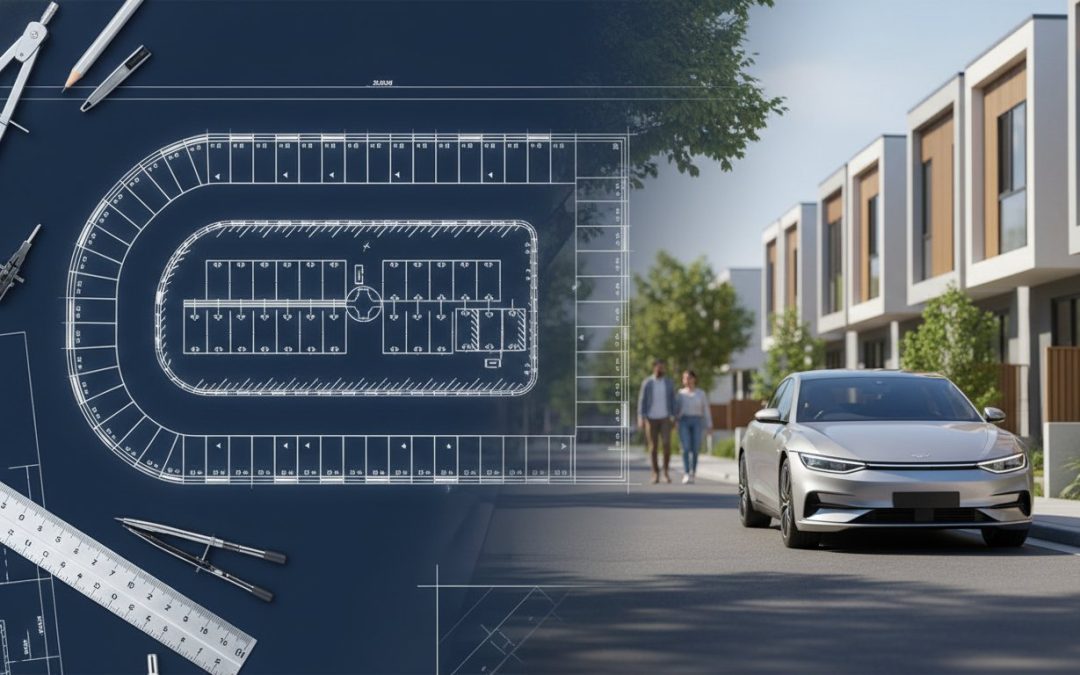
The success of a development application often hinges on meeting stringent parking regulations, making a compliant Car Parking Certificate in Sydney a non-negotiable requirement. A common point of confusion, however, arises between this technical certification needed for a development and a simple residential parking permit. These are two fundamentally different approvals, and misunderstanding the distinction can lead to costly delays and rejections from the council.
This definitive guide provides the clarity you need. For developers, we detail the essential requirements for obtaining a car park design certificate, ensuring your plans are safe, efficient, and fully compliant with Australian Standard AS 2890.1 for a smooth council approval process. For residents, we outline the straightforward steps to apply for a local street parking permit. We will equip you with the precise knowledge needed to secure the correct parking approval for your specific needs, eliminating confusion and potential setbacks.
Understanding ‘Car Parking Certificate’: Two Different Needs in Sydney
The term "Car Parking Certificate in Sydney" often causes confusion as it refers to two fundamentally different documents for two distinct audiences. One is a permit for residents seeking to park on local streets, while the other is a technical certification for property developers. Before delving into the specific requirements for each, a foundational Understanding Parking principles and regulations is essential. This guide clarifies the distinction and directs you to the correct process for your specific needs, whether you are a resident or a developer.
This initial section serves to identify which document you require, saving you time and ensuring you follow the correct compliance pathway from the start. We will outline the purpose, application process, and key stakeholders for both residential permits and professional design certifications.
For Residents: The Residential Parking Permit
For individuals living within high-demand parking areas, a Residential Parking Permit is the relevant document. This is not a technical certificate but a permit issued by a local council that grants an exemption from parking time limits in a specific designated zone. Its primary function is to provide residents with more equitable access to on-street parking near their homes, particularly where off-street parking is unavailable.
-
Purpose: To exempt a resident’s vehicle from restrictive parking time limits (e.g., 1P, 2P) on local streets within their designated parking area.
-
Who Needs It: Residents who live at an eligible address within a council parking permit zone and do not have access to off-street parking.
-
How to Get It: By applying directly to your local council, such as the City of Sydney, and providing proof of residency and vehicle ownership.
For Developers: The Car Park Design Certificate of Compliance
For property developers, architects, and builders, the required document is a Car Park Design Certificate of Compliance. This is a professional, technical report essential for the Development Application (DA) process. It certifies that a proposed car park’s design-including layout, ramp grades, aisle widths, and individual space dimensions-complies with all relevant Australian Standards, primarily AS 2890.1. This certificate is a critical component for gaining council approval for a new development or major renovation.
-
Purpose: To formally certify that a proposed car park design is safe, functional, and compliant with Australian Standards for a DA submission.
-
Who Needs It: Developers, architects, project managers, and builders requiring project approval from a local council.
-
How to Get It: By engaging a qualified and experienced traffic engineering consultant to assess the architectural plans and issue a formal certificate of compliance.
This guide will provide detailed information on both pathways, ensuring you can confidently secure the correct Car Parking Certificate in Sydney for your specific requirements.
The Developer’s Guide: Securing a Car Park Design Certificate for DA Approval
For any developer navigating the Development Application (DA) process in Sydney, the car park design is a critical component that demands specialist attention. Councils mandate compliant car park designs to ensure public safety, accessibility, and traffic efficiency. A Car Parking Certificate in Sydney is the formal statement from a qualified traffic engineer that provides this assurance.
This certificate formally confirms that your proposed car park layout, including dimensions, ramp grades, and vehicle circulation, strictly adheres to Australian Standards, primarily AS 2890.1: Parking facilities – Off-street car parking. Submitting a DA without this certification is a common cause of significant delays, Requests for Information (RFIs) from council, or outright rejection, jeopardising project timelines and budgets.
Why is a Traffic Engineer’s Certification Crucial?
Engaging a professional traffic engineer to certify your plans is an essential risk mitigation strategy. It provides objective, third-party verification that your design is compliant and functional, offering several key advantages:
-
Ensures Safety: A certified design verifies safe sight lines, pedestrian routes, and vehicle movements, minimising the risk of accidents on-site.
-
Guarantees Functionality: It confirms that all vehicles, from small cars to service trucks, can circulate efficiently and access parking spaces without conflict.
-
Provides Council Confidence: The certificate demonstrates due diligence, giving the council’s assessment officers the confidence needed to approve the traffic-related aspects of your DA.
-
Prevents Costly Rework: Identifying and resolving design flaws before construction prevents expensive and disruptive redesigns after concrete has been poured.
When is this Certificate Required?
A car park design certificate is not an optional document for most significant developments. While specific requirements can vary between local councils, certification is almost universally required for DA submissions across a broad range of project types. These requirements are often embedded within local planning controls and reference state-level guidelines like the NSW development codes. A certificate is typically mandatory for:
-
All new multi-unit residential and mixed-use developments.
-
Commercial projects, including office buildings, retail centres, and industrial warehouses.
-
Any development that proposes modifications to existing car parks, access driveways, or loading docks.
-
High-traffic facilities such as childcare centres, medical facilities, and places of public worship.
Key Compliance Checks: What We Assess for Certification (AS 2890.1)
Securing a Car Parking Certificate in Sydney requires a meticulous assessment against the definitive industry benchmark: the Australian Standard AS 2890.1 for off-street car parking. Compliance is not optional; it is a mandatory prerequisite for achieving council approval for your development. The technical complexity of these standards-from geometric design to vehicle dynamics-necessitates the involvement of a qualified traffic engineering consultant to ensure every detail is addressed correctly and efficiently.
Our certification process involves a rigorous audit of your architectural plans against these critical standards. This demonstrates to the council that your car park is safe, functional, and fit for purpose.
Parking Bay Dimensions & Aisle Widths
Our assessment begins with the fundamentals of the car park layout. We conduct precise verification to ensure every component meets the minimum requirements. Key checks include:
-
Car Space Dimensions: Verifying the correct length, width, and vertical height clearance for all standard, small car, and motorcycle spaces.
-
Aisle Widths: Ensuring circulation aisle widths are sufficient to accommodate vehicle turning movements without conflict.
-
Disabled Parking: Confirming dedicated accessible parking spaces comply with the specific dimensions and shared area requirements of AS 2890.6.
-
Obstruction Clearance: Assessing the placement of columns, walls, and services to guarantee adequate clearance from parking spaces and accessways.
Access, Ramps, and Sight Lines
Safe and efficient vehicle movement is paramount. Our analysis extends beyond static dimensions to evaluate the dynamic performance of the car park design, focusing on critical access points.
-
Ramp Grades: Analysing all driveway and internal ramp grades, including transitions, to prevent vehicle underbody or bumper scraping.
-
Sight Lines: Confirming that sight lines for drivers entering or exiting the property are clear and compliant, allowing them to see pedestrians and other vehicles safely.
-
Swept Path Analysis: Conducting computer-modelled swept path analysis for design vehicles (e.g., B85/B99) to prove all cars can navigate the layout.
-
Headroom Clearance: Reviewing drawings to confirm continuous and compliant headroom clearance throughout all accessways, ramps, and parking areas.
Specialised Vehicle Requirements
A functional design must account for more than just passenger cars. We assess provisions for larger, essential vehicles to ensure operational efficiency, particularly for residential and commercial developments.
-
Service Vehicles: Designing for garbage trucks and loading/delivery vehicles, including swept paths for entry, collection, and exit.
-
Removalist Vans: Ensuring adequate height clearance and manoeuvring space for removalist vans, a common oversight in residential buildings.
-
Emergency Access: Planning for compliant access routes for fire trucks and other emergency vehicles where required by council or legislation.
These specialised vehicle assessments are a core component of our comprehensive traffic engineering services for your project.
The Certification Process: A Step-by-Step Walkthrough
At ML Traffic Engineers, we have refined our process over thousands of projects to ensure maximum efficiency and clarity for our clients. We work collaboratively with architects, developers, and builders to demystify the compliance requirements and secure a successful outcome for your Development Application (DA). Our approach is direct and results-oriented, designed to move your project forward without unnecessary delays.
The entire engagement, from initial contact to the final report, is handled by a senior traffic engineer. This ensures accountability and a deep understanding of your project’s specific needs.
Step 1: Initial Consultation & Design Review
The process begins when you provide us with the architectural plans for your proposed development. Our senior engineers conduct a thorough preliminary review, assessing the car park layout against the relevant council codes (DCPs) and the mandatory Australian Standard AS 2890.1. This initial step is critical for:
-
Identifying any major non-compliance issues upfront, saving significant time and redesign costs.
-
Understanding the unique constraints and opportunities of your site.
-
Providing a detailed, fixed-price quote for the full certification report.
Step 2: Detailed Assessment & Swept Path Analysis
Once engaged, we undertake a meticulous technical assessment. This involves precise checks on all critical design elements, including ramp grades, aisle widths, parking bay dimensions, and sight lines. Using industry-leading AutoTURN software, we perform detailed vehicle swept path analysis to verify that the design safely accommodates the required vehicle types. If minor adjustments are needed to achieve compliance, we provide clear, actionable recommendations. This detailed work is performed by the same experts who do the work from start to finish.
Step 3: Issuing the Car Park Certificate & Report
Upon satisfactory assessment, we compile the final documentation for your DA submission. This package includes a comprehensive traffic and parking assessment report that details our methodology and findings. Crucially, it contains the formal Certificate of Compliance statement, confirming the design adheres to all relevant standards. You will receive certified drawings and diagrams ready for direct inclusion in your council submission, completing the requirements to obtain your Car Parking Certificate in Sydney. The final report provides council with the expert verification needed for a smooth approval process.
To begin the certification for your Sydney development, contact ML Traffic Engineers for a direct consultation.
Common Car Park Design Flaws to Avoid in Sydney
Securing a Car Parking Certificate in Sydney requires more than just meeting the minimum number of spaces. Development Applications (DAs) are frequently delayed or rejected due to fundamental design flaws that council planners identify immediately. These errors, often overlooked in the early stages, can lead to expensive and complex rectification works post-construction. Engaging an experienced traffic consultant to review designs proactively is a critical investment that prevents these costly mistakes and streamlines the approval process.
Inadequate Swept Paths for Service Vehicles
A common reason for DA rejection is the failure to account for large service vehicles. Designs must demonstrate that council garbage trucks and other essential vehicles can safely enter the site, perform their service, and exit in a forward direction without complex manoeuvres. ML Traffic Engineers provides detailed swept path diagrams to prove compliance, ensuring your design accommodates all necessary vehicle movements from the outset.
Non-compliant Ramp Grades and Transitions
Ramps that are too steep or have poorly designed transitions are a significant functional and compliance issue. These flaws can cause vehicles to ‘bottom out’, scraping their undercarriage and creating liability issues. Our team meticulously assesses every ramp grade and transition point against the strict requirements of Australian Standard AS 2890.1, guaranteeing a safe and functional design that avoids user complaints and council objections.
Poor Sight Lines at Exits
Pedestrian safety is a non-negotiable priority for Sydney councils. Car park exits must provide drivers with clear and unobstructed sight lines of pedestrians on the footpath. Council planners are extremely strict on this point, and inadequate sight splays will halt a DA. We conduct thorough sight-line assessments to ensure your exit design meets all safety requirements. You can explore more technical insights in our in-depth articles.
Addressing these critical design elements before lodging your DA is essential for a smooth and successful project. The expert team at ML Traffic Engineers identifies and resolves these potential issues, ensuring your design is robust, compliant, and ready for approval. Contact us to ensure your project avoids these common pitfalls and secures its Car Parking Certificate in Sydney without unnecessary delays.
Streamline Your DA Approval with Compliant Car Park Design
Navigating the requirements for a Development Application demands meticulous attention to car park design. As outlined, achieving compliance with Australian Standard AS 2890.1 is the critical step for securing council approval and obtaining your Car Parking Certificate in Sydney. Proactively addressing potential design flaws from the outset is the most effective strategy to prevent costly delays and ensure your project progresses without issue.
Don’t let compliance issues derail your project. At ML Traffic Engineers, our principal traffic engineers leverage over 15 years of experience in securing DA approvals. With deep expertise across all Sydney councils and Australian Standards, we provide the authoritative guidance needed to certify your design. You gain direct access to our senior team, ensuring the consultant who provides your quote is the expert who completes the work.
Ensure your project’s success from the ground up. Contact us for a free quote on your Car Park Design Certification.
Frequently Asked Questions
What is the difference between a residential permit and a DA car park certificate?
A residential parking permit is issued by a local council to a resident, allowing them to park on the street in a designated permit zone. In contrast, a DA car park certificate is a technical document required for a Development Application. It is prepared by a qualified traffic engineer to certify that a proposed off-street parking facility, such as a new garage or basement, complies with Australian Standards and council codes. It concerns design compliance, not on-street parking rights.
Do I need a car park design certificate for a small residential development?
Yes, it is highly probable. Most councils in Sydney mandate a car park design certificate for any development involving new or altered vehicle parking and access, irrespective of the project’s scale. This includes duplexes, townhouses, and even single dwellings with basement parking or complex driveways. The certificate is a critical component of the DA process, ensuring the design is safe, compliant, and functional from the outset, thereby preventing costly post-construction modifications or council rejections.
What is Australian Standard AS 2890.1 and why is it so important?
AS 2890.1 is the principal Australian Standard governing the design of off-street car parking facilities. Its importance is paramount as it sets the mandatory minimum requirements for all geometric elements, including parking space dimensions, aisle widths, ramp gradients, circulation roadway widths, and sight lines for safety. Compliance with AS 2890.1 is non-negotiable for council approval, as it ensures the final car park is safe, accessible, and operationally efficient for all intended vehicle types.
How much does a car park design assessment and certification cost?
The cost for a car park design assessment and certificate depends on the complexity and scale of the development. For a standard residential project, such as a duplex or small apartment block in Sydney, fees typically range from A$1,500 to A$3,000. Larger commercial or mixed-use developments require a more detailed assessment, and costs are quoted on a project-specific basis. We provide a firm, itemised quote upon reviewing the architectural plans for your project.
Can ML Traffic Engineers help if my DA was rejected for parking issues?
Yes. Addressing DA rejections related to parking design is a core area of our expertise. Our process involves a thorough review of the council’s notice of determination to identify the specific points of non-compliance. We then provide expert advice and revised drawings, often including detailed vehicle swept path analysis, to rectify the issues. Our goal is to deliver a comprehensive, compliant certification report that directly addresses council’s concerns, facilitating a successful resubmission of your application.
Does the certificate cover aspects like lighting and ventilation?
A car park certificate from a traffic engineer specifically addresses compliance with the geometric design standards outlined in AS 2890.1. This includes layout, access, ramp grades, and vehicle manoeuvrability. While our design considers overall safety, specialised aspects such as mechanical ventilation, lighting levels, fire safety, and structural adequacy are outside our scope. These elements must be assessed and certified by other specialist consultants, such as mechanical, electrical, or structural engineers, as required by the council.
How long does the car park certification process take?
Our standard turnaround time is efficient to ensure your project timelines are met. For most residential and small-scale commercial projects, the assessment and delivery of a Car Parking Certificate in Sydney is typically completed within 5 to 10 working days, subsequent to our receipt of all required architectural drawings. More complex projects may require additional time for in-depth analysis. We confirm the specific delivery timeframe for your project at the time of quotation.
What areas do we cover?
We prepare Car Parking Certificates for developments in every suburb of Sydney such as Abbotsbury, Abbotsford, Acacia Gardens, Agnes Banks, Airds, Alexandria, Alfords Point, Allambie Heights, Allawah, Ambarvale, Angus, Annandale, Annangrove, Arcadia, Arncliffe, Arndell Park, Artarmon, Ashbury, Ashcroft, Ashfield, Asquith, Auburn, Austral, Avalon Beach, Badgerys Creek, Balgowlah, Balgowlah Heights, Balmain, Balmain East, Bangor, Banksia, Banksmeadow, Bankstown, Bankstown Aerodrome, Barangaroo, Barden Ridge, Bardia, Bardwell Park, Bardwell Valley, Bass Hill, Baulkham Hills, Bayview, Beacon Hill, Beaconsfield, Beaumont Hills, Beecroft, Belfield, Bella Vista, Bellevue Hill, Belmore, Belrose, Berala, Berkshire Park, Berowra, Berowra Heights, Berowra Waters, Berrilee, Beverley Park, Beverly Hills, Bexley, Bexley North, Bidwill, Bilgola Beach, Bilgola Plateau, Birchgrove, Birrong, Blackett, Blacktown, Blair Athol, Blairmount, Blakehurst, Bligh Park, Bondi, Bondi Beach, Bondi Junction, Bonnet Bay, Bonnyrigg, Bonnyrigg Heights, Bossley Park, Botany, Bow Bowing, Box Hill, Bradbury, Bradfield, Breakfast Point, Brighton-Le-Sands, Bringelly, Bronte, Brooklyn, Brookvale, Bundeena, Bungarribee, Burraneer, Burwood, Burwood Heights, Busby, Cabarita, Cabramatta, Cabramatta West, Caddens, Cambridge Gardens, Cambridge Park, Camellia, Cammeray, Campbelltown, Camperdown, Campsie, Canada Bay, Canley Heights, Canley Vale, Canoelands, Canterbury, Caringbah, Caringbah South, Carlingford, Carlton, Carnes Hill, Carramar, Carss Park, Cartwright, Castle Cove, Castle Hill, Castlecrag, Castlereagh, Casula, Catherine Field, Cattai, Cecil Hills, Cecil Park, Centennial Park, Chatswood, Chatswood West, Cheltenham, Cherrybrook, Chester Hill, Chifley, Chippendale, Chipping Norton, Chiswick, Chullora, Church Point, Claremont Meadows, Clarendon, Clareville, Claymore, Clemton Park, Clontarf, Clovelly, Clyde, Coasters Retreat, Cobbitty, Colebee, Collaroy, Collaroy Plateau, Colyton, Como, Concord, Concord West, Condell Park, Connells Point, Constitution Hill, Coogee, Cottage Point, Cowan, Cranebrook, Cremorne, Cremorne Point, Cromer, Cronulla, Crows Nest, Croydon, Croydon Park, Curl Curl, Currans Hill, Currawong Beach, Daceyville, Dangar Island, Darling Point, Darlinghurst, Darlington, Davidson, Dawes Point, Dean Park, Dee Why, Denham Court, Denistone, Denistone East, Denistone West, Dharruk, Dolans Bay, Dolls Point, Doonside, Double Bay, Dover Heights, Drummoyne, Duffys Forest, Dulwich Hill, Dundas, Dundas Valley, Dural, Eagle Vale, Earlwood, East Hills, East Killara, East Lindfield, East Ryde, Eastern Creek, Eastgardens, Eastlakes, Eastwood, Edensor Park, Edgecliff, Edmondson Park, Elanora Heights, Elderslie, Elizabeth Bay, Elizabeth Hills, Elvina Bay, Emerton, Enfield, Engadine, Englorie Park, Enmore, Epping, Ermington, Erskine Park, Erskineville, Eschol Park, Eveleigh, Fairfield, Fairfield East, Fairfield Heights, Fairfield West, Fairlight, Fiddletown, Five Dock, Forest Glen, Forest Lodge, Forestville, Frenchs Forest, Freshwater, Gables, Galston, Georges Hall, Gilead, Girraween, Gladesville, Glebe, Gledswood Hills, Glen Alpine, Glendenning, Glenfield, Glenhaven, Glenmore Park, Glenorie, Glenwood, Gordon, Grantham Farm, Granville, Grays Point, Great Mackerel Beach, Green Valley, Greenacre, Greendale, Greenfield Park, Greenhills Beach, Greenwich, Gregory Hills, Greystanes, Guildford, Guildford West, Gymea, Gymea Bay, Haberfield, Hammondville, Harrington Park, Harris Park, Hassall Grove, Haymarket, Heathcote, Hebersham, Heckenberg, Henley, Hillsdale, Hinchinbrook, Hobartville, Holroyd, Holsworthy, Homebush, Homebush West, Horningsea Park, Hornsby, Hornsby Heights, Horsley Park, Hoxton Park, Hunters Hill, Huntingwood, Huntleys Cove, Huntleys Point, Hurlstone Park, Hurstville, Hurstville Grove, Illawong, Ingleburn, Ingleside, Jamisontown, Jannali, Jordan Springs, Kangaroo Point, Kareela, Kearns, Kellyville, Kellyville Ridge, Kemps Creek, Kensington, Kenthurst, Kentlyn, Killara, Killarney Heights, Kings Langley, Kings Park, Kingsford, Kingsgrove, Kingswood, Kirkham, Kirrawee, Kirribilli, Kogarah, Kogarah Bay, Ku-ring-gai Chase, Kurnell, Kurraba Point, Kyeemagh, Kyle Bay, La Perouse, Lakemba, Lalor Park, Lane Cove, Lane Cove North, Lane Cove West, Lansdowne, Lansvale, Laughtondale, Lavender Bay, Leets Vale, Leichhardt, Len Waters Estate, Leppington, Lethbridge Park, Leumeah, Lewisham, Liberty Grove, Lidcombe, Lilli Pilli, Lilyfield, Lindfield, Linley Point, Little Bay, Liverpool, Llandilo, Loftus, Londonderry, Long Point, Longueville, Lovett Bay, Lower Portland, Lucas Heights, Luddenham, Lugarno, Lurnea, Macquarie Fields, Macquarie Links, Macquarie Park, Maianbar, Malabar, Manly, Manly Vale, Maraylya, Marayong, Maroota, Maroubra, Marrickville, Marsden Park, Marsfield, Mascot, Matraville, Mays Hill, McCarrs Creek, McGraths Hill, McMahons Point, Meadowbank, Melonba, Melrose Park, Menai, Menangle Park, Merrylands, Merrylands West, Middle Cove, Middle Dural, Middleton Grange, Miller, Millers Point, Milperra, Milsons Passage, Milsons Point, Minchinbury, Minto, Minto Heights, Miranda, Mona Vale, Monterey, Moore Park, Moorebank, Morning Bay, Mortdale, Mortlake, Mosman, Mount Annan, Mount Colah, Mount Druitt, Mount Kuring-Gai, Mount Lewis, Mount Pritchard, Mount Vernon, Mulgoa, Mulgrave, Narellan, Narellan Vale, Naremburn, Narrabeen, Narraweena, Narwee, Nelson, Neutral Bay, Newington, Newport, Newtown, Nirimba Fields, Normanhurst, North Balgowlah, North Bondi, North Curl Curl, North Epping, North Kellyville, North Manly, North Narrabeen, North Parramatta, North Rocks, North Ryde, North St Marys, North Strathfield, North Sydney, North Turramurra, North Wahroonga, North Willoughby, Northbridge, Northmead, Northwood, Norwest, Oakhurst, Oakville, Oatlands, Oatley, Old Guildford, Old Toongabbie, Oran Park, Orchard Hills, Oxford Falls, Oxley Park, Oyster Bay, Paddington, Padstow, Padstow Heights, Pagewood, Palm Beach, Panania, Parklea, Parramatta, Peakhurst, Peakhurst Heights, Pemulwuy, Pendle Hill, Pennant Hills, Penrith, Penshurst, Petersham, Phillip Bay, Picnic Point, Pitt Town, Pleasure Point, Plumpton, Point Piper, Port Botany, Port Hacking, Potts Hill, Potts Point, Prairiewood, Prestons, Prospect, Punchbowl, Putney, Pymble, Pyrmont, Quakers Hill, Queens Park, Queenscliff, Raby, Ramsgate, Ramsgate Beach, Randwick, Redfern, Regents Park, Regentville, Revesby, Revesby Heights, Rhodes, Richards, Richmond, Riverstone, Riverview, Riverwood, Rockdale, Rodd Point, Rookwood, Rooty Hill, Ropes Crossing, Rose Bay, Rosebery, Rosehill, Roselands, Rosemeadow, Roseville, Roseville Chase, Rossmore, Rouse Hill, Rozelle, Ruse, Rushcutters Bay, Russell Lea, Rydalmere, Ryde, Sackville North, Sadleir, Sandringham, Sandy Point, Sans Souci, Schofields, Scotland Island, Seaforth, Sefton, Seven Hills, Shalvey, Shanes Park, Silverwater, Singletons Mill, Smeaton Grange, Smithfield, South Coogee, South Granville, South Hurstville, South Maroota, South Penrith, South Turramurra, South Wentworthville, South Windsor, Spring Farm, St Andrews, St Clair, St Helens Park, St Ives, St Ives Chase, St Johns Park, St Leonards, St Marys, St Peters, Stanhope Gardens, Stanmore, Strathfield, Strathfield South, Summer Hill, Surry Hills, Sutherland, Sydenham, Sydney, Sydney Olympic Park, Sylvania, Sylvania Waters, Tallawong, Tamarama, Taren Point, Telopea, Tempe, Tennyson Point, Terrey Hills, The Ponds, The Rocks, Thornleigh, Toongabbie, Tregear, Turramurra, Turrella, Ultimo, Varroville, Vaucluse, Villawood, Vineyard, Voyager Point, Wahroonga, Waitara, Wakeley, Wareemba, Warrawee, Warriewood, Warwick Farm, Waterfall, Waterloo, Watsons Bay, Wattle Grove, Waverley, Waverton, Wedderburn, Wentworth Point, Wentworthville, Werrington, Werrington County, Werrington Downs, West Hoxton, West Pennant Hills, West Pymble, West Ryde, Westleigh, Westmead, Wetherill Park, Whalan, Whale Beach, Wheeler Heights, Wiley Park, Willmot, Willoughby, Willoughby East, Windsor, Windsor Downs, Winston Hills, Wisemans Ferry, Wolli Creek, Wollstonecraft, Woodbine, Woodcroft, Woodpark, Woollahra, Woolloomooloo, Woolooware, Woolwich, Woronora, Woronora Heights, Yagoona, Yarrawarrah, Yennora, Yowie Bay, Zetland.
