

A request from council for a detailed parking report can bring a development application to a halt. Determining the correct number of car parking spaces is a critical calculation; over-provision wastes valuable gross floor area and increases construction costs, while under-provision leads to council rejection and significant project delays. The terminology is technical and the methodology can seem opaque, leaving many developers uncertain of the best path forward. A professional car parking demand assessment is the essential tool to navigate these requirements with confidence.
This guide provides a direct, no-nonsense overview of the entire process. We will explain the technical requirements, the data analysis involved, and the key factors council planners look for in a submission. By following this guide, you will understand how to produce a robust justification for your proposed parking supply, ensuring your development is functional, compliant with Australian Standards, and positioned for a smooth and timely approval. Avoid the costly back-and-forth with council and gain the certainty needed to move your project forward.
What is a Car Parking Demand Assessment (and Why Your DA Needs One)?
A Car Parking Demand Assessment is a specialised technical report prepared by a traffic engineer. Its fundamental purpose is to analyse and justify the amount of on-site vehicle parking proposed for a new development. This assessment provides council with the necessary evidence to confirm that your proposal complies with the statutory requirements of the relevant planning scheme, such as Clause 52.06 in Victoria. A professional report moves beyond a general Parking overview to deliver a site-specific, data-driven justification for your proposed parking supply.
To better understand the key components of this report, review the following summary.
Submitting a robust assessment from the outset is critical for an efficient Development Application (DA) process. It directly addresses council’s concerns regarding parking, pre-empting potential objections and minimising the risk of costly Requests for Information (RFIs) or outright refusals that can delay your project by months.
The Purpose of a Parking Assessment in Development Planning
The primary objective is to demonstrate that your development will not create adverse parking impacts on the surrounding area. A professionally prepared car parking demand assessment provides a robust, evidence-based case for your proposal by:
- Ensuring the proposed parking supply complies with the rates and requirements stipulated in local council planning controls.
- Balancing statutory parking requirements with an efficient and functional site layout and design.
- Preventing negative amenity impacts, such as traffic congestion caused by vehicles searching for spaces or overflow parking onto local residential streets.
- Justifying any variation or reduction from standard parking rates with sound traffic engineering principles and survey data.
Key Differences: Parking Demand vs. Full Traffic Impact Assessment
It is important to distinguish between a Parking Demand Assessment and a full Traffic Impact Assessment (TIA), as they serve different functions. A Parking Demand Assessment focuses specifically on the adequacy of on-site parking provision and internal circulation. Its scope is confined to the development site itself.
A TIA, by contrast, has a much broader scope. It analyses the development’s impact on the external road network, including traffic generation, intersection performance, and public transport access. While a TIA will almost always include a parking assessment component, a standalone parking assessment may be sufficient for smaller-scale developments where the wider traffic impacts are considered negligible by the council.
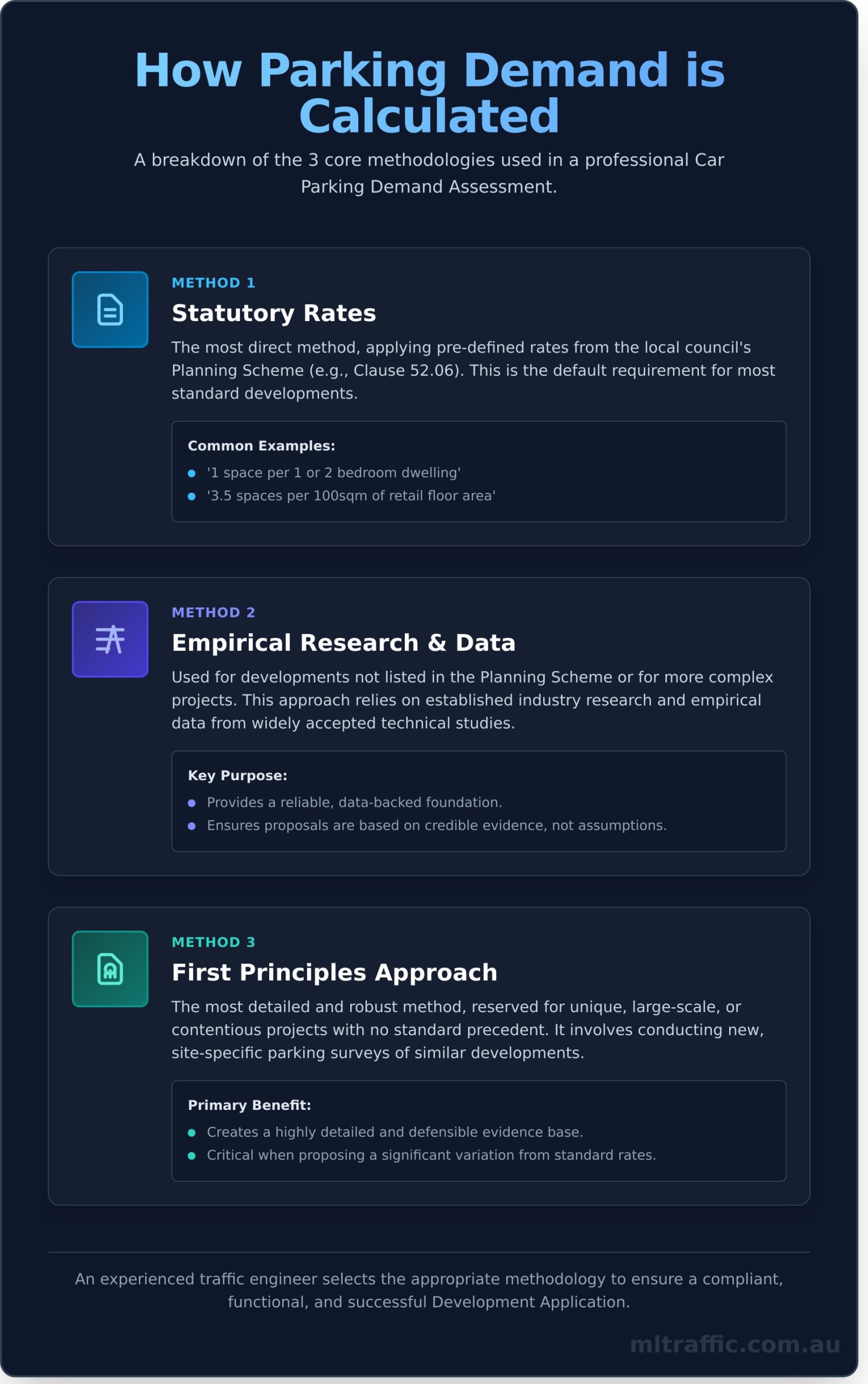
The Core Methodologies: How Parking Demand is Calculated
A professional car parking demand assessment is a technical exercise based on established standards and data, not guesswork. The calculation hinges on applying appropriate ‘parking generation rates’—standardised metrics that correlate a specific land use with the number of parking spaces it is expected to generate. A hierarchy of methodologies exists to determine these rates, and the selection of the correct approach requires the professional judgment of an experienced traffic engineer to ensure compliance and a functional outcome for the development.
Method 1: Statutory Rates in the Victoria Planning Scheme
The most direct and common assessment method involves applying the statutory rates prescribed within the relevant council’s Planning Scheme, primarily under Clause 52.06. These provisions specify the minimum number of car spaces required for various land uses. For example, a scheme might mandate ‘1 space per 1 or 2 bedroom dwelling’ or ‘3.5 spaces per 100sqm of net floor area for a supermarket’. While these rates are the default requirement, a deviation may be justified if it can be demonstrated that site-specific characteristics, such as excellent access to public transport or shared parking arrangements, will result in lower actual demand.
Method 2: Applying Rates from Empirical Surveys and Research
In cases where a proposed land use is not listed in the local Planning Scheme, or for more complex developments, traffic engineers refer to established industry research and data. This can include technical guidelines and widely accepted studies that have collected empirical data on parking demand for a vast range of uses. This method provides a reliable, data-backed foundation for developments that fall outside standard classifications, ensuring the proposed parking provision is based on credible evidence rather than assumptions.
Method 3: First Principles Approach & Parking Surveys
For unique, large-scale, or contentious developments with no standard precedent, a ‘first principles’ approach is required. This is the most detailed methodology, involving new, site-specific traffic surveys of comparable, existing developments to gather real-world, localised data on parking accumulation and turnover. A car parking demand assessment prepared using this bespoke method provides a highly detailed and defensible evidence base, which is critical when proposing a significant variation from standard requirements. Our experts can determine the right methodology for your project.
Key Factors Influencing Parking Demand for Different Land Uses
A core component of any development application is determining the appropriate number of car parking spaces. The Victoria Planning Scheme provides statutory rates, but a comprehensive car parking demand assessment must account for the specific land use, its operational characteristics, and external factors. The demand generated by a residential apartment block is fundamentally different from that of a retail centre or a medical facility.
Factors that can modify standard parking rates include:
- Proximity to Public Transport: Sites located near train stations or high-frequency bus and tram routes may justify a reduction in parking provision.
- Shared Parking: In mixed-use developments, peak demand for different uses (e.g., office and restaurant) may occur at different times, allowing for shared use of the same parking spaces.
- Operational Needs: The assessment must also consider non-customer requirements, such as dedicated staff parking, loading docks for deliveries, and service vehicle bays.
Residential Developments (Apartments, Townhouses)
For residential projects, parking demand is primarily calculated based on the number of bedrooms per dwelling. A typical requirement is one space for one or two-bedroom dwellings and two spaces for dwellings with three or more bedrooms. Additionally, a separate provision for visitor parking is mandated, often at a rate of one space per five dwellings. All car park designs, including aisle widths and space dimensions, must comply with Australian Standard AS 2890.1.
Commercial and Retail Sites (Shops, Offices)
Parking rates for commercial and retail uses are typically based on the Gross Floor Area (GFA) of the premises. The assessment must distinguish between the needs of employees, who require long-term parking, and customers, who require short-term, high-turnover spaces. A crucial factor is an analysis of peak demand periods. For example, a café’s peak may be the weekday lunch rush, while a large retail outlet’s peak is on a Saturday afternoon.
Specialised Uses (Medical Centres, Childcare, Places of Worship)
Specialised land uses have unique demand profiles that require a tailored approach. The appropriate metric for calculating parking varies significantly:
- Medical Centres: Demand is often calculated per practitioner or consulting room.
- Childcare Centres: Rates are based on the number of children the facility is licensed for, plus a provision for staff.
- Places of Worship: Parking requirements are usually linked to the maximum seating capacity or anticipated peak attendance during services.
Successfully navigating these diverse requirements is critical for a compliant and functional development. An accurate car parking demand assessment ensures your project meets council standards and serves its end-users effectively. For professional traffic engineering advice, contact our experienced consultants.
What to Expect in a Professional Car Parking Demand Assessment Report
The car parking demand assessment report is the key deliverable submitted to the local council. It is not simply a document of calculations; it is a formal submission designed to withstand scrutiny and provide council planners with a clear, logical, and defensible justification for your proposed parking supply. A well-structured report demonstrates professionalism and a thorough understanding of the Victoria Planning Scheme, significantly improving the likelihood of a smooth assessment process.
The ultimate goal of the report is to present an unambiguous conclusion. Council planners require a definitive statement on whether the proposed car parking provision is adequate for the development. A professional report leaves no room for interpretation and provides all the necessary evidence to support its findings.
Standard Report Structure and Contents
To facilitate a quick and efficient review by council officers, a professional report follows a logical and predictable structure. While project specifics may vary, the core components remain consistent:
- Introduction: A concise overview of the proposed development, its location, and the purpose of the report.
- Methodology: A clear statement of the assessment framework, referencing Clause 52.06, relevant council policies, and the specific parking rates applied.
- Calculation: The detailed, step-by-step calculation of the parking demand based on the stated methodology. This section shows all working transparently.
- Conclusion: A final, definitive statement confirming that the proposed parking supply satisfies the calculated demand and complies with the planning scheme.
Data Presentation and Justification
Clarity is paramount. The report must present complex data in a simple, digestible format. This is typically achieved through the use of tables to show the application of parking rates to the different components of the development (e.g., number of dwellings, floor area). Architectural site plans are always included to visually demonstrate the proposed parking layout, dimensions, and access arrangements, proving compliance with Australian Standards such as AS 2890.1. If any deviation from standard rates is proposed, a robust written justification supported by evidence is essential.
The ML Traffic Engineers Process
Our process is designed for efficiency and accountability. We ensure you receive a comprehensive car parking demand assessment that meets all council requirements. The consultant who provides the quote is the senior engineer who does the work.
- Initial Quote: We provide a fixed quote based on your specific project plans and council requirements.
- Direct Communication: You have direct contact with the senior traffic engineer responsible for your report throughout the entire process.
- Draft Review: We issue a draft report for your review and comment, ensuring it aligns with your application before finalisation.
- Ongoing Support: We remain available to respond to any council queries or requests for further information after submission.
For expert advice on your development’s parking requirements, contact ML Traffic Engineers today.
Secure Your DA with an Expert Car Parking Demand Assessment
Navigating council requirements for parking is a critical step in any development application. A comprehensive assessment is not merely a box-ticking exercise; it is a technical document that substantiates your project’s design and mitigates potential planning objections. The accuracy of this report, based on proven methodologies and site-specific factors, can be the difference between a swift approval and costly delays.
To ensure compliance and a smooth DA process, entrust your project to proven specialists. For over 15 years, ML Traffic Engineers has delivered professional reports accepted by councils across Australia. When you work with us, you gain direct access to our principal engineers—the same expert who provides your quote will complete the work. This ensures your car parking demand assessment receives the highest level of technical oversight.
Secure the expertise your development deserves. Request a Fee Proposal for Your Car Parking Demand Assessment today and move your project forward with confidence.
Frequently Asked Questions About Car Parking Demand Assessments
How much does a car parking demand assessment cost in Australia?
The cost for a standard car parking demand assessment in Australia typically ranges from A$2,000 to A$5,000 plus GST. This fee is influenced by the project’s complexity, the proposed land use, and the need for on-site data collection like parking utilisation surveys. Simple change-of-use applications fall at the lower end of this scale, while large-scale or mixed-use developments require a more detailed analysis to satisfy council requirements and will incur a higher fee.
What happens if my development proposal doesn’t meet the minimum parking rates?
If a proposal does not provide the statutory parking rates specified in Clause 52.06, a formal justification is required to proceed. This is the primary function of a car parking demand assessment. The report provides an evidence-based argument to the local council demonstrating that the proposed parking supply is sufficient for the actual demand generated by the specific land use. Without this expert justification, the planning permit application is likely to be refused.
Can I use on-street parking spaces to meet my development’s demand?
On-street parking is a shared public asset and generally cannot be formally counted towards a development’s required parking provision. A traffic engineering report may survey the availability of on-street parking to demonstrate that any minor overflow from an on-site shortfall can be accommodated without negatively impacting local amenity. However, the primary objective is to prove the on-site provision is sufficient for the site’s anticipated peak demand.
How long does it typically take to prepare a car parking demand assessment report?
A standard car parking demand assessment report is typically completed within 5 to 10 working days from formal engagement. This timeframe can be extended if the project requires on-site data collection, such as parking surveys, which must be scheduled for representative periods. More complex projects or those that necessitate pre-submission consultation with council traffic engineers may also require additional time. We provide a clear delivery schedule with every fee proposal.
Is a parking assessment required for a simple change of use application?
Yes, a parking assessment is frequently required for a change of use application, even when no building works are proposed. The need is triggered if the new land use has a higher statutory parking requirement under the Planning Scheme than the previous lawful use. For instance, converting a retail store to a medical centre increases the parking rate, creating a deficit that must be formally justified to the council via a technical report.
Do I need a separate assessment for bicycle and motorcycle parking?
No, a separate assessment is not usually required. The analysis of bicycle and motorcycle parking is typically integrated into the comprehensive traffic and parking assessment report. Requirements for bicycle facilities are detailed in Clause 52.34 of the Victoria Planning Scheme and must be addressed. Our reports provide a complete assessment of all vehicle parking needs to ensure full compliance with all relevant planning provisions and Australian Standards.
What information do I need to provide to get a quote for a parking assessment?
To receive a fixed-fee proposal, we require a full set of architectural drawings, including site and floor plans. You should also provide the complete site address and a detailed description of the proposed development or change of use, including key operational details like operating hours and employee numbers. Supplying any correspondence from the local council, such as a Request for Further Information (RFI), is also essential for an accurate assessment and quote.