

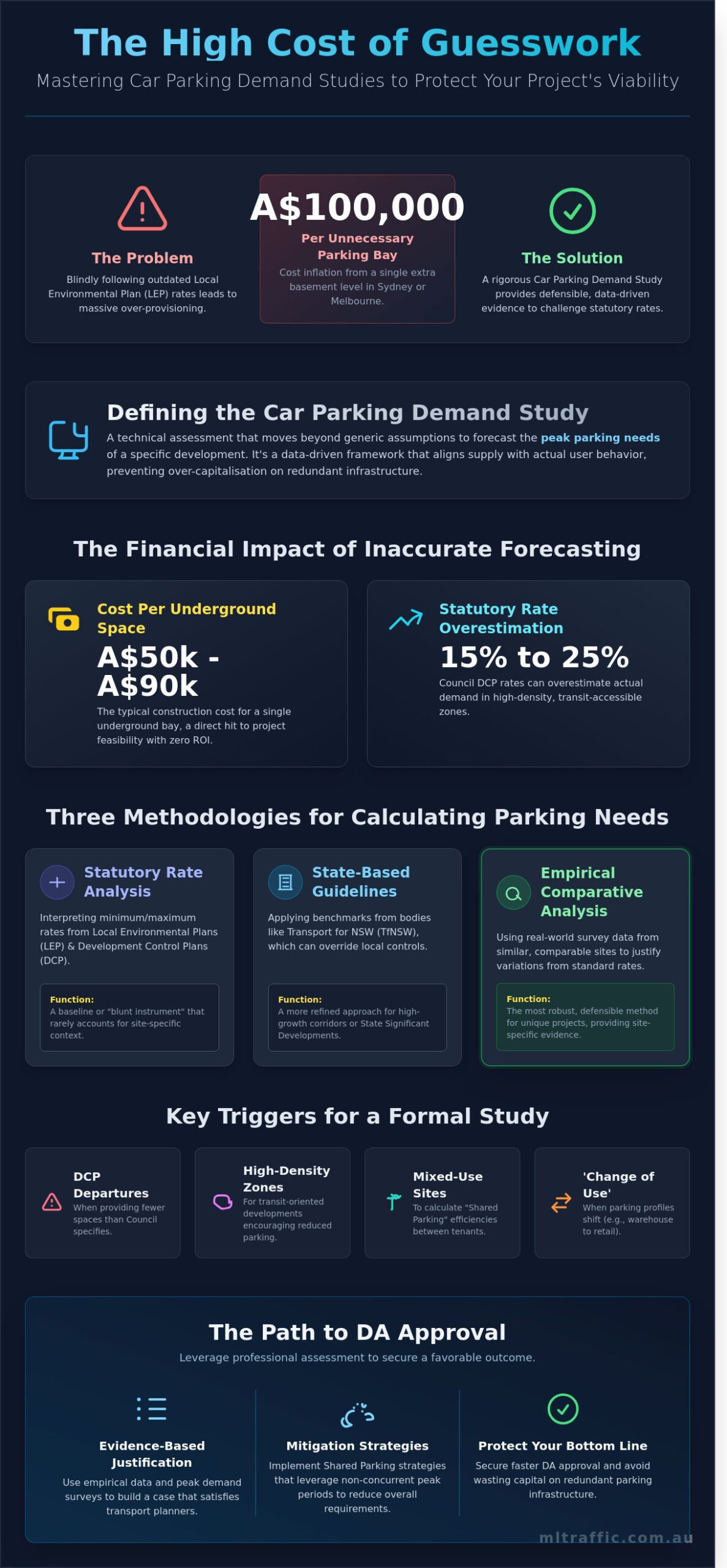
An unnecessary basement level in a Sydney or Melbourne multi-residential project can inflate construction costs by A$100,000 per parking bay. For many Australian developers, blindly following Local Environmental Plan (LEP) rates isn’t just conservative; it’s a direct threat to project viability. Implementing a rigorous car parking demand study methodology is the only defensible way to challenge these rigid statutory requirements and secure a more favorable outcome.
You’ve likely experienced the frustration of a Council rejection due to “inadequate” parking or the financial burden of over-provisioning based on outdated standards. It’s common for LEP rates to vary by 30% between neighboring LGAs, creating inconsistent hurdles for your development team. This technical guide provides the exact frameworks used to justify parking supply and fast-track DA approvals. You’ll learn how to leverage empirical data, peak demand surveys, and comparative site analysis to build a case that satisfies transport planners and protects your bottom line. We’ll break down the transition from generic parking codes to site-specific evidence that stands up under technical scrutiny.
Key Takeaways
- Identify the critical differences between statutory rates in Local Environmental Plans (LEP) and empirical data to prevent project over-capitalisation.
- Apply a rigorous car parking demand study methodology using primary field surveys and “Design Hour” identification to accurately forecast peak parking needs.
- Utilise state-level guidelines from bodies like Transport for NSW (TfNSW) to provide technical evidence that supports your specific development context.
- Mitigate potential council objections regarding parking shortfalls by implementing Shared Parking strategies that leverage non-concurrent peak periods.
- Secure DA approval by leveraging professional assessments from senior traffic engineers who manage the entire reporting process from quote to completion.
Table of Contents
- Defining the Car Parking Demand Study Methodology
- Primary Methodologies for Calculating Parking Requirements
- Data Collection Framework: Gathering Empirical Evidence
- Justifying Parking Shortfalls: The Methodology of Mitigation
- The Role of Professional Assessment in DA Approval
Defining the Car Parking Demand Study Methodology
A Car Parking Demand Study (CPDS) is a technical assessment used to forecast the peak parking needs of a specific land use. It’s a critical component of the planning process that moves beyond generic assumptions to provide site-specific clarity. A car parking demand study methodology is a data-driven framework designed to align development supply with user behavior. This approach ensures that developers don’t waste capital on redundant infrastructure while meeting the operational requirements of the site.
The methodology must balance statutory requirements, often rooted in historical Parking mandates, with real-world empirical data to prevent over-capitalisation. In many Australian jurisdictions, building a single underground parking space can cost between A$50,000 and A$90,000. Applying a standardized approach is essential for traffic engineering and long-term site functionality, as it provides a defensible evidence base for both councils and private stakeholders.
To better understand the technical basis of volume and demand assessments, watch this video on traffic studies:
The Core Purpose of Parking Assessments
The primary objective is to demonstrate that a development won’t cause ‘overflow’ parking on public streets. This protects local amenity and prevents traffic congestion caused by drivers circling for spots. Additionally, the study provides the technical basis for a Traffic Impact Assessment (TIA) report. By accurately predicting demand, engineers can optimise land use, avoiding the construction of redundant, expensive parking spaces that offer no return on investment.
When is a Formal Methodology Required?
A formal car parking demand study methodology is mandatory for ‘Change of Use’ applications where parking profiles shift. For instance, moving from a low-intensity warehouse to a high-turnover retail outlet changes the temporal demand of the site. It’s also required for new residential, commercial, or industrial builds that exceed local threshold sizes defined by the Council.
- DCP Departures: Essential when a developer seeks to provide fewer spaces than specified in a Council Development Control Plan (DCP).
- High-Density Zones: Often required in transit-oriented developments where reduced parking is encouraged.
- Mixed-Use Sites: Necessary to calculate “shared parking” efficiencies between different tenants.
Professional traffic consultants use these methodologies to ensure compliance with Australian Standards (AS 2890.1) while advocating for the most efficient use of the developer’s land and capital.
Primary Methodologies for Calculating Parking Requirements
Traffic engineers utilize three established approaches to determine a project’s parking needs. Selecting the right car parking demand study methodology depends on the development’s scale and its proximity to major transport hubs. Accuracy in these early stages prevents over-provision, which can significantly inflate construction budgets.
- Statutory Rate Analysis: Interpreting minimum and maximum rates defined in Local Environmental Plans (LEP) and Development Control Plans (DCP).
- State-Based Guidelines: Applying Transport for NSW (TfNSW) Guide to Traffic Generating Developments or similar state-level benchmarks.
- Empirical Comparative Analysis: The most robust method for unique projects, using real-world data from similar sites to justify variations.
Statutory Rate Analysis vs. Empirical Data
Council DCP rates function as blunt instruments. They provide a baseline but rarely account for site-specific walkability or high-frequency transit access. A 2022 assessment of Sydney metropolitan councils found that standard DCP rates can overestimate actual demand by 15% to 25% in high-density zones. We apply credits for existing land uses to lower new parking obligations. If a 1,000sqm warehouse is replaced by a new commercial facility, the developer only pays for the net increase in demand. State guidelines often override local controls in specific high-growth corridors or for State Significant Developments (SSD). Our traffic engineering services identify which hierarchy of controls takes precedence for your specific lot.
The Comparative Site Analysis Framework
Empirical analysis is the gold standard for non-standard developments. We identify proxy sites with matching land-use characteristics, scale, and demographic catchments. This process requires data normalization to ensure a like-for-like comparison. We adjust for geographic factors like the Public Transport Accessibility Level (PTAL) to ensure council assessors accept the findings. Utilizing a technical methodology for mixed-use developments allows for shared parking calculations; this often reduces total space requirements by 20% through peak-demand staggering between residential and commercial users.
Small-scale projects usually rely on DCP rates for simplicity. Large-scale residential towers or complex industrial hubs require a customized car parking demand study methodology to avoid the high costs of unnecessary basement excavation. Excavating a single parking space in an Australian CBD can cost between A$80,000 and A$150,000. Accurate data prevents these sunken costs. If you’re unsure which method applies to your site, contact our senior engineers for a direct assessment of your project requirements.
Data Collection Framework: Gathering Empirical Evidence
A defensible car parking demand study methodology relies on primary data collected through rigorous field surveys. We don’t rely on generic assumptions or outdated census data. Our engineers conduct site-specific observations to capture the unique variables of a development. The first step involves identifying the ‘Design Hour’, which is the period of peak parking occupancy. For retail developments, this is typically a Saturday between 11:00 AM and 2:00 PM. For commercial or industrial sites, we focus on mid-week periods, usually Tuesday through Thursday, when staff attendance is highest.
The survey boundary must be carefully defined to produce accurate results. It’s not enough to look at the site in isolation. We establish a catchment area that includes:
- All existing on-site parking bays and loading docks.
- On-street parking within a 200-metre walking distance of the site entrance.
- Adjacent off-street public car parks that might absorb overflow demand.
- Kerbside restrictions and existing time-limited zones (1P, 2P, etc.).
This comprehensive approach ensures we capture interactions between the proposed development and the surrounding street network. All data collected is subsequently applied in accordance with AS 2890.1 standards to ensure the physical design accommodates the observed demand safely and efficiently.
Parking Accumulation Surveys
The technical process involves recording ‘in’ and ‘out’ vehicle movements at 15-minute intervals. This granularity is essential for identifying the exact moment of maximum accumulation. By subtracting departures from arrivals, we determine the peak number of vehicles present on-site at any given time. We distinguish between long-stay profiles, such as staff or residents, and short-stay profiles, such as customers or couriers. This data is critical when applying for a parking rate reduction, as it provides empirical proof that the actual demand is lower than statutory requirements. It’s a method we’ve refined over 10,000 sites since 2005.
Duration of Stay and Turnover Analysis
Turnover analysis is a vital component of a car parking demand study methodology for high-intensity land uses like medical centres or quick-service restaurants. We calculate the turnover rate by dividing the total number of vehicles served by the number of available spaces. If a medical clinic has a high patient volume, we must calculate an ‘efficiency factor’ for the car park. This factor accounts for the time lost during vehicle manoeuvres and the ‘search time’ for a vacant bay. We use duration data to justify parking management plans to Council. If 90% of visitors stay for less than 60 minutes, we can confidently propose time-limited zones that ensure high turnover and prevent staff from occupying premium customer spaces.
Justifying Parking Shortfalls: The Methodology of Mitigation
The most frequent objection from local councils involves a perceived parking shortfall. When the proposed supply is lower than the statutory requirements outlined in a Local Environmental Plan (LEP) or Development Control Plan (DCP), the car parking demand study methodology must demonstrate that the actual demand won’t exceed the provided capacity. We focus on evidence-based mitigation to prove that a lower number of physical spaces won’t result in vehicle overspill into the surrounding street network.
Reciprocal and Shared Parking Arrangements
Mixed-use developments rarely require the sum of all individual parking requirements. Our methodology utilizes temporal demand analysis to identify how different land uses peak at different times. An office space typically reaches peak occupancy at 11:00 AM and clears by 6:00 PM. A restaurant or bar on the ground floor often sees negligible demand until 5:30 PM.
By applying a mathematical overlay to these demand curves, we justify a lower total supply. For example, a development with both professional suites and a gym can share a significant portion of their visitor allocation. Data shows that these reciprocal arrangements can reduce the total required parking provision by 25% to 35% without compromising site functionality. This approach treats parking as a dynamic resource rather than a static requirement.
Sustainable Transport and Location Offsets
The proximity of a site to public transport infrastructure is a critical factor in reducing private vehicle reliance. We apply specific reduction factors for sites located within 400m of a railway station or 800m of a high-frequency bus interchange. These geographic offsets are supported by census data showing lower vehicle ownership rates in transit-oriented developments.
- Car-Sharing Schemes: Integrating dedicated bays for services like GoGet can remove up to 10 private vehicles from the local road network for every one car-share pod provided.
- End-of-Trip (EOT) Facilities: We quantify the demand reduction gained through high-quality showers, lockers, and secure bicycle parking. Providing 1.5 bike spaces per 100sqm of GFA can justify a measurable decrease in staff parking demand.
- Green Travel Plans (GTP): A formal GTP outlines operational strategies to encourage sustainable commuting, which we use to support a 10% to 15% reduction in total demand calculations.
Functionality is as important as quantity. We use swept path analysis to ensure that every provided space is accessible for the B85 or B99 design vehicle. This technical verification proves to the council that the proposed supply is 100% functional and compliant with AS 2890.1 standards. Even a small shortfall is acceptable if the remaining spaces are designed for maximum efficiency and ease of use.
Need a technical assessment to justify your project’s parking provision? Contact our senior engineers for a direct consultation on your site’s specific requirements.
The Role of Professional Assessment in DA Approval
Council assessors prioritize reports signed by experienced traffic consultants because they provide a defensible evidence base for planning decisions. When a development application (DA) seeks a variation from standard parking rates, the assessor requires certainty that the proposal won’t result in overspill into surrounding streets. A professional report functions as a technical justification that balances commercial viability with public interest. It’s the difference between a project being delayed by multiple Requests for Information (RFIs) and receiving a timely approval.
At ML Traffic Engineers, we operate on a “Quote to Work” promise. This means the senior engineer who assesses your site’s specific needs is the same person who prepares the final report. This direct accountability eliminates the risk of junior staff overlooking critical site constraints. Our car parking demand study methodology focuses on empirical data. We ensure every recommendation is backed by site-specific observations rather than generic assumptions. Our focus is results. We’ve completed over 10,000 projects since 2005, giving us the experience to anticipate council objections before they’re raised.
The final report must be structured to facilitate quick review by council officers. It includes an executive summary for decision-makers, a detailed methodology section, comprehensive data analysis, and clear recommendations. We integrate these findings with broader car park design and access requirements to ensure the entire transport component of the DA is cohesive. This includes checking sight-lines and driveway ramp grades against local requirements.
Report Certification and Compliance
Technical reports often require oversight from a Registered Professional Engineer of Queensland (RPEQ) or an equivalent senior engineer in other states to be considered valid by planning authorities. We ensure all calculations and swept path assessments align with the latest versions of AS 2890.1 and relevant state guidelines. A professionally certified report also serves as an expert witness document. If a project moves to a planning appeal or a court hearing, the car parking demand study methodology must withstand rigorous cross-examination by council solicitors. Our principals bring between 30 and 40 years of experience to every assessment.
Next Steps for Developers
Developers should engage a traffic engineer as early as possible in the design process. Identifying a parking shortfall during the initial concept stage allows for design adjustments before significant costs are incurred. When preparing a brief for a parking demand study, include all proposed land uses and any nearby public transport infrastructure. This helps pre-empt council concerns regarding traffic generation. For expert assistance with your project, contact ML Traffic Engineers to discuss your specific requirements with our senior principals. We provide direct access to experts who understand the technicalities of Australian traffic engineering.
Advancing Your Development Through Technical Precision
A rigorous car parking demand study methodology is the difference between a stalled application and a successful DA approval. You must bridge the gap between rigid council rates and the empirical reality of your site using defensible data. ML Traffic Engineers provides this technical certainty through over 15 years of experience in Australian traffic engineering. We’ve delivered results for over 10,000 sites across the country, specializing in everything from high-rise apartments to complex industrial warehouses.
Our firm operates on a direct-access model. You’ll work directly with our senior principals, Michael Lee and Benny Chen, rather than junior consultants. This ensures your project benefits from decades of technical expertise and a deep understanding of AS 2890.1 standards. We’ve built our reputation on being meticulous and results-oriented. The engineer who provides your quote is the person who performs the work, ensuring total accountability throughout the assessment process. It’s a reliable approach designed to navigate bureaucratic requirements with ease.
Secure Your DA Approval with a Professional Parking Assessment
Take the next step toward project success by partnering with experts who understand the complexities of the Australian planning landscape.
Frequently Asked Questions
What is a car parking demand study?
A car parking demand study is a technical assessment that calculates the peak number of vehicles expected at a specific development site. It evaluates whether the proposed parking supply meets the actual needs of the project based on its specific land use. This analysis ensures the development complies with AS 2890.1 and local planning schemes to prevent negative impacts on the surrounding road network.
How is parking demand calculated for a new development?
Engineers use a specific car parking demand study methodology that combines statutory requirements with empirical data. We apply parking rates from the RTA Guide to Traffic Generating Developments or local Planning Schemes to the Gross Floor Area (GFA) or unit count. For a 50 unit apartment block, we calculate specific needs based on bedroom counts and visitor requirements to ensure 100% compliance with local government standards.
Why do councils require a car parking demand assessment?
Councils mandate these assessments to prevent vehicle overspill onto public streets and ensure local traffic safety. A shortfall in on-site parking often leads to a 15% or higher increase in local street congestion. This professional report proves your development won’t adversely impact the 100% capacity of existing street parking infrastructure or create hazards for other road users.
What is the difference between statutory parking rates and empirical demand?
Statutory rates are fixed numbers set by local government planning schemes or the NSW RTA Guide. Empirical demand reflects the actual measured parking usage at 3 or more comparable sites in similar locations. Often, statutory rates require 2 spaces per unit while empirical data shows only 1.2 spaces are actually used during the 9:00 PM peak period.
Can I justify a parking shortfall for my development?
You can justify a parking shortfall by providing technical evidence of high public transport accessibility or shared parking efficiencies. If a site is within 400 metres of a major train station, councils often accept a 20% reduction in required spaces. We use a car parking demand study methodology to prove that the actual peak demand won’t exceed your proposed supply.
What data is needed for a parking accumulation survey?
A survey requires vehicle entry and exit counts at 15 minute intervals over a 12 hour or 24 hour period. We track total occupancy levels to identify the exact peak hour of demand for the specific land use. This data must be collected during typical operating conditions, avoiding public holidays or school vacation periods to ensure the results are 100% accurate.
How long does a parking demand study take to complete?
A standard assessment usually takes 10 to 15 business days from the initial site visit to the final report delivery. This timeline includes on-site data collection, analysis against AS 2890.1 standards, and the drafting of the technical documentation. Complex sites requiring multiple accumulation surveys or RPEQ certification typically require an additional 5 to 7 days for full completion.
Do I need a traffic engineer for a car parking demand study?
Yes, most Australian councils require reports signed by a qualified traffic engineer or an RPEQ registered professional. At ML Traffic Engineers, the consultant who provides your quote performs the actual technical work themselves. This ensures your DA submission includes professional, peer-reviewed data that stands up to council scrutiny and meets all necessary Australian Standards for transport planning.
Which areas do you cover?
We are traffic engineers servicing Melbourne, Sydney, Brisbane, Gold Coast, Hobart, Perth, Adelaide, Darwin, Canberra and surrounding areas.
Disclaimer
The content on www.mltraffic.com.au, including all technical articles, guides, and resources, is provided for general informational and educational purposes only. It is not intended to constitute professional advice in traffic engineering, transportation planning, development approvals, or any other technical or legal field.
While ML Traffic Engineers makes every reasonable effort to ensure the accuracy, completeness, and timeliness of the information published, we do not provide any warranties or representations (express or implied) regarding its reliability, suitability, or availability for any particular purpose. Any reliance you place on the content is strictly at your own risk.
In no event shall ML Traffic Engineers, its directors, employees, authors, or affiliates be liable for any direct, indirect, incidental, special, consequential, or punitive damages (including, without limitation, loss of profits, data, or business opportunities) arising out of or in connection with the use of, or inability to use, any information provided on this website.
The articles and guides on this site are not a substitute for engaging a qualified, registered professional traffic engineer (such as an NPER or RPEQ engineer) to assess your specific project requirements. For tailored advice, compliance assessments, or traffic engineering services, please contact a competent professional.
This disclaimer may be updated from time to time without notice. By accessing or using this website, you agree to be bound by the most current version of this disclaimer.
