

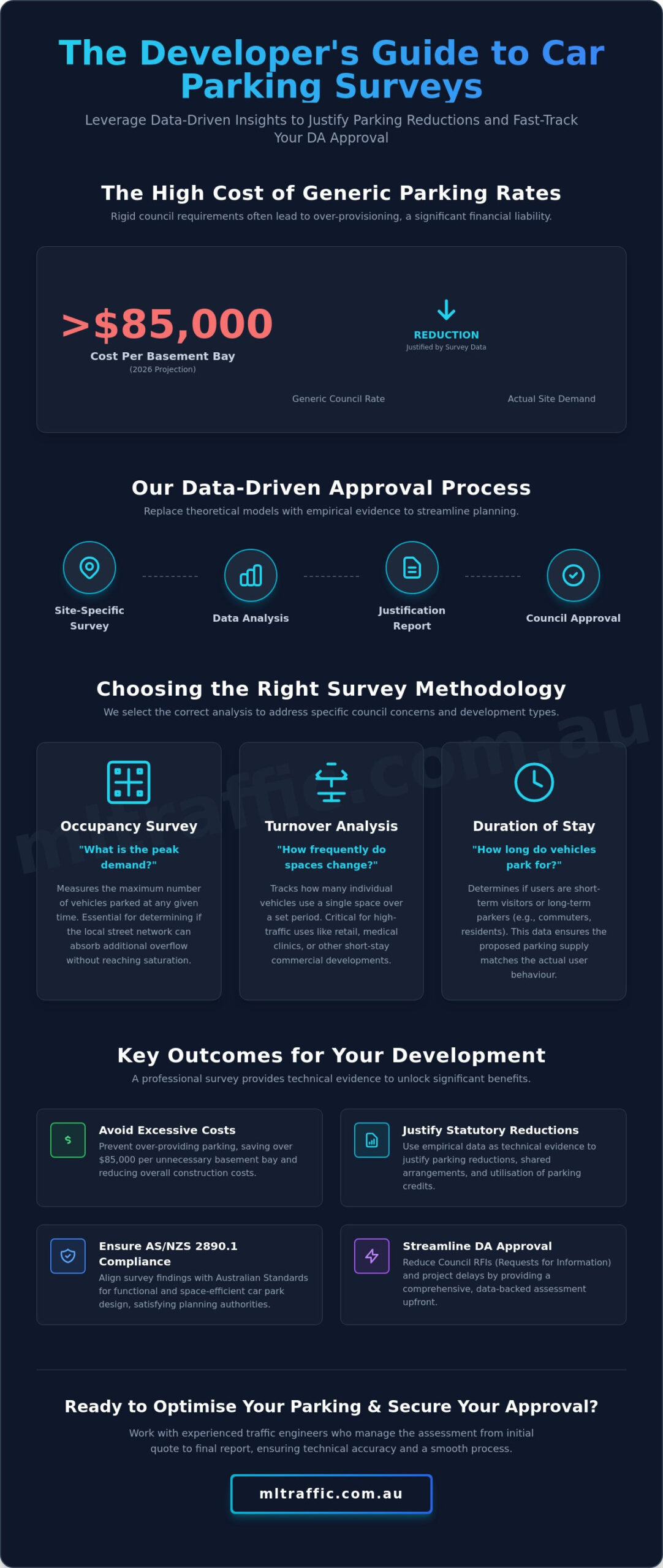
With basement construction costs now exceeding $85,000 per bay in 2026, over-providing parking based on generic Council rates is a financial liability. You’ve likely encountered a Council RFI demanding more spaces than your site can accommodate, even when data indicates those spots will remain underutilised. It’s a common obstacle for developers caught between rigid statutory requirements and the practical constraints of modern urban design.
A professional Car Parking Survey provides the empirical, site-specific evidence required to justify a parking reduction and secure a compliant report that Council will accept. This article details how to leverage technical data to fast-track your planning approval. We’ll cover the essential requirements of AS/NZS 2890.1:2021, the implications of the 2025 Victorian and South Australian regulatory updates, and the specific survey methodologies used to satisfy planning authorities. Our focus is providing the technical assessments, including Car Parking Demand Assessments and Vehicle Swept Path Analysis, that secure results for private clients and their development applications.
Key Takeaways
- Utilise empirical data from local sites to replace generic Council parking rates and avoid the excessive costs of over-providing parking spaces.
- Identify whether occupancy, turnover, or duration metrics are the most effective survey methodologies for your specific development type.
- Leverage a professional Car Parking Survey to provide the technical evidence required to justify shared parking arrangements and statutory reductions.
- Ensure your development remains compliant with AS 2890.1:2021 by aligning survey findings with functional and space-efficient car park design.
- Streamline the planning approval process and reduce RFIs by working with experienced traffic engineers who manage the assessment from initial quote to final report.
Table of Contents
The Role of Car Parking Surveys in Development Applications
Councils across Australia rely on statutory parking rates derived from broad, often outdated datasets. These figures frequently represent a peak, worst-case scenario that doesn’t reflect the reality of modern urban transport. This rigid approach can make a development financially unfeasible. A professional Car Parking Survey provides the site-specific evidence needed to challenge these assumptions. We replace theoretical models with real-world data collected from the immediate vicinity. By citing actual local conditions, we bypass generic parking mandates that don’t account for proximity to public transport or changing vehicle ownership patterns.
To better understand the technical methodologies used to capture this data, watch this helpful video:
A data-driven report directly impacts your DA approval timeline. Without empirical evidence, Councils often issue a Request for Information (RFI), which can stall a project for months. Providing a Car Parking Survey at the initial lodgement stage demonstrates technical competence. It gives planning officers the objective justification they need to support a parking reduction. This is critical given the 2025 updates to Victorian and South Australian parking regulations, which have significantly altered statutory requirements for developers in Greater Adelaide and Melbourne.
When is a Parking Assessment Legally Required?
A formal assessment is typically triggered when a proposed parking supply falls below the minimums set in the local Development Control Plan (DCP). You’ll also need one for a change of land use where the new activity technically requires more spaces than the existing building provides. High-density developments in areas with high on-street parking stress are also major trigger points. In these cases, Council won’t accept a simple statement; they require a detailed assessment as part of our traffic engineering services to prove the project won’t negatively impact the local community.
Understanding the Concept of ‘Parking Credits’
Parking credits are a vital tool for reducing your construction burden. They represent the parking demand already legally associated with a site’s existing use. If a building has historically operated with a specific shortfall, those "credits" can often be applied to offset the requirements of your new proposal. We document these historical rights by surveying the current site use. This evidence ensures you aren’t forced to provide parking for demand that already exists. It’s a meticulous process where the traffic consultant who quotes the work does the work, ensuring no technical detail is missed during the assessment.
Understanding Survey Methodologies: Occupancy, Turnover, and Duration
A successful Car Parking Survey requires selecting the correct methodology to address specific Council concerns. We don’t just count cars; we analyse how the parking ecosystem functions. Parking occupancy measures the peak demand within a defined study area. It identifies the maximum number of vehicles parked at any given time. This data is essential for determining if a local street network can absorb additional overflow from a new development without reaching a saturation point.
Turnover and duration provide a deeper layer of technical insight. Parking turnover tracks how many individual vehicles utilise a single space over a set period. High turnover is typical for retail or medical clinics where visitors stay for short periods. Conversely, duration of stay determines if users are short-term visitors or long-term residents. Understanding these patterns allows us to align our findings with the Transport for NSW Parking Guidelines or relevant local equivalents. This ensures the proposed parking supply matches the actual needs of the end-users rather than an arbitrary figure.
Timing is a critical factor in data collection. We conduct surveys during peak periods specific to the land use. A residential project requires data from late nights or early mornings when residents are home. A retail project demands Saturday peak or weekday lunch hour counts. We avoid school holidays or public holidays unless specifically requested by Council. This precision prevents the use of skewed data that could jeopardise your application. If you’re unsure which timing applies to your site, you can speak directly with our senior engineers for technical guidance.
Inventory and Accumulation Surveys
We begin by establishing a baseline of available capacity. This includes mapping all on-street and off-street spaces within the survey zone. We then calculate the residual capacity, which is the number of spaces that remain empty during peak times. Parking accumulation is the total number of vehicles present at specific intervals. This metric proves to Council exactly how much "breathing room" exists in the current network to accommodate your project’s demand.
Advanced Data Collection Methods
Methodology choice depends on the complexity of the site and the specific concerns raised by the planning authority. Manual beat counts involve staff walking the area at set intervals. This is cost-effective for smaller catchments. High-definition video monitoring or License Plate Recognition (LPR) provides higher accuracy for large-scale duration studies. LPR captures exact entry and exit times, removing the margin of error found in manual intervals. We select the tool that best satisfies the Car Parking Survey requirements of your local Council.
Leveraging Empirical Data to Justify Parking Reductions
Generic statutory parking rates are often a barrier to development feasibility. Councils typically apply a "one size fits all" approach that ignores site-specific nuances. A professional Car Parking Survey provides the empirical evidence required to challenge these rigid requirements. We use real-world data to prove that local demand is lower than the standard rates listed in a Development Control Plan (DCP). This objective justification is the only way to secure a parking reduction without triggering a project-killing RFI.
Proximity to public transport is a primary lever in this argument. In jurisdictions like Victoria and the Australian Capital Territory, planning schemes are moving toward performance-based requirements. These rules acknowledge that residents near train stations or high-frequency bus corridors own fewer vehicles. We document these local ownership patterns and transport accessibility metrics to demonstrate that the mandated parking supply exceeds actual demand. Addressing Council’s fear of "overflow" into residential streets is essential. By providing detailed occupancy data, we show exactly how much residual capacity exists in the surrounding area to absorb minor shortfalls during peak events.
The Shared Parking Demand Model
Mixed-use developments offer a unique opportunity to reduce parking provisions through shared demand logic. A Car Parking Survey can prove that the peak demand for retail occurs during the day, while residential demand peaks at night. This allows the same physical spaces to serve different users at different times. For example, our assessments often demonstrate that 10 well-managed spaces can satisfy a statutory requirement for 15. This isn’t just a planning win; it’s a financial one. With basement construction costs exceeding $85,000 per bay in 2026, avoiding unnecessary levels can save hundreds of thousands in capital expenditure.
Case for On-Street Parking Availability
When a site cannot accommodate the full statutory requirement, we look to the surrounding street network. We use occupancy data to identify the "residual capacity" within a defined walking catchment, usually 200 to 400 metres from the site. If the survey shows that nearby streets remain under 85% capacity during peak hours, we argue that the network can safely absorb the development’s minor parking shortfall. This justification is often paired with a Swept Path Analysis: A Developer’s Guide to Council Approval to prove that vehicles can access the site safely without causing congestion. Our senior engineers ensure the data is meticulous because the traffic consultant who provides the quote is the one who does the work.
Technical Requirements and AS 2890.1 Compliance
A Car Parking Survey is only as effective as the design it supports. Generic parking counts are useless if the physical site cannot accommodate spaces that meet technical legal requirements. We ensure that the data collected informs a functional Car Park Design that complies with Australian Standards. There’s a direct intersection between parking demand and physical space constraints. If a survey justifies a reduction to 20 spaces, but those spaces don’t meet the minimum dimensions for their intended user class, Council will reject the application regardless of the demand data.
The primary standard governing these layouts is AS/NZS 2890.1:2021. This standard dictates the technical parameters for bay widths, lengths, and aisle clearances. For example, User Class 1 (short-term, high turnover) requires a minimum width of 2.5 metres and a length of 5.4 metres for 90-degree parking. User Class 3 (long-term residential) allows for a narrower 2.3-metre width, provided there are no adjacent obstructions. We integrate these technical constraints into the final Traffic Impact Assessment (TIA) to ensure the proposed parking supply is both mathematically sufficient and physically compliant.
Applying AS 2890.1 to Your Parking Layout
Standardising space widths and aisle lengths based on user class is a mandatory step in the planning process. We verify that every "surveyed" space used in our comparative analysis meets these legal dimensions. This prevents Council from arguing that your data is skewed by sub-standard or "illegal" parking spots in the surrounding area. For a deep dive into these technicalities, read our guide on AS 2890.1 Explained: The Ultimate Guide to Compliant Car Park Design.
The Survey Process: From Scoping to Reporting
Our methodology follows a structured, four-step process to ensure data integrity. We don’t outsource the technical oversight; the traffic consultant who provides the quote is the one who manages the assessment.
-
Step 1: Scoping. We identify the survey area and peak periods with a senior Traffic Engineer to ensure we capture the most relevant data for your specific land use.
-
Step 2: Field Survey. We conduct the count using standardised "beat" methods or high-definition video, depending on the complexity of the site.
-
Step 3: Data Cleaning. We analyse the raw figures to remove statistical outliers, such as unusual events or roadworks that might temporarily skew parking demand.
-
Step 4: Justification. We formulate the final justification argument for the DA report, linking the empirical data directly to the proposed parking reduction.
If you need a compliant report to secure your development approval, contact our senior engineers for a technical quote.
Professional Parking Assessments for Australian Projects
Securing a development approval requires more than just raw numbers. It requires a Car Parking Survey backed by a reputation for technical accuracy and professional integrity. ML Traffic Engineers Australia has completed over 10,000 successful site assessments across the country since 2005. This volume of work provides an unparalleled understanding of how different planning authorities interpret parking demand data. We don’t use junior staff or offshore data processors for our analysis. Our core philosophy is simple: the traffic consultant who provides your quote is the expert who does the work.
This hands-on approach ensures that when your project faces scrutiny from a Council or a Planning Panel, the evidence remains robust. We provide direct access to our senior principals, Michael Lee and Benny Chen, who bring between 30 and 40 years of experience each to every assessment. This level of accountability is rare in larger firms where projects are often handed down to less experienced staff. By working directly with the experts at ML Traffic Engineers Australia, you’re ensuring that every technical nuance of your site is captured and defended. There’s no gatekeeper between you and the technical lead; this streamlines communication and ensures the final report is tailored to your project’s unique constraints.
Why Experience Matters in Council Negotiations
Every local government authority in Australia has its own specific set of expectations regarding parking reductions. Navigating these nuances is critical for a fast-tracked approval. A report signed by a registered professional engineer carries significant weight in these negotiations. It transforms a simple data set into a formal expert opinion that planning officers can trust. We ensure your Traffic Impact Assessment is bulletproof by aligning our survey findings with the specific policy objectives of your local Council. This meticulous preparation reduces the likelihood of costly RFIs and project delays. Whether your site is in Victoria, New South Wales, or South Australia, our national experience ensures compliance with the relevant state-level variations.
Get a Comprehensive Parking Survey Quote
We scope every project individually to ensure we aren’t collecting wasted data that adds unnecessary cost. Our focus is on providing the exact evidence required for your specific land use, whether it’s an apartment complex, a medical clinic, or a warehouse. We understand that timing is critical in the development cycle, so we maintain fast turnaround times to help you meet DA submission deadlines. You can contact our principals directly at ML Traffic Engineers Australia to discuss your site requirements. We provide technical clarity from the first phone call, ensuring your Car Parking Survey is designed for success from the outset.
Secure Your Planning Approval with Empirical Data
Generic parking requirements are no longer a fixed barrier to development. By leveraging a professional Car Parking Survey, you replace theoretical mandates with performance-based evidence that planning authorities can verify. We’ve demonstrated how site-specific data justifies reductions, satisfies AS 2890.1:2021 compliance, and ultimately protects your project’s financial feasibility against excessive basement construction costs.
ML Traffic Engineers Australia provides the technical certainty required for complex Australian developments. With over 10,000 sites assessed nationally, our senior principals ensure that the consultant who quotes the work is the expert who does the work. This direct accountability results in robust reports that withstand the scrutiny of Councils and Planning Panels alike. Our focus remains on delivering meticulous assessments that fast-track your approval process and eliminate the uncertainty of generic statutory rates.
Protect your project from unnecessary delays and over-engineering. Request a quote for your Car Parking Survey from our Senior Engineers at ML Traffic Engineers Australia to secure a compliant, data-driven path to approval. We look forward to providing the expertise your development requires.
Frequently Asked Questions
What is the purpose of a car parking survey for a DA?
A Car Parking Survey provides empirical, site-specific data to justify a parking supply that deviates from statutory rates. It replaces generic planning scheme requirements with real-world evidence of local demand. This data is critical for securing Council approval when a development cannot physically or financially accommodate the standard number of spaces mandated by the local planning scheme.
How many days of surveying does Council typically require?
Councils generally require a minimum of two survey days to capture a representative sample of parking activity. This usually includes one typical weekday and one weekend day during peak demand periods. For residential projects, this often involves late-night or early-morning counts, while retail or commercial projects focus on midday or Saturday peaks to capture maximum occupancy levels.
Can I use a car parking survey to justify a zero-parking development?
Yes, a survey can support a zero-parking application in areas with high public transport accessibility and low vehicle ownership rates. We use the data to prove that the proposed land use and location won’t generate a demand for on-site spaces. This approach is increasingly common in inner-city developments located near major transport hubs where sustainable transport is prioritised.
What happens if the survey shows the street is already full?
If a Car Parking Survey indicates high on-street saturation, we pivot the justification to internal site management or shared parking demand. We analyse the timing of your development’s peak demand against the street’s existing peak. If the peaks don’t coincide, we can still argue that the development won’t exacerbate existing parking stress during those critical periods.
What is the difference between a parking occupancy survey and a turnover survey?
Occupancy surveys measure the total number of vehicles present at specific time intervals to determine the maximum demand. Turnover surveys track individual vehicles to see how many unique users occupy a single space over a set duration. Occupancy is used to find total capacity, while turnover is essential for retail or short-stay justifications where space availability is the priority.
Does a car parking survey include bicycle and motorcycle parking?
Yes, modern parking assessments often include data collection for bicycles and motorcycles to support a holistic transport strategy. Proving high demand for these alternative modes can strengthen the case for a reduction in standard car parking spaces. This is particularly relevant for developments in high-density urban corridors where local planning schemes incentivise non-car travel.
How much does a professional car parking survey cost in Australia?
Costs vary based on the size of the survey area, the number of days required, and the complexity of the data analysis. We provide tailored quotes that reflect the specific technical requirements of your local Council. This ensures you only pay for the data collection necessary to secure your planning approval without wasting resources on irrelevant data.
Can video surveys be used instead of manual counting for Council reports?
Video surveys are a highly effective alternative to manual counts and are widely accepted by Australian Councils. They provide a verifiable record of parking activity and allow for precise duration-of-stay analysis. We often recommend high-definition video monitoring for complex sites where accuracy is paramount for a successful Development Application outcome.
Which areas do you cover?
We are traffic engineers servicing Melbourne, Sydney, Brisbane, Gold Coast, Hobart, Perth, Adelaide, Darwin, Canberra and surrounding areas.

Disclaimer
The content on www.mltraffic.com.au, including all technical articles, guides, and resources, is provided for general informational and educational purposes only. It is not intended to constitute professional advice in traffic engineering, transportation planning, development approvals, or any other technical or legal field.
While ML Traffic Engineers makes every reasonable effort to ensure the accuracy, completeness, and timeliness of the information published, we do not provide any warranties or representations (express or implied) regarding its reliability, suitability, or availability for any particular purpose. Any reliance you place on the content is strictly at your own risk.
In no event shall ML Traffic Engineers, its directors, employees, authors, or affiliates be liable for any direct, indirect, incidental, special, consequential, or punitive damages (including, without limitation, loss of profits, data, or business opportunities) arising out of or in connection with the use of, or inability to use, any information provided on this website.
The articles and guides on this site are not a substitute for engaging a qualified, registered professional traffic engineer (such as an NPER or RPEQ engineer) to assess your specific project requirements. For tailored advice, compliance assessments, or traffic engineering services, please contact a competent professional.
This disclaimer may be updated from time to time without notice. By accessing or using this website, you agree to be bound by the most current version of this disclaimer.
