
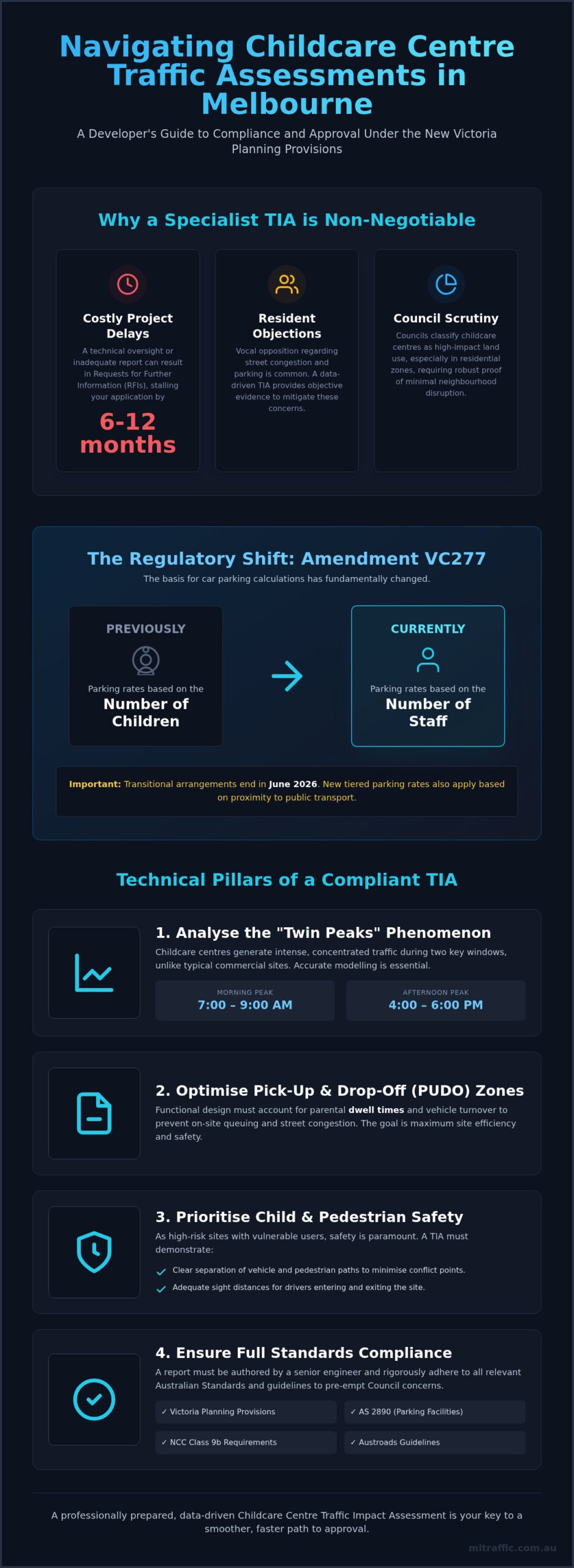
What if the success of your multi-million dollar project hinges on the number of staff members rather than the number of children? Under Amendment VC277 to the Victoria Planning Provisions, the calculation for car parking has fundamentally shifted, making a professional Childcare Centre Traffic Impact Assessment Melbourne more critical than ever. You’ve likely experienced the frustration of Council delays or the pressure of vocal resident objections regarding street congestion. It’s a high-stakes environment where a technical oversight in a drop-off zone can stall your application for six to twelve months.
This guide provides the technical expertise needed to navigate these regulatory changes, including the new tiered parking rates based on public transport access. You’ll learn how to secure a compliant TIA report that addresses pedestrian safety for NCC Class 9b buildings, meets AS 2890 standards, and preempts Council concerns. We’ll outline how to optimise your car park design and manage transitional arrangements before the June 2026 deadline. This approach ensures your development remains viable, compliant, and ready for approval without unnecessary bureaucratic friction.
Key Takeaways
- Understand why a Childcare Centre Traffic Impact Assessment Melbourne is classified as a high-impact technical study and how to address Council’s specific concerns regarding residential zone placements.
- Learn to manage the “Twin Peaks” traffic phenomenon by accurately calculating traffic generation rates during critical morning and afternoon peak periods.
- Optimise your pick-up and drop-off (PUDO) zones by factoring in parental dwell times to ensure maximum site efficiency and vehicle turnover.
- Use data-driven traffic modelling to provide objective evidence that mitigates resident objections regarding street parking and local road congestion.
- Recognise the value of direct senior principal involvement to ensure your report meets AS 2890 standards and avoids costly RFI delays.
Why Childcare Centre Traffic Impact Assessments in Melbourne Require Specialist Scrutiny
A Childcare Centre Traffic Impact Assessment Melbourne is a specialised technical study evaluating the movement of vehicles and pedestrians within and around a proposed facility. These reports are not merely parking counts; they are comprehensive analyses of how a development interacts with the existing road network. Unlike a standard office or retail space, a childcare centre operates with intense, short-duration activity that requires precise engineering to manage safely.
Melbourne Councils typically classify childcare as a high-impact land use, particularly when proposed in residential zones. This classification stems from the friction created when high-volume commercial traffic enters quiet local streets. To secure approval, developers must provide a data-driven Trip generation analysis. This analysis proves the surrounding infrastructure can absorb the predicted traffic without compromising the amenity of the neighbourhood or the safety of local residents.
To better understand the broader context of childcare safety and community impact in Melbourne, watch this report:
The traffic engineer serves as a critical mediator between the developer’s commercial objectives and Council’s regulatory requirements. While a developer seeks to maximise child places, the engineer ensures the site remains functional. This involves prioritising child safety over standard traffic flow metrics, ensuring that every vehicle movement is predictable and every pedestrian path is protected.
The Legal Necessity of a Traffic Report for DA
Under the Victoria Planning Provisions, specifically Clause 52.06, most childcare developments require a formal submission to obtain a permit. Professional Traffic Impact Assessments are the primary tool for navigating this process. Inadequate or amateur reports frequently lead to Requests for Further Information (RFIs). These requests can delay a project by six to twelve months, costing developers significant holding charges. A compliant report addresses all technical requirements in the initial planning phase, facilitating a smoother path to approval.
Child Safety and Pedestrian Interaction
Childcare sites involve a high concentration of vulnerable road users, including toddlers and distracted parents. Traffic engineers design safe systems that physically separate vehicle paths from pedestrian zones to prevent accidents. We focus on minimising conflict points where cars and people might cross paths. Sight distance is the length of road or driveway visible to a driver, ensuring they can identify a pedestrian or another vehicle and stop safely before a collision occurs. Maintaining these distances is a non-negotiable requirement for every childcare driveway and car park design.
Technical Pillars of a Childcare TIA: Traffic Generation and Parking
A Childcare Centre Traffic Impact Assessment Melbourne must account for the unique temporal distribution known as the “Twin Peaks” phenomenon. Unlike standard commercial developments, childcare centres experience highly concentrated activity during the 7:00 to 9:00 AM drop-off and the 4:00 to 6:00 PM pick-up windows. This creates significant pressure on the local road network during narrow intervals. Traffic engineers calculate generation rates based on the total number of child places and staff numbers, ensuring the assessment reflects the maximum potential impact on the street.
Directional distribution analysis is another critical pillar. This determines how traffic arrives from and departs to the surrounding network. We don’t rely solely on generic industry averages; we prioritise empirical data from similar sites. This data-driven approach is supported by the Austroads Guide to Traffic Management, which provides the framework for assessing network capacity. By using site-specific observations, we can justify lower traffic impacts to Council, often preventing unnecessary infrastructure upgrades and reducing project costs.
Calculating Car Parking Demand and Compliance
Statutory parking requirements in Melbourne have shifted under Amendment VC277. Requirements are now calculated based on employee numbers rather than child places, though transitional arrangements remain for applications lodged before June 18, 2026. A professional Car Parking Demand Assessment identifies the specific needs of your site, distinguishing between long-term staff parking and short-term visitor bays. All car park layouts must strictly adhere to AS 2890.1 to ensure vehicle manoeuvrability and safety are maintained throughout the facility.
The Impact on Local Intersection Performance
For complex sites, we model the Level of Service (LoS) at nearby intersections using SIDRA software. This modelling evaluates how the development’s traffic affects wait times and queue lengths. A key metric is the Degree of Saturation. Simply put, this measures how much of an intersection’s capacity is being used. If an intersection is at 0.90, it’s at 90% capacity. Our goal is to demonstrate that your development won’t push local intersections into failure, maintaining a reliable flow for the community. Ensuring these technical pillars are solid is essential for a successful Traffic Impact Assessment report.
Designing Functional Pick-up and Drop-off (PUDO) Zones
The pick-up and drop-off (PUDO) zone serves as the engine room of a childcare centre’s daily operations. Within a Childcare Centre Traffic Impact Assessment Melbourne, this area requires the most rigorous testing because it manages the high-frequency turnover identified in peak period analysis. We focus heavily on the “dwell time” variable, which represents the duration a parent remains on-site. While some parents drop children at the door quickly, others require 10 to 15 minutes for handovers and settling. If the PUDO zone isn’t designed to accommodate these varying durations, the entire internal circulation system fails.
Efficient internal circulation prevents vehicle queuing from extending onto the public road network. We design these zones to ensure that even during the busiest intervals, the site can contain its own traffic volume. For shared zones where pedestrians and vehicles interact, we implement specific safety measures such as raised threshold treatments and clearly defined walking paths to protect vulnerable users. This technical precision is what separates a successful permit application from a project stalled by Council safety concerns.
Queuing Analysis and Prevention Strategies
Queuing analysis determines the exact length of on-site storage needed to avoid “spillback” onto external streets. Council will rarely approve a development that risks blocking through-traffic on a local collector road. To ensure the layout is practical, we conduct a Swept Path Analysis for every bay and turn. This technical simulation confirms that vehicles can enter and exit in a single forward motion without the need for dangerous multi-point turns near children.
An efficient PUDO layout should include:
- One-way traffic flow to eliminate head-on conflict points.
- Dedicated bypass lanes to allow departing vehicles to pass those still loading.
- Clear, high-visibility signage indicating time limits and directional requirements.
- Sufficient width for parent vehicles to open doors fully without obstructing the drive aisle.
Staff Parking vs. Parent Parking Management
Separating long-stay staff vehicles from high-turnover parent spaces is essential for site efficiency. Staff occupy bays for eight hours or more, while parent bays might turn over six times in a single hour. By placing staff parking in less accessible areas, such as the rear of a basement or a dedicated upper level, we free up the most convenient spaces for PUDO activity. This separation reduces internal congestion and improves the overall user experience for parents.
Strategic Car Park Design directly impacts the commercial viability of a development. In Melbourne, where basement construction costs can exceed $85,000 per bay, every square metre must be optimised. A well-designed layout ensures compliance with Australian Standards while minimising the total footprint required for vehicle movements. This efficiency often allows for more indoor and outdoor play space, which increases the total number of child places the site can support.
Mitigating Resident Objections and Council Scrutiny
Resident objections are a predictable component of the planning process for childcare developments in Melbourne’s residential zones. Most concerns centre on the perceived loss of street parking and a projected increase in local congestion. A professionally prepared Childcare Centre Traffic Impact Assessment Melbourne provides the objective data required to address these emotional responses with technical facts. By quantifying the actual impact on the road network, we provide Council with a defensible basis for approval.
A critical part of this process is the parking survey. We measure existing on-street parking occupancy at various times of the day to establish a baseline of availability. This evidence proves whether the local street network can accommodate the development’s peak activity without displacing residents. Proactive communication, backed by these technical findings, often resolves friction early in the application phase. If you are facing local opposition, you can contact our senior principal engineers to discuss a tailored mitigation strategy.
Addressing the “Not In My Backyard” (NIMBY) Challenge
We use traffic volume data to demonstrate that the additional trips generated by a childcare centre remain well within the functional capacity of the existing road category. To satisfy Council and resident concerns regarding “rat-running,” we design site access points that discourage parents from using narrow side streets as shortcuts. During the construction phase, a comprehensive Traffic Management Plan ensures that heavy vehicle movements and contractor parking do not disrupt the neighbourhood’s daily rhythm.
Expert Witness and VCAT/Council Representation
When a project proceeds to a Council meeting or a VCAT hearing, the traffic engineer acts as an expert witness to defend the technical merits of the proposal. The testimony of a senior engineer carries significantly more weight than a generic report, as it reflects a deep understanding of Victorian planning law and engineering standards. Our commitment to personnel continuity ensures the specific expert who performed your technical analysis is the one defending the project at the hearing. This expert knows the site’s nuances intimately, providing a level of accountability and detail that is essential for overcoming complex legal or technical challenges.
Expert Traffic Engineering for Childcare Developments
Securing approval for a childcare development in Melbourne requires more than a standard traffic report. It demands a specialised understanding of the intense peak-hour movements and safety protocols unique to the sector. Generalist firms often lack the technical depth to anticipate Council’s specific concerns regarding local amenity and pedestrian safety conflict. Engaging a specialist consultant ensures that your Childcare Centre Traffic Impact Assessment Melbourne is robust enough to withstand both technical scrutiny and resident objections.
ML Traffic Engineers Australia brings over 15 years of specialist experience to every project. We maintain a national capability while providing deep local expertise in the Melbourne Planning Scheme. This experience allows us to navigate the complexities of local regulations with precision. Our approach is built on reliability and results, ensuring your project moves from the planning phase to construction without unnecessary bureaucratic delays.
The ML Traffic Engineers Australia Advantage
We operate with a “no-gatekeepers” philosophy. This means developers speak directly to the senior principals performing the technical work. This direct access to leadership ensures that complex design challenges are resolved quickly and accurately. Our professional traffic engineering services are defined by several key pillars:
- Senior Principal Involvement: A senior expert reviews and signs off on every TIA report, providing a high level of accountability.
- Personnel Continuity: The engineer who initiates your project remains your point of contact throughout the entire Council or VCAT process.
- Technical Rigour: Every assessment strictly adheres to AS 2890.1 and AS 2890.2 compliance standards.
- Broad Experience: Our team has managed successful childcare projects across a vast range of urban and residential environments.
Getting Started with Your Childcare TIA
To begin your assessment, we require a current site plan, the proposed number of child places, and the anticipated staff count. This information allows us to generate an accurate quote and technical timeline for your project. A standard Traffic Impact Assessment for a childcare centre is typically completed within two to three weeks. This timeframe includes the necessary data collection, traffic modelling, and report drafting required for a compliant submission. If you’re ready to advance your development, Contact ML Traffic Engineers Australia to discuss your project-specific requirements and secure a technical partner who understands the Melbourne landscape.
Secure Your Childcare Development Approval
Navigating the technical requirements of Victorian planning schemes requires a precise, data-driven approach to ensure project viability. A comprehensive Childcare Centre Traffic Impact Assessment Melbourne serves as the foundation for managing high-turnover traffic profiles and meeting the latest employee-based parking benchmarks. By prioritising functional PUDO zones and objective parking surveys, you can effectively resolve resident objections and avoid costly RFI delays that stall construction timelines.
ML Traffic Engineers Australia provides 15+ years of expert consultancy with a focus on results and regulatory compliance. We offer direct access to Senior Principals on every project, ensuring your development benefits from national expertise in AS 2890 standards without junior gatekeepers. Our team is committed to personnel continuity, meaning the expert who designs your car park is the same one who defends it at Council or VCAT. Taking these proactive steps ensures your facility remains safe, compliant, and ready for operation.
Get a Professional Traffic Impact Assessment for Your Childcare Project
Frequently Asked Questions
Is a Traffic Impact Assessment mandatory for every childcare centre application?
Yes, a formal traffic report is required for almost all childcare developments in Melbourne. Local Councils classify these facilities as high-impact land uses, particularly when located in residential zones. The assessment must address traffic generation, parking demand, and pedestrian safety to satisfy the requirements of the Victoria Planning Provisions and secure a planning permit.
How many car parking spaces are required for a childcare centre in Melbourne?
As of December 18, 2025, under Amendment VC277, car parking requirements are calculated based on the number of employees rather than the number of children. The specific rate depends on your site’s Public Transport Accessibility Level (PTAL). Category 1 locations require 1 space per employee, while Category 4 areas have no minimum parking requirement, though a maximum of 0.5 spaces per employee applies.
What is the “Twin Peaks” problem in childcare traffic planning?
The “Twin Peaks” problem refers to the intense concentration of vehicle movements during the 7:00 to 9:00 AM drop-off and 4:00 to 6:00 PM pick-up windows. These short intervals create significant pressure on both the internal car park and the surrounding road network. A Childcare Centre Traffic Impact Assessment Melbourne must prove that the site can manage these spikes without causing vehicle queuing on public streets.
Can I get a parking waiver or reduction for my childcare centre?
Yes, you can apply for a parking reduction by submitting a Car Parking Demand Assessment. This process involves providing empirical evidence that the actual demand for your specific site will be lower than the statutory requirements. Engineers use data from similar developments and proximity to public transport to justify a lower provision to Council.
How does Swept Path Analysis help with Council approval?
Swept Path Analysis provides a technical simulation proving that vehicles can safely navigate your site. Council requires this analysis to ensure that parents, staff, and waste collection vehicles can enter and exit in a forward motion. It is a critical component for demonstrating compliance with AS 2890.1 and AS 2890.2, reducing the risk of a Request for Further Information (RFI).
What happens if residents object to my childcare centre based on traffic concerns?
If residents object, your traffic report serves as the primary technical defence during Council meetings or VCAT hearings. We conduct parking surveys to estabelece current on-street occupancy and use data-driven modelling to show the impact is within the road’s functional capacity. This objective evidence often carries more weight than emotional objections regarding local congestion.
How much does a Childcare Centre Traffic Impact Assessment cost?
The cost of a TIA report depends on the scale of the development and the complexity of the required modelling. Factors such as the number of child places, the need for SIDRA intersection analysis, and the volume of parking surveys required will influence the fee. Developers should provide a site plan and staff count to obtain a project-specific quote tailored to their site’s requirements.
How long does it take to prepare a TIA report for Council?
A standard TIA report for a childcare centre is typically completed within 2 to 3 weeks. This timeframe includes site observations, traffic modelling, and the direct involvement of senior principals in the report drafting. Engaging an engineer early in the design phase ensures that any necessary car park modifications are identified before you lodge your application.

Disclaimer
The content on www.mltraffic.com.au, including all technical articles, guides, and resources, is provided for general informational and educational purposes only. It is not intended to constitute professional advice in traffic engineering, transportation planning, development approvals, or any other technical or legal field.
While ML Traffic Engineers makes every reasonable effort to ensure the accuracy, completeness, and timeliness of the information published, we do not provide any warranties or representations (express or implied) regarding its reliability, suitability, or availability for any particular purpose. Any reliance you place on the content is strictly at your own risk.
In no event shall ML Traffic Engineers, its directors, employees, authors, or affiliates be liable for any direct, indirect, incidental, special, consequential, or punitive damages (including, without limitation, loss of profits, data, or business opportunities) arising out of or in connection with the use of, or inability to use, any information provided on this website.
The articles and guides on this site are not a substitute for engaging a qualified, registered professional traffic engineer (such as an NPER or RPEQ engineer) to assess your specific project requirements. For tailored advice, compliance assessments, or traffic engineering services, please contact a competent professional.
This disclaimer may be updated from time to time without notice. By accessing or using this website, you agree to be bound by the most current version of this disclaimer.
