

A single avoidable Request for Information (RFI) from a local Council often stalls Australian developments for 30 to 60 days, racking up thousands in unnecessary holding costs. You likely understand that technical compliance isn’t just a checkbox; it’s the critical path to breaking ground. When you’re choosing your traffic consultant for a 2026 project, the difference between a junior staffer’s template and a principal engineer’s assessment determines whether you face expensive mid-project revisions.
This guide provides a clear framework for vetting traffic engineering firms to ensure your Development Application meets AS 2890.1 and AS 2890.2 standards without the typical back and forth. You’ll learn how to secure first-time DA approval by demanding direct access to the RPEQ or senior engineer actually performing the technical work. We will examine the specific qualifications, technical benchmarks, and accountability markers required to keep your project on schedule and fully compliant with current Australian regulations.
Key Takeaways
- Understand how a single technical oversight in a driveway ramp grade can trigger a 42-day Council delay and how to mitigate this risk.
- Learn to verify technical proficiency by auditing a firm’s use of AutoTURN for Swept Path Analysis and strict adherence to Australian Standards.
- Avoid the “junior hand-off” trap common in large firms by ensuring the senior engineer who provides your quote is the one performing the technical work.
- Discover the essential developer’s checklist for choosing your traffic consultant, including verifying a portfolio of over 10,000 successful site assessments.
- Streamline your DA approval process by leveraging principal-led expertise that prioritizes accountability and direct access to senior engineers.
The Impact of Your Traffic Consultant on Development Approval
A traffic consultant acts as a primary risk mitigator for private developers. They translate complex technical requirements into the data sets required for a successful Development Application (DA). Choosing your traffic consultant is a critical step that dictates your project timeline. A single technical error in a driveway ramp grade or a car park layout can trigger a 42-day Council delay via a formal Request for Information (RFI). This delay often stalls the entire project team, from architects to town planners.
The technical output from Traffic engineering specialists forms a core component of the Statement of Environmental Effects (SEE). Whether you’re managing a small residential subdivision or a large-scale commercial land-use project, traffic impact is a non-negotiable planning criteria. Consultants provide the Vehicle Swept Path Assessments and Sight-Line Assessments necessary to prove that a site is safe, functional, and compliant with local planning instruments.
To better understand the value of expert advice in this field, watch this helpful video:
The Cost of a Poorly Prepared Traffic Impact Assessment
Incomplete reports lead to expensive Council RFIs. These requests don’t just waste time; they increase holding costs and project management fees. Non-compliant car park designs discovered during the construction certificate phase often lead to expensive structural redesigns. If a parking layout fails to meet the minimum requirements for aisle widths or column placements, you may be forced to reduce your yield. Securing first-time planning approval requires a Traffic Impact Assessment (TIA) that anticipates Council objections before they’re raised. You can view our full range of traffic engineering services to see how we address these risks.
National Compliance: Beyond Local Council Schemes
Compliance isn’t limited to local Council Development Control Plans (DCP). Every project must adhere to Australian Standards, specifically AS 2890.1 for off-street car parking and AS 2890.2 for commercial vehicle facilities. Your consultant must understand how national transport planning frameworks impact your specific site. When choosing your traffic consultant, ensure they’ve the technical depth to produce a TIA that stands up to independent review. This is particularly vital if your project faces scrutiny from state road authorities or requires representation in the Land and Environment Court. Meticulous adherence to these standards prevents 11th-hour compliance failures that can sink a development’s profitability.
Key Criteria for Evaluating Traffic Engineering Expertise
Choosing your traffic consultant requires a deep dive into their technical toolkit. You aren’t just hiring a report writer; you’re hiring an engineer who can defend your project during Council RFI (Request for Information) stages. Verify that the firm uses industry-standard software like AutoTURN for Swept Path Analysis. This isn’t a luxury. It’s a requirement for proving that service vehicles, such as an 8.8-metre Medium Rigid Vehicle (MRV) or a 12.5-metre Heavy Rigid Vehicle (HRV), can safely enter and exit your site without clipping kerbs or encroaching on opposing traffic lanes. Since 2005, ML Traffic Engineers has applied these technical rigours to over 10,000 sites across Australia.
Mastery of Swept Path and Access Assessments
Accurate vehicle maneuvering diagrams are critical because Council engineers won’t approve site access based on guesswork. Many consultants rely on generic templates that don’t account for specific site constraints like steep topography or narrow road frontages. A site-specific Swept Path Analysis ensures that the proposed driveway location is functional and safe. You can learn more about these requirements in our Swept Path Analysis: A Complete Guide for Australian Developments.
Understanding Parking Generation and Demand Studies
A parking demand study is a data-driven justification for parking provision. When a development doesn’t meet the strict numerical requirements of a Local Environmental Plan (LEP) or Development Control Plan (DCP), consultants use empirical data to negotiate yields. This involves comparing your project against similar land-use types, such as childcare centres, medical clinics, or places of public worship. These assessments often follow rigorous Traffic Impact Study Guidelines to ensure the data stands up to legal scrutiny. Custom assessments are vital for unique land uses where standard rates don’t apply.
Expertise in Driveway Ramp Grade and Car Park Design
Compliance with AS 2890.1 is a non-negotiable requirement for Australian DAs. Choosing your traffic consultant based on their ability to handle complex ramp grades is essential for steep or constrained sites. If a ramp is too steep, vehicles will scrape; if it’s too narrow, two-way flow fails. Engineers must certify that the car park design, including headroom clearances and blind aisle extensions, meets the 2004 standard. For a deeper technical breakdown, read AS 2890.1 Explained: The Ultimate Guide to Compliant Car Park Design.
A consultant’s track record should span diverse categories, including:
- Residential apartments and mixed-use developments
- Commercial warehouses and industrial distribution centres
- Specialised uses like service stations, child care, and boarding houses
- Sight distance and intersection analysis for high-speed rural roads
If you need a firm where the traffic consultant who provides the quote actually does the work, contact our senior engineers for a direct assessment of your site.
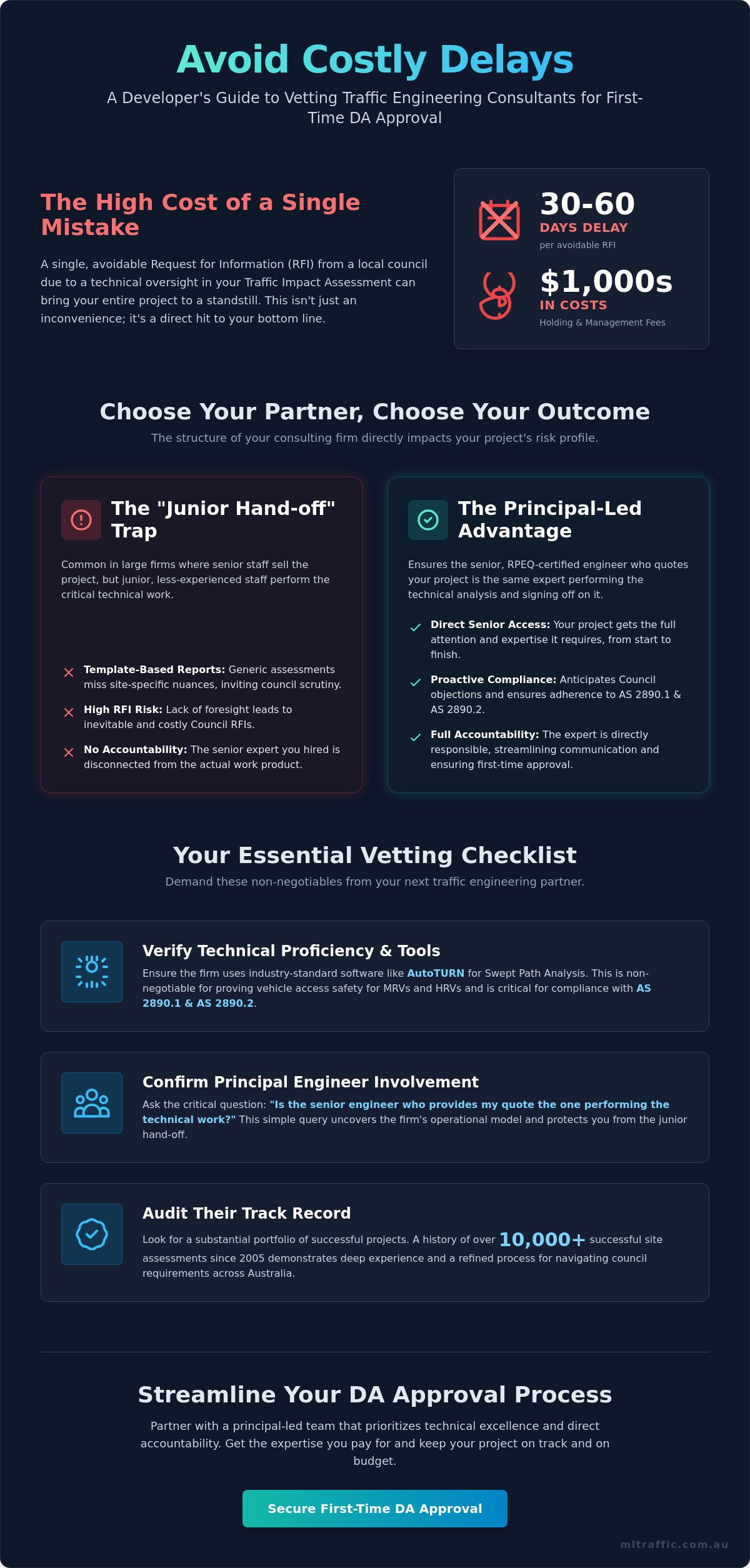
The “Principal-Led” Model vs. Large Consultancy Hand-offs
Choosing your traffic consultant requires understanding who actually performs the technical heavy lifting. Large engineering firms frequently employ a “Junior Hand-off” model. A senior director might win the bid, but a junior graduate often prepares the Traffic Impact Statement (TIS). This creates significant risk for developers. At ML Traffic Engineers, we’ve operated since 2005 on a different premise: the consultant who provides the quote is the one who performs the technical work. This ensures accountability from the initial site visit to the final Council submission. We’ve completed assessments for over 10,000 sites, and that experience stays with the project lead, not a trainee.
The Problem with Junior Staff and Technical Reports
Junior staff often lack the experience to spot subtle site constraints that lead to project-stalling RFIs. They frequently use “cookie-cutter” templates that don’t account for complex site geometries. Small errors in Vehicle Swept Path Assessments or Sight-Line Assessments can delay a DA for 4 to 6 months. While organizations like the U.S. Department of Transportation provide high-level frameworks for safety, local Australian councils demand granular compliance with AS 2890.1. Senior oversight isn’t just a final check; it’s required at every stage to prevent technical data errors that lead to costly redesigns.
The Advantage of Hands-on Senior Engineering
Direct involvement from a Principal Engineer with 30 to 40 years of experience streamlines the approval process. We don’t use gatekeepers. You get direct mobile access to the lead engineer. This seniority is vital during Council negotiations where a Principal can defend a report’s findings with authority. It also leads to better design outcomes. For example, optimizing a basement car park layout can often add an extra parking space or reduce excavation requirements by 15%. Our traffic engineering services focus on these specific efficiencies. Senior engineers identify these opportunities during the initial assessment, not after the plans are finished.
When you’re choosing your traffic consultant, ask who signs the final report and who will answer the phone when Council calls. Accountability rests with the person who understands the technicalities of your specific site inside and out. A report signed by an RPEQ with decades of experience carries more weight with planning authorities than a document processed through a corporate assembly line. You can learn more about our principal-led approach and how it benefits private developers across Australia.
A Developer’s Checklist for Selecting a Traffic Engineering Partner
Choosing your traffic consultant shouldn’t be a gamble based on the lowest bid. A cheap report that fails to address Council concerns leads to expensive delays and potential project refusal. Accuracy matters. To secure a DA approval in 2026, you need a partner who understands the technicalities of the Australian Standards and the bureaucratic nuances of local government.
Use this five-step checklist to evaluate your potential partner:
- Step 1: Verify the specific engineer. Large firms often use senior partners to sell the project, only to hand the actual technical work to a junior graduate. This dilutes quality. At ML Traffic Engineers, the traffic consultant who provides the quote is the one who writes the report. Direct accountability ensures nothing is lost in translation.
- Step 2: Check the portfolio volume. Look for a firm with a massive track record. A portfolio of 10,000+ completed site assessments proves the consultant has handled every land-use type from childcare centres to industrial warehouses. This volume of experience means they’ve likely already solved the exact problem your site faces.
- Step 3: Confirm technical breadth. Your consultant must be proficient in both Traffic Impact Assessments (TIA) and Swept Path Analysis. If they can’t perform detailed vehicle movement simulations in-house, your project will stall when Council asks for proof of heavy vehicle access.
- Step 4: Demand land-use specificity. Traffic requirements for a 24-hour gym differ vastly from a residential flat building. Ask for examples of projects they’ve completed within your specific sector.
- Step 5: Ensure direct certification. The engineer must provide direct certification for compliance with Australian Standards, specifically AS 2890.1 for off-street car parking. This isn’t optional; it’s a requirement for a valid DA submission.
Questions to Ask During the Quoting Phase
Don’t sign a contract without asking these three questions. First, will the person quoting this project be the one writing the report? This prevents the “bait and switch” common in the industry. Second, what’s your success rate for first-time DA approvals in this specific jurisdiction? Local knowledge of Council preferences is invaluable. Finally, how do you handle Council RFIs if they arise? You need a consultant who stays with you through the entire Request for Information process, not one who disappears after the first invoice.
Reviewing the Scope of Services
A quote is only useful if it’s comprehensive. Ensure the scope includes necessary Intersection Analysis or Sight Distance Assessments. If these are missing, you’ll face hidden costs later. You can find a full breakdown of what to look for in this Professional Traffic Engineer Services: The Definitive Checklist. Additionally, check if the consultant can provide Traffic Guidance Schemes (TGS) for the construction phase. Having one firm handle both the DA and the subsequent traffic management plans streamlines your workflow.
Choosing your traffic consultant is the most important decision you’ll make this quarter. Contact our senior engineers directly to discuss your project requirements. Get a technical quote from ML Traffic Engineers today.
Streamlining Your Project with ML Traffic Engineers
ML Traffic Engineers provides a direct alternative to the bureaucratic layers often found in large engineering firms. When choosing your traffic consultant, the internal structure of the firm impacts your project’s speed and accuracy. Our promise is simple: the traffic consultant who provides the quote, does the work. We’ve been trading since 2005, leveraging over 15 years of national experience to support private developers through the complex DA process. This hands-on approach ensures that the person defending your project to Council is the same expert who designed the technical solution.
Senior-led engineering is the most effective way to minimize technical risk. By involving principals in every assessment, we identify potential issues with driveway ramp grades or sight-line requirements before they become formal Council objections. Our comprehensive services for private developers include:
- Traffic Impact Statements (TIS) and Traffic Impact Assessments (TIA)
- Vehicle Swept Path Assessments using industry-standard software
- Car Parking Demand Assessments and parking layout design
- Construction Traffic Management Plans (CTMP)
- Sight-Line Assessments according to Australian Standards (AS 2890.1)
Why 10,000+ Sites Matter for Your Development
Experience isn’t just a number; it’s a database of solutions. With over 10,000 successful site assessments completed, we’ve encountered almost every conceivable land-use scenario. Our portfolio spans a massive range of developments, including:
This depth of experience allows for faster identification of site constraints. We understand the specific triggers that lead to Council RFI (Request for Further Information) letters. By addressing these triggers in the initial report, we accelerate your DA approval timeline. You can learn more about how our expertise integrates into your planning in our article on The Role of a Traffic Engineer in Developments.
Contacting Your Senior Traffic Consultant
Choosing your traffic consultant shouldn’t involve navigating layers of junior staff or account managers. We provide direct access to our principals, Michael Lee and Benny Chen, for immediate project advice. This direct line of communication ensures accountability and technical precision from day one. It’s a “no-gatekeepers” approach that prioritizes your project’s success over corporate hierarchy.
To move forward, you can request a technical quote that covers all specific Council requirements for your site. We provide fixed-fee proposals based on the specific scope of your development. To integrate senior traffic engineering into your project timeline, visit our contact page or call our senior consultants directly. We’ll review your site plans and provide the technical clarity needed to secure your DA in 2026.
Secure Your DA Approval with Technical Certainty
Securing a 2026 development approval requires more than just a standard report. It demands technical precision and a deep understanding of evolving Australian Standards. Choosing your traffic consultant is a decision that dictates whether your project faces costly Council delays or moves straight to construction. You should avoid the common industry pitfall where senior engineers win the work only to hand the technical assessment to junior staff. This lack of oversight often results in errors that stall projects during the Request for Information (RFI) stage.
At ML Traffic Engineers, we’ve assessed over 10,000 sites across Australia since 2005. Our model is built on direct accountability. The traffic consultant who provides the quote is the same principal engineer who does the work. You get direct access to experts with 30 to 40 years of industry experience on every project. This approach ensures every Traffic Impact Statement (TIS) or parking assessment is compliant, accurate, and ready for scrutiny. We focus on delivering results that help private developers navigate complex bureaucratic requirements without the overhead of larger, impersonal firms.
Get a technical quote from a Senior Traffic Engineer today to ensure your next project remains on schedule. We look forward to providing the technical expertise your development deserves.
Frequently Asked Questions
What is the most common reason a traffic report is rejected by Council?
The most common reason for rejection is non-compliance with Australian Standard AS 2890.1. Approximately 35% of reports fail because they lack detailed sight-line assessments or feature incorrect driveway ramp grades. If your report doesn’t explicitly demonstrate how the design meets these technical benchmarks, Council planners will likely issue a refusal or a request for significant amendments.
How much does a Traffic Impact Assessment (TIA) typically cost for a private development?
For a standard private development in Australia, a TIA usually costs between A$3,000 and A$8,500. Small-scale residential projects might sit at the lower end of this range, while complex commercial sites requiring SIDRA modelling often exceed A$15,000. These costs reflect the technical expertise and software required to produce a report that meets current regulatory standards.
Can I use a general civil engineer for my traffic and parking report?
You shouldn’t use a generalist because traffic engineering requires specific qualifications and specialized modelling software like SIDRA. Choosing your traffic consultant ensures you’re working with a specialist who understands the nuances of the RTA Guide to Traffic Generating Developments. General civil engineers often lack the specific transport planning experience needed to navigate complex Council negotiations effectively.
What happens if Council issues an RFI regarding my traffic report?
If Council issues a Request for Further Information (RFI), your consultant must provide technical clarifications or revised data within a set timeframe, usually 21 days. This process involves addressing specific concerns about parking numbers, vehicle movements, or safety. A prompt, expert response is vital to keep your DA on track and avoid a formal project refusal.
How long does it take for a traffic consultant to complete a DA report?
A standard traffic report takes between 10 and 15 business days to complete once final architectural plans are provided. Complex projects involving multi-day traffic counts or extensive intersection modelling can take 4 weeks or longer. When choosing your traffic consultant, always confirm their current lead times to ensure they align with your planned submission date.
Is a Swept Path Analysis always required for a new driveway design?
Yes, a Swept Path Analysis is mandatory for almost all new driveway designs to prove a B85 or B99 vehicle can maneuver safely. This analysis uses specialized software to simulate vehicle movements, ensuring cars can enter and exit the site in a single forward motion. Without this evidence, Council can’t verify that your design complies with AS 2890.1 safety requirements.
Does my traffic consultant need to be registered in a specific state?
Your consultant must hold the relevant professional registrations for the state where the project is located. In Queensland, the lead engineer must be a Registered Professional Engineer of Queensland (RPEQ) to sign off on the report. In other states, being on the National Engineering Register (NER) is the standard requirement for demonstrating professional competence and accountability.
What is the difference between a Traffic Impact Statement (TIS) and a Traffic Impact Assessment (TIA)?
A Traffic Impact Statement (TIS) is a concise document used for low-impact developments that generate minimal vehicle movements. A Traffic Impact Assessment (TIA) is a comprehensive study required for larger projects that significantly affect the road network. The TIA includes complex data such as intersection capacity analysis and 10-year traffic growth projections that a TIS omits.

Disclaimer
The content on www.mltraffic.com.au, including all technical articles, guides, and resources, is provided for general informational and educational purposes only. It is not intended to constitute professional advice in traffic engineering, transportation planning, development approvals, or any other technical or legal field.
While ML Traffic Engineers makes every reasonable effort to ensure the accuracy, completeness, and timeliness of the information published, we do not provide any warranties or representations (express or implied) regarding its reliability, suitability, or availability for any particular purpose. Any reliance you place on the content is strictly at your own risk.
In no event shall ML Traffic Engineers, its directors, employees, authors, or affiliates be liable for any direct, indirect, incidental, special, consequential, or punitive damages (including, without limitation, loss of profits, data, or business opportunities) arising out of or in connection with the use of, or inability to use, any information provided on this website.
The articles and guides on this site are not a substitute for engaging a qualified, registered professional traffic engineer (such as an NPER or RPEQ engineer) to assess your specific project requirements. For tailored advice, compliance assessments, or traffic engineering services, please contact a competent professional.
This disclaimer may be updated from time to time without notice. By accessing or using this website, you agree to be bound by the most current version of this disclaimer.
