

Misinterpreting Victoria’s new car parking rules is a direct route to significant project delays and costly Development Application (DA) rejections. The impending Clause 52.06 Updates of 18Dec25, introduced through Amendment VC277, represent a fundamental shift in how parking requirements are assessed across the state. For developers, navigating the new Public Transport Accessibility Level (PTAL) methodology and revised Car Parking Rate (CPR) categories is not just a procedural step-it is critical to project viability. Failure to correctly apply these standards can lead to budget blowouts and stalled approvals.
This professional guide provides an essential breakdown of these critical legislative changes. We will dissect what has changed, provide clear instructions on how to determine the new parking requirements for your project, and demystify the technical terminology. By following this analysis, you will gain the necessary understanding to confidently prepare or commission a compliant traffic impact assessment. The outcome is a streamlined planning process, the avoidance of unnecessary council requests for information (RFIs), and the protection of your project’s timeline and budget.
Overview: What Changed in Clause 52.06 with Amendment VC277?
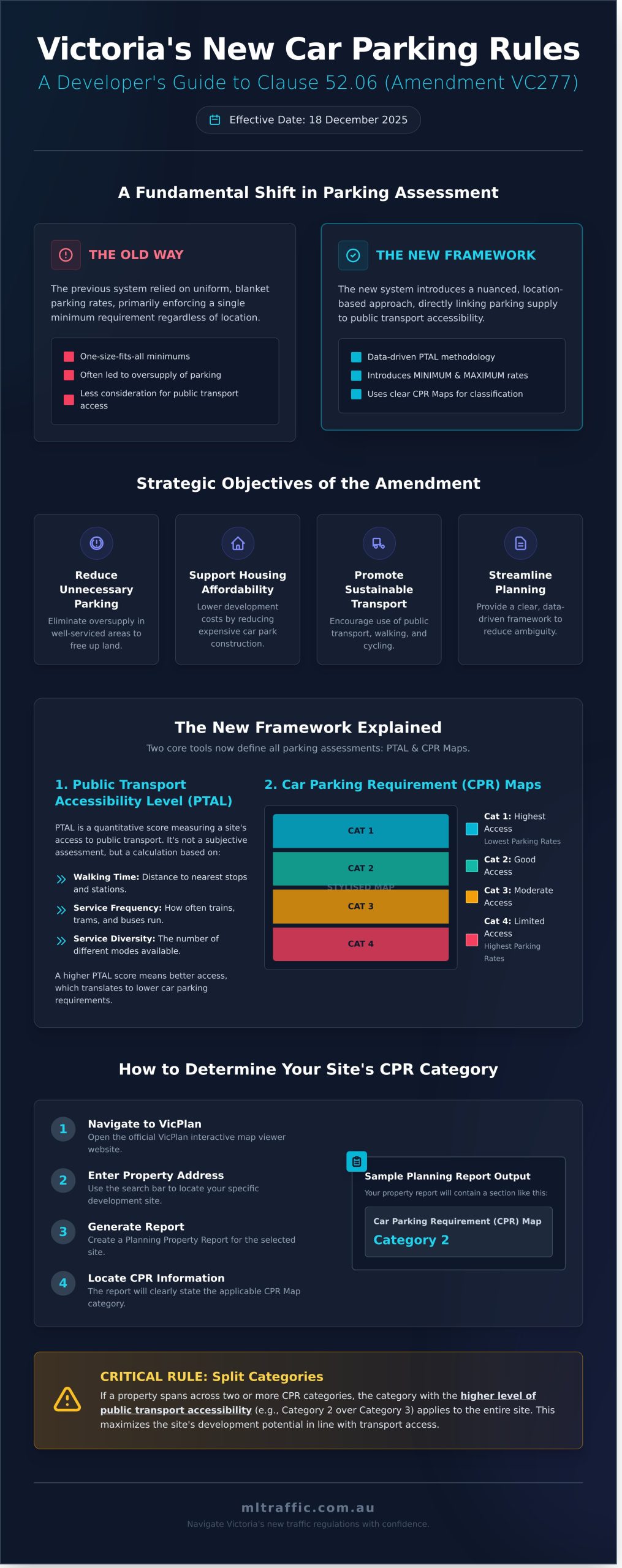
On 18 December 2025, Planning Scheme Amendment VC277 will fundamentally alter car parking requirements across Victoria. These Clause 52.06 Updates of 18Dec25 represent a significant shift from uniform, blanket parking rates to a more nuanced, location-based approach. The core principle of the amendment is to align car parking supply directly with a site’s access to public transport.
This is achieved through two new critical tools for developers and planners: the Public Transport Accessibility Level (PTAL) methodology and the corresponding Car Parking Requirement (CPR) Maps. For many development sites, particularly in metropolitan and well-serviced regional areas, this will mean the introduction of both minimum and maximum parking rates. This replaces the previous system, which primarily enforced a single minimum requirement, and introduces a new layer of strategic assessment for all new developments.
Key Objectives of the Amendment
The strategic goals of Amendment VC277 are clear and align with modern principles of Urban planning in Australia. The Department of Transport and Planning aims to deliver a more efficient and sustainable built environment. The primary objectives are:
- Reduce Unnecessary Car Parking: Eliminate the oversupply of parking in locations well-serviced by trains, trams, and buses, freeing up space for more productive uses.
- Support Housing Affordability: Lower overall development costs by reducing or removing the need for expensive underground and structured parking bays.
- Promote Sustainable Transport: Encourage the use of public transport, walking, and cycling by managing car dependency in well-connected areas.
- Streamline Planning: Provide a clearer, data-driven framework that reduces ambiguity and streamlines the assessment process for development applications.
Who is Most Affected by These Changes?
The comprehensive nature of the Clause 52.06 updates will have a direct impact on a wide range of stakeholders involved in land development. The groups who must be most aware of these changes include:
- Property Developers: Proponents of residential, commercial, and mixed-use projects must re-evaluate project feasibility and design based on new parking constraints and opportunities.
- Town Planners and Architects: These consultants must integrate the new PTAL and CPR map data into their development applications and design proposals from the earliest stages.
- Landowners: Those with property in areas designated with high public transport accessibility may find their land has increased development potential or different development parameters.
- Local Councils: Municipal planners and traffic engineers are now responsible for assessing planning permit applications against these new, more complex requirements.
The New Framework: Understanding PTAL and Car Parking Requirement (CPR) Maps
The Clause 52.06 Updates of 18Dec25 introduce a more sophisticated, data-driven system for calculating car parking requirements. This new framework moves away from broad, one-size-fits-all rules, replacing them with two key tools: the Public Transport Accessibility Level (PTAL) methodology and the corresponding Car Parking Requirement (CPR) maps. These instruments are now central to any parking assessment and are formally incorporated into the Victoria Planning Provisions, superseding previous, less nuanced methods of determining parking rates.
What is the Public Transport Accessibility Level (PTAL) Methodology?
The Public Transport Accessibility Level (PTAL) is a quantitative measure of a location’s access to the public transport network. While an established international methodology, it has been specifically adapted for Victorian conditions. The system calculates an objective score based on critical factors including walking times to stops and stations, the frequency of services, and the diversity of available transport modes (trains, trams, buses). This data-driven score directly determines which car parking category an area falls into, creating a clear and defensible link between transport accessibility and parking demand.
How to Use the Car Parking Requirement (CPR) Maps
The CPR maps are the practical, visual application of the PTAL scoring system. They divide Victoria into four distinct categories, providing an immediate reference for a site’s parking obligations. These maps are the definitive source for developers.
- Category 1: Highest level of public transport access (lowest parking rates apply).
- Category 2: Good public transport access.
- Category 3: Moderate public transport access.
- Category 4: Limited public transport access (highest parking rates apply).
To determine the category for a specific property, developers must consult the official maps on the VicPlan website. The process is straightforward:
- Navigate to the VicPlan interactive map viewer.
- Enter the subject property address in the search bar.
- Generate a Planning Property Report for the site.
- Within the report, locate the “Car Parking Requirement (CPR) Map” section, which will clearly state the applicable category.
A critical rule to note from the Clause 52.06 Updates of 18Dec25 is that if a property’s land area spans across two or more CPR categories, the category with the higher level of public transport accessibility (e.g., Category 2 over Category 3) applies to the entire site. This ensures that development leverages the best available transport access.
Practical Implications for Your Development Application (DA)
Understanding the theoretical changes is one step; applying the Clause 52.06 Updates of 18Dec25 to your project is another. The new car parking provisions directly influence project feasibility, design, and the information required for a successful Development Application. Here is a breakdown of the tangible impacts on your project.
Calculating Your New Parking Rate
Determining your car parking requirement is a new three-step process under the updated Clause 52.06-5:
- Step 1: Identify your proposed land use within Table 1.
- Step 2: Locate your site on the official Car Parking Requirement (CPR) Map to determine its category (Category 1, 2, 3, or 4).
- Step 3: Cross-reference your land use and CPR category in Table 1 to find the applicable rate.
Crucially, for sites in Category 1 and 2 areas, the table now specifies both a minimum and a maximum number of car spaces. This is a significant shift designed to prevent the over-provision of parking in locations with good access to public transport.
When Can the Parking Rate Be Varied?
A planning permit is required to provide fewer spaces than the minimum or more spaces than the maximum. To justify such a variation, a comprehensive Car Parking Demand Assessment is no longer optional-it is essential. This report must provide a robust, evidence-based justification for the proposed rate, considering factors like public transport access, site-specific demographics, and shared parking opportunities. Our expert traffic engineering services specialise in preparing these assessments to satisfy council requirements.
Impact on Different Land Uses
The updated planning scheme affects various development types differently:
- Residential Apartments: Developments near train stations (often Category 1 or 2) may now be able to provide fewer car spaces, potentially reducing construction costs. However, exceeding the maximum rate will be difficult without exceptional justification.
- Office & Retail: In designated activity centres, the new maximums will restrict the provision of large, car-dominant developments, encouraging a shift towards sustainable transport modes.
- Industrial & Other Uses: For land uses not specified in Table 1, a first-principles Car Parking Demand Assessment is mandatory to establish an appropriate rate, increasing the need for professional traffic engineering input from the project’s outset.
Navigating these changes requires precise analysis. Contact ML Traffic Engineers at mltraffic.com.au to ensure your DA is compliant and robust.
Preparing a Compliant Car Parking Demand Assessment
For any developer seeking a variation to the standard car parking rates, the Car Parking Demand Assessment is the single most critical document. A professionally prepared, evidence-based report is not an expense but a strategic investment. By accurately justifying a reduced parking provision, developers can save significant project costs associated with excavation and construction, potentially freeing up hundreds of thousands of dollars and valuable gross floor area.
This report forms the technical foundation of your planning application, providing council with the necessary justification to approve a car parking waiver or reduction.
Key Components of a Strong Assessment Report
A generic or template-based report will not satisfy council planners. A robust assessment must be tailored to the specific site and its context. Councils demand a detailed analysis that includes:
- Local Demographics & Car Ownership: A detailed analysis of car ownership rates and travel behaviour for the local catchment area, using current and verifiable data from sources like the Australian Bureau of Statistics (ABS).
- Public Transport Services: A qualitative and quantitative review of the availability, frequency, and accessibility of nearby train, tram, and bus services.
- Operational Demand Profile: A first-principles assessment of the likely parking demand based on the specific operational nature of the proposed use (e.g., hours of operation, staff numbers, visitor profiles), rather than a simple reliance on statutory rates.
- Parking Occupancy Surveys: Comprehensive surveys of on-street and public car parking availability within a reasonable walking distance, conducted during relevant peak periods to establish existing capacity and demand.
Justifying a Reduction Below the Minimum Rate
To successfully argue for a parking rate below the statutory minimum, your assessment must present a compelling, evidence-based case. Navigating the Clause 52.06 Updates of 18Dec25 requires a sophisticated argument that the standard rates are excessive for your development. This can be achieved by demonstrating factors like exceptional public transport access not fully captured by standard metrics, providing evidence of lower car dependency for the target demographic, or integrating comprehensive facilities such as dedicated car-share bays and extensive, secure bicycle parking. A meticulously prepared report is critical for council approval.
Strategic Considerations and Common Pitfalls
A common pitfall is submitting a generic report that relies on outdated assumptions about car ownership and travel behaviour. This approach is frequently challenged and rejected by council traffic engineers, causing costly delays. The most effective strategy is to engage an experienced traffic consultant early in the design process to identify parking challenges and opportunities before plans are finalised. An expert ensures your approach aligns with the latest planning expectations, including the Clause 52.06 Updates of 18Dec25.
For a detailed review of your development’s car parking requirements, contact our experts to discuss your project’s specific needs.
Mastering the New Clause 52.06 Framework for Your DA
The changes to Victoria’s planning scheme via Amendment VC277 have created a more complex, location-based approach to car parking. Successfully navigating the new Public Transport Accessibility Level (PTAL) and Car Parking Requirement (CPR) maps is now fundamental to calculating your project’s needs. To ensure full compliance with the Clause 52.06 Updates of 18Dec25, a detailed, site-specific Car Parking Demand Assessment is no longer optional-it is a critical component of any successful development application. Proactively addressing these standards is the most effective strategy to avoid costly delays.
Do not let these regulatory shifts jeopardise your project’s timeline. ML Traffic Engineers are specialists in preparing robust traffic reports for development applications. With over 15 years of dedicated experience, we provide the authoritative assessments required to satisfy council requirements under the new framework. Every client benefits from direct access to our senior engineers, ensuring your application is handled with meticulous attention to detail from a team that understands the intricacies of Victorian planning policy.
Take the next step towards a successful development outcome. Need an expert assessment for your DA? Contact ML Traffic Engineers for a quote.
Frequently Asked Questions
Where can I find the official Car Parking Requirement (CPR) Maps?
The official Car Parking Requirement (CPR) Maps are maintained by the Department of Transport and Planning (DTP). Developers and consultants can access these maps directly through the state government’s VicPlan interactive mapping service. This platform allows you to search for a specific property address and view the applicable CPR category-be it Category 1, 2, or 3. It is critical to use this official source to ensure your development application is based on correct spatial data.
What happens if my development site falls into two different CPR categories?
When a single development site is subject to more than one Car Parking Requirement (CPR) category, the Victoria Planning Provisions state that the higher, more stringent parking rate applies to the entire site. For example, if a portion of your land is in a Category 2 area and another is in a Category 3, all parking requirements for the development must be calculated based on the Category 3 rates. This ensures a consistent and conservative approach to parking provision, aligning with the intent of the planning scheme.
Do the Clause 52.06 updates apply to existing planning permits or applications already lodged?
No, the Clause 52.06 Updates of 18Dec25 do not apply retroactively. According to transitional provisions, they do not affect planning permit applications lodged with the responsible authority before the amendment’s commencement date. Similarly, existing and valid planning permits are not impacted. The new car and bicycle parking requirements are only applicable to new planning permit applications submitted on or after the official implementation date, providing certainty for projects already in the system.
Are there any changes to bicycle parking requirements under Amendment VC277?
Yes, Amendment VC277 introduced significant changes to bicycle parking. The amendment separates bicycle parking rates from car parking, creating a new, distinct set of requirements detailed in Clause 52.34. It mandates specific provisions for both employee and visitor bicycle parking, including requirements for both horizontal and vertical spaces. These new rates are designed to better promote active transport options in new developments and must be addressed in all new applications.
How do I calculate parking for a land use not listed in Table 1 of Clause 52.06?
For a land use not specified in Table 1, the parking requirement must be determined to the satisfaction of the responsible authority, which is typically the local council. This process requires the preparation of a detailed Car Parking Demand Assessment. This report must justify the proposed parking rate by referencing empirical data, rates for similar uses, or relevant transport surveys. Engaging an experienced traffic engineering consultant, such as **ML Traffic Engineers Pty Ltd**, is essential to prepare a robust assessment that satisfies council requirements.
Can I provide car parking spaces off-site under the new rules?
Yes, providing car parking off-site remains an option under the updated Clause 52.06, but it is subject to strict conditions. The off-site spaces must be located on land that is in the same ownership as the development site, or the owner must have a legal agreement securing permanent user access. Furthermore, the off-site location must be convenient and safe for users, a factor that is assessed by the responsible authority on a case-by-case basis.
What is the difference between this amendment and a Parking Overlay?
The Clause 52.06 Updates of 18Dec25 represent a state-wide provision within the Victoria Planning Provisions, applying a consistent set of car parking rules across all municipalities. In contrast, a Parking Overlay (PO) is a local planning tool applied by a specific council to a particular precinct. If a Parking Overlay applies to your site, its specific local requirements, which may include financial contributions in lieu of parking, will override the standard state-wide rates set out in Clause 52.06.
