
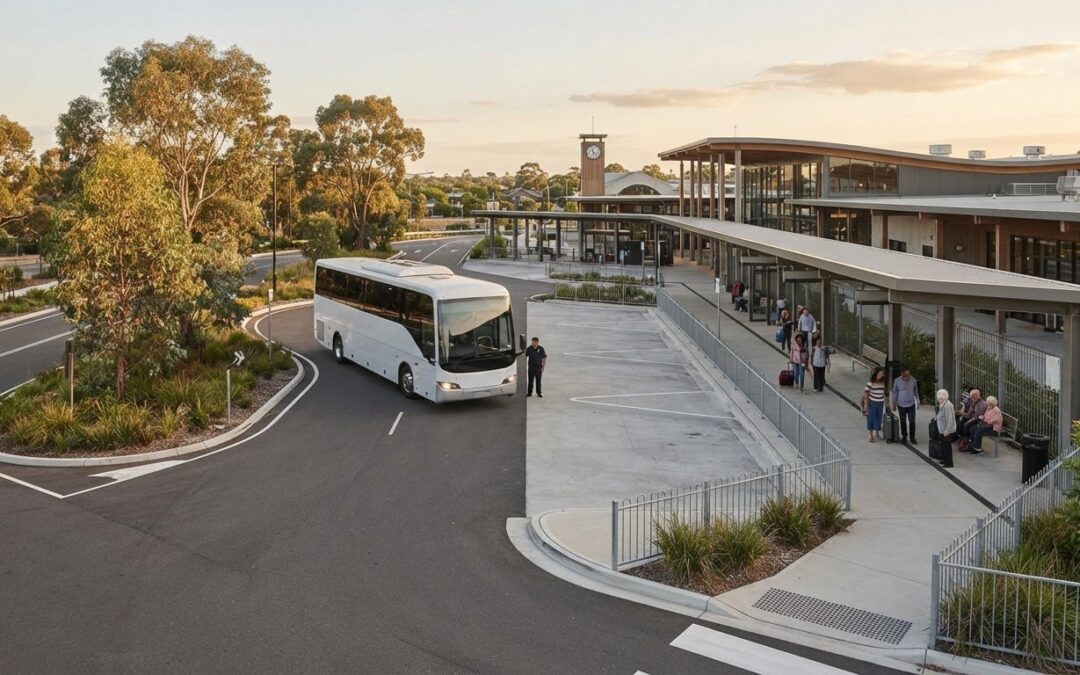
A bus site is only as safe as the space between the road, the stopping area and the passenger entrance. Effective coach and bus access design brings these areas together, allowing vehicles to enter, manoeuvre and stop while passengers move through clear, practical routes. Operational planning can also allow drivers to be on stand and ready to start boarding 3 minutes before departure.
It’s easy to focus only on the vehicle’s path, but passenger movement, boarding areas and interactions between people and vehicles matter just as much. A well-planned layout accounts for these connections, along with the site’s purpose and physical constraints.
This article covers the key considerations for safer bus and coach access design in Australia. Learn how to plan vehicle entry and turning movements, arrange stopping and boarding areas, and reduce conflicts between vehicles and pedestrians. It also explains how traffic assessment and swept path analysis can inform decisions when planning or reviewing a site layout.
Key Takeaways
- Plan vehicle entry, turning and stopping areas as connected parts of the site layout.
- Separate passenger walking routes from vehicle movements wherever the layout allows.
- Use swept path analysis to assess whether coaches and buses can manoeuvre through the proposed access and site circulation areas.
- A Traffic Impact Assessment can help evaluate how a proposed site may affect surrounding traffic and access.
Coach and bus access design
In Australia, a safe layout considers the entire journey, from the public road to the passenger boarding point. Coach and bus access design must account for vehicle entry, circulation within the site, stopping, passenger movement and exit. Considering these as connected tasks helps identify potential conflicts, such as a turning coach crossing a pedestrian route or blocking another vehicle. For example, a terminal entrance should lead to a usable stopping area, rather than straight into a confined manoeuvring space.
Start by identifying the vehicles expected to use the site and the movements they need to make. Map each vehicle’s entry, route through the site, loading position and exit, then assess the movements against the actual site geometry. Vehicle Swept Path Analysis shows how a selected vehicle tracks through bends and confined areas. A coach may be able to enter but still need more space to turn, align with a kerb or leave without reversing across passenger activity.
Plan stopping and boarding as a single operation. The boarding position must work for both the vehicle and the passengers waiting to use it. Locate it so passengers can reach the entrance along a clear pedestrian path, without crossing the vehicle’s turning area. For example, a central island may require a defined pedestrian crossing across the site circulation route. Make the intended crossing point visible and direct.
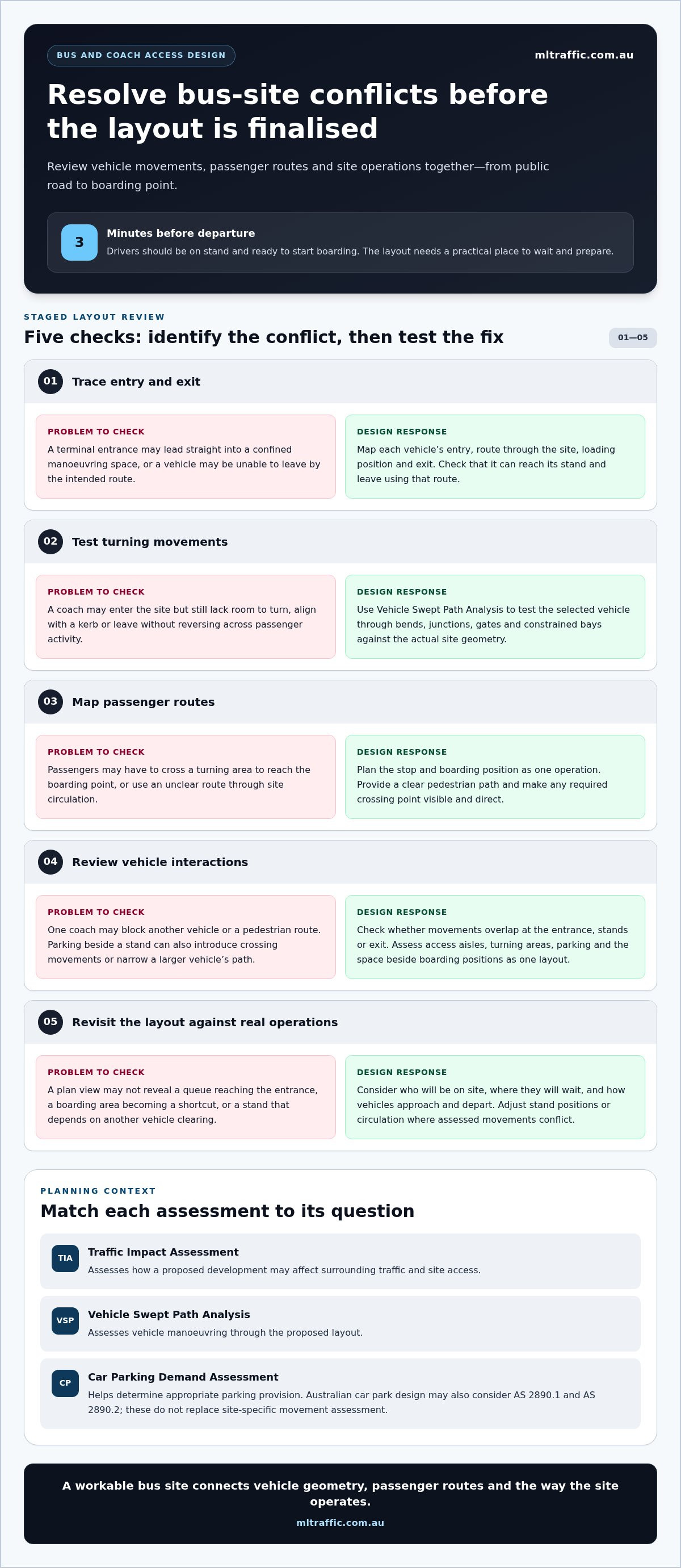
Allow the operating sequence to inform the layout. Drivers should be on stand and ready to start boarding 3 minutes before departure. This requires a practical place to wait and prepare, rather than a stopping position that depends on another vehicle clearing at the last moment. Consider how arriving coaches leave the circulation path while boarding takes place. Where several vehicles serve one site, assess whether their movements overlap at the entrance, stands or exit.
Use a staged review to test the plan before finalising the layout:
- Trace entry and exit. Check whether the vehicle can reach its stand and leave using the intended route.
- Test turning movements. Use swept path analysis at bends, junctions, gates and constrained bays.
- Map passenger routes. Identify where people walk from the arrival point to the boarding area.
- Review vehicle interactions. Check whether one coach blocks another vehicle or the pedestrian route.
- Revisit the layout. Adjust stand positions or circulation where the assessed movements conflict.
Parking and access arrangements also need to work together. A coach stand beside a car parking aisle can introduce crossing movements, while poorly placed parking can narrow the path available for larger vehicles. Assess the full layout, including access aisles, turning areas and the space beside boarding positions. For Australian car park layouts, the relevant design work may consider AS 2890.1 and AS 2890.2. These standards are part of the car park design context, not a substitute for assessing site-specific vehicle and passenger movements.
Finally, check the drawing against how the site will operate. A school pickup area, transport interchange and tourist attraction may each have different arrival patterns, waiting areas and vehicle circulation needs. For each use, identify who will be on site, where they will wait, and how vehicles will approach and depart. This operational review can reveal issues that a plan view alone may obscure, such as a queue reaching the entrance or a boarding area becoming an informal shortcut. Where sites require dedicated entry infrastructure to manage these flows safely, access control specialists like linkssystems.co.uk showcase practical examples of integrated barriers and speed gates in transport environments.
A practical design reviews vehicle geometry, passenger routes and site operations together. Confirm the intended vehicle movements, test them against the proposed layout and resolve conflicts before finalising the arrangement. This gives planners a clearer basis for assessing safe access and usable stopping areas.
ML Traffic Engineers Australia: Traffic Impact Assessment (TIA) Report
ML Traffic Engineers Australia prepares Traffic Impact Assessment (TIA) Reports to assess how a proposed development may affect traffic and site access. Consider a TIA when planning a new facility or changing a site’s use, particularly if coach movements may affect nearby roads or circulation within the site.
A TIA can be paired with Vehicle Swept Path Analysis to assess vehicle movements through the proposed layout. A Car Parking Demand Assessment can help determine appropriate parking provision. Together, these assessments address separate planning questions: traffic impacts, vehicle manoeuvring and parking demand.
Move from concept to a workable site plan
The next step is to develop the access concept into a coordinated proposal that reflects how the site will operate. Before plans progress, bring together the intended vehicle movements, passenger access routes and parking arrangements. Clear project information helps identify which traffic questions need assessment and where design decisions may affect surrounding roads or circulation within the site.
ML Traffic Engineers can support this planning stage with a Traffic Impact Assessment (TIA) Report, Vehicle Swept Path Analysis and Car Parking Demand Assessment. These services address distinct parts of a proposal, from potential traffic effects to vehicle manoeuvring and parking needs. A considered approach to coach and bus access design helps project teams refine the layout and communicate its traffic implications.
Share your project requirements with ML Traffic Engineers Australia to discuss the relevant assessment. A clear next step can help move your proposal forward with purpose.

Disclaimer
The content on www.mltraffic.com.au, including all technical articles, guides, and resources, is provided for general informational and educational purposes only. It is not intended to constitute professional advice in traffic engineering, transportation planning, development approvals, or any other technical or legal field.
While ML Traffic Engineers makes every reasonable effort to ensure the accuracy, completeness, and timeliness of the information published, we do not provide any warranties or representations (express or implied) regarding its reliability, suitability, or availability for any particular purpose. Any reliance you place on the content is strictly at your own risk.
In no event shall ML Traffic Engineers, its directors, employees, authors, or affiliates be liable for any direct, indirect, incidental, special, consequential, or punitive damages (including, without limitation, loss of profits, data, or business opportunities) arising out of or in connection with the use of, or inability to use, any information provided on this website.
The articles and guides on this site are not a substitute for engaging a qualified, registered professional traffic engineer (such as an NPER or RPEQ engineer) to assess your specific project requirements. For tailored advice, compliance assessments, or traffic engineering services, please contact a competent professional.
This disclaimer may be updated from time to time without notice. By accessing or using this website, you agree to be bound by the most current version of this disclaimer.
