
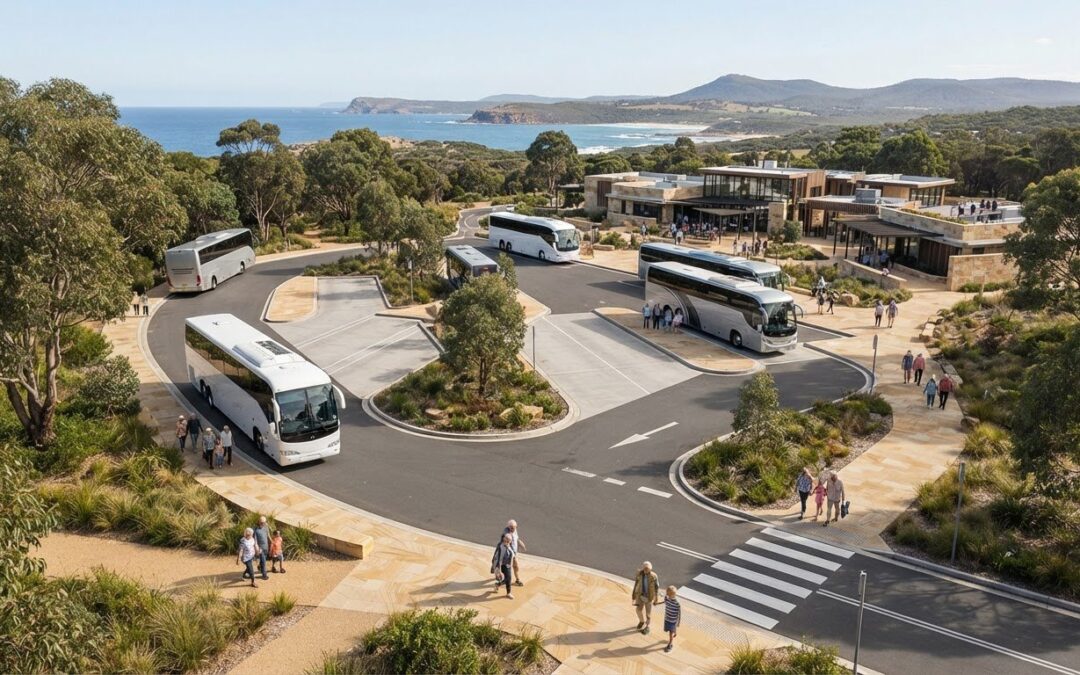
A coach bay count is not a parking plan. Effective coach and bus parking design for tourist attractions starts with how visitors arrive, how long vehicles stay and what happens during peak periods. A layout that looks adequate on paper can still create queues or difficult manoeuvres if it hasn’t been tested against the vehicles expected to use it.
It’s understandable to be unsure how many spaces to provide, especially when coach access must fit alongside visitor parking, pedestrian routes and the character of the site. The design needs to respond to expected demand and site constraints, while making vehicle movements clear and separating pedestrians where practicable.
This article explains how to build a practical design brief, assess coach and bus demand, and test parking and circulation layouts using project-specific vehicle assumptions. It also outlines what to discuss with consultants and authorities, including the current applicability of relevant standards such as AS 2890.2 and any local requirements. ML Traffic Engineers Australia’s car parking demand assessment and vehicle swept path analysis can inform these decisions, but they complement, rather than replace, operational planning.
Key Takeaways
- Build the parking brief around arrival patterns, dwell times, group profiles and operating hours, not just the number of bays.
- Compare drive-through, reverse-in and parallel layouts against the site’s circulation, manoeuvring and pedestrian interface needs.
- Use coach and bus parking design for tourist attractions to connect demand assumptions with a layout that can be tested for vehicle movements.
- Work through a staged assessment, from collecting operator information to reviewing concept options and confirming project requirements.
- Prepare concept plans, survey information, vehicle details and operating assumptions before engaging a traffic engineer.
Why tourist attractions need a coach and bus parking plan built around visitor operations
Coach and bus parking design for tourist attractions is the planning of spaces, circulation and site access for passenger vehicles arriving at a destination. The brief needs to reflect how the attraction operates, not just how many coaches might visit. Arrival windows, dwell times, group sizes and opening hours all affect whether vehicles can enter, wait, unload and leave without conflicting with other site activity.
Start with the visitor journey. A school group arriving before opening may need a different arrangement from tour coaches arriving throughout the day. Set-down, longer-term parking and later pick-up may need separate areas, depending on the site layout and operating plan. General bus station design principles can help explain how vehicle areas and passenger facilities relate, but an attraction’s design must be developed for its own conditions.
The following video shows a coach parking area in a tourism setting:
Agree the operational brief early with tour and bus operators, visitor services staff, designers, access consultants and relevant approval authorities. Their input can expose constraints that a plan alone may not show, such as group assembly needs, accessible routes or service vehicles crossing passenger areas. Record open questions and confirm them with the people who will use or assess the site.
What is the difference between coach parking and passenger set-down?
Set-down is a short-duration transfer for passengers, not long-stay parking. Coaches may need space for passengers to alight, luggage to be unloaded and groups to assemble clear of vehicle paths. Pick-up involves a similar transfer in reverse and may require a designated waiting area. One kerbside area may not safely or practically serve every function. The final arrangement depends on the site, operating plan and authority review.
What visitor and operational information should inform the brief?
Gather expected coach numbers, arrival windows, dwell times and seasonal peaks. Identify likely user groups, including tour operators and school groups, along with mobility needs and service vehicle movements. Ask operators to confirm vehicle types and how arrivals, unloading and collection are managed. Treat unverified figures as assumptions, not established demand. A clear record helps consultants test options against realistic operating conditions.
The design inputs that make coach and bus parking work safely
A coach parking layout must work as a connected system. Vehicle dimensions and turning paths influence bay geometry, while entry and exit movements determine whether coaches can reach those bays without mounting kerbs, blocking circulation or reversing into pedestrian areas. The design vehicle and its operating assumptions need to reflect the coaches expected to use the attraction.
Agree the design vehicle and test its swept path before fixing bay geometry; otherwise, the layout may provide spaces that coaches can’t enter, use or leave safely. Vehicle swept path analysis tests representative movements into, through and out of the proposed site. Confirm the selected vehicle, entry approach and operating assumptions with operators and project consultants. ML Traffic Engineers uses specialist software such as AutoTURN for vehicle swept path analysis services, subject to project requirements.
Bay arrangement, circulation aisles, queuing space and clearances must also be assessed together. A bay may fit on a plan but still be impractical if a coach needs to occupy an aisle while manoeuvring, or if arriving vehicles queue across an entrance. Test the intended sequence of movements, including how coaches pass one another and how a vehicle exits when other bays are occupied.
Pedestrian routes need equal attention. Map the path from coach bays and set-down areas to the attraction entrance and visitor gathering points. Consider where passengers cross active circulation areas, assemble with their group or move with luggage. In Australia, check the relevant AS/NZS 2890 requirements and project-specific access provisions alongside the layout. Confirm the applicable standards and authority requirements for the site.
How does swept path analysis test a coach parking layout?
Analysis checks whether a nominated vehicle can complete the proposed manoeuvres within the available space. It can reveal conflicts with kerbs, islands, structures, parked vehicles or opposing traffic before the arrangement is settled. It doesn’t determine how many parking spaces the attraction needs. Demand assessment and swept path analysis are complementary: one informs capacity, the other tests vehicle movement.
Which standards and approval requirements need checking?
AS 2890.2 may be relevant, but its current applicability and any authority-specific requirements should be verified for each project. Check local planning controls and access conditions rather than assuming a uniform rule across Australia. Coordinate the standards review with operational needs and site-specific safety considerations.
- Visibility: Check sightlines at entrances, exits and pedestrian crossings.
- Lighting and surface: Review visibility during operating hours, pavement condition and drainage.
- Accessible routes: Coordinate paths, gradients and crossing points with the project’s access requirements.
These checks help establish whether the proposed layout is workable on the ground, not just geometrically possible.
Choosing a coach parking layout: compare the options and site trade-offs
There’s no single layout that suits every attraction. The right choice depends on available land, coach arrival patterns, visitor parking demand and how passengers move between vehicles and the entrance. For coach and bus parking design for tourist attractions, test feasible arrangements against actual site constraints rather than assuming a tight site must accept unsafe or unclear vehicle movements.
Compare the options against the same operating assumptions. Consider whether coaches can enter and leave without obstructing other vehicles, where queues may form, and whether passengers cross active circulation routes.
| Layout | Manoeuvring and circulation | Pedestrian interface | Potential site constraints |
|---|---|---|---|
| Drive-through | Supports forward entry and departure if a continuous circulation route is available. | Crossings may be needed where the route passes visitor paths or gathering areas. | Can require more land for circulation and may conflict with visitor parking or queues. |
| Reverse-in | Requires a suitable turning and reversing movement into or out of each bay. | Assess reversing exposure near passenger routes, waiting areas and other vehicles. | May suit some site geometries, but depends on visibility, operating controls and vehicle access. |
| Parallel | Vehicles enter and leave along the direction of travel, subject to available approach and departure space. | Kerbside boarding and alighting can bring passengers close to circulation routes. | May require a long, clear edge and can compete with other kerbside uses. |
When might drive-through coach bays suit an attraction?
Drive-through bays may be worth testing where the site can accommodate a continuous route and forward movement simplifies departure. That benefit needs to be weighed against land take and aisle requirements. Check for conflicts with pedestrian crossings, visitor vehicles and coach queues, particularly if arrivals cluster around opening or tour times. Don’t assume the circulation route will remain clear during peak activity.
When might reverse-in or parallel arrangements be considered?
Reverse-in or parallel layouts may be practical where the site geometry limits a drive-through loop or where bays can be placed along an appropriate edge. Assess reversing exposure, sightlines, pedestrian separation and whether operators are familiar with the proposed movements. These are project-specific considerations, not reasons to select a layout in advance.
Use swept path diagrams to compare options before settling on a preferred arrangement. They can show whether nominated coaches can complete the required movements, while demand assessment helps establish how much capacity the attraction may need. Shared visitor parking or multi-purpose areas also require careful review: check peak demand, operating controls, passenger conflicts and approval requirements before relying on shared use.
Assessing coach parking: from brief to workable design
A sound assessment turns visitor and operator information into a layout that can be tested and reviewed. For coach and bus parking design for tourist attractions, keep confirmed data separate from assumptions so decision-makers can see where the concept is reliable and where more information is needed.
- Gather operational information. Request operator schedules, booking patterns, seasonal data and any expected visitor growth assumptions. Record the source and date of each input.
- Assess peak demand. Consider simultaneous arrivals, dwell periods, departure peaks and how these could create queues. A daily total alone may not show how many coaches need space at the same time.
- Set out scenarios. Where forecasts or schedules are uncertain, test reasonable operating cases rather than treating estimates as facts. Note data gaps, constraints and assumptions that operators must confirm.
- Develop a concept. Identify bay functions, circulation routes, pedestrian paths and site access points. Check how the arrangement relates to visitor parking and other site activity.
- Test and review. Assess representative coach movements, revise the geometry where conflicts or impractical manoeuvres appear, then coordinate the concept with relevant project consultants and approval requirements.
What information helps estimate coach parking demand?
Ask operators for schedules and booking patterns, including seasonal variations and expected changes in visitation. Identify when coaches arrive together, how long they remain, and whether passenger pick-up coincides with new arrivals. Consider likely queuing and group profiles. If information is incomplete, document the gap and compare plausible scenarios with the operator rather than presenting an unverified forecast as established demand.
How does a concept layout progress towards review?
Begin with a plan showing proposed bays, circulation, access points and pedestrian connections. Test the nominated coach movements through the areas they’ll use, then update the concept if paths conflict with kerbs, other vehicles or passenger routes. AS/NZS 2890.1 may offer relevant general parking-design context, but confirm its current applicability and coordinate any standards review with project-specific requirements.
A demand assessment estimates the parking capacity an attraction may need; a swept path analysis tests whether nominated vehicles can manoeuvre through the proposed layout. The two inputs complement each other, but neither replaces confirmed operating assumptions. Where the development requires a Traffic Impact Assessment, coordinate its findings with the parking assessment and access review.
For support with car park design and assessment services, provide the available plans, operator information and documented assumptions for project review.
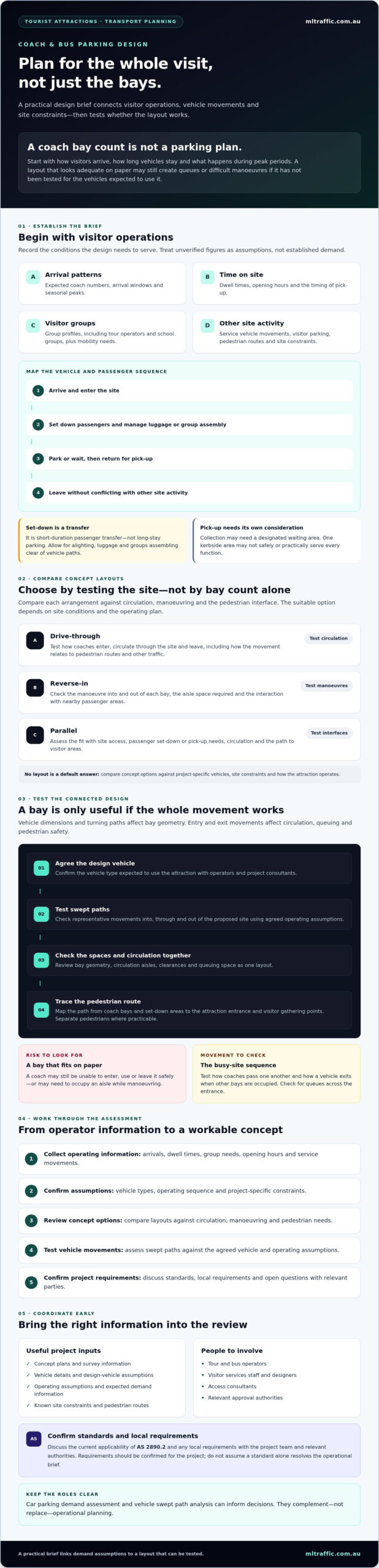
Engage a traffic engineer to resolve coach parking design risks early
Early traffic engineering input helps connect the key design questions: how many coach spaces may be needed, whether the nominated vehicles can use the layout, how site access works and where pedestrians interact with coach movements. Addressing these matters while options are still being developed can help the project team identify constraints and refine the brief before design decisions become harder to change.
What should a project team provide to its traffic consultant?
Useful information gives the consultant a clear picture of the proposed attraction and how it will operate. Provide current site plans, available survey information, proposed uses, access points and known site constraints. Include planning requirements and identify the design stage, programme and questions requiring assessment.
Operational details matter too. Share coach types and relevant vehicle information, operator schedules, arrival profiles, expected dwell times and passenger transfer activities. Note any assumptions that haven’t been confirmed with operators. This allows the assessment to distinguish known conditions from information that may need further checking.
- Site and concept plans, survey information and known physical constraints
- Proposed attraction uses, vehicle access points and relevant planning information
- Coach details, operator information and expected arrival and departure patterns
- Passenger set-down, pick-up and pedestrian movement requirements
- Project stage, programme and specific questions for assessment
How can specialist review support a more robust design?
Each assessment addresses a different part of the design. A car parking demand assessment considers the capacity supported by expected use and operating assumptions. Vehicle swept path analysis tests whether nominated coaches can manoeuvre through the proposed layout. Car park design brings the parking arrangement together with circulation and access considerations. These inputs support decision-making, but don’t replace operator confirmation or authority review.
ML Traffic Engineers Australia is an Australian traffic engineering and transport planning consultancy with a national scope and over 15 years of experience. Its relevant services include car park design, car parking demand assessment, vehicle swept path analysis and Traffic Impact Assessment reports for development applications. The appropriate scope depends on the project, and applicable standards and authority requirements should be confirmed for each site.
For an overview of relevant traffic engineering services, see the services information. If you’re ready to discuss coach and bus parking design for tourist attractions, contact ML Traffic Engineers Australia with your available plans, vehicle details and operating assumptions.
Set your coach parking project up for a clear next step
Effective coach and bus parking design for tourist attractions begins with visitor operations, then tests demand, vehicle movements and pedestrian connections against the site. The preferred layout should reflect realistic arrival and dwell assumptions, not simply maximise the number of bays. Comparing options early can help identify access constraints and clarify what needs confirmation with operators and approval authorities.
Demand assessment and swept path analysis answer different questions. Used alongside car park design, they help the project team consider both the required capacity and whether nominated vehicles can use the proposed arrangement. Project-specific standards and authority requirements still need to be checked.
ML Traffic Engineers brings over 15 years of traffic engineering and transport planning experience, with relevant capabilities in car park design, parking demand assessment and swept path analysis. Share your concept plans, available vehicle information and operating assumptions to start a focused discussion about your project requirements.
Discuss your coach parking design requirements and take the next step towards a practical, well-considered plan.
Frequently Asked Questions
How many coach parking spaces does a tourist attraction need?
There’s no fixed number. The required capacity depends on how many coaches are expected at the same time, their arrival windows and dwell times, and how demand changes during seasonal peaks. Review operator schedules and booking patterns, then test realistic scenarios, including overlapping arrivals and departures. Keep set-down and pick-up activity in view as well. A car parking demand assessment can help establish a project-specific brief, but assumptions should be confirmed with operators.
What is the difference between a coach set-down area and a coach parking bay?
A set-down area is for a short passenger transfer, while a parking bay accommodates a coach that remains on site. Set-down needs room for passengers to alight, luggage handling and group assembly without obstructing vehicle movements or pedestrian paths. A parked coach may need to remain until passengers are ready for pick-up. The site’s operating plan determines whether these functions can share an area or need separate spaces.
Do coach parking layouts need swept path analysis?
Swept path analysis is useful for checking whether a nominated coach can enter, manoeuvre through and exit a proposed layout. It can test movements around bays, aisles, kerbs and other fixed features, using vehicle information and operating assumptions confirmed for the project. It doesn’t determine how many spaces are needed. Pair it with demand assessment: one tests vehicle movements, while the other informs the required capacity.
Which Australian Standard applies to coach and bus parking design?
AS 2890.2 may be relevant to off-street commercial vehicle facilities, but its current applicability should be confirmed for each project. Check the applicable standard requirements alongside local planning controls, site access conditions and authority-specific requirements. Don’t assume one reference resolves every design question. The project team should also confirm the expected vehicle types and operational needs, then coordinate standards review with the layout and site-specific safety considerations.
Can a tourist attraction combine coach parking with visitor car parking?
Potentially, but shared use needs to work under actual demand and operating conditions. Compare peak coach and visitor vehicle demand, including arrival overlap, dwell times and seasonal patterns. Consider whether vehicle circulation and pedestrian routes remain clear when both uses are active. Operating controls may help manage shared areas, but the proposal should be assessed against site conditions and approval requirements before shared capacity is assumed in the design.
What information is needed to design coach parking for a tourist attraction?
Provide current site and concept plans, available survey information, access points and known constraints. Include coach types or vehicle details, operator schedules, expected arrival windows, dwell times, booking patterns and seasonal peaks. Explain set-down and pick-up arrangements, visitor group profiles, accessibility needs and service vehicle movements. Identify planning requirements and any expected changes in visitation. Clearly mark unconfirmed figures as assumptions so they can be checked with operators.
When should a traffic engineer be involved in coach parking design?
Involve a traffic engineer while layout options are still being developed, before bay geometry and access arrangements are fixed. Early input can connect parking demand, coach manoeuvres, site access and pedestrian interfaces, and help identify information that needs confirmation. ML Traffic Engineers provides relevant services including car park design, car parking demand assessment and vehicle swept path analysis. The scope depends on project requirements, and approval outcomes should not be assumed.

Disclaimer
The content on www.mltraffic.com.au, including all technical articles, guides, and resources, is provided for general informational and educational purposes only. It is not intended to constitute professional advice in traffic engineering, transportation planning, development approvals, or any other technical or legal field.
While ML Traffic Engineers makes every reasonable effort to ensure the accuracy, completeness, and timeliness of the information published, we do not provide any warranties or representations (express or implied) regarding its reliability, suitability, or availability for any particular purpose. Any reliance you place on the content is strictly at your own risk.
In no event shall ML Traffic Engineers, its directors, employees, authors, or affiliates be liable for any direct, indirect, incidental, special, consequential, or punitive damages (including, without limitation, loss of profits, data, or business opportunities) arising out of or in connection with the use of, or inability to use, any information provided on this website.
The articles and guides on this site are not a substitute for engaging a qualified, registered professional traffic engineer (such as an NPER or RPEQ engineer) to assess your specific project requirements. For tailored advice, compliance assessments, or traffic engineering services, please contact a competent professional.
This disclaimer may be updated from time to time without notice. By accessing or using this website, you agree to be bound by the most current version of this disclaimer.
