

Is your development application being held hostage by outdated, generic traffic data? Many developers face the persistent frustration of a Council rejecting their DA due to perceived ‘traffic chaos’ or demanding expensive, oversized infrastructure based on inflated figures. These challenges often stem from common misconceptions about traffic generation rates that fail to account for site-specific reality. Relying solely on generic state or local planning guidelines for traffic generation without expert interpretation can lead to unnecessary costs and significant project delays.
We’ll debunk the most frequent myths surrounding these metrics to ensure your application is built on accurate data and sound engineering logic. You’ll learn how these rates are actually calculated, the critical difference between theoretical trip generation and actual car movements, and how to technically justify lower rates to secure approval. This guide provides the technical clarity needed to bridge the gap between rigid regulatory standards and the practical performance of your specific development, ensuring your project expectations remain realistic and achievable.
Key Takeaways
- Distinguish between a single vehicle and a ‘trip’ to ensure your Traffic Impact Assessment accurately reflects actual site activity.
- Address common misconceptions about traffic generation rates by recognising that technical guidelines serve as evidence-based estimates rather than inflexible mandates.
- Separate peak hour data from daily traffic volumes to avoid over-designing infrastructure and incurring redundant project costs.
- Deploy site-specific surveys and proxy data to provide a technical basis for lower, more realistic traffic generation figures in your development application.
- Involve an expert traffic consultant during the initial design phase to align your project with Australian Standards while maintaining commercial viability.
What are Traffic Generation Rates and Why Do They Matter?
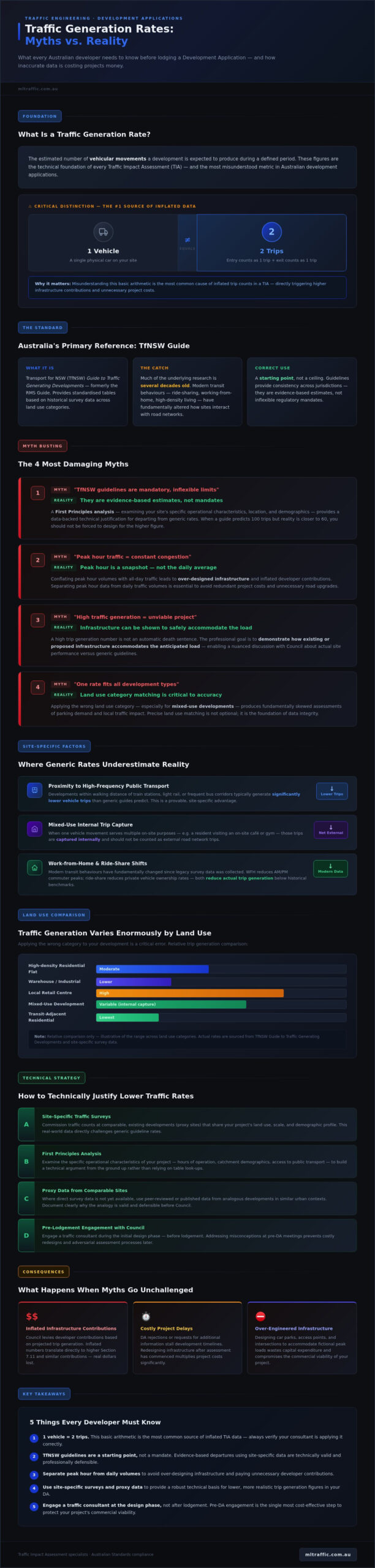
Traffic generation rates represent the estimated number of vehicular movements a specific development is expected to produce during a defined period. These figures serve as the technical foundation for any Traffic Impact Assessment. One of the most common misconceptions about traffic generation rates involves the distinction between a ‘vehicle’ and a ‘trip’. In traffic engineering, a single vehicle entering and subsequently leaving a site constitutes two trips. Failing to account for this basic arithmetic often leads to inflated data and unnecessary friction during the planning process.
The primary source for these benchmarks in Australia is the Transport for NSW (TfNSW) Guide to Traffic Generating Developments, previously known as the RMS Guide. This document provides standardised tables based on historical survey data. While these rates provide a starting point, they are frequently misapplied as rigid rules rather than the evidence-based estimates they are intended to be. Meticulous data integrity is required to ensure these generic rates don’t unfairly penalise a well-designed project.
The Role of Land Use Categories
Land use categories dictate the baseline rates applied to a project. A high-density residential flat building generates vastly different traffic volumes compared to a warehouse or a local retail centre. Mixed-use developments present a particular challenge. Applying a ‘one size fits all’ rate to a complex project often results in inaccurate projections. Precise land use matching is essential. If a development is classified under the wrong category, the resulting data integrity is compromised, leading to skewed assessments of parking demand and local impact.
Why Council Fixates on These Numbers
Local Councils scrutinise these figures because they directly correlate to the residual capacity of the surrounding road network. High trip generation numbers often trigger requirements for significant developer contributions or the construction of expensive infrastructure upgrades. Addressing common misconceptions about traffic generation rates during the pre-lodgement phase can prevent costly redesigns later. There is a persistent myth that a high traffic generation rate automatically renders a project unviable. This is incorrect. The goal of a professional assessment is to demonstrate how the existing or proposed infrastructure can safely accommodate the anticipated load. Meticulous data allows for a more nuanced discussion with planning authorities regarding actual site performance versus generic guidelines.
Myth: Technical Guidelines are Inflexible Mandates
Many developers assume the rates published in the TfNSW Guide to Traffic Generating Developments are mandatory regulatory limits. This is one of the most common misconceptions about traffic generation rates. In reality, these figures are based on historical survey data. Much of this research was conducted several decades ago. Modern transit behaviours have changed significantly. The rise of ride-sharing services and the shift toward working-from-home models have fundamentally altered how developments interact with the local road network. Relying on outdated data often leads to over-engineered parking requirements. It can also result in inflated infrastructure contributions that don’t reflect actual site demand.
Guidelines provide a baseline for consistency across different jurisdictions. They cannot predict the specific nuances of every individual site. A project’s unique location, demographic target, and operational model all influence vehicular activity. When a guide predicts 100 trips but the reality is closer to 60, the developer shouldn’t be forced to accommodate the higher figure. Professional analysis allows for a more accurate projection based on current conditions rather than historical averages.
When Guidelines Fail to Reflect Reality
Traditional rates for residential and commercial land uses often fail to account for site-specific advantages. Developments located within walking distance of high-frequency public transport hubs typically exhibit significantly lower trip generation than generic guides suggest. Similarly, mixed-use projects often benefit from internal trip capture. This occurs when one vehicle movement serves multiple purposes, such as a resident visiting an on-site cafe or gym. A departure from standards is a data-backed technical justification for using non-standard rates. By applying a ‘First Principles’ analysis, we examine the specific operational characteristics of your project. This approach ensures the data accurately reflects a modern urban environment where car dependency is frequently lower than previous benchmarks indicated.
The Engineer’s Role in Justifying Departures
Securing Council approval for non-standard rates requires more than a simple request. It demands a qualified Traffic Engineer who can provide empirical evidence to support the deviation. This process involves comparing the proposed development against ‘proxy’ sites with similar characteristics and transit access. Our role is to build a credible technical case that aligns with the broader objectives of Australian planning frameworks. We focus on safety and network efficiency. Professional credibility is paramount when presenting non-standard data to authorities. Councils are more likely to accept a departure when it is backed by meticulous data integrity and senior-level accountability. If you are concerned that generic data is hindering your project’s feasibility, you can contact our senior principals for a direct assessment of your site’s specific potential.
Myth: Peak Hour Traffic Equals Constant Congestion
One of the most persistent common misconceptions about traffic generation rates is the belief that peak hour figures represent a permanent state of congestion. If a technical report indicates 100 trips per hour, it doesn’t imply a constant, unrelenting stream of 100 vehicles. It describes a concentrated window of activity. This peak hour volume is merely a subset of the Annual Average Daily Traffic (AADT). Understanding the relationship between these two metrics is essential for accurate site assessment. Traffic engineers analyse arrival and departure distributions to determine how vehicular movements spread throughout the day. A development’s internal peak often doesn’t align with the peak hour of the adjacent road network. This temporal mismatch frequently reduces the actual impact on local traffic flow.
Understanding Am Peak vs Pm Peak
Generation profiles vary significantly across different land use categories. A primary school generates intense, short-lived activity during morning drop-off and afternoon pick-up. Conversely, a fitness centre or gym typically peaks at 6:00 am and 6:00 pm. Industrial facilities often operate with staggered shifts that avoid traditional commuter rush hours entirely. There’s a frequent misconception that every new development adds directly to the existing ‘school run’ or ‘commuter rush’. Staggered generation can actually benefit the local network by utilising spare capacity during off-peak windows. Demonstrating these specific profiles to Council requires meticulous data integrity and professional engineering logic.
The ‘Worst-Case Scenario’ Trap
Modelling only the absolute worst-case scenario frequently leads to over-engineered and unnecessarily costly road works. This trap occurs when planning authorities focus solely on theoretical maximums rather than operational reality on Australian roads. Generic guidelines often assume every vehicle arrives simultaneously during the busiest minute of the hour. Real-world behaviour is far more fluid. Intersection Analysis provides a much more nuanced view than raw generation rates. It examines specific metrics such as queue lengths, delays, and Level of Service (LoS) at critical junctions. This technical evidence often proves that a project is viable without the need for redundant infrastructure upgrades.
The Truth About Site-Specific Surveys and Data Accuracy
Site-specific surveys serve as the ultimate technical tool for correcting common misconceptions about traffic generation rates. When a development application is stalled due to perceived traffic impacts, raw data from the actual environment often provides the only path forward. Relying on 20-year-old national guidelines is a frequent point of failure in modern planning. These documents cannot account for local transit improvements or shifts in car ownership. By conducting a survey of ‘proxy’ sites, we collect data from existing developments with similar characteristics to your proposed project. This includes matching land use, scale, and proximity to public transport. Integrating this bespoke data into a Traffic Impact Assessment replaces theoretical estimates with verifiable facts. This transition from generic to specific data is often the difference between a rejected application and a successful approval.
The Methodology of a Traffic Survey
Selecting appropriate proxy sites is a meticulous process. Engineers must identify locations that mirror the subject site in terms of gross floor area, parking provision, and surrounding road hierarchy. Council acceptance depends on this technical alignment. A valid survey requires specific conditions to ensure data integrity:
- Duration: Surveys typically cover peak periods over multiple days to capture average volumes.
- Weather: Data collection must occur during fine weather to avoid skewed results from unusual driving patterns.
- Seasonality: Surveys are scheduled outside of school holidays or public holidays to reflect standard network performance.
A site-specific survey provides empirical proof that overrides generic assumptions.
Presenting Bespoke Data to Council
Packaging this data for planning authorities requires a strategic approach. We don’t just present raw numbers. We interpret the findings to address specific Council objections regarding congestion or infrastructure capacity. Transparency in data collection is vital. Providing detailed survey logs and methodology builds trust with Council officers. Professional Traffic Engineering expertise is essential to defend these findings during the assessment process. Our senior principals directly oversee this data collection to ensure it meets the highest technical standards. If your project is being restricted by generic traffic figures, request a site-specific survey assessment to secure more accurate generation rates.
Navigating Council Approvals with Expert Traffic Analysis
Successfully navigating the approval process requires a strategic shift from defensive planning to proactive technical justification. When developers address common misconceptions about traffic generation rates during the pre-lodgement phase, they significantly reduce the likelihood of costly delays. Early engagement with a traffic consultant ensures that site access and internal circulation are aligned with Australian Standards, specifically AS 2890.1. This early alignment prevents the need for major structural changes to the development after the application has been submitted to Council. Accessing senior engineering expertise directly ensures that every report is built on professional logic rather than bureaucratic assumptions.
Optimising Your DA Strategy
A strategic approach to traffic data can lead to substantial savings on infrastructure contributions and road upgrade requirements. By demonstrating that a development’s actual impact is manageable, you remove the technical justification for oversized ‘voluntary’ contributions. This analysis works in conjunction with Swept Path Analysis to prove that the proposed layout is functional and safe for the intended vehicle types. A meticulous, fact-based report is the most effective tool for countering generic objections regarding traffic congestion or parking shortfalls. This evidence-based strategy ensures your project remains commercially viable while meeting all regulatory requirements.
Partnering with ML Traffic Engineers Australia
ML Traffic Engineers Australia offers over 15 years of national experience in transport planning and civil engineering. Our firm is dedicated to providing meticulous data integrity through direct principal involvement in every project. The expert who initiates the relationship is the same person who performs the technical work, ensuring a level of accountability and expertise that larger firms often lack. We provide fixed-fee proposals for a range of services, including car park design and traffic impact statements. This hands-on approach ensures that your DA report is prepared with the precision required for high-stakes approvals. Contact ML Traffic Engineers Australia today to discuss your site’s specific traffic generation needs.
Securing Your Development Approval with Technical Evidence
Addressing common misconceptions about traffic generation rates is the first step toward a realistic development outcome. By moving beyond generic guidelines and static peak-hour assumptions, developers can ensure their applications reflect actual site performance. The integration of site-specific surveys and first-principles analysis provides the technical foundation required to justify departures from standard rates and secure planning approvals without redundant infrastructure costs. This evidence-based approach aligns your project with Australian Standards while maintaining commercial viability.
ML Traffic Engineers Australia provides the seasoned expertise needed to bridge the gap between regulatory guidelines and site-specific reality. With over 15 years of national consultancy experience, we specialise in preparing Council-compliant reports that maintain direct access to senior principals. Every assessment is performed by the expert who initiates the project, ensuring meticulous data integrity and senior-level accountability for your DA. Request a Professional Traffic Assessment for Your Development today to secure an accurate and defensible traffic strategy for your next project.
Frequently Asked Questions
What exactly is a trip generation rate in traffic engineering?
A trip generation rate is the estimated number of vehicular movements a development produces per unit of measure, such as gross floor area or number of dwellings. In traffic engineering, a single vehicle movement constitutes one trip. This means a car entering and later leaving a site equals two trips. These rates are fundamental for calculating the impact of a project on the local road network during peak periods.
Can I use lower traffic rates than what is listed in the RMS Guide?
Yes, you can use lower rates if they are supported by site-specific technical evidence or ‘First Principles’ analysis. One of the common misconceptions about traffic generation rates is that the TfNSW Guide figures are mandatory. While they provide a starting point, they are evidence-based estimates. A qualified traffic engineer can justify a departure from these standards by surveying proxy sites that mirror your development’s actual operational characteristics.
How do traffic generation rates affect my car parking requirements?
Traffic generation rates directly influence the Car Parking Demand Assessment required for your DA. High trip rates generally suggest higher vehicle turnover and longer stay durations, which may increase the total parking spaces required by Council. By accurately determining the generation rates, we ensure your car park design meets Australian Standards (AS 2890.1) without being over-engineered. This prevents the loss of valuable floor space to redundant parking stalls.
What happens if Council disagrees with the traffic rates in my report?
If Council disputes the rates, they typically issue a Request for Further Information. We resolve these disagreements by providing additional technical justification or empirical data from site-specific surveys. Our reports are built on 15 years of national experience and direct principal involvement, which provides the professional credibility needed to defend non-standard data. We address Council concerns with fact-based engineering logic to ensure your application progresses without unnecessary infrastructure costs.
Is a site-specific traffic survey always necessary for a DA?
A site-specific survey isn’t always mandatory if your development aligns closely with standard land use categories and generic rates. However, it becomes an essential tool when you need to challenge common misconceptions about traffic generation rates that might otherwise hinder your project. For unique developments or sites with high transit accessibility, a survey provides the empirical proof required to secure more realistic and favourable figures from planning authorities.
Do all Australian states use the same traffic generation guidelines?
No, each Australian state has its own specific guidelines and planning frameworks. While the TfNSW Guide is frequently used as a benchmark across the country, other states maintain their own technical datasets for transport planning. Our consultancy operates nationally, ensuring every Traffic Impact Assessment complies with the specific regulatory standards of the relevant jurisdiction. We match the correct state-based land use categories to your proposal to maintain data integrity.
How does public transport proximity influence trip generation rates?
Proximity to high-frequency public transport significantly reduces vehicular trip generation. Residents or visitors in transit-oriented developments are less likely to rely on private cars, leading to lower peak hour volumes. We account for this ‘mode shift’ by applying technical reductions to standard generation rates. This adjustment reflects the modern urban reality where car dependency is lower, helping you avoid inflated infrastructure requirements based on car-centric data.
Can an expert traffic report help avoid expensive road infrastructure upgrades?
Yes, an expert traffic report can prevent the need for costly upgrades by demonstrating that the existing road network has sufficient residual capacity. Through detailed Intersection Analysis and realistic trip generation modelling, we often prove that a development’s impact is less than generic guidelines suggest. This technical evidence allows you to negotiate developer contributions and avoid paying for infrastructure that your project doesn’t actually necessitate.

Disclaimer
The content on www.mltraffic.com.au, including all technical articles, guides, and resources, is provided for general informational and educational purposes only. It is not intended to constitute professional advice in traffic engineering, transportation planning, development approvals, or any other technical or legal field.
While ML Traffic Engineers makes every reasonable effort to ensure the accuracy, completeness, and timeliness of the information published, we do not provide any warranties or representations (express or implied) regarding its reliability, suitability, or availability for any particular purpose. Any reliance you place on the content is strictly at your own risk.
In no event shall ML Traffic Engineers, its directors, employees, authors, or affiliates be liable for any direct, indirect, incidental, special, consequential, or punitive damages (including, without limitation, loss of profits, data, or business opportunities) arising out of or in connection with the use of, or inability to use, any information provided on this website.
The articles and guides on this site are not a substitute for engaging a qualified, registered professional traffic engineer (such as an NPER or RPEQ engineer) to assess your specific project requirements. For tailored advice, compliance assessments, or traffic engineering services, please contact a competent professional.
This disclaimer may be updated from time to time without notice. By accessing or using this website, you agree to be bound by the most current version of this disclaimer.
