

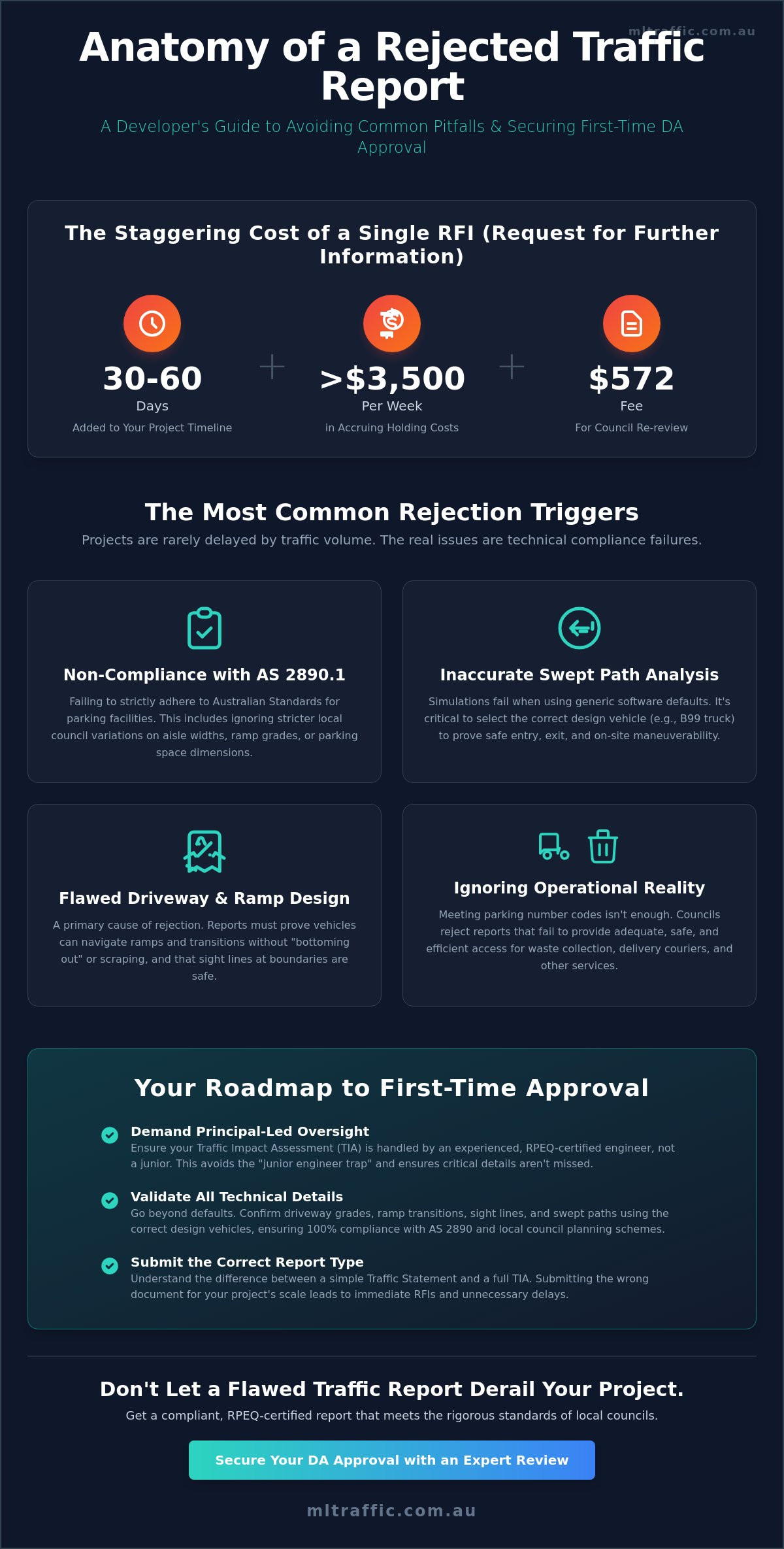
A single Request for Further Information (RFI) from your local council can stall a medium-sized development for 30 to 60 days, accruing holding costs of more than $3,500 per week as of May 2026. These delays are rarely about the volume of traffic. Instead, they usually stem from technical non-compliance with AS/NZS 2890.1:2004. Identifying the common reasons council rejects traffic reports, such as non-compliant driveway ramp grades or insufficient vertical clearance, is essential for maintaining your project timeline and avoiding the $572 fee for re-reviewing traffic drawings.
We understand the frustration of facing unexpected redesign costs due to complex Australian Standards. This guide identifies the critical technical errors and compliance gaps that lead to rejections, providing you with a roadmap to secure approval on your first submission. You’ll gain a clear understanding of the failure points in vehicle swept path analysis and learn how to ensure your traffic engineering consultant delivers a compliant, RPEQ-certified report that meets the rigorous standards required by local authorities.
Key Takeaways
- Understand why strict adherence to AS 2890.1 and AS 2890.2 is non-negotiable and how ignoring local council variations leads to immediate technical rejections.
- Learn how to avoid failures in Vehicle Swept Path Analysis by selecting the correct design vehicle for simulations rather than relying on generic software defaults.
- Identify the operational disconnects, such as inadequate provision for waste collection and delivery couriers, that cause councils to reject reports despite meeting numerical parking codes.
- Discover the common reasons council rejects traffic reports and gain a technical roadmap to secure a successful Development Application on your first submission.
- Recognize the importance of principal-led oversight to ensure your Traffic Impact Assessment (TIA) is handled by an experienced engineer rather than a junior staff member.
Table of Contents
-
Technical Non-Compliance with AS 2890: The Most Common Trigger
-
Inaccurate Swept Path Analysis: Why Simulations Fail Scrutiny
The High Cost of Rejection: Why Traffic Reports Stalls DAs
A Traffic Impact Assessment (TIA) is a technical document that proves a development won’t adversely affect road safety or the efficiency of the surrounding road network. Council planners rely on these traffic reports to justify the safety of a proposed land-use change. It isn’t just a formality; it’s a rigorous application of traffic engineering principles to ensure public safety. Identifying the common reasons council rejects traffic reports early in the planning phase is the first step toward a successful submission.
Understanding the difference between a simple Traffic Statement and a full TIA is vital for compliance. A Traffic Statement is a brief letter for low-impact developments. A TIA is a comprehensive study required for larger projects. Submitting the wrong type of report leads to an immediate Request for Information (RFI), which can add months to your project timeline. Council planners will not approve a DA if the technical data is missing or if the report fails to address specific local traffic conditions.
To better understand the weight of council decisions on traffic resolutions, watch this helpful video:
The Financial Impact of Traffic-Related RFIs
Rejections often manifest as an RFI, stalling your project in council limbo. Holding costs for a medium-sized development site in 2026 can exceed $3,500 per week. Interest payments accrue while you wait for a new assessment. Redesigning car parks or driveways after a rejection is significantly more expensive than getting it right initially. You may also face a $572 fee for the re-review of traffic signal drawings. If traffic safety concerns aren’t adequately addressed, you risk a total DA refusal. This forces a complete restart or a costly appeal process.
The Role of the Traffic Engineer in the DA Process
A traffic engineer acts as the technical bridge between your architectural vision and council regulatory requirements. We provide the mandatory certification that your designs meet Australian Standards, such as AS/NZS 2890.1:2004 for off-street parking. Our role includes performing Vehicle Swept Path Analysis and Car Parking Demand Assessments to prove your site’s operational feasibility. Engaging an expert ensures your project avoids the "junior engineer trap" where reports from large firms are often rejected due to a lack of senior oversight. Learn more about the role of a traffic engineer in development applications to ensure your first submission is your only submission.
Technical Non-Compliance with AS 2890: The Most Common Trigger
Australian Standards are the baseline for every development application. Councils treat AS 2890.1 (Off-street car parking) and AS 2890.2 (Commercial vehicle facilities) as non-negotiable benchmarks. One of the common reasons council rejects traffic reports is the use of outdated versions of these standards or a total disregard for local council variations. While national standards provide a foundation, local planning schemes often impose stricter requirements on aisle widths or parking space dimensions. The Queensland Government’s Guide to Traffic Impact Assessment outlines the framework for these reports, yet many submissions fail because they treat these technical requirements as suggestions rather than mandates.
Errors in driveway ramp grades and transition zones remain a primary cause of non-compliance. If a report doesn’t explicitly demonstrate that a vehicle can enter and exit the site without "bottoming out" or scraping, council planners will issue a safety objection. Similarly, failing to provide adequate sight distances at the property boundary is a critical failure point. These technicalities require precision that junior staff often overlook.
Driveway and Ramp Gradient Failures
Councils are meticulous about ramp design because poor gradients lead to vehicle damage and safety hazards. AS 2890.1 mandates specific gradient rules, such as a 1:20 (5%) maximum grade for the first 6 metres of a driveway to ensure visibility and prevent scraping. For steeper sections, the standard typically allows up to a 1:8 (12.5%) or 1:5 (20%) grade depending on the land use, but only if transition zones are correctly applied. A 2-metre transition zone prevents vehicle damage and secures council approval. Securing a professional Driveway Ramp Grade Assessment early prevents these technical roadblocks.
Sight Distance and Pedestrian Safety Objections
Pedestrian safety is a top priority for council assessors. Drivers exiting a site must have a clear line of sight to pedestrians on the footpath and vehicles on the road. A common mistake in rejected reports is placing landscaping, signage, or structural pillars within the "sight triangle." This triangle is a specific area that must remain clear of obstructions to meet safety standards. When these zones are compromised, the council will reject the report based on avoidable safety risks. A professional Sight Distance Assessment pre-empts these concerns by identifying obstructions during the design phase. We ensure your site layout complies with both AS 2890.1 and local safety requirements to avoid common reasons council rejects traffic reports during the initial review.
Inaccurate Swept Path Analysis: Why Simulations Fail Scrutiny
Swept path analysis uses specialised software like AutoTURN to simulate the physical space a vehicle requires while turning. It’s a critical component of a Traffic Impact Assessment. One of the common reasons council rejects traffic reports is a lack of technical rigour in these simulations. According to the Austroads Guide to Traffic Management, safe access design must account for the swept path of the largest vehicle expected to use the site. If your report fails to prove safe manoeuvrability, the council will likely issue an RFI or a flat rejection.
Council assessors look for "clearance logic" in every diagram. This means allowing for a minimum 300mm buffer between the vehicle’s swept path and any fixed objects like walls, pillars, or parked cars. Simulations that show a vehicle’s body or wheels overlapping these boundaries are technically flawed. Another frequent failure point is submitting diagrams where a vehicle must cross the road centreline to enter or exit a site. This is often rejected on safety grounds as it forces oncoming traffic to stop or swerve, creating an unacceptable liability for the local authority.
Choosing the Correct Design Vehicle
Selecting the wrong "design vehicle" is a major error. You must match the vehicle type to the specific land use of your development. For residential projects, this usually means a waste collection vehicle. For industrial sites, it might be a B-double. Using a "standard" template that doesn’t reflect the actual service vehicles required is a shortcut that leads to rejection. For instance, a 12.5m Heavy Rigid Vehicle (HRV) has specific dimensions mandated by Australian Standards: a width of 2.5 metres and a turning circle of 25.0 metres. If your simulation uses a smaller van template when an HRV is required, the entire access design is invalid.
Proving Manoeuvrability in Tight Spaces
Most councils mandate that all vehicles must enter and exit a site in a forward direction. Reversing onto a public road is a significant safety risk and a frequent cause for rejection. Your analysis must prove the vehicle can turn around within the site boundaries. Councils also dislike "3-point turns" or complex multi-point manoeuvres that block internal traffic flow or cause queuing on the street. If a vehicle takes too long to clear the driveway, it compromises network efficiency. For a deeper look at these requirements, read our swept path guide to ensure your diagrams meet every technical benchmark.
Operational Disconnect: Parking Demand vs. Site Reality
Meeting the minimum numerical requirements of a planning scheme doesn’t guarantee approval. One of the common reasons council rejects traffic reports is a failure to demonstrate "operational feasibility." A report might show 50 parking spaces to satisfy a code, but if the layout makes those spaces inaccessible during peak delivery times, the council will likely reject the submission. Assessors prioritize how a site functions in the real world, particularly regarding service vehicles, delivery couriers, and waste collection.
Inadequate provision for these operational needs often leads to on-street parking spillover. If a courier has no dedicated bay, they park illegally or block traffic on the public road. Councils are sensitive to these effects. Additionally, poorly designed shared parking arrangements between residential and commercial users are a major red flag. Without a clear management plan or physical separation, these arrangements lead to internal conflict and safety hazards that planners won’t ignore.
The Car Parking Demand Assessment
When council parking rates are too high for your specific project, you can challenge them with empirical data. A professional Car Parking Demand Assessment uses data from similar land uses to justify a lower rate. This is particularly relevant following the March 14, 2025 Inner-City Affordability Initiative, which allows for reduced parking in specific urban hubs if supported by technical data. A parking shortfall isn’t an automatic rejection if it’s supported by a robust demand assessment that proves the proposed rate is sufficient for the intended use. A parking demand assessment balances commercial viability with council codes by proving through data that the development won’t rely on existing public infrastructure. This data-driven approach is critical for overcoming common reasons council rejects traffic reports involving parking numbers.
Loading Dock and Service Access Failures
Loading dock design is a frequent failure point in development applications. A common reason for rejection is forcing service vehicles to reverse out onto a main road. This is a significant safety liability. You must prove that even large delivery vehicles can enter and exit in a forward direction without obstructing resident parking access. Vertical clearance is another overlooked detail. Basement loading areas must provide enough headroom for the specific trucks required by the site. For instance, a medium rigid vehicle (MRV) requires a minimum vertical clearance of 4.5 metres under AS 2890.2. Failing to account for these heights in architectural plans leads to a costly RFI. To ensure your site is operationally sound, consider a comprehensive Vehicle Swept Path Analysis before finalising your design.
Securing Approval: The ML Traffic Principal-Led Approach
Many developers are surprised when a report from a top-tier firm fails to pass council scrutiny. This frequently occurs because the senior principal who signed the proposal isn’t the one who performed the Vehicle Swept Path Analysis or calculated the parking demand. This "Junior Engineer" trap is one of the common reasons council rejects traffic reports. Junior staff often rely too heavily on software defaults without understanding the specific operational requirements or local constraints of a site. At ML Traffic Engineers, we’ve eliminated this risk. The traffic consultant who provides the quote, does the work.
We’ve been trading since 2005 and have successfully assessed over 10,000 sites across Australia. Our principals, Michael Lee and Benny Chen, bring between 30 and 40 years of individual experience to every project. This depth of knowledge is critical for our pre-submission audits. We review every report against local council Development Control Plans (DCPs) and Australian Standards before it leaves our office. This meticulous oversight ensures that your submission is technically robust and ready for immediate approval.
The Value of Senior-Level Accountability
Our clients have direct access to our principals’ mobile numbers for every project. This "no-gatekeepers" approach ensures that potential compliance issues, such as non-compliant driveway ramp grades or sight-line obstructions, are identified and resolved during the design phase. Senior engineers have the expertise to interpret the "grey areas" of council codes that automated software often misses. We don’t just provide data; we provide a professional certification that your project meets mandatory safety and efficiency standards. We ensure your report is bulletproof before it reaches the council planner’s desk, minimizing the risk of a costly RFI.
Next Steps for Your Development
If you’ve already received a council RFI, we can help you transition to a compliant, approved report. We specialize in resolving the technical failure points that stall DAs. Transitioning from a rejection to an approval requires a meticulous response to every council concern. Whether you’re at the initial design phase or responding to a safety objection, our team provides the RPEQ-certified data required to secure your DA. Requesting a quote for a professional Traffic Impact Assessment is the first step toward keeping your project on schedule. Don’t let technical errors add $3,500 per week in holding costs to your project. Contact us today to ensure your traffic report addresses all common reasons council rejects traffic reports and secures approval on your first submission.
Secure Your DA Approval with Technical Precision
Securing a successful Development Application requires more than meeting basic parking codes. It demands a rigorous application of AS 2890.1:2004 and accurate vehicle swept path simulations that account for real-world site constraints. By understanding the common reasons council rejects traffic reports, you can avoid the project delays and holding costs that typically stall developments for 30 to 60 days. Professional certification from an experienced traffic engineer ensures your design is operationally sound and compliant with local planning schemes.
ML Traffic Engineers offers over 15 years of industry experience and has assessed more than 10,000 sites nationally. We don’t use junior staff for critical assessments; our senior engineers handle every project from the initial quote to final completion. This principal-led approach provides the technical accountability needed to satisfy council planners and maintain your construction timeline. It’s time to move past RFIs and focus on building.
Get a compliant traffic report from the experts at ML Traffic Engineers today. Your project deserves the reliability and expertise of seasoned consultants who deliver results on the first submission.
Frequently Asked Questions
Why does council require a traffic report for a small development?
Councils require traffic reports for small developments to ensure the proposed use doesn’t create safety hazards or exceed the local road capacity. Even a minor increase in vehicle movements can affect sight distances for neighboring properties. Planners must verify that the development provides adequate on-site parking to prevent spillover onto public streets. This technical verification is a mandatory part of the risk management process for every local authority.
What is the most common reason a swept path analysis is rejected?
The most frequent reason for rejection is using an incorrect design vehicle that doesn’t reflect the site’s operational reality. For example, submitting a simulation for a small van when the land use requires a 12.5m Heavy Rigid Vehicle is a critical error. Other common reasons council rejects traffic reports include failing to show the mandatory 300mm clearance buffer between the vehicle body and structural pillars or walls.
How long does it take to fix a council rejection regarding traffic?
Engineering revisions typically take 5 to 10 business days depending on the complexity of the Request for Information. However, the council’s re-review process can add 30 to 60 days to your project timeline. This delay often results in holding costs exceeding $3,500 per week for medium-sized sites as of May 2026. Getting the technical details right in the first submission is the only way to avoid these significant project stalls.
Can I use a generic car park design from my architect for council approval?
Generic designs often fail because they lack the specific technical certifications required by RPEQ engineers. Architects focus on spatial efficiency, but traffic reports must prove compliance with AS 2890.1 regarding ramp transition zones and aisle widths. A design that looks correct on a floor plan might fail a swept path analysis. You need a qualified traffic engineer to certify that the layout is functional and safe for the intended vehicles.
What happens if my site cannot meet the AS 2890.1 driveway requirements?
If your site cannot meet the prescriptive requirements of AS 2890.1, you must provide a merit-based performance solution. This involves an RPEQ-certified engineer proving that the proposed deviation doesn’t compromise safety or operational efficiency. Councils may accept these solutions if supported by high-quality data and professional assessment. Without this expert justification, non-compliance with driveway standards will result in a flat rejection of your DA.
Is a Traffic Management Plan (TMP) the same as a Traffic Impact Assessment (TIA)?
No, these documents serve entirely different purposes in the development cycle. A Traffic Impact Assessment (TIA) evaluates the long-term transport effects of a new land use for DA approval. A Traffic Management Plan (TMP) or Traffic Guidance Scheme (TGS) manages short-term safety during the construction phase. You cannot substitute one for the other; councils require the TIA to justify the permanent changes to the road network.
How much does it cost to have a traffic report revised after a council rejection?
While consultant fees for revisions vary based on the RFI’s scope, you must also account for mandatory government charges. For example, Brisbane City Council charges a $572 fee for the re-review and approval of traffic signal drawings according to the 2025-2026 fee schedule. These administrative costs, combined with the professional fees for engineering redesigns, make initial non-compliance an expensive mistake for any developer.
Do all councils follow the same traffic and parking standards across Australia?
While AS 2890.1:2004 is the national benchmark, local councils frequently implement their own variations through Development Control Plans. Standards for parking rates and driveway widths can differ significantly between neighboring local government areas. One of the common reasons council rejects traffic reports is the failure to account for these local nuances. Professional consultants must cross-reference national standards with specific local planning policies to ensure full compliance.
Which areas do you cover?
We are traffic engineers servicing Melbourne, Sydney, Brisbane, Gold Coast, Hobart, Perth, Adelaide, Darwin, Canberra and surrounding areas.

Disclaimer
The content on www.mltraffic.com.au, including all technical articles, guides, and resources, is provided for general informational and educational purposes only. It is not intended to constitute professional advice in traffic engineering, transportation planning, development approvals, or any other technical or legal field.
While ML Traffic Engineers makes every reasonable effort to ensure the accuracy, completeness, and timeliness of the information published, we do not provide any warranties or representations (express or implied) regarding its reliability, suitability, or availability for any particular purpose. Any reliance you place on the content is strictly at your own risk.
In no event shall ML Traffic Engineers, its directors, employees, authors, or affiliates be liable for any direct, indirect, incidental, special, consequential, or punitive damages (including, without limitation, loss of profits, data, or business opportunities) arising out of or in connection with the use of, or inability to use, any information provided on this website.
The articles and guides on this site are not a substitute for engaging a qualified, registered professional traffic engineer (such as an NPER or RPEQ engineer) to assess your specific project requirements. For tailored advice, compliance assessments, or traffic engineering services, please contact a competent professional.
This disclaimer may be updated from time to time without notice. By accessing or using this website, you agree to be bound by the most current version of this disclaimer.
