
A single non-compliant gradient or a misplaced bollard in your disabled parking design can stall a development project for months. Many developers realize too late that meeting the technical requirements of AS 2890.6 isn’t just about drawing a wider bay; it’s about precision engineering that satisfies both regulatory authorities and the Building Code of Australia. If you’re concerned about a DA rejection due to overlapping standards or technical errors, you aren’t alone. As experienced traffic engineers trusted by developers nationwide for over 10,000 sites, ML Traffic Engineers Australia has seen how minor oversights in car park layouts lead to costly delays and redesign fees.
You likely understand that compliance is non-negotiable, yet the complexity of Australian Standards often creates more questions than answers. This guide clarifies the technical requirements of AS 2890.6 to ensure your car park layout meets all Australian accessibility standards on the first submission. We’ll examine the specific dimensions for dedicated bays, the critical placement of shared zones, and the common errors that trigger regulatory RFI letters. By following these engineering principles, you’ll secure faster approvals and gain direct access to the senior experts at ML Traffic Engineers Australia who perform the design work.
Key Takeaways
-
Learn the critical technical specifications of AS 2890.6 to ensure your off-street parking designs meet mandatory Australian accessibility standards.
-
Understand how to correctly position shared zones and bollards to facilitate wheelchair hoist deployment and avoid common Development Application (DA) refusals.
-
Engage a qualified traffic engineer Perth to map a continuous accessible path of travel from parking bays to building entrances, ensuring full DDA compliance.
-
Discover how to calculate the exact number of required accessible bays based on specific land-use types to streamline your Traffic Impact Assessment.
-
Benefit from over 15 years of technical expertise where the consultant who quotes your project is the senior engineer who delivers the final compliant design.
Table of Contents
-
The Role of a Traffic Engineer in Perth for Accessible Design
-
Core Technical Specifications for Compliant Disabled Parking Bay Design
-
Shared Zones and Bollard Placement: Avoiding Common DA Refusals
-
How to Integrate Accessible Parking into Your Traffic Impact Assessment
-
ML Traffic Engineers: Direct Access to Senior Consultants for Your Project
The Role of a Traffic Engineer in Perth for Accessible Design
Perth local councils, such as the City of Perth, City of Canning, and City of Stirling, enforce rigid parking standards for every Development Application (DA). A traffic engineer Perth ensures that parking layouts don’t just fit the physical site but strictly adhere to Australian Standard AS 2890.6. Without professional certification, councils frequently reject plans that fail to provide necessary shared zones or minimum vertical clearances of 2.5 metres. This technical oversight is a primary reason for project delays during the planning phase.
Navigating Council Requirements and DDA
The Disability Discrimination Act (DDA) 1992 creates a legal obligation to provide equitable access for all commercial and residential developments. In Western Australia, the Building Code of Australia (BCA) specifies exactly how many accessible bays a project requires based on its classification. A traffic engineer translates these legislative mandates into functional site plans. We ensure that surface gradients don’t exceed 1:40 for outdoor areas or 1:33 for indoor areas. While some designers aim for minimum compliance, experienced consultants focus on best practice design. This involves aligning with international standards for disabled parking to ensure that signage, pavement markings, and bay dimensions accommodate modern side-loading wheelchair vehicles effectively.
Avoiding Development Application Delays
Requests for Further Information (RFI) from council planners are the most common cause of project bottlenecks. These often stem from non-compliant vehicle swept paths or inadequate headroom in basement car parks. Engaging professional traffic engineering services during the initial design phase eliminates these technical errors before the application reaches the council desk. A certified traffic report provides the evidence planners need to approve a project without further questioning.
Consider the financial risk: correcting a non-compliant concrete slab after it’s poured can cost a developer more than A$25,000 in demolition and reconstruction fees. A traffic engineer Perth identifies these issues during the 2D planning stage, saving both time and capital. Our firm has reviewed over 10,000 sites, providing the meticulous detail required for rapid approvals in sectors ranging from medical centres and childcare to high-density residential apartments. We operate on a simple principle: the traffic consultant who provides the quote, does the work, ensuring total accountability for your project’s success.
Core Technical Specifications for Compliant Disabled Parking Bay Design
AS 2890.6:2009 governs the technical requirements for off-street parking for people with disabilities. This standard ensures that vehicles equipped with side-loading ramps or hoists have sufficient space to operate safely. A professional traffic engineer Perth must integrate these specifications during the initial site planning phase to avoid costly structural retrofits. While our guide on AS 2890.1 car park design outlines general parking geometry, AS 2890.6 introduces specific spatial buffers that are non-negotiable for Building Code of Australia (BCA) compliance. Failure to meet these standards often results in failed building inspections and potential legal liability under the Disability Discrimination Act.
Dimensions and Space Requirements
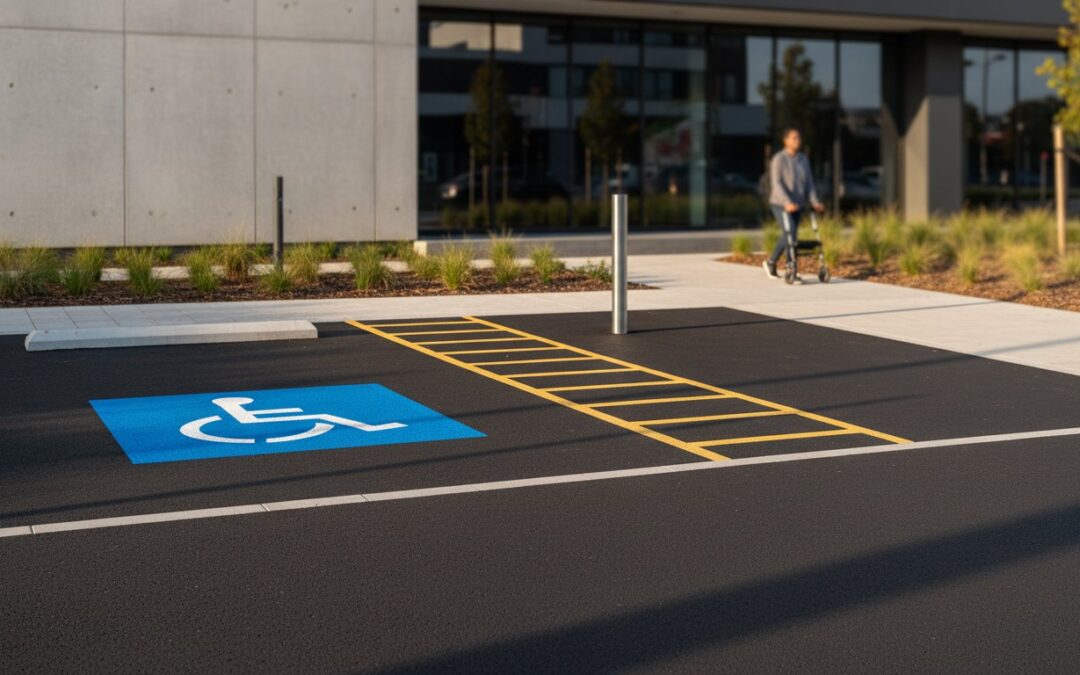
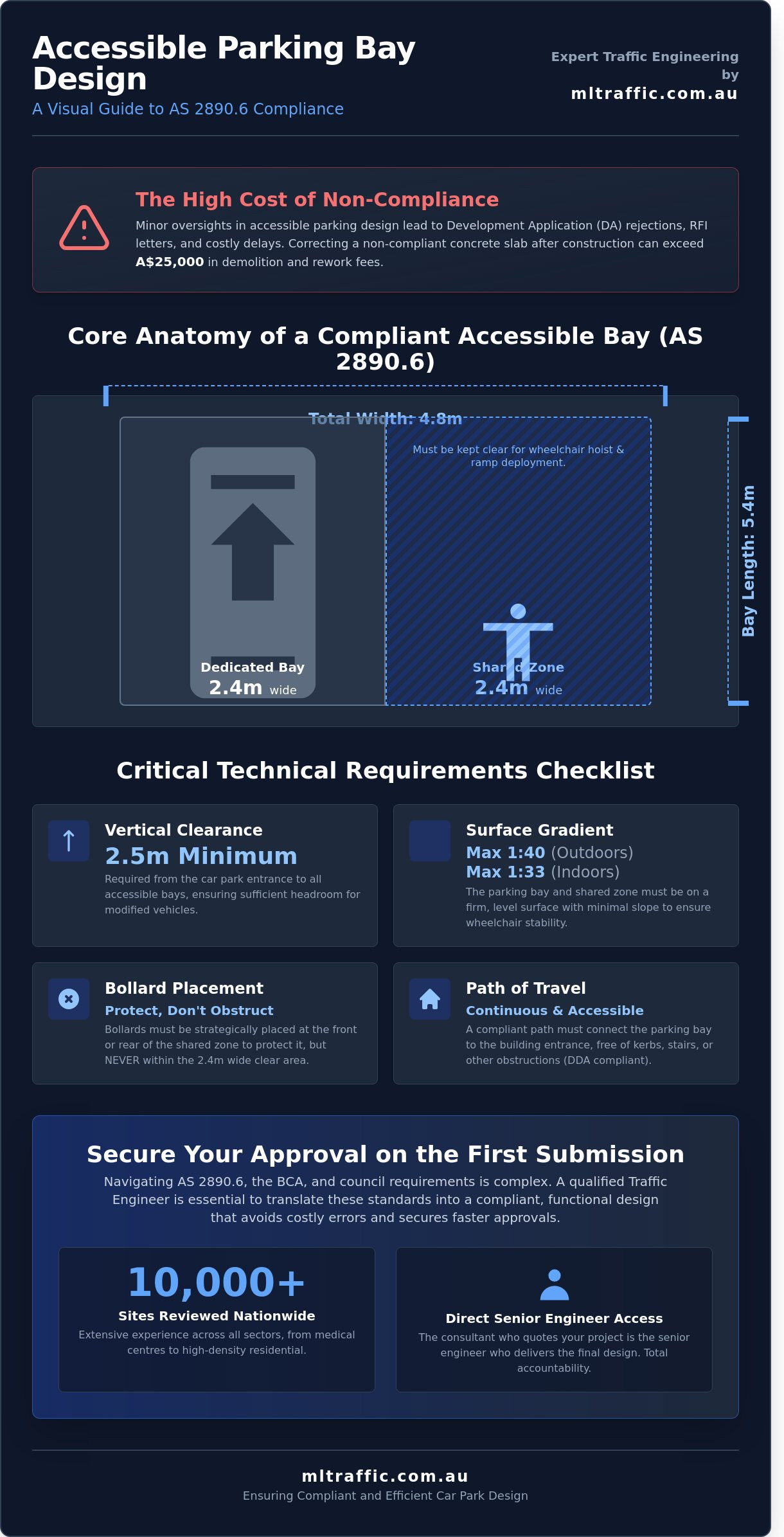
Spatial requirements for accessible bays are significantly larger than standard 2.4m or 2.6m wide bays. The design relies on a dual-component system: the dedicated parking space and the shared zone. Under AS 2890.6, a standard compliant accessible space must consist of a 2.4m wide dedicated bay adjacent to a 2.4m wide shared area, providing a total width of 4.8m. The shared zone allows for the deployment of wheelchairs and ramps without obstruction from other parked vehicles. This area must remain clear of all permanent fixtures, including bollards, which should be placed strategically to protect the space without hindering movement.
-
Single Bay Footprint: 4.8m total width by 5.4m length.
-
Side-by-Side Configuration: Two 2.4m bays can share a single 2.4m central shared area, totaling 7.2m in width for both spaces.
-
Shared Zone Markings: The shared area must be marked with yellow cross-hatching at a 45-degree angle with 150mm wide lines to prevent other drivers from obstructing the space.
Vertical Clearance and Headroom
Inadequate headroom is the most frequent reason for non-compliance in multi-deck or basement car parks. AS 2890.6 mandates a minimum vertical clearance of 2.2m. This requirement doesn’t just apply to the parking space itself; it extends from the site entrance, through the entire path of travel, to the designated bay. We often identify obstructions like fire sprinklers, drainage pipes, and cable trays that violate this 2.2m limit during our assessments. Transition zones from the street must also account for vehicle overhangs and ramp grades to prevent scraping or grounding of modified vans. If you’re unsure about your site’s current clearances, reviewing our technical assessment services can help identify potential compliance risks early.
Pavement Marking and Signage
Visual identification is a core requirement for enforcement and usability. Every accessible bay requires the International Symbol of Access (ISA) painted in white on a blue background. The paint must be slip-resistant to ensure safety for users in wet conditions. Vertical signage is equally critical. A sign featuring the ISA must be installed at the head of the bay at a height between 1.5m and 2.5m. This ensures the space is visible even when a vehicle is already parked in an adjacent bay. A qualified traffic engineer Perth will ensure these markings are positioned to meet both visibility and durability standards.
Shared Zones and Bollard Placement: Avoiding Common DA Refusals
Development applications in Western Australia frequently stall due to technical non-compliance in accessible parking design. A traffic engineer Perth identifies these errors before they reach the council desk. The shared zone is a dedicated space adjacent to an accessible parking bay, designed specifically for wheelchair hoist deployment and passenger maneuverability. It’s not merely a "buffer" area; it’s a functional requirement under AS 2890.6. If a shared zone is undersized or contains obstructions, the entire parking layout fails to meet Australian Standards.
Surface gradients are the most common cause of DA refusal. AS 2890.6 mandates a maximum gradient of 1:40 (2.5%) in any direction for both the parking bay and the shared zone. This requirement ensures a level surface for wheelchair stability. While a 1:33 (3%) gradient is sometimes permitted for outdoor bituminous surfaces to allow for drainage, councils in the Perth metropolitan area strictly enforce the 1:40 limit for most new developments. We use swept path analysis to verify that vehicles can enter and exit these bays in a single motion without encroaching on the protected shared zone area.
Designing Effective Shared Zones
Effective design requires a total prohibition of obstructions. Structural columns, bollards, drainage pits, and landscaping must remain outside the designated 2400mm x 4800mm shared zone area. Our traffic engineer Perth consultants often design "dual-use" shared zones. This configuration places one shared zone between two accessible bays, which maximises space efficiency while maintaining full compliance. We also ensure that kerb ramps and Tactile Ground Surface Indicators (TGSIs) are integrated into the path of travel to provide a seamless transition from the vehicle to the building entrance.
Bollard and Signage Compliance
Bollard placement is a precise science governed by AS 2890.6. A single bollard must be positioned within the shared zone, typically centered at a distance of 750mm to 1000mm from the front of the parking bay. This prevents standard vehicles from illegally occupying the space while allowing enough room for a wheelchair hoist to operate. Signage requirements are equally strict. The International Symbol of Access (ISA) must be clearly painted on the pavement in white on a blue background. Vertical parking signs must be installed at a minimum height of 2.2 metres. This height prevents the sign from becoming a head-height hazard for pedestrians and ensures it remains visible even when a vehicle is parked in the bay.
Technical precision in these areas reduces the risk of costly redesigns during the construction phase. Our team focuses on delivering designs that satisfy both the City of Perth and regional council requirements on the first submission. We provide the technical documentation necessary to prove that every millimetre of your parking layout is functional and compliant.
How to Integrate Accessible Parking into Your Traffic Impact Assessment
Compliance with the Building Code of Australia (BCA) and AS 2890.6 is a mandatory requirement for development applications in Western Australia. A traffic engineer Perth ensures that accessible parking isn’t a secondary consideration but a primary element of the site design. Proper integration requires precise spatial modeling and a deep understanding of the Disability Discrimination Act (DDA) standards to avoid costly design revisions during the council approval process.
Determining Provision Rates
Provision rates aren’t uniform. They change based on the land-use classification defined in the National Construction Code (NCC). For example, a Class 6 retail building requires one accessible space for every 100 car spaces provided. A Class 9a medical facility has stricter requirements, often needing one space for every 50 bays. When a project faces physical site constraints, we provide a formal justification for parking variations. This involves analyzing local demand and demonstrating that the proposed provision won’t negatively impact the community.
Swept Path and Manoeuvrability Testing
We use AutoTURN software to simulate the movements of B99 vehicles. These simulations confirm that a vehicle measuring 5.2 metres in length can navigate into the designated bay and the adjacent 2.4-metre wide shared zone. We pay close attention to structural elements. Columns can’t interfere with the required 2.2-metre vertical clearance or the door opening area. Our traffic engineer Perth team also checks for "blind aisles." We ensure that accessible bays aren’t located in areas where a driver would have to reverse more than 15 metres to exit the site safely.
The final Traffic Impact Assessment (TIA) maps the continuous accessible path of travel. This path must maintain a gradient no steeper than 1:40 for outdoor bitumen or concrete surfaces. It links the parking bay to the main entrance without any steps or steep kerb ramps. You can see how traffic engineering covers the entire scope of development by integrating these accessibility requirements into the broader transport network.
If you need a compliant parking layout for your next project, contact our senior engineers for a technical consultation.
ML Traffic Engineers: Direct Access to Senior Consultants for Your Project
ML Traffic Engineers Australia has been trading since 2005, providing a level of consistency that’s rare in the consultancy sector. We have secured approvals across more than 10,000 sites by maintaining a straightforward philosophy: the professional who quotes your work is the one who performs the work. This "no-gatekeepers" approach ensures that technical details aren’t lost in translation between a sales team and a production department. You’ll have direct communication with our principals, Michael Lee and Benny Chen, throughout the life of your project. We don’t hide behind junior staff or administrative layers.
Our firm specialises in tailored solutions for private developers and complex land-use projects. We have extensive experience across a massive variety of sectors, including:
-
Residential apartments and mixed-use developments
-
Childcare centres and educational facilities
-
Medical suites and allied health clinics
-
Taverns, bars, and fast-food outlets
-
Industrial warehouses and transport depots
-
Places of public worship and community centres
By choosing an experienced traffic engineer Perth developers can rely on, you ensure your project meets the rigorous standards required by local councils and Main Roads Western Australia. Our focus is on technical accuracy and achieving compliance without unnecessary delays.
Accountability and Expertise
Many larger firms operate on a junior-heavy model where graduates handle the bulk of the technical design. This often leads to oversight on difficult site constraints, such as tight driveway ramp grades or restricted sight-lines, which results in rejected applications. Our hands-on approach means senior eyes are on every Vehicle Swept Path Assessment and Traffic Impact Statement (TIS). We solve problems at the design phase rather than waiting for a council RFI to highlight issues. You can learn more about our team and our 40 years of combined experience in the industry. We use our deep knowledge of Australian Standards, specifically AS 2890.1, to deliver results that stand up to scrutiny.
Get Your Project Moving
Delays in the planning phase cost money. We prioritise fast, accurate quotes so you can finalise your project budgets quickly. Once we receive your site plans, we work efficiently to produce compliant parking designs and TIA reports. The typical timeline for our assessments is structured to keep your development application on track. We understand the bureaucratic requirements of Western Australian planning authorities and prepare our documentation to facilitate smooth approvals. It’s about providing a reliable, no-nonsense service that gets your project to the construction phase. Contact us today to speak directly with a senior traffic engineer Perth clients trust for professional, registered expertise.
Secure Your Development Approval with Compliant Accessible Design
Achieving compliance with AS 2890.6 isn’t just a regulatory hurdle. It’s a critical component of a functional site layout. Avoiding common DA refusals requires precise bollard placement and shared zone dimensions that satisfy local council requirements. When you integrate these technical specifications into your Traffic Impact Assessment early, you reduce the risk of expensive project delays. Engaging a qualified traffic engineer Perth ensures your accessible parking bays meet every Australian Standard while maximizing your site’s efficiency.
ML Traffic Engineers brings a proven track record to your project. We’ve completed over 10,000 sites across Australia since 2005. You won’t deal with junior staff or administrative gatekeepers here. The senior principal who provides your quote is the same expert who performs the technical work. With 15+ years of experience in the industry, we provide the authoritative guidance needed for successful development applications. Don’t leave your accessibility compliance to chance. Request a Traffic Engineering Quote from our Senior Principals today. We’re ready to help you navigate the complexities of transport planning in Western Australia.
Frequently Asked Questions
How many disabled parking bays are required for my development?
The National Construction Code (NCC) Volume One determines the number of accessible spaces required based on your building’s classification. For a Class 5 office building, you must provide 1 space for every 100 car parking spaces or part thereof. Retail developments under Class 6 require 1 space for every 50 spaces. We review your specific land use against Table D3.5 of the NCC to ensure your development meets all statutory requirements.
What is the minimum height clearance for an accessible parking space?
Australian Standard AS 2890.6 mandates a minimum vertical clearance of 2.2 metres for the parking space and the path of travel to it. Dedicated van spaces require a 2.5 metre clearance. It’s critical to measure from the lowest point, such as fire sprinklers or overhead pipes. A traffic engineer Perth ensures these clearances are maintained throughout the entire basement or car park structure to avoid costly post-construction modifications.
Does a disabled parking bay need a shared zone on both sides?
No, a shared zone is only required on one side of the dedicated bay. This shared area must be 2.4 metres wide by 5.4 metres long and marked with diagonal yellow stripes. It’s common practice to place the shared zone between two accessible bays to maximize efficiency. This configuration allows both spaces to utilize the same 2.4 metre wide area for loading and unloading wheelchairs and mobility aids.
Can I use a standard parking space as a disabled bay if it is wide enough?
You can’t simply repurpose a standard space without meeting all technical requirements of AS 2890.6. Accessible bays require specific pavement markings, a non-slip surface, and a dedicated shared zone. A standard 2.4 metre space lacks the necessary 2.4 metre shared area and the required 1:40 maximum gradient. Professional certification ensures the bay meets the Disability Discrimination Act 1992 standards and local planning requirements.
What is the maximum allowable slope for a disabled parking bay?
The maximum allowable gradient for an accessible parking space and its associated shared zone is 1:40 in any direction. For outdoor bitumen surfaces, a slightly steeper 1:33 slope is permitted to allow for drainage. These measurements are strict. If a site survey shows a 4% slope, the design fails compliance. Correcting these errors after construction costs thousands of dollars in remedial works; therefore, precise levels are essential during the design phase.
Is a traffic engineer required to certify my car park design for council?
Most local councils in Western Australia require a certified traffic engineer Perth to review and sign off on car park designs before issuing a building permit. This professional certification confirms the layout complies with AS 2890.1 for off-street car parking and AS 2890.6 for people with disabilities. Engaging an expert early prevents delays during the Development Application process and ensures your project meets the necessary technical standards for council approval.
What are the consequences of non-compliant disabled parking design?
Non-compliance often leads to the denial of an Occupancy Permit, which prevents the building from being used. Under the Disability Discrimination Act 1992, owners face significant legal liability and potential lawsuits if facilities are inaccessible. Remedial construction to fix a 1% gradient error or a 100mm clearance shortfall is expensive. It’s cheaper to ensure the design is compliant before the concrete is poured to avoid these avoidable financial risks.
Do I need a swept path analysis for disabled parking bays?
Yes, a swept path analysis is necessary to demonstrate that a B99 vehicle can enter and exit the bay in a single maneuver. This assessment uses specialized software to simulate the turning circle of a large van or wheelchair-accessible vehicle. We provide these technical drawings to prove to council that the proposed bay is functional. Without this analysis, you risk design rejection during the planning phase because the bay might be physically inaccessible.
Which suburbs do you service?
We operate in Alexander Heights, Alfred Cove, Alkimos, Anketell, Applecross, Ardross, Armadale, Ascot, Ashby, Ashendon, Ashfield, Attadale, Atwell, Aubin Grove, Aveley, Balcatta, Baldivis, Balga, Ballajura, Banksia Grove, Bassendean, Bateman, Bayswater, Beaconsfield, Beckenham, Bedford, Beechboro, Beeliar, Beldon, Bellevue, Belmont, Bentley, Bertram, Bibra Lake, Bicton, Booragoon, Brentwood, Brigadoon, Brookdale, Bull Creek, Bullsbrook, Burns Beach, Burswood, Butler, Byford, Canning Vale, Cannington, Carine, Carlisle, Carramar, Casuarina, Caversham, Champion Lakes, Chidlow, Churchlands, City Beach, Claremont, Clarkson, Cloverdale, Cockburn Central, Connolly, Coogee, Coolbellup, Coolbinia, Cottesloe, Craigie, Crawley, Currambine, Dalkeith, Darch, Doubleview, East Perth, Edgewater, Ellenbrook, Floreat, Fremantle, Girrawheen, Greenwood, Guildford, Hamilton Hill, Heathridge, Hillarys, Inglewood, Joondalup, Kallaroo, Kingsley, Leeming, Mandurah, Maylands, Melville, Midland, Mindarie, Morley, Mosman Park, Mount Hawthorn, Mount Lawley, Mullaloo, Nedlands, North Perth, Northbridge, Ocean Reef, Osborne Park, Padbury, Perth, Piara Waters, Rockingham, Scarborough, South Perth, Subiaco, Swanbourne, Thornlie, Tuart Hill, Victoria Park, Wangara, Wanneroo, Warwick, Wembley, West Perth, Willetton, Woodvale, Yokine.
Disclaimer
The content on www.mltraffic.com.au, including all technical articles, guides, and resources, is provided for general informational and educational purposes only. It is not intended to constitute professional advice in traffic engineering, transportation planning, development approvals, or any other technical or legal field.
While ML Traffic Engineers makes every reasonable effort to ensure the accuracy, completeness, and timeliness of the information published, we do not provide any warranties or representations (express or implied) regarding its reliability, suitability, or availability for any particular purpose. Any reliance you place on the content is strictly at your own risk.
In no event shall ML Traffic Engineers, its directors, employees, authors, or affiliates be liable for any direct, indirect, incidental, special, consequential, or punitive damages (including, without limitation, loss of profits, data, or business opportunities) arising out of or in connection with the use of, or inability to use, any information provided on this website.
The articles and guides on this site are not a substitute for engaging a qualified, registered professional traffic engineer (such as an NPER or RPEQ engineer) to assess your specific project requirements. For tailored advice, compliance assessments, or traffic engineering services, please contact a competent professional.
This disclaimer may be updated from time to time without notice. By accessing or using this website, you agree to be bound by the most current version of this disclaimer.
