

A single error in a driveway ramp grade or a miscalculated sight-line can halt a multi-million dollar development before the first brick is laid. You likely understand that securing a Development Application (DA) through an Australian Council is a rigorous process where technical precision is mandatory. However, the hidden consequences of non-compliant traffic design often extend far beyond a standard request for information letter. Failing to adhere to AS 2890 standards can lead to immediate project rejection, expensive structural retrofitting, and permanent legal exposure if an accident occurs on-site.
It’s stressful to manage complex engineering requirements while trying to maintain tight project timelines. This guide details the critical legal, financial, and operational risks associated with non-compliance. You’ll learn how to safeguard your business from litigation and fines while ensuring your site remains functional and safe. We’ll break down the technical pitfalls that cause DA failures and explain how professional oversight protects your bottom line from the start. This information is based on our experience across 10,000 sites where compliance was the difference between approval and failure.
Key Takeaways
- Understand how failing to meet Australian Standards (AS 2890) and local Council requirements creates a flawed baseline for your Development Application.
- Identify the financial impact of project delays, including mounting holding costs triggered by Council Requests for Information (RFIs) and DA rejections.
- Recognise the operational risks and site safety hazards that serve as direct consequences of non-compliant traffic design and poor swept path analysis.
- Learn about the legal liabilities and “Duty of Care” obligations that shift from regulatory non-compliance to civil litigation following site accidents.
- Discover why engaging an experienced traffic consultant during the concept stage is critical for navigating complex technical requirements and ensuring project success.
Table of Contents
- Defining Non-Compliant Traffic Design in Australia
- Project Delays and Development Application (DA) Rejection
- Operational Failures and Site Safety Hazards
- Legal Liabilities and Financial Penalties
- Strategies for Ensuring Compliance and Project Success
Defining Non-Compliant Traffic Design in Australia
Non-compliance in Australian traffic engineering refers to any design element that fails to meet the rigorous specifications of the AS 2890 series or specific local Council Development Control Plans (DCP). Developers often overlook the consequences of non-compliant traffic design, assuming that minor deviations won’t impact their Development Application (DA). This is a high-risk assumption. Regulatory bodies and certifying authorities now demand strict adherence to technical baselines. Designing for Defining Non-Compliant Traffic Design in Australia is about more than just checking boxes; it’s about mitigating long-term liability and ensuring the functional safety of the built environment.
The Traffic Impact Assessment (TIA) serves as the primary document for establishing compliance. It outlines how a development interacts with the existing road network and confirms that the proposed internal layout meets Australian Standards. You must distinguish between temporary measures and permanent infrastructure. A Traffic Guidance Scheme (TGS) manages short-term risks during construction, while permanent traffic design dictates the lifelong utility of the site. In the current regulatory climate, “near enough” is a recipe for project refusal. Councils like the City of Sydney or Brisbane City Council employ specialist engineers to scrutinize every ramp grade and sightline.
To better understand this concept, watch this helpful video:
Key Australian Standards (AS 2890 Series)
The AS 2890 series provides the technical foundation for all off-street parking and loading facilities. AS 2890.1 (2004) governs off-street car parking, setting mandatory requirements for bay dimensions and aisle widths based on user classes. AS 2890.2 (2018) focuses on commercial vehicle facilities, ensuring that heavy vehicles can enter and exit in a forward direction. Compliance with AS 2890.6 is critical for disability parking, where even a 5mm deviation in surface level can lead to a non-compliance report. These standards dictate the physics of the site, from the maximum 1:20 grade for disabled bays to the specific transition lengths required for steep ramps.
Common Design Failures Identified by Councils
Councils frequently identify failures that could have been avoided with a professional Traffic Impact Assessment. One common error is inadequate sight distance at property boundaries. If a driver cannot see pedestrians on the footpath due to a boundary wall, the design fails AS 2890.1 Clause 3.2.4. Driveway ramp grades are another frequent pain point. If the transition between grades is too abrupt, vehicles will scrape, leading to costly post-construction rectifications. Finally, many developers fail to provide accurate swept path analysis. Using the wrong vehicle class for a loading dock design often results in trucks being unable to maneuver without hitting structural columns or blocking traffic flow. These consequences of non-compliant traffic design lead to expensive redesigns and delayed Occupation Certificates.
Project Delays and Development Application (DA) Rejection
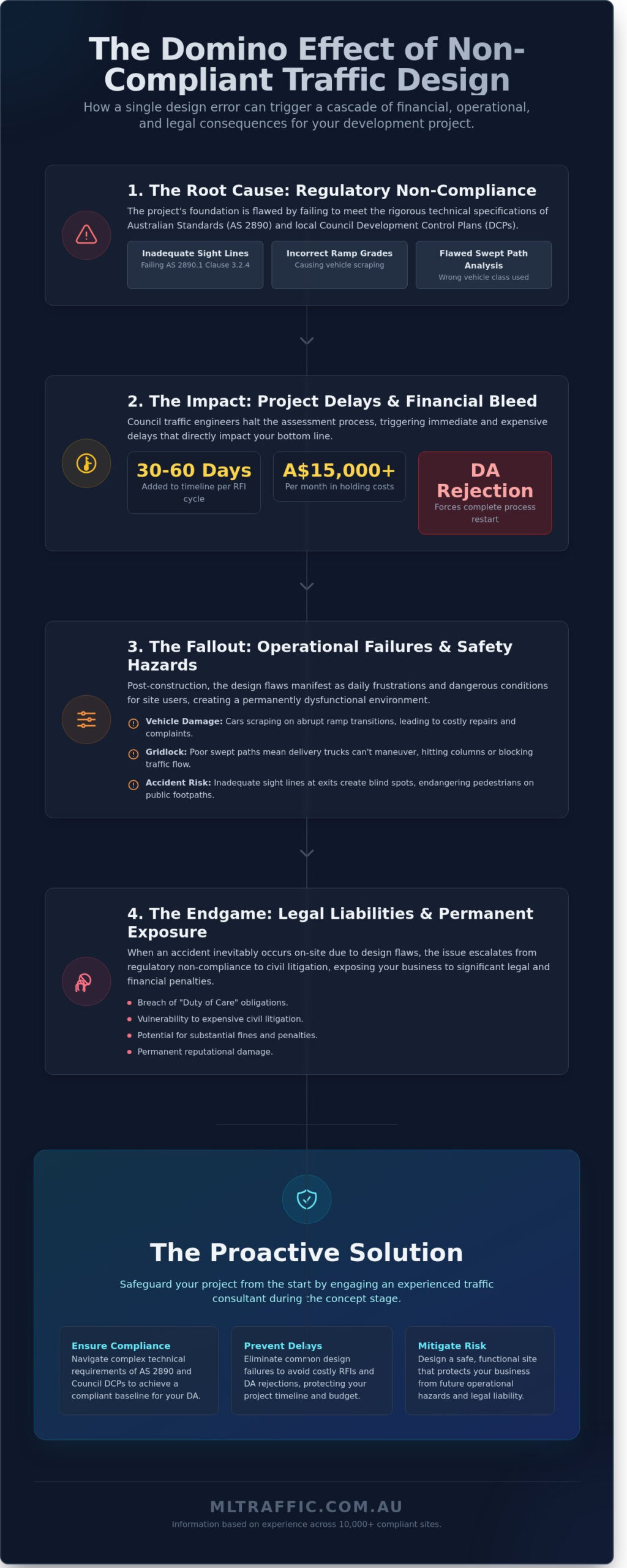
Council traffic engineers scrutinise every technical detail of a submission. One of the most immediate consequences of non-compliant traffic design is the issuance of a formal Request for Information (RFI). When a design fails to meet Australian Standards, such as AS 2890.1 for parking facilities, the assessment process stops. This isn’t a minor inconvenience; a single RFI cycle can add 30 to 60 days to a project timeline. For developers carrying significant land acquisition debt, these delays are expensive. With interest rates on development finance often ranging between 8% and 12%, holding costs can easily exceed A$15,000 per month for mid-sized projects.
Engaging in professional traffic engineering at the pre-lodgement stage prevents these bottlenecks. Without it, you risk a total DA refusal. Councils are increasingly unwilling to negotiate on fundamental safety or access shortfalls. If your proposal doesn’t demonstrate adequate sight lines or vehicle manoeuvrability, the authority has clear grounds for rejection. This forces a complete restart of the application process, costing tens of thousands in wasted consultant fees and lost market opportunity.
The Council Review Process
Technical errors in swept path assessments or driveway gradients are common triggers for RFI letters. Council engineers look for compliance with local planning instruments and state-specific transport policies. If a mistake is identified, it creates a “red flag” for the rest of the application. This damages your reputation with local authorities. Once a developer is known for submitting non-compliant plans, every future application faces higher levels of scrutiny and longer wait times. Maintaining a record of high-quality, compliant submissions is essential for long-term operational success in the Australian property market.
The High Cost of Post-Submission Redesign
Modifying traffic layouts after architectural and structural plans are finalised is a logistical nightmare. A minor change to a basement ramp location to meet compliance can necessitate moving structural columns or fire services. This often leads to a reduction in Gross Floor Area (GFA) or the loss of valuable car parking spaces. In metropolitan areas where residential space sells for over A$12,000 per square metre, losing even 10sqm to a redesign is a massive financial blow.
Developers must also consider the safety implications outlined in Safe Work Australia’s traffic management guide, which emphasizes the need for rigorous risk management from the design phase. To avoid these consequences of non-compliant traffic design, you should commission a Traffic Impact Assessment during the early concept stage. This ensures the building’s footprint is built around a functional, compliant transport core rather than trying to “fix” a broken design later. If you need a reliable review of your current plans, you can contact our senior engineers for a direct technical consultation.
Operational Failures and Site Safety Hazards
Non-compliant traffic design triggers immediate operational failures once a development is occupied. These errors aren’t just theoretical; they manifest as daily bottlenecks that frustrate users and increase long-term maintenance costs. One of the most severe consequences of non-compliant traffic design is the physical damage to the asset itself. Failing to conduct a swept path analysis during the design phase often results in vehicles striking structural columns, bollards, or walls.
Commercial value drops when a site becomes known for being “difficult” or “tight.” Retail tenants lose customers who prefer accessible competitors, while residential developments see higher turnover rates. Industry data from 2023 suggests that poor parking functionality can reduce commercial rental yields by 5% to 10% in high-density urban areas. When a car park is hard to navigate, it’s the developer’s reputation and the owner’s bottom line that suffer.
Vehicle Maneuverability and Property Damage
Designers who ignore the minimum requirements of AS 2890.1 often create narrow aisles that lead to constant “kerbing” of wheels and scrapes on basement walls. These issues are frequently “locked-in” because structural elements like concrete pillars cannot be moved after the pour. Common failures include:
- Heavy vehicle access: Delivery trucks or waste collection vehicles find themselves unable to enter loading docks, forcing dangerous on-street unloading.
- Ramp grade errors: Vehicles with low ground clearance bottom out on ramps that don’t meet Australian Standards for transitions.
- Blind corners: Inadequate turning radii that force drivers to cross into the path of oncoming traffic to complete a turn.
Pedestrian and Driver Safety Hazards
Safety is the primary driver of traffic regulations. Another of the critical consequences of non-compliant traffic design is the increased risk of vehicle-to-pedestrian collisions. Blind spots created by non-compliant sight-line assessments at driveway exits put pedestrians on public footpaths at risk. This isn’t just a safety issue; it’s a significant legal liability for the developer.
The psychological impact on tenants is equally damaging. A car park that requires a five-point turn to exit or features constant conflicts between reversing vehicles and pedestrian walkways creates a high-stress environment. This leads to:
- Increased insurance premiums due to frequent minor collision claims.
- Reduced foot traffic for retail components as shoppers avoid the “stress” of the site.
- Potential Work Health and Safety (WHS) breaches for staff operating in loading zones.
Experienced traffic engineers identify these hazards during the DA stage. Fixing a sight-line issue on paper costs very little. Fixing it after the building is finished is often impossible without significant structural demolition.
Legal Liabilities and Financial Penalties
Developers and designers owe a strict duty of care to the public, including residents, visitors, and passing motorists. This legal obligation requires that all traffic infrastructure is designed to minimize foreseeable risks of injury or property damage. When a design deviates from established Australian Standards, it creates a direct pathway for legal action. The consequences of non-compliant traffic design often transition from simple regulatory hurdles to complex civil litigation immediately following an on-site accident.
WorkSafe authorities across various states, such as SafeWork NSW or WorkSafe Victoria, maintain the power to intervene if a site’s traffic management is deemed unsafe. Under the Work Health and Safety Act 2011, corporate entities face substantial fines for safety breaches. These penalties aren’t limited to the company; insurance providers may also scrutinize compliance records. If a developer knowingly bypasses AS 2890.1 requirements, an insurer might argue that the professional indemnity or public liability policy is void due to a failure to adhere to statutory regulations.
Litigation and Civil Liability
In the event of a collision or pedestrian injury, forensic traffic engineers are hired to investigate the site. They use Australian Standards as the primary benchmark to prove negligence in court. If a driveway ramp grade or sight-line assessment doesn’t meet the minimum technical requirements, the developer’s defense becomes significantly more difficult. Defending these claims involves high legal fees, often exceeding A$50,000 before a case even reaches trial. Directors should also be aware that various state-based safety acts allow for personal liability and prosecution if they’ve failed to exercise due diligence in ensuring site safety.
Regulatory Fines and Remediation Orders
Local Councils and state road authorities have the power to issue heavy fines for breaching planning permits or road acts. However, the most devastating financial hit often comes from Remediation Orders. These orders force developers to rebuild non-compliant sections of a project after construction is finished. Some key risks include:
- The cost of demolishing and re-pouring concrete for non-compliant driveway gradients.
- Loss of occupancy certificates, which prevents the settlement of units and halts project cash flow.
- Mandatory installation of expensive traffic control devices to mitigate original design flaws.
- Daily penalties for failing to resolve safety issues identified during a final council inspection.
The financial impact of a Remediation Order can be five times the cost of the initial construction. Ensuring compliance during the design phase is the only way to protect a project’s bottom line. For expert guidance on meeting these technical requirements, contact our senior traffic engineers today.
Strategies for Ensuring Compliance and Project Success
Mitigating the consequences of non-compliant traffic design requires a technical approach from the project’s outset. Engaging an experienced traffic consultant at the concept stage prevents costly redesigns during the construction phase. Technical precision is non-negotiable. Our team utilizes advanced software like AutoTURN to conduct vehicle swept path assessments. This ensures every turn, loading dock entry, and parking maneuver works in reality, not just on paper. Without this level of detail, developers risk the consequences of non-compliant traffic design, including refused certificates of occupancy or expensive structural rectifications.
The “Senior Engineer” advantage is central to project success. Oversight from principals with 30 to 40 years of experience ensures that potential issues are identified before they reach Council. This level of seniority provides a layer of reliability that junior staff cannot offer. It’s about accountability. We follow a strict philosophy: the traffic consultant who provides the quote, does the work. This eliminates communication gaps and ensures the expert you hired is the one performing the technical analysis.
Early Involvement of Traffic Engineers
Traffic input isn’t just about compliance; it’s a tool to increase project yield. Early involvement allows for the optimization of parking layouts. We often find that minor adjustments to column placement or aisle widths can unlock additional parking spaces that architects might overlook. Integrating AS 2890.1 compliance into the first architectural draft stops errors before they become structural. This proactive method secures the maximum allowable density for the site while meeting all regulatory requirements.
Certification and Quality Assurance
Securing formal certification for car park designs and ramp grades is a mandatory step for most Australian development applications. We conduct rigorous internal audits before any submission to local authorities. This meticulous process ensures every Traffic Impact Statement (TIS) or Traffic Impact Assessment (TIA) meets the specific requirements of the relevant Council. For a comprehensive compliance review of your current plans, contact ML Traffic Engineers. Our direct access to principals means your project receives immediate professional attention.
Final Checklist for a Compliant Development Application:
- Verification of AS 2890.1 (Off-street car parking) and AS 2890.6 (Off-street parking for people with disabilities).
- Swept path analysis for the largest expected vehicle, such as an 8.8m Medium Rigid Vehicle (MRV).
- Sight-line assessments at all driveway exits to ensure pedestrian and motorist safety.
- Driveway ramp grades and transitions checked against BFA (Blind Frontage Area) requirements.
- Provision of bicycle parking and end-of-trip facilities as per local planning schemes.
- Internal audits of all parking aisle widths and bay dimensions.
Secure Your Development Approval with Proven Traffic Expertise
Navigating the complexities of Australian Standards like AS 2890.1 is essential for any successful development application. Neglecting these requirements leads to severe consequences of non-compliant traffic design, including immediate DA rejections and long term operational failures. These mistakes don’t just stall progress. They create significant safety hazards and financial liabilities that can derail a project’s viability. Ensuring your site meets every regulatory hurdle requires a technical approach grounded in experience.
ML Traffic Engineers brings over 15 years of industry experience to your project. We’ve successfully completed assessments for over 10,000 sites across Australia, providing the technical data needed to satisfy council requirements. You’ll work directly with our principals, Michael Lee and Benny Chen. We follow a simple rule: the consultant who provides your quote is the one who does the work. This hands-on accountability ensures your Traffic Impact Statement or Vehicle Swept Path Assessment is accurate and compliant from the start.
Ensure your project is compliant; contact our senior traffic engineers today.
Your project deserves the certainty that comes with professional engineering oversight.
Frequently Asked Questions
What is the most common reason for a traffic design to be found non-compliant?
The most common reason for traffic design non-compliance is failing to meet the minimum dimensional requirements of AS 2890.1 for parking facilities. This frequently involves inadequate aisle widths or incorrect column setbacks that obstruct vehicle door opening areas. Data indicates that over 70% of initial plan rejections stem from these technical oversights. Developers often overlook the specific clearance zones required between structural elements and parking spaces during the initial drafting phase.
Can I get a waiver for AS 2890.1 standards if my site is too small?
You cannot get a formal waiver for AS 2890.1 standards based solely on site constraints or small land size. Australian Standards are safety-critical benchmarks that Councils use to assess development applications and ensure public safety. If a site is too small to fit a standard space, you must seek a performance-based solution through a qualified traffic engineer. This process requires technical justification to prove the design remains safe and functional despite the deviation from the deemed-to-satisfy provisions.
How much does a Council RFI regarding traffic typically delay a project?
A Council Request for Information (RFI) regarding traffic issues typically delays a project by 4 to 8 weeks. This timeframe includes the 14 to 21 days usually given to respond and the subsequent review period by Council officers. If the response is inadequate, a second RFI can push timelines back by another 30 days or more. Addressing the consequences of non-compliant traffic design early in the process prevents these costly administrative bottlenecks and keeps construction schedules on track.
What happens if an accident occurs in a car park that does not meet Australian Standards?
If an accident occurs in a car park that doesn’t meet Australian Standards, the property owner or developer faces significant legal liability. Courts use AS 2890.1 as the benchmark for “duty of care” in civil litigation and personal injury claims. Non-compliance often leads to the denial of insurance claims and successful negligence lawsuits. A 2022 legal review showed that technical non-compliance is a primary factor in determining fault during car park collisions on private property.
Is a swept path analysis mandatory for all residential developments?
Vehicle swept path analysis is mandatory for almost all multi-unit residential developments in Australia. Councils require B85 or B99 vehicle templates to prove that cars can enter and exit the site in a single forward motion. For developments with more than 3 dwellings, planners must also demonstrate that waste collection vehicles and emergency services can navigate the internal layout. Without this digital simulation, a traffic design is considered incomplete and will likely face rejection during the assessment phase.
How do I know if my driveway ramp grade is compliant?
You determine if a driveway ramp grade is compliant by measuring the gradient against AS 2890.1:2004 specifications. For domestic driveways, the maximum grade shouldn’t exceed 1 in 4, which is 25%. You’re also required to include transitions of at least 2.0 metres at the top and bottom of the ramp to prevent vehicle scraping. These transitions are necessary whenever the change in grade exceeds 12.5% to ensure low-clearance vehicles don’t bottom out while entering or exiting.
Can a non-compliant traffic design affect my property insurance premiums?
Non-compliant traffic design can lead to significantly higher property insurance premiums or a total refusal of coverage. Insurers assess the risk of a site based on its adherence to safety standards like AS 2890. Underwriters view technical deviations as increased risks for public liability and property damage claims. One of the major consequences of non-compliant traffic design is the long-term financial burden of elevated premiums that persist over the building’s entire lifecycle.
What is the difference between a Traffic Impact Assessment and a Traffic Management Plan?
A Traffic Impact Assessment (TIA) focuses on the long-term effects of a new development on the surrounding road network during the planning phase. In contrast, a Traffic Management Plan (TMP) outlines specific safety measures and vehicle movements during the construction or event phase. While a TIA supports the initial Development Application, a TMP is usually a condition of consent required before any work starts on site. Both documents are essential for ensuring compliance and safety at different stages of the project.
Which areas do you cover?
We are traffic engineers servicing Melbourne, Sydney, Brisbane, Gold Coast, Hobart, Perth, Adelaide, Darwin, Canberra and surrounding areas.
Disclaimer
The content on www.mltraffic.com.au, including all technical articles, guides, and resources, is provided for general informational and educational purposes only. It is not intended to constitute professional advice in traffic engineering, transportation planning, development approvals, or any other technical or legal field.
While ML Traffic Engineers makes every reasonable effort to ensure the accuracy, completeness, and timeliness of the information published, we do not provide any warranties or representations (express or implied) regarding its reliability, suitability, or availability for any particular purpose. Any reliance you place on the content is strictly at your own risk.
In no event shall ML Traffic Engineers, its directors, employees, authors, or affiliates be liable for any direct, indirect, incidental, special, consequential, or punitive damages (including, without limitation, loss of profits, data, or business opportunities) arising out of or in connection with the use of, or inability to use, any information provided on this website.
The articles and guides on this site are not a substitute for engaging a qualified, registered professional traffic engineer (such as an NPER or RPEQ engineer) to assess your specific project requirements. For tailored advice, compliance assessments, or traffic engineering services, please contact a competent professional.
This disclaimer may be updated from time to time without notice. By accessing or using this website, you agree to be bound by the most current version of this disclaimer.
