

A Construction Logistics and Traffic Management Plan (CLTMP) is not merely a box-ticking exercise for Council; it is the critical strategic blueprint that dictates whether your project remains on schedule or stalls indefinitely. You likely understand the frustration of seeing a development timeline slip because of non-compliant reports or the hidden costs associated with inefficient on-site vehicle movements. Managing the specific requirements for Australian local governments is often a source of confusion, especially when trying to distinguish between a standard traffic plan and a comprehensive logistics strategy.
This guide provides the technical clarity needed to master CLTMP requirements, helping you secure Council approval without the burden of multiple revisions while ensuring your site logistics operate with precision. We will examine the core components of a successful plan, including Vehicle Swept Path Analysis and waste management. By the end of this article, you will have a clear understanding of how to align your project with Australian Standards to ensure a seamless construction phase from start to finish.
Key Takeaways
- Understand why a Construction Logistics and Traffic Management Plan (CLTMP) is a mandatory strategic requirement for minimising road network disruption and ensuring public safety.
- Identify the essential technical components, including detailed construction programmes and vehicle movement plans, required to meet Australian Standards and Council expectations.
- Learn the critical differences between a CLTMP and a standard Traffic Management Plan (TMP) to ensure your submission covers the full scope of construction-phase logistics.
- Discover how to navigate the Council approval process more effectively by using data-driven analysis and professional engineering expertise to avoid costly report rejections.
- Gain insights into integrating specialised assessments, such as Vehicle Swept Path Analysis, to optimise on-site vehicle movements and protect your project’s bottom line.
What is a Construction Logistics and Traffic Management Plan (CLTMP)?
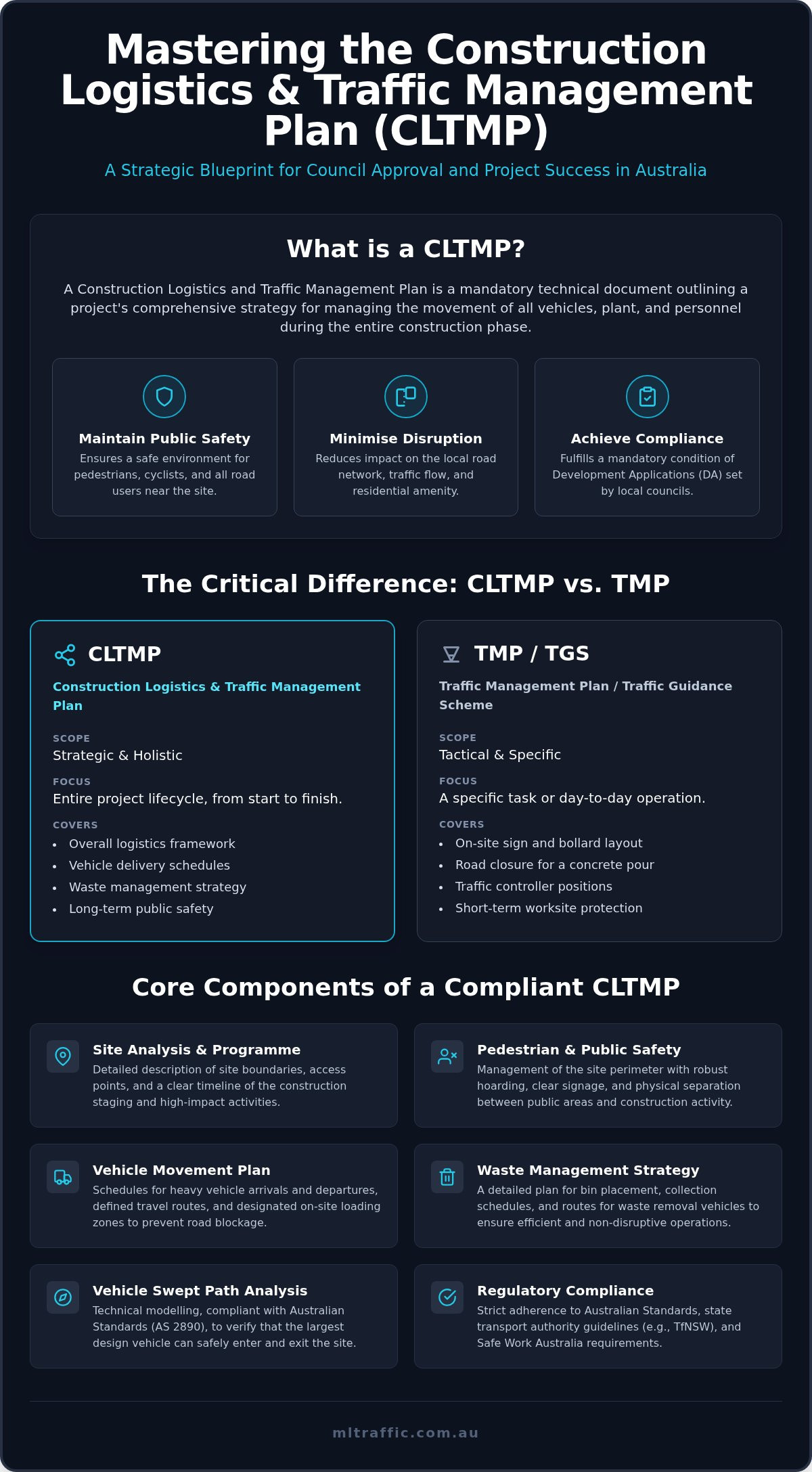
A Construction Logistics and Traffic Management Plan (CLTMP) is a technical document that outlines how a developer intends to manage the movement of vehicles, plant, and personnel during the construction phase of a project. It’s a comprehensive logistics strategy rather than a simple map of signs. Its primary objective is to maintain public safety while minimising disruption to the surrounding road network. By adhering to Road Traffic Control Principles, the plan ensures that interaction between construction traffic and the public is managed according to established safety benchmarks.
Councils mandate these plans as a standard condition of a Development Application (DA) to ensure that heavy vehicle movements don’t compromise local traffic flow or residential amenity. Without an approved CLTMP, developers cannot legally commence works that impact public roads or footpaths. The document must be site-specific, addressing unique constraints such as narrow street frontages, nearby schools, or high-volume intersections. It’s vital to distinguish a CLTMP from a Traffic Guidance Scheme (TGS). While a TGS provides a specific layout for signs and bollards on a given day, a CLTMP provides the high-level framework for the entire construction programme, covering vehicle arrival times, loading zones, and waste removal schedules.
To better understand how these plans function on-site, watch this helpful video:
The Role of a CLTMP in the Development Life Cycle
Engaging a traffic engineer during the early planning stages is essential for a smooth project rollout. Waiting until a Council inspector issues a stop-work order is a costly mistake that can derail your timeline. A well-prepared Construction Logistics and Traffic Management Plan (CLTMP) prevents these bureaucratic delays by addressing potential conflicts before they occur on-site. Efficient logistics planning directly impacts project profitability by reducing vehicle idle time and ensuring materials arrive exactly when they’re needed. This proactive approach demonstrates to Council that the development is being managed by seasoned experts who prioritise community safety and operational efficiency.
National Standards and Regulatory Compliance
Compliance requires strict adherence to Australian Standards, specifically the AS 2890 series for parking and access. Every plan must also meet the requirements of state transport authorities, such as Transport for NSW or Victoria’s Department of Transport and Planning. Keeping your plan audit-ready is a requirement, not a suggestion. Council inspectors frequently visit sites to verify that the actual operations match the approved documentation. If the details don’t align, you risk heavy fines and project delays. Our reports focus on technical accuracy, ensuring that elements like Vehicle Swept Path Analysis and sight distance assessments are beyond reproach during a regulatory audit.
Core Components of a Compliant CLTMP
A compliant Construction Logistics and Traffic Management Plan (CLTMP) begins with a rigorous site description and a clear overview of the construction programme. This section identifies all site access points and details the specific staging of works. It provides Council with a timeline of when high-impact activities, such as excavation or concrete pours, will occur. Precise documentation of site boundaries and existing road infrastructure is mandatory to establish a baseline for logistics planning.
Managing the site perimeter requires a heavy focus on pedestrian and cyclist safety. High-traffic urban environments demand physical separation between construction activity and the public. Adhering to Safe Work Australia’s traffic management guide ensures your plan includes robust hoarding, clear signage, and dedicated spotters where vehicle paths intersect with footpaths. On-site loading and unloading arrangements must be designed to prevent any blockage of the public road network. Council will not accept plans that rely on illegal queuing or haphazard street loading.
Vehicle Swept Path Analysis
Proving that your site can accommodate the intended heavy vehicles is a technical requirement. We use specialised software to conduct a Swept Path Analysis Guide, demonstrating that trucks can safely manoeuvre within the site boundaries. This analysis must account for the ‘worst-case scenario’ vehicle for each loading dock or access point. If a 12.5-metre Heavy Rigid Vehicle (HRV) is required for waste removal, the plan must prove it can enter and exit in a forward direction without striking permanent fixtures. If you require technical assistance with these assessments, our team provides comprehensive traffic engineering services to ensure your site layout is functional.
Construction Vehicle Routes and Scheduling
The CLTMP must specify the exact routes heavy vehicles will take to reach the site. These routes are designed to avoid residential streets and weight-restricted bridges. Scheduling is equally critical. Most Australian Councils impose ‘peak hour’ restrictions, typically between 7:00 AM and 9:00 AM and 4:00 PM and 6:00 PM. Your plan must detail how deliveries are organised to ensure trucks do not arrive during these windows or queue on public roads while waiting for site access. Effective scheduling reduces the risk of community complaints and maintains the project’s reputation with local authorities.
Navigating the Council Approval Process
Council approval is the definitive gateway to commencing site works. Timelines for review vary significantly across Australian Local Government Areas (LGAs), but developers should typically allow four to eight weeks for a comprehensive assessment. Large-scale projects or those located on major arterial roads often require additional referrals to state transport agencies, which can extend these periods. Securing approval requires a Construction Logistics and Traffic Management Plan (CLTMP) that addresses every specific condition of the Development Application (DA) without ambiguity.
Rejection often stems from reports that are generic or fail to account for site-specific constraints. Councils prioritise the safety of the public and the integrity of the road asset. If a report lacks technical depth, such as failing to provide a detailed construction schedule or ignoring the impact on local bus routes, it will be sent back for revision. Professional certification by a qualified traffic engineer is essential. This ensures the document is legally robust and meets the evidentiary standards required by Council planners and engineers. Effective stakeholder consultation during the planning phase also reduces friction, as addressing the concerns of local residents and businesses early prevents formal objections during the review period.
Common Pitfalls in CLTMP Submissions
Submissions frequently fail due to inadequate consideration of pedestrian traffic flow, particularly in high-density areas. Councils expect to see how foot traffic will be diverted or protected without creating bottlenecks. Another common error is failing to account for the impact on existing on-street parking. If your logistics plan requires the temporary removal of parking bays, you must provide a data-driven justification. Inaccurate vehicle dimensions in swept path diagrams are also a major cause for rejection. Using generic vehicle templates that don’t match the actual trucks used on-site leads to operational failures and immediate report dismissal by Council engineers.
The Value of Senior Principal Involvement
Direct access to senior principals with over 15 years of experience is the most effective way to speed up the approval process. Senior oversight ensures that every report adheres to complex traffic engineering principles from the outset. This level of expertise allows for the anticipation of Council concerns before the report is even submitted. We operate on a ‘personnel continuity promise’, meaning the same expert who initiates the client relationship performs the technical work. This accountability eliminates the communication gaps often found in larger firms and ensures your project moves from submission to approval with minimal revisions.
CLTMP vs. Traffic Management Plan (TMP): Key Differences
A common point of confusion for developers is the distinction between a Traffic Management Plan (TMP) and a CLTMP. While they share safety objectives, their technical scope and regulatory purpose differ. A TMP generally addresses the broad impact of a development on the surrounding road network post-completion or during major roadworks. In contrast, a Construction Logistics and Traffic Management Plan (CLTMP) is a dedicated strategy for the build phase. It manages the day-to-day friction between construction activities and existing traffic flow.
The technical depth of a CLTMP is significantly higher regarding site-specific logistics. It includes precise details on loading zones, crane locations, and waste management paths. A TMP might focus on intersection capacity and long-term traffic flow, whereas a CLTMP prioritises the immediate safety and efficiency of vehicle arrivals and departures. Large-scale developments often require both reports to satisfy different departments within Council. The TMP secures the initial approval for the site’s existence, while the CLTMP unlocks the ability to actually start construction by proving the site is operationally viable during the works.
When to Use a Traffic Guidance Scheme (TGS)
A Traffic Guidance Scheme (TGS) is the operational arm of your logistics strategy. While the CLTMP provides the high-level framework, the TGS provides the specific layout for signs, barriers, and traffic controllers on a daily basis. It’s the document that workers on-site use to set up physical controls. Legal requirements for TGS implementation are strict. Any work that interferes with a public road or footpath must have a TGS that complies with state regulations and Australian Standards. If you’re unsure which plan your specific DA condition requires, contact our senior principals today for a technical consultation.
Choosing the Right Plan for Your Project Scale
Project scale dictates the complexity of the required documentation. Small-scale residential developments might only require a basic CLTMP focusing on driveway access and on-site parking. Large-scale commercial or multi-residential projects demand extensive intersection analysis and detailed swept path diagrams for various vehicle classes. Determining the level of analysis required early prevents Council from requesting additional data mid-assessment, which can stall a project for weeks. You can view our full range of technical capabilities on our services overview page. We ensure that every assessment is tailored to the specific regulatory requirements of your local Council.
Why Professional Traffic Engineering is Essential for CLTMPs
Securing Council buy-in requires more than just a site map; it demands data-driven analysis that stands up to rigorous technical scrutiny. Professional traffic engineering provides the empirical evidence needed to justify complex logistics decisions. We focus on technical accuracy to ensure that your Construction Logistics and Traffic Management Plan (CLTMP) meets the specific safety benchmarks required by local authorities. This technical foundation is what distinguishes a compliant report from one that will face immediate rejection by Council engineers.
A robust logistics strategy often involves the integration of a Car Parking Demand Assessment or specialised Car Park Design. This is particularly relevant when construction activity forces the temporary relocation of workforce or visitor parking. We use industry-standard software like AutoTURN to provide millimetre-accurate swept path diagrams for various vehicle classes. These certified, compliant traffic reports are essential for mitigating project liability and ensuring the site remains operationally viable under peak pressure. Using professional engineering ensures that every movement on-site is calculated rather than estimated.
Optimising Site Access and Egress
Access optimisation involves technical assessments of driveway ramp grades to ensure they meet the AS 2890 standard. This prevents heavy machinery from bottoming out or damaging public kerbs and infrastructure. We also conduct Sight Distance Assessments to verify that heavy vehicles exiting the site have clear lines of sight to oncoming traffic and pedestrians. These engineering details allow for a smaller construction zone footprint. By refining these access points, we maximise the usable space for your contractors on-site without compromising the safety of the public road network.
The ML Traffic Engineers Australia Advantage
ML Traffic Engineers Australia provides over 15 years of specialised experience in the Australian transport sector. We don’t use junior staff for technical work. Our senior principals handle every report from the initial consultation to final approval. This no-nonsense approach is detailed in our about us page, where we outline our commitment to client results and regulatory compliance. This level of accountability ensures your report is accurate and audit-ready from day one. If your project requires an authoritative and compliant report, contact our principals directly for immediate technical assistance.
Secure Your Project’s Timeline with Expert Logistics Planning
A Construction Logistics and Traffic Management Plan (CLTMP) is the definitive document that bridges the gap between a successful Development Application and actual site commencement. By prioritising technical accuracy through Vehicle Swept Path Analysis and rigorous scheduling, you protect your development from the financial risks of Council rejections and operational delays. Ensuring your plan adheres to Australian Standards isn’t just about compliance; it’s about maintaining a safe, efficient site that respects the community and the road network.
ML Traffic Engineers provides national coverage with over 15 years of specialised experience in the Australian transport sector. We offer direct access to senior principals who manage your report from inception to final approval. This level of oversight guarantees a meticulous, audit-ready document tailored to the specific requirements of your Local Government Area. Our no-nonsense approach focuses on delivering results that keep your project moving forward.
Get a Compliant CLTMP from Senior Traffic Engineers
We look forward to helping you navigate the complexities of Council regulations to ensure your next project moves forward without delay.
Frequently Asked Questions
Is a CLTMP mandatory for all construction projects in Australia?
A CLTMP is mandatory if it’s specified as a condition of consent in your Development Application (DA). While smaller residential renovations might not require one, most commercial, industrial, and multi-residential projects in Australian LGAs must submit this plan before a Construction Certificate is issued. The requirement is typically triggered by the project’s scale or its potential impact on local road safety and traffic flow.
How much does a Construction Logistics and Traffic Management Plan cost?
The cost of a Construction Logistics and Traffic Management Plan (CLTMP) varies according to the project’s scale and technical complexity. Factors influencing the fee include the number of construction stages, the volume of heavy vehicle movements, and whether complex intersection analysis is required. We recommend requesting a site-specific fee proposal to ensure all technical requirements of your Council DA conditions are addressed accurately without hidden costs.
What is the difference between a TGS and a CLTMP?
A CLTMP provides the high-level strategic framework for the entire construction phase, whereas a Traffic Guidance Scheme (TGS) is a specific diagram used for daily operations. The CLTMP outlines vehicle routes and delivery schedules, while the TGS details the exact placement of signs and barriers for a particular work zone. You typically need the overarching logistics plan approved before specific traffic guidance schemes can be implemented on public roads.
Can I prepare a CLTMP myself or do I need a traffic engineer?
Councils generally require these plans to be prepared and certified by a qualified traffic engineer with appropriate professional indemnity insurance. A self-prepared plan lacks the technical weight of a data-driven report and is likely to be rejected for failing to meet Australian Standards. Engaging an expert ensures that complex components, such as vehicle swept paths and sight distance assessments, are calculated with the precision required for regulatory approval.
How long does it take for a Council to approve a CLTMP?
Approval timelines typically range from four to eight weeks, depending on the workload of the local Council and the complexity of the development. Projects located on state-managed roads may require additional referrals to transport authorities, which can extend the review period. Submitting a comprehensive, compliant report on the first attempt is the most effective way to avoid the delays associated with multiple rounds of Council requests for further information.
What happens if my site logistics change during construction?
Any significant change to site logistics requires an amendment to the approved plan, which must be resubmitted to Council for endorsement. Operating outside the parameters of your approved plan can lead to heavy fines or stop-work orders from Council inspectors. If your construction methodology evolves, we recommend updating the documentation immediately to ensure continued compliance and to maintain the legal protection provided by a certified logistics strategy.
Does a CLTMP cover pedestrian safety and cycle lanes?
Pedestrian and cyclist safety is a core component of any compliant logistics plan. The document must detail how vulnerable road users are protected from construction traffic, especially near site access points and temporary hoarding. This includes managing footpath diversions and ensuring that heavy vehicle movements don’t compromise the safety of existing cycle lanes. Councils prioritise these safety measures to minimise the risk of accidents in high-activity urban areas.
What software is used to create the vehicle swept paths in the plan?
We use industry-standard software like AutoTURN to create precise vehicle swept path diagrams. This technology allows us to simulate the exact turning circles of specific heavy vehicles, such as 12.5-metre Heavy Rigid Vehicles or articulated trucks, against your proposed site layout. Using specialised software ensures that the plan meets the technical accuracy required by Council engineers and proves that vehicles can safely enter and exit the site in a forward direction.

Disclaimer
The content on www.mltraffic.com.au, including all technical articles, guides, and resources, is provided for general informational and educational purposes only. It is not intended to constitute professional advice in traffic engineering, transportation planning, development approvals, or any other technical or legal field.
While ML Traffic Engineers makes every reasonable effort to ensure the accuracy, completeness, and timeliness of the information published, we do not provide any warranties or representations (express or implied) regarding its reliability, suitability, or availability for any particular purpose. Any reliance you place on the content is strictly at your own risk.
In no event shall ML Traffic Engineers, its directors, employees, authors, or affiliates be liable for any direct, indirect, incidental, special, consequential, or punitive damages (including, without limitation, loss of profits, data, or business opportunities) arising out of or in connection with the use of, or inability to use, any information provided on this website.
The articles and guides on this site are not a substitute for engaging a qualified, registered professional traffic engineer (such as an NPER or RPEQ engineer) to assess your specific project requirements. For tailored advice, compliance assessments, or traffic engineering services, please contact a competent professional.
This disclaimer may be updated from time to time without notice. By accessing or using this website, you agree to be bound by the most current version of this disclaimer.
