

A construction traffic and pedestrian management plan is often the single biggest bottleneck standing between a developer and their Construction Certificate. You likely already know that Council requirements are becoming increasingly technical, with a heavy focus on protecting vulnerable road users under the latest regulatory standards. With 18% of work-related fatalities in the UK involving moving vehicles in 2023/24, the stakes for site safety and public protection have never been higher for those managing complex urban projects.
We recognise that balancing site productivity with stringent safety protocols is a difficult task that often leads to costly project delays. This 2026 guide explains exactly what a compliant CTPMP requires, how to navigate the complexities of Council approvals, and how professional traffic engineering ensures site safety. We will break down the essential components of a successful plan, from heavy vehicle routing to pedestrian safety protocols, providing you with a clear path to minimising disruption and securing your approvals on the first attempt.
Key Takeaways
- Understand the technical scope of a construction traffic and pedestrian management plan to protect public safety and maintain road network efficiency.
- Identify the core components required for compliance, including site access diagrams and vehicle schedules that bypass peak-hour traffic.
- Distinguish between the overarching strategy of a Traffic Management Plan (TMP) and the site-specific application of a CTPMP.
- Streamline the Council approval process by understanding the timelines for submission and the necessity of early consultation with relevant authorities.
- Ensure technical accuracy and project accountability through direct access to senior principals and experienced traffic engineering consultants.
What is a Construction Traffic and Pedestrian Management Plan (CTPMP)?
A construction traffic and pedestrian management plan is a precise technical document that outlines how vehicular and pedestrian movements are controlled during a project’s lifecycle. It functions as a live safety document, ensuring site operations don’t compromise the surrounding community. The main goal is to uphold public safety while minimising the project’s footprint on the local road network.
Developers find this plan is a non-negotiable component of the Development Application (DA) process. It provides a detailed blueprint for road traffic control that accounts for everything from concrete pours to worker parking. Legally, developers are responsible for the safety of both their onsite workforce and the public. A failure to manage these risks can result in WorkCover interventions, site shutdowns, or costly litigation.
Planning for traffic isn’t just about placing cones. It involves a deep understanding of traffic flow, sight distances, and vehicle swept paths. When a developer submits a DA, the Council needs assurance that the proposed construction won’t lead to accidents or significant delays for existing residents. This document provides that assurance through data-backed engineering solutions.
To better understand the practical application of these documents, watch this overview of traffic management planning:
The legal obligation to provide a safe environment extends beyond the site fence. Under current Australian legislation, the head contractor and developer share a duty of care to the public. If a pedestrian is injured due to a lack of clear signage or poorly managed site access, the legal consequences are severe. A comprehensive plan acts as the first line of defence, proving that all reasonable steps were taken to manage known hazards.
Statutory Requirements and Site Safety
Every plan must adhere to Australian Standard AS 1742.3 to ensure all traffic control devices are uniform and legally compliant. A professional CTPMP mitigates liability for developers by creating a documented safety framework. It bridges the gap between Work Health and Safety (WHS) laws and site logistics, ensuring that vehicle-pedestrian interactions are managed through rigorous risk assessment.
Why Councils Require a CTPMP for DA Approval
Councils mandate a construction traffic and pedestrian management plan to prevent heavy vehicle movements from causing local gridlock. This review process allows authorities to assess truck routes and delivery schedules in residential or commercial zones. Additionally, it protects public infrastructure, such as footpaths and kerbs, from damage caused by heavy machinery. Our traffic engineering services facilitate these approvals by meeting Council standards.
Core Components of a Compliant Management Plan
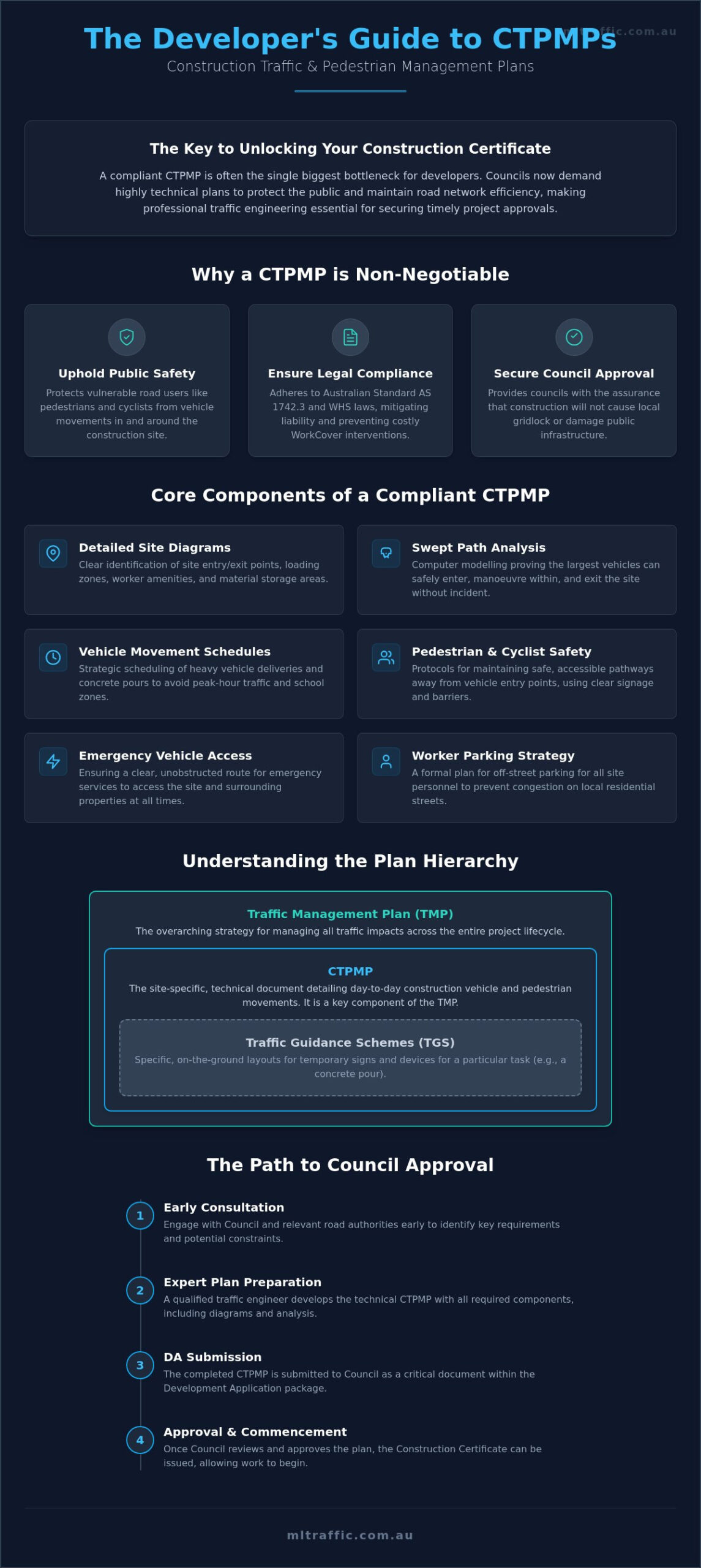
A compliant construction traffic and pedestrian management plan must be a robust, site-specific document that addresses every technical interaction between the project and the public road network. Council engineers scrutinise these plans to ensure they meet strict safety standards and operational benchmarks. Standard TMP submission requirements often dictate a high level of detail regarding site access points, work zone locations, and emergency vehicle protocols. A generic plan will likely fail the review process, leading to project delays.
The foundation of any successful plan is a detailed site map. This map must clearly identify entry and exit points, loading zones, and the location of any site sheds or plant. To ensure the plan is feasible, we integrate Swept Path Analysis. This analysis uses specialised computer modelling to prove that the largest anticipated vehicles can safely enter and leave the site without mounting kerbs or colliding with street furniture. Without this data, Councils cannot be certain that your site can handle the heavy vehicle volume required for construction.
Timing and access are equally critical. Vehicle movement schedules must be designed to avoid peak hour congestion, typically between 7:00 AM and 9:00 AM and 4:00 PM and 6:00 PM. Additionally, emergency vehicle access must be maintained 24/7. Any temporary closures, gantries, or hoardings must provide sufficient clearance for fire trucks and ambulances at all times. This ensures that the construction site remains a safe environment for workers and the surrounding community.
Vehicle Movement and Site Access
Designing site access requires a balance between site productivity and road safety. We focus on minimising conflict with through-traffic by positioning gates away from busy intersections. Swept Path diagrams are essential here, specifically for the largest vehicles expected on site, such as a 12.5m Heavy Rigid Vehicle (HRV). Managing on-site loading zones is always preferable to on-street work zones to reduce the impact on local traffic flow. If you require assistance with these technical requirements, our traffic engineering services provide the necessary documentation for Council approval.
Prioritising Pedestrian Safety and Public Amenity
Pedestrian safety is a primary concern for local authorities. The plan must detail clear, safe paths of travel around the construction site. This often involves the use of hoardings, gantries, or temporary detours that keep foot traffic away from active work zones. Signage and line marking must be intuitive and visible. We also assess the impact on local parking and public transport stops, ensuring that bus zones remain accessible and that any loss of on-street parking is minimised and technically justified.
Navigating the Jargon: CTPMP, TMP, and TGS Differences
The construction industry is saturated with acronyms that are frequently used interchangeably, yet they represent distinct technical documents. Misunderstanding the hierarchy between a Traffic Management Plan (TMP), a construction traffic and pedestrian management plan (CTPMP), and a Traffic Guidance Scheme (TGS) often leads to immediate Council refusal. A TMP serves as the overarching strategic framework, typically established during the initial planning phase of a development. In contrast, the CTPMP is the site-specific application of that strategy, detailing how traffic and pedestrians are managed throughout the actual construction phase.
Submitting a tactical diagram when a strategic report is required is a common error. Councils expect a specific level of detail based on the project’s scale and its potential impact on the local road network. While a CTPMP focuses on the “what” and “why” of site logistics, the TGS provides the “how” through precise technical drawings. Getting this hierarchy wrong doesn’t just delay approvals; it demonstrates a lack of technical oversight that can undermine your entire Development Application.
Traffic Guidance Schemes (TGS) Explained
The term Traffic Guidance Scheme has replaced the older “Traffic Control Plan” (TCP) terminology in modern Australian standards. A TGS is a tactical diagram that illustrates the exact placement of signage, cones, and barriers on the road. It includes specific engineering requirements such as taper lengths, which must be calculated based on the prevailing speed limit and road conditions. These schemes ensure that the high-level safety objectives outlined in your construction traffic and pedestrian management plan are physically implemented correctly on the ground.
When a Full Traffic Management Plan is Mandatory
A full TMP is generally mandatory for large-scale developments that significantly impact arterial roads or require major road diversions. These projects often involve complex staging and multiple road closures that affect a wider geographic area than a standard site. It’s essential to link your TMP to the Traffic Impact Assessment prepared during the planning phase. This continuity ensures that the traffic volumes and intersection capacities identified early in the project are managed effectively during the heavy vehicle movements of the construction phase.
Preparation and the Council Approval Process
Securing approval for a construction traffic and pedestrian management plan is a rigorous process that requires technical precision and strategic timing. Early engagement with a traffic engineer is vital to avoid project delays. Council review periods for these documents often range from four to eight weeks, depending on the complexity of the site and the volume of heavy vehicle movements. If your project sits on or near an arterial road, you must also factor in consultation time with State road authorities.
Data-driven reports are the only way to satisfy Council requirements. Generic templates fail because they don’t account for site-specific constraints like existing street furniture or local traffic cycles. When a Council issues a Request for Further Information (RFI), the speed of your response determines your commencement date. Having a senior engineer who understands the technicalities of the local road network ensures these queries are resolved without multiple rounds of revisions.
Consultation with relevant authorities must be proactive. This includes coordinating with local Council traffic committees and, where necessary, utility providers or public transport operators. A plan that hasn’t been vetted against local bus routes or waste collection schedules will likely face pushback. We focus on creating a seamless integration between your construction activities and the existing infrastructure to minimise community friction.
The Role of a Qualified Traffic Engineer
Professional certification, such as Chartered Professional Engineer (CPEng) or National Engineering Register (NER) status, adds significant weight to your submission. Senior-led assessments identify site constraints early, preventing costly mid-construction adjustments. This expertise ensures all access and parking designs meet AS 2890.1 standards. If you need a compliant report for your DA, contact our senior traffic engineers to discuss your project requirements.
Common Pitfalls in Plan Submission
Many submissions are refused due to inadequate consideration for heavy vehicle turning circles. If a truck cannot make a turn without crossing into oncoming lanes or mounting a kerb, the plan is non-compliant. Another common error is failing to account for pedestrian movements during school zone hours or peak commuter periods. Signage must also be consistent with Australian Standard requirements. Inconsistent or poorly placed signs lead to immediate rejection by Council traffic committees.
Engaging Expert Traffic Engineering Consultants for Your Project
ML Traffic Engineers Australia provides over 15 years of national consultancy experience, delivering technical reports for a vast range of project environments. We operate with a “no-gatekeepers” approach, which means you have direct access to senior principals for every report we produce. This direct line of communication is vital when a construction traffic and pedestrian management plan requires urgent technical revisions to satisfy Council traffic committees. Our senior-led approach ensures that the technicalities of the local road network are fully integrated into your site’s specific logistics from day one.
A high-quality plan doesn’t just secure a Construction Certificate; it facilitates site productivity. By combining our specialised knowledge of traffic flow with your project’s specific staging requirements, we create a document that is as functional as it is compliant. We focus on minimising the project’s footprint on the local road network while maintaining the high volume of heavy vehicle movements required for modern developments. This balance prevents the costly delays associated with poorly planned site access or non-compliant pedestrian detours.
Senior-Led Technical Assessments
We provide a specific promise of personnel continuity. The senior traffic engineer who initiates your project is the same expert who performs the technical analysis and finalises the report. This ensures that no technical detail is lost between the site inspection and the final submission of your Traffic Management Plan. Our team maintains a proven track record with local Councils across Australia, having successfully navigated thousands of diverse project environments, from high-density urban centres to sensitive residential zones.
Ensuring Compliance with Australian Standards
Our engineers use industry-standard software like AutoTURN to provide precise vehicle analysis for every construction traffic and pedestrian management plan. This level of technical rigour proves to Council that your site can handle 12.5m Heavy Rigid Vehicles or larger specialised plant without compromising public safety or damaging infrastructure. We take a results-oriented approach designed to secure your planning approval on the first attempt, minimising the risk of repetitive Requests for Further Information. For a comprehensive traffic engineering assessment, contact our team to ensure your project meets all regulatory benchmarks.
Securing Your Project’s Commencement with Technical Precision
A construction traffic and pedestrian management plan is the final technical hurdle before site commencement. As established, successful Council approval relies on the precise integration of swept path data and rigorous safety protocols. Moving beyond generic templates ensures that your project avoids the common pitfalls of RFI cycles and operational bottlenecks that often stall urban developments.
ML Traffic Engineers Australia provides the professional certainty required for these high-stakes submissions. With over 15 years of experience and a senior-led consultancy model, we ensure your project benefits from deep local regulatory knowledge and direct principal accountability. This approach guarantees that the technical work is performed by the same expert who understands your site’s specific constraints and Council’s unique expectations.
Contact ML Traffic Engineers Australia for a compliant Construction Traffic and Pedestrian Management Plan to secure your project’s timeline. We provide the technical rigour necessary to navigate complex approvals and maintain a safe, efficient site environment.
Frequently Asked Questions
What is the difference between a TMP and a CTPMP?
A TMP serves as the high-level strategic framework for a development, while a construction traffic and pedestrian management plan is the site-specific document used during the actual build. The CTPMP details exact gate locations, truck routes, and pedestrian protection measures required for the construction phase. It bridges the gap between the initial planning approvals and the tactical execution of site logistics on the ground.
Who is authorised to prepare a construction traffic management plan in Australia?
A construction traffic management plan should be prepared by a qualified traffic engineering consultant with recognised professional certification. In most Australian jurisdictions, Councils require the report to be signed off by an engineer with Chartered Professional Engineer (CPEng) or National Engineering Register (NER) status. This ensures the document meets Australian Standards and technical safety requirements for public road occupancy.
How long does Council take to approve a CTPMP?
Council approval timelines typically range from four to eight weeks. This duration depends on the complexity of the site and the responsiveness of the developer to any Requests for Further Information (RFI). Projects located on State-managed arterial roads may face longer wait times as the local Council must coordinate with state road authorities for concurrent approval.
Do I need a Swept Path Analysis for my construction management plan?
Swept Path Analysis is mandatory if your project requires heavy vehicles to enter or exit the site. This analysis uses computer modelling to prove that vehicles, such as 12.5m Heavy Rigid Vehicles, can complete turns without mounting kerbs or striking street furniture. Council engineers require this technical data to verify that your proposed access points are physically feasible for the anticipated construction traffic.
What happens if we don’t follow the approved management plan on-site?
Non-compliance with an approved plan can lead to significant legal and financial penalties. Local Councils and authorities like SafeWork NSW or WorkSafe Victoria have the power to issue on-the-spot fines or stop-work notices. In the event of an accident, a failure to adhere to the approved safety protocols significantly increases the developer’s liability and can lead to criminal prosecution under Work Health and Safety laws.
How much does a professional traffic and pedestrian management plan cost?
The cost of a professional construction traffic and pedestrian management plan varies significantly based on project scale and complexity. Factors influencing the fee include the number of site access points, the requirement for Swept Path Analysis, and the intensity of the surrounding road network. Developers should seek a project-specific quote from a traffic engineering firm to account for these variables rather than relying on generic estimates.
Are there specific requirements for pedestrian safety in school zones?
Pedestrian safety in school zones involves strict operational constraints. Most Councils prohibit heavy vehicle movements during morning drop-off and afternoon pick-up windows, typically 8:00 AM to 9:30 AM and 2:30 PM to 4:00 PM. Your plan must include specific traffic guidance schemes that account for high volumes of vulnerable road users and ensure all site gates remain closed and marshalled during these peak times.
Can a CTPMP be amended once construction has commenced?
A CTPMP can be amended, but significant changes require formal Council re-approval. If site conditions change or a new construction stage requires different access points, an amended plan must be submitted for technical review. Minor tactical adjustments may be handled via an updated Traffic Guidance Scheme, but any shift in truck routes or major pedestrian detours necessitates a full assessment by Council engineers.

Disclaimer
The content on www.mltraffic.com.au, including all technical articles, guides, and resources, is provided for general informational and educational purposes only. It is not intended to constitute professional advice in traffic engineering, transportation planning, development approvals, or any other technical or legal field. While ML Traffic Engineers makes every reasonable effort to ensure the accuracy, completeness, and timeliness of the information published, we do not provide any warranties or representations (express or implied) regarding its reliability, suitability, or availability for any particular purpose. Any reliance you place on the content is strictly at your own risk. In no event shall ML Traffic Engineers, its directors, employees, authors, or affiliates be liable for any direct, indirect, incidental, special, consequential, or punitive damages (including, without limitation, loss of profits, data, or business opportunities) arising out of or in connection with the use of, or inability to use, any information provided on this website. The articles and guides on this site are not a substitute for engaging a qualified, registered professional traffic engineer (such as an NPER or RPEQ engineer) to assess your specific project requirements. For tailored advice, compliance assessments, or traffic engineering services, please contact a competent professional. This disclaimer may be updated from time to time without notice. By accessing or using this website, you agree to be bound by the most current version of this disclaimer.
