
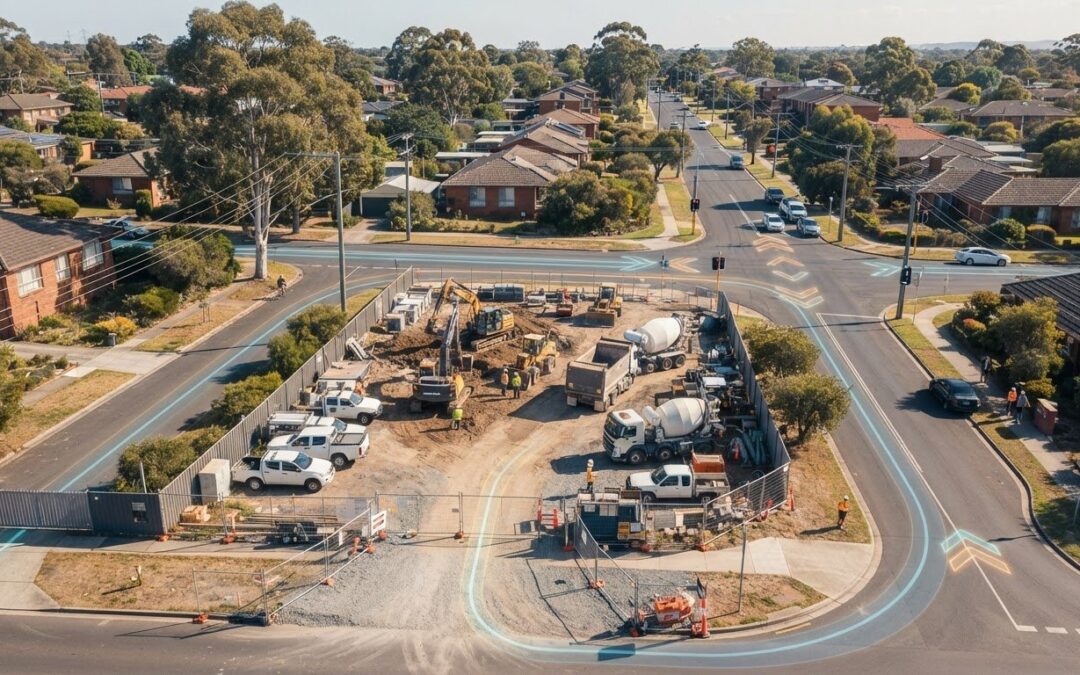
Could a delivery schedule that looks manageable at the site gate create queues or access problems several streets away? A sound assessment considers construction traffic impact on local road network performance, including how worker trips, heavy vehicles and deliveries use shared roads and intersections.
It’s reasonable to be concerned about congestion, safety, property access and road condition during construction. The effects depend on the project, its traffic volumes, routes and work stages. Identify the roads and road users that could be affected rather than assuming every nearby street will experience the same change. Network assessment is also distinct from on-site traffic control: one evaluates likely effects on surrounding roads, while the other addresses how traffic is managed around works.
This guide explains how construction activity can affect local roads and what information supports a credible, project-specific assessment. You’ll learn what a Traffic Impact Assessment examines, how intersections and different road users can be considered, and how proportionate measures can help avoid, reduce and monitor disruption. ML Traffic Engineers Australia is a specialist consultancy with over 15 years of experience in traffic engineering and transport planning, preparing Traffic Impact Assessment reports to inform planning decisions.
Key Takeaways
- Map construction vehicle origins, destinations and site approaches to identify which connecting roads and intersections may experience added pressure.
- Assess construction traffic impact on local road network operation by comparing project trips and work-stage changes with verified baseline conditions.
- Check how delivery timing, route suitability, site access and staging could address specific impacts, then confirm who is responsible for each measure.
- Set the assessment scope to match the project, construction stages and expectations of the relevant authority.
- A traffic engineer can provide a project-specific Traffic Impact Assessment when heavy vehicle activity, constrained access or network sensitivity warrants closer analysis.
What construction traffic impact on the local road network actually means
Construction traffic impact on local road network operation means the change project activity may cause to how surrounding roads function, how safely people use them, whether properties remain accessible and how road surfaces or other infrastructure are affected. The impact isn’t limited to vehicles entering and leaving the site. It can also arise from delivery trucks, worker travel, plant movements and temporary works that occupy or alter road space.
Consider a project on a narrow street. Deliveries may need to turn at a nearby intersection, while temporary access arrangements or work vehicles could affect traffic flow or pedestrian and cycling routes. The extent and type of impact depend on the project’s activity, timing, vehicle mix and the local network. A nearby road may see little change, while a connecting route used by project vehicles could experience more noticeable effects.
Logistics sequencing helps clarify how deliveries and site access relate to surrounding roads. This video discusses planning the movement of vehicles and materials:
Which parts of the local road network can be affected?
Start with the site access points, then trace likely vehicle routes through connecting streets and intersections. Include nearby footpaths and cycling routes where construction vehicles or temporary changes may affect movement. Follow actual project travel paths rather than limiting the assessment to the site frontage. Don’t assume every nearby road will experience the same level or type of change.
Road traffic control concerns how vehicle and pedestrian movement is directed around a work area. That’s related to, but distinct from, assessing wider network effects. For background, see Road traffic control.
How construction traffic differs from operational traffic
Construction trips are temporary and change with work stages, workforce levels and delivery schedules. Once a development opens, operational traffic means the regular trips generated by its ongoing use. These are different demands and may need separate consideration. A project-specific assessment can examine construction activity, while a Traffic Impact Assessment considers proposed development effects on the surrounding road network. ML Traffic Engineers can assess proposed development effects on surrounding roads.
How construction activity creates pressure on surrounding roads
Construction traffic reaches beyond the site gate. To assess its effect, trace likely vehicle movements from their origins to the site and on to their destinations. Identify expected approaches, connecting routes, turning points and any locations where vehicles may need to wait or manoeuvre. The route used by a delivery truck may put pressure on different streets and intersections from the route taken by workers.
Road space can also change during works. A temporary occupation, lane change or altered site access may reduce available space, affect turning movements or shift pedestrian and cyclist movements. These changes can interact with general traffic, public transport and other road users, particularly where routes or access points are shared. The construction traffic impact on local road network operation depends on where, when and how often these activities occur, not simply on the project’s distance from a road.
Traffic flow, queuing and intersection operation
Delivery timing matters. If vehicles arrive while traffic is already busy, or wait for a site entry to become available, queues may form on the approach road. A large vehicle turning into a site could also slow following traffic or affect movements at a nearby intersection. Even when construction is concentrated at one property, the effects may reach an intersection connecting the site approach to a busier route.
For example, if a delivery vehicle must slow or wait before turning, vehicles behind it may queue. If that queue reaches an intersection, it could affect other turning movements or through traffic. This is a cause-and-effect pathway to investigate, not a prediction that it will occur on every project.
Road safety, access and pavement condition
Network assessment should consider how construction vehicle movements interact with everyday access and travel. Relevant matters include driver visibility at site entrances, turning conflicts, pedestrian access, cyclist movements and vehicles entering or leaving nearby driveways. Public transport routes may also need consideration if temporary works or vehicle movements affect their path or stopping locations.
Vehicle size, frequency and route suitability can inform concerns about road condition. Repeated movements by larger vehicles may raise different questions from occasional deliveries, especially where the route includes narrow streets or constrained turning areas. Identify the route and the nature of the concern rather than assuming damage or a particular outcome.
Construction traffic can affect the network through added vehicle movements, restricted road space, changed access, conflicts between road users and pressure on road condition. A short, isolated delivery may cause a brief interruption; repeated movements or a prolonged work-stage arrangement may create recurring pressure. Traffic assessment services can help examine these network effects.
How to assess construction traffic impacts on the road network
A credible assessment follows a clear sequence. Define which roads, intersections and travel modes need consideration, then test construction demand against documented existing conditions. This makes the basis for findings transparent and helps keep the scope proportionate to the project.
- Define the scope. Identify the site, construction stages, likely vehicle routes and potentially affected parts of the network. Confirm relevant expectations with the responsible road authority or council.
- Establish the baseline. Record existing traffic patterns, road function, access constraints and known roadworks or other planned activity. Verify where information came from and whether it represents the conditions being assessed.
- Estimate project traffic. Use the construction programme, workforce travel assumptions, delivery profile and vehicle types to describe expected movements by stage and time.
- Test the effects. Consider how those movements interact with existing network conditions, site access and relevant road users. Focus analysis on routes and locations where a change could matter.
- Document findings. Explain the evidence, assumptions, identified constraints and any measures or further analysis recommended.
What information should the assessment bring together?
Confirm the construction duration and staging, workforce numbers, delivery schedules and expected vehicle types. Bring these together with available network information, site access geometry, nearby pedestrian and cycling routes, relevant public transport considerations, and other planned works that could affect the baseline.
Check the source, date and coverage of traffic or road information rather than treating every available record as current or complete. If an input is unavailable, identify it as an assumption. Explain how it could affect confidence in the findings, and whether obtaining better information or additional analysis is warranted.
How should impacts and uncertainty be reported?
Compare expected conditions during relevant construction stages with the documented baseline. Describe material changes in plain technical language, including where and when they may occur and which road users or access points could be affected. Separate evidence-based findings from estimates.
State limitations, assumptions and unresolved questions clearly. Methods, thresholds and approval expectations can vary with the project and responsible authority, so verify applicable requirements rather than relying on a generic numerical threshold. A project-specific Traffic Impact Assessment can provide broader development-assessment context, while construction traffic assumptions should reflect the actual work programme and site logistics.
Which measures can reduce construction traffic impacts?
Mitigation should respond to an identified effect, not rely on a standard list of controls. A suitable measure depends on the construction stage, surrounding network, road users and relevant project approvals. The table outlines options to assess, not universal requirements.
| Impact | Possible response | Typical party to coordinate | Project-specific limitation |
|---|---|---|---|
| Delivery vehicles arriving during forecast traffic peaks | Schedule or coordinate deliveries to avoid unnecessary conflicts and manage arrival timing. | Builder, site logistics team and suppliers | Delivery windows depend on work sequencing, supplier availability and any authority conditions. |
| Heavy vehicles using unsuitable or constrained roads | Assess route suitability, turning movements and access options before confirming preferred routes. | Project team, transport planner and relevant road authority | A more suitable route may be longer or affect different locations; assess the whole route, not just the site approach. |
| Vehicle queues or conflicts at the site entrance | Coordinate site access with delivery timing and construction staging; consider whether vehicles can enter without waiting on the road. | Builder and site team | Access arrangements are limited by site layout, road geometry and approval conditions. |
| Changed access or movement for nearby road users | Plan staging and communicate relevant changes to affected residents, businesses and road users. | Project team, with relevant authority coordination | Communication doesn’t replace approved arrangements or remove physical access constraints. |
Match mitigation to the identified impact
Start with the cause. If analysis identifies delivery overlap with a busy period, test whether rescheduling is workable. If turning movements or sensitive locations are the concern, assess alternative routes and access coordination. Staging may help limit the duration or extent of road-space changes, but its feasibility depends on the construction programme and site constraints.
Network-level assessment considers how project activity affects surrounding routes and intersections. It’s distinct from site-specific traffic control and temporary traffic guidance, which address movement around the work area. Any proposed arrangements must align with project approvals and applicable authority requirements.
Monitor impacts as construction stages change
Review whether actual activity matches the assumptions used in the assessment. Project-specific review triggers might include observed queues, access complaints, a changed delivery pattern or a new construction stage that alters routes or road-space use. These are examples to consider, not universal statutory thresholds. Record observations and reassess measures if conditions change.
For project-specific advice on assessing network effects, explore traffic assessment services.
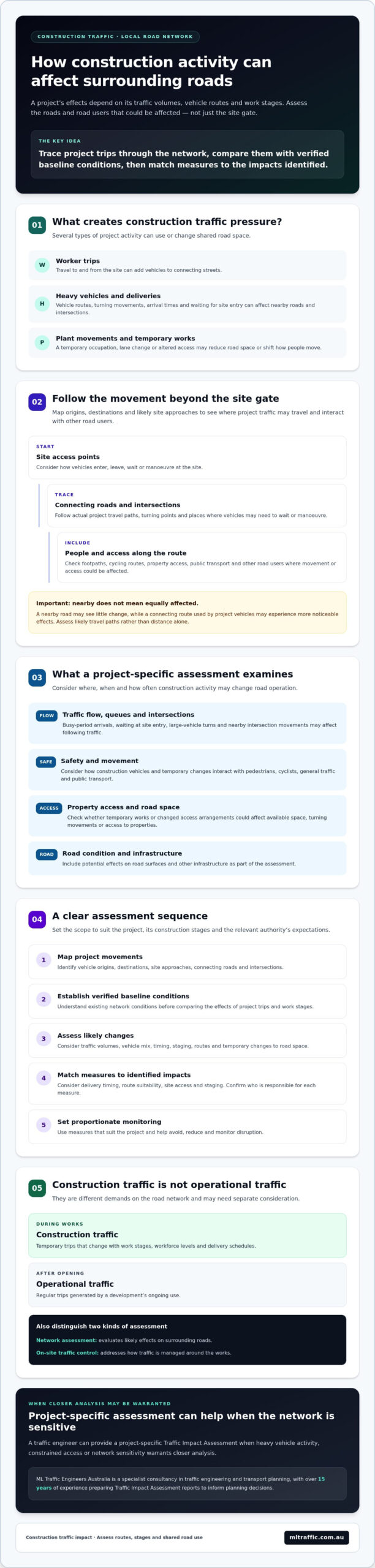
When a traffic engineer can help assess construction impacts
A traffic engineer can help when project activity may affect more than the immediate site entrance. Specialist assessment may be warranted where construction involves regular heavy vehicle movements, constrained access, complex turning movements or a road network sensitive to additional traffic. The key question is whether project trips and work stages could create effects that need to be understood and addressed through planning.
The assessment scope should match the development, construction programme and expectations of the relevant authority. It may focus on particular stages, delivery routes, intersections or access points rather than treating every surrounding road as equally affected. A clear report records the evidence considered, documents assumptions and limitations, identifies likely network effects and sets out proportionate recommendations. It informs decisions; it doesn’t guarantee an approval or a particular outcome.
What to prepare before seeking an assessment
Providing project information early helps define a practical scope. Gather what’s available, and flag details that are still uncertain:
- Site plans showing proposed access points and relevant surrounding roads.
- Construction staging and anticipated duration, including changes that may affect traffic over time.
- Known delivery schedules, vehicle types and workforce travel assumptions.
- Available traffic information, access constraints and nearby planned works.
- Relevant planning or road-authority correspondence that may set expectations for the assessment.
Missing information doesn’t need to be disguised. Identifying gaps allows the assessment to state assumptions transparently and explain how they affect confidence in the findings or whether more information may be needed.
How ML Traffic Engineers can support a project
For a project-specific assessment of construction traffic impact on the local road network, a Traffic Impact Assessment report can examine proposed development effects on surrounding roads. Intersection analysis can help assess relevant junctions. The appropriate scope depends on project activity and authority expectations, which should be confirmed for the relevant approval pathway.
ML Traffic Engineers has over 15 years of experience in traffic engineering and transport planning, serving clients nationally. The business also prepares Traffic Guidance Schemes for construction activity. These are planning services, not physical traffic control. The right deliverable depends on the project’s needs and the service required.
If you’re preparing a project and want to discuss its assessment requirements, contact ML Traffic Engineers to outline the site, construction stages and information available.
Plan construction traffic with a clearer view of the network
Construction traffic can affect more than the road outside a site. A practical assessment follows likely vehicle routes, considers how each construction stage interacts with existing conditions, and identifies proportionate responses to the impacts that matter. Clear evidence and stated assumptions help project teams and authorities understand the basis for decisions.
The construction traffic impact on local road network operation depends on project activity, timing, vehicle types and the roads involved. Reviewing those factors early can help clarify where further analysis or mitigation may be needed, without assuming every nearby route will be affected in the same way.
ML Traffic Engineers has over 15 years of experience in traffic engineering and transport planning. Its services include Traffic Impact Assessments and intersection analysis to help examine effects on surrounding roads. For a project-specific discussion, discuss your project traffic assessment.
With a well-scoped assessment, you can make informed decisions and plan construction activity with greater confidence.
Frequently Asked Questions
How does construction traffic affect the local road network?
Construction traffic can change how surrounding roads operate, affect access and create conflicts between road users. Delivery trucks, worker vehicles and plant movements may add trips, require turning manoeuvres or interact with existing traffic. Temporary works or changes to site access can also alter available road space. The effects depend on project activity, timing, vehicle types and the routes used, so nearby roads may experience different kinds and levels of impact.
What should a construction traffic impact assessment include?
A construction traffic impact assessment should define its scope, describe existing network conditions and set out expected project traffic. It should consider construction staging, delivery timing, workforce travel, vehicle types, site access and relevant connecting routes or intersections. Findings should compare expected conditions with the documented baseline and explain proposed responses. Any unavailable information, assumptions, limitations and authority expectations should also be recorded so readers can understand the basis and confidence of the assessment.
Can construction traffic affect roads beyond the site frontage?
Yes. Construction vehicles may use connecting streets and intersections between the site and their origins or destinations, so impacts can extend beyond the frontage. For example, a truck turning through a nearby intersection or waiting to enter a site may affect traffic on its approach. The assessment should trace likely routes and consider relevant access points and road users. It shouldn’t assume every nearby road will be affected equally, or that distance from the site alone determines impact.
When should construction vehicle routes be assessed?
Assess likely routes while planning construction logistics, before delivery patterns and site access arrangements are settled. Early consideration can reveal constraints such as limited turning space, sensitive locations or routes that may not suit the vehicles involved. Revisit route assumptions if construction staging, vehicle types, delivery schedules or access arrangements change. The scope and timing of assessment should reflect the project and expectations of the relevant authority, which can vary with the approval context.
How can construction traffic impacts be reduced?
Choose measures that address the impact identified in the assessment. Options to examine include coordinating delivery times, selecting suitable routes, managing site access and staging works to limit disruption. Clear communication can help affected road users understand relevant access changes. Each measure has practical limits, including site layout, construction sequencing and authority requirements. Network assessment and site-specific traffic control are related but distinct, so confirm who is responsible for each arrangement and check applicable approvals.
Who is responsible for assessing construction traffic impacts?
Responsibility depends on the project and its approval arrangements. A project proponent or development team may arrange the assessment, while a traffic engineer can prepare technical analysis of construction trips and network effects. The relevant council or road authority may identify assessment expectations or review submitted information. Confirm responsibilities and requirements for the specific project rather than assuming one process applies everywhere. ML Traffic Engineers prepares Traffic Impact Assessments and provides intersection analysis for clients nationally.
Does a construction traffic assessment guarantee planning approval?
No. An assessment provides evidence about likely traffic effects and may inform planning decisions, but it can’t guarantee approval. The decision-maker considers the application in its full context, including applicable requirements and other relevant matters. A useful report clearly explains its data, assumptions, findings and recommendations, giving reviewers a transparent basis for consideration. Confirm the project’s specific assessment expectations with the relevant authority, and don’t treat an assessment as a substitute for approval.

Disclaimer
The content on www.mltraffic.com.au, including all technical articles, guides, and resources, is provided for general informational and educational purposes only. It is not intended to constitute professional advice in traffic engineering, transportation planning, development approvals, or any other technical or legal field.
While ML Traffic Engineers makes every reasonable effort to ensure the accuracy, completeness, and timeliness of the information published, we do not provide any warranties or representations (express or implied) regarding its reliability, suitability, or availability for any particular purpose. Any reliance you place on the content is strictly at your own risk.
In no event shall ML Traffic Engineers, its directors, employees, authors, or affiliates be liable for any direct, indirect, incidental, special, consequential, or punitive damages (including, without limitation, loss of profits, data, or business opportunities) arising out of or in connection with the use of, or inability to use, any information provided on this website.
The articles and guides on this site are not a substitute for engaging a qualified, registered professional traffic engineer (such as an NPER or RPEQ engineer) to assess your specific project requirements. For tailored advice, compliance assessments, or traffic engineering services, please contact a competent professional.
This disclaimer may be updated from time to time without notice. By accessing or using this website, you agree to be bound by the most current version of this disclaimer.
