

A single stop-work order for a non-compliant traffic management plan can cost a contractor over $50,000 per day in lost productivity. You’ve likely experienced the frustration of a project stalled by bureaucratic delays or a rejected submission because the distinction between a simple Traffic Guidance Scheme (TGS) and comprehensive construction traffic management plan requirements wasn’t clearly addressed. Managing heavy vehicle access in constrained urban environments remains one of the most significant bottlenecks for modern developers.
This guide provides the technical clarity you need to master regulatory standards and secure council approval on your first submission. We’ll examine the 11th Edition of the Manual on Uniform Traffic Control Devices (MUTCD) standards effective as of March 2026, the necessity of accurate vehicle swept path analysis, and the specific documentation required to maintain site safety and road network efficiency. By following these rigorous engineering standards, you’ll ensure your project remains compliant, safe, and on schedule.
Key Takeaways
- Learn the critical distinction between a strategic Construction Traffic Management Plan and an operational Traffic Guidance Scheme to ensure comprehensive site coverage.
- Identify the specific construction traffic management plan requirements mandated by local authorities for projects involving significant road occupation or heavy vehicle activity.
- Utilise technical tools like Vehicle Swept Path Analysis and AutoTURN software to provide empirical evidence of safe vehicle access within constrained construction zones.
- Expedite the council approval process by engaging qualified traffic engineers who understand complex regulatory frameworks and bureaucratic expectations.
Regulatory Framework and Triggers for a Construction Traffic Management Plan
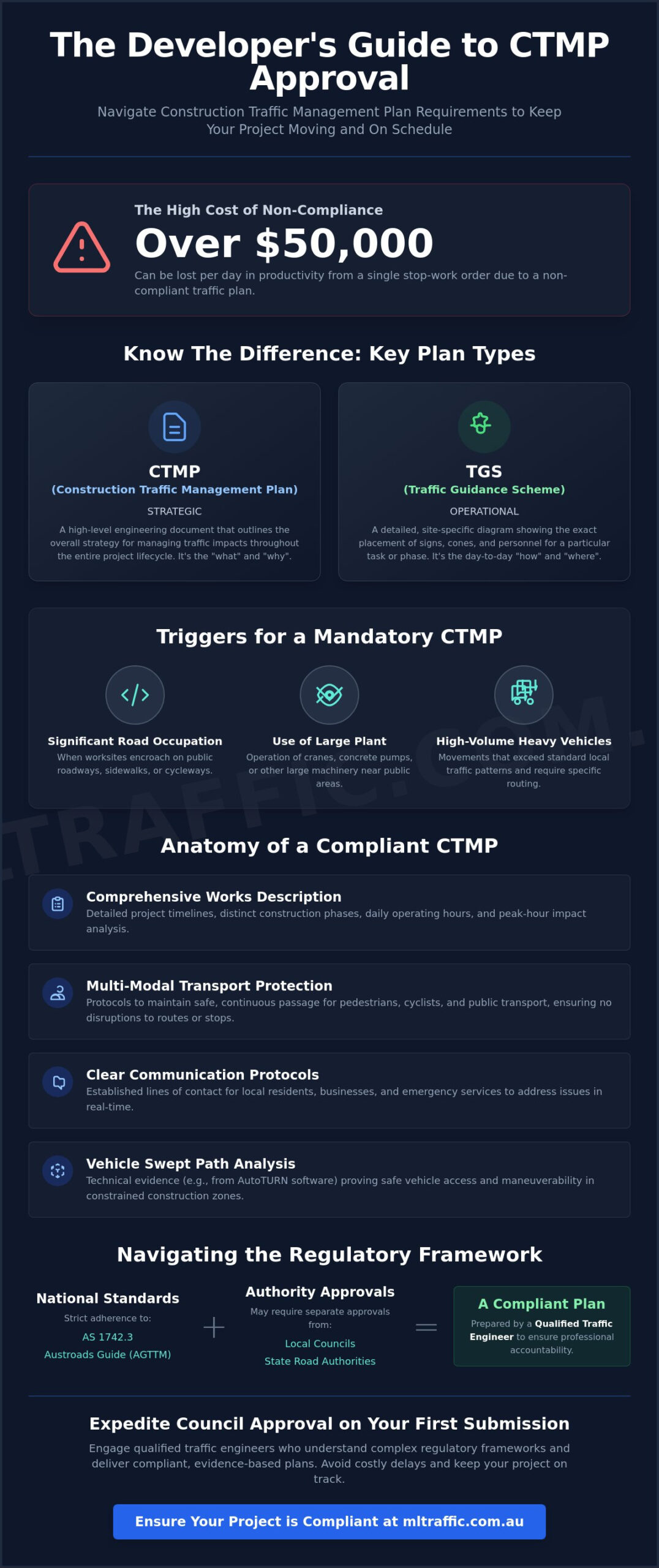
A Construction Traffic Management Plan (CTMP) is a strategic engineering document designed to mitigate the impacts of construction activities on the local road network. It isn’t merely a site map; it’s a technical roadmap for maintaining safety and efficiency. Most developers encounter construction traffic management plan requirements as a mandatory condition of their planning permit. Common triggers for a formal CTMP include significant road occupation, the use of cranes or concrete pumps, or high-volume heavy vehicle movements that exceed standard local traffic patterns. Failure to provide a compliant plan results in immediate stop-work orders, which can cost contractors over $50,000 per day in lost productivity according to 2026 industry benchmarks.
Local councils and state road authorities use these documents to manage public assets and ensure developer liability is clearly defined under the Road Management Act. This legislation places the burden of public safety and asset protection on the developer. Professional road traffic control principles dictate that these plans must be prepared by a qualified traffic engineer. This ensures adherence to Australian Standards and local government bylaws, providing a layer of professional accountability that council planners expect.
To better understand the core elements of these management strategies and how they integrate into site safety, watch this helpful video:
National Standards and Compliance Requirements
Compliance starts with strict adherence to AS 1742.3: Manual of uniform traffic control devices. This standard provides the foundation for all temporary traffic management in Australia. It’s integrated with the Austroads Guide to Temporary Traffic Management (AGTTM), which outlines the technical requirements for managing risks at worksites. Understanding the hierarchy of road authorities is vital. A project may require separate approvals from both the local council for side streets and the state authority for arterial roads. Each body has specific powers to reject plans that don’t meet their unique safety criteria or technical construction traffic management plan requirements.
CTMP vs. CTIA: Identifying the Correct Documentation
Developers often confuse a Management Plan (CTMP) with a Construction Traffic Impact Assessment (CTIA). While a CTMP focuses on operational safety and vehicle routing during the build, a CTIA is a deeper dive into network capacity. A CTIA is typically required for major developments where the volume of construction traffic might cause significant congestion at nearby intersections. Both documents function as subsets of the broader Construction Management Plan (CMP). They ensure that site logistics don’t compromise the surrounding community’s accessibility or safety. For a full list of technical assessments required for your project, you can view our professional traffic services.
Core Technical Components of a Compliant CTMP
A compliant CTMP is an exhaustive document detailing every operational variable affecting the public road network. Council planners require a comprehensive works description outlining project timelines, distinct construction phases, and daily operating hours. This technical detail allows authorities to assess peak-hour impacts and coordinate with other local infrastructure projects. Adherence to Transportation Management Plan Requirements ensures that all safety and operational bases are covered from a regulatory standpoint. Professional documentation must prove that the developer has considered every impact on the surrounding environment.
The plan must explicitly identify and protect all transport modes. This includes maintaining safe passage for pedestrians and cyclists and ensuring no disruption to public transport routes or stops. Effective communication protocols are equally vital. You must establish clear lines of contact for local residents, businesses, and emergency services to address issues in real-time. Without these protocols, minor site issues can quickly escalate into significant community grievances or legal challenges.
Technical construction traffic management plan requirements also dictate the inclusion of the following elements:
- Designated site access points with verified sight distances.
- On-site loading zones to prevent illegal street parking and blockages.
- Allocated parking for construction personnel to minimise local amenity impact.
- Contingency plans for unexpected road closures, weather events, or traffic incidents.
Site Logistics and Staging Analysis
A static plan is insufficient for a dynamic construction site. You need a site layout plan that evolves with the project. This involves identifying specific entry and exit points for the demolition, excavation, and structural phases. Managing these transitions is critical. For example, excavation typically involves high-frequency heavy vehicle movements requiring different traffic control measures than the structural phase. Detailed planning for temporary road or footpath occupations must include precise permit durations to avoid compliance penalties and project delays.
Stakeholder and Amenity Management
Minimising disruption to the local community is a core objective of any traffic strategy. Your plan should include strategies for reducing noise and vibration impacts from heavy vehicle movements. It’s essential to ensure continued access for neighbouring properties and commercial loading docks. Failure to account for these local amenities often leads to community complaints and subsequent council intervention. To manage these complexities effectively, you should explore the full range of specialised traffic engineering services required for complex site logistics. Professional oversight ensures your site remains both productive and compliant with all local regulations.
Vehicle Access and Swept Path Analysis Requirements
Swept Path Analysis (SPA) is the technical backbone of any construction logistics strategy. It provides the empirical proof that heavy vehicles can enter and exit a site without encroaching on opposing traffic lanes or damaging public infrastructure. We utilize AutoTURN software to simulate the precise turning movements of the largest vehicles expected on-site. This includes everything from standard 8.8m medium rigid vehicles to 19m articulated trucks. Council planners won’t approve a plan that relies on guesswork; they require simulated evidence of feasibility to ensure public safety.
Validating access requires a deep understanding of existing intersection geometry. Many urban sites are constrained by narrow carriageways or permanent street furniture. Our analysis identifies where temporary modifications, such as the removal of parking bays or the relocation of bollards, are necessary to facilitate safe movement. Referencing strategies found in the Caltrans Transportation Management Plan Guidelines allows us to implement global best practices in managing these technical hurdles. Compliance with AS 2890.2 is the benchmark for all commercial vehicle facilities. It governs the design of loading areas and ensures that driveway ramp grades don’t lead to vehicle scraping or loss of traction during heavy haulage operations.
Heavy Vehicle Haulage Route Planning
Haulage route planning is about more than just finding the shortest path. It’s about identifying the safest path for the community. We prioritize arterial roads to keep heavy traffic away from schools and residential zones. Our engineers conduct site-specific assessments of bridge load limits and overhead clearances. This is vital when transporting specialized plant or oversized structural elements. For more technical details on vehicle maneuvering, refer to our comprehensive guide on swept path analysis.
Loading and Unloading Zone Compliance
Temporary work zones must be positioned to maintain through-traffic flow and pedestrian safety. We provide detailed diagrams showing the exact positioning of concrete agitators, pump trucks, and mobile cranes. A primary goal is to ensure these vehicles don’t block essential sightlines at nearby intersections. Reversing maneuvers on public roads are a major liability and a frequent cause of permit rejection. We design site access to prioritize forward-entry and forward-exit movements whenever possible. These rigorous standards are fundamental to meeting modern construction traffic management plan requirements and ensuring a safe, productive work environment.
Traffic Guidance Schemes (TGS) and Operational Implementation
A Traffic Guidance Scheme (TGS) is the tactical component of your broader logistics strategy. While the CTMP provides the high-level engineering rationale, the TGS serves as the visual diagram of signs and devices used by on-site personnel. It’s the document that translates strategic construction traffic management plan requirements into a physical layout. Every TGS must illustrate the precise location of pylons, variable message signs (VMS), and temporary barriers. This ensures that the operational execution aligns perfectly with the safety objectives defined during the planning phase.
Execution of a TGS relies on strict adherence to AS 1742.3. This standard dictates the technical specifics of signage placement, taper lengths, and safety buffers. Taper lengths, for example, are calculated based on the prevailing speed limit of the road to ensure vehicles can merge safely without sudden braking. Safety buffers provide a necessary “cushion” between live traffic and the work zone. Accredited traffic controllers are responsible for the daily implementation of these schemes. Their role is to manage the flow of vehicles and pedestrians in real-time, ensuring that the site remains compliant with the approved engineering documents at all times.
Pedestrian and Cyclist Safety Protocols
Protecting vulnerable road users is a non-negotiable aspect of modern traffic management. Managing footpath closures requires the provision of compliant detours that are clearly signed and physically separated from construction activity. In high-density urban environments, you may need to implement overhead protection, such as gantries or heavy-duty hoarding, to protect pedestrians from falling objects. All temporary walkways must meet accessibility standards, including appropriate ramp grades and widths for wheelchair users. Failure to provide these facilities often leads to immediate council intervention and permit revocation.
Monitoring, Auditing, and Plan Adjustments
Compliance is a continuous process, not a one-time approval. You must establish a rigorous schedule for site inspections to ensure the TGS is being followed correctly. If construction methodologies change or project timelines shift, the plan must be amended to reflect the new reality. Professional engineers should oversee these audits to identify potential safety gaps before they lead to incidents. To understand how these operational details fit into the broader regulatory landscape, you should read our definitive guide on traffic management plans for Australian projects. If your project requires an urgent technical review, you can request a professional Traffic Guidance Scheme from our senior consultancy team to ensure full site compliance.
Engaging a Qualified Traffic Engineer for CTMP Approval
Council planners prioritize submissions from established consultancies that demonstrate senior principal oversight. A report backed by a principal engineer carries significantly more weight during the assessment process than one produced by junior staff at a large firm. Meeting construction traffic management plan requirements isn’t just about drawing lines on a map; it’s about providing a technically sound engineering rationale that stands up to scrutiny. With over 15 years of experience in the field, our team understands the nuances of local council expectations and the specific bureaucratic hurdles that often stall development approvals.
Expert traffic engineering acts as a primary risk management tool. It reduces the likelihood of permit rejections and the subsequent stop-work orders that can derail a project’s financial feasibility. We prioritize personnel continuity, ensuring the same expert who initiates your project performs the technical analysis and represents you in discussions with road authorities. This hands-on approach eliminates the communication gaps that frequently occur in larger organizations. By providing direct access to our leadership, we ensure that every technical decision is backed by decades of practical experience.
The ML Traffic Engineers Australia Approach
Our methodology is built on accountability and technical precision. We provide every client with direct access to senior principals, ensuring that high-level expertise is applied to every facet of your project. We leverage our national experience across diverse environments to address site-specific challenges, whether you’re developing in a dense CBD or a sensitive residential area. Our results-oriented focus means we don’t just provide a document; we provide a path to approval. This involves a meticulous review of all site variables, from vehicle swept paths to pedestrian safety detours.
Securing Your Construction Approval
Early engagement with a traffic consultant is vital for a smooth approval process. Involving us during the DA or permit phase allows for the early identification of potential logistics bottlenecks. A well-prepared CTMP serves as a comprehensive risk management tool for the entire project lifecycle, protecting you from liability and operational downtime. Ready to progress your development? Contact our senior engineering team today for a technical consultation to ensure your project meets all construction traffic management plan requirements. We’re here to help you navigate the complexities of urban planning and secure your approval without unnecessary delays.
Achieving Operational Compliance and Site Safety
Mastering construction traffic management plan requirements involves more than just administrative filing. It requires the integration of high-level engineering data, such as Vehicle Swept Path Analysis, with precise operational schemes like the TGS. Adhering to the latest national standards ensures your project avoids the costly stop-work orders that plague non-compliant sites. These technical documents serve as your primary defense against project delays and developer liability.
ML Traffic Engineers Australia brings over 15 years of traffic engineering experience to your development. We provide direct access to senior principals who manage your project from inception to council approval. With national coverage across all Australian jurisdictions, our team understands the specific bureaucratic requirements of every local road authority. We don’t just provide reports; we deliver results-oriented strategies that secure your site’s future.
Discuss your CTMP requirements with a senior ML Traffic Engineer today. Professional engineering oversight is the most effective way to protect your project timeline and ensure a safe, efficient construction phase.
Frequently Asked Questions
What is the difference between a TMP and a CTMP?
A Traffic Management Plan (TMP) is a general document used for any activity that impacts road users, including events or short term maintenance. A Construction Traffic Management Plan (CTMP) is a specialized strategy focused specifically on the complexities of a building site. It addresses long term staging, heavy vehicle haulage routes, and site specific logistics like crane positioning. A CTMP is a mandatory requirement for most medium to high density development approvals.
Who is qualified to prepare a Construction Traffic Management Plan in Australia?
A CTMP must be prepared by a qualified traffic engineer who holds the necessary state based certifications for temporary traffic management design. Council planners prioritize reports from established consultancies where senior principals oversee the technical analysis. This ensures the document meets all construction traffic management plan requirements and adheres to local government bylaws. Engaging an engineer with at least 15 years of experience reduces the risk of permit rejections.
How long does it typically take for a council to approve a CTMP?
The approval process typically takes between 4 and 8 weeks depending on the specific local government area and the complexity of the project. If the development impacts arterial roads managed by state authorities, the timeline may extend further. Providing a high quality, compliant submission on the first attempt is the most effective way to avoid lengthy delays. Early engagement with a traffic consultant during the permit phase helps streamline this process.
Do I need a swept path analysis for my construction traffic plan?
You need a swept path analysis if your project involves heavy vehicle movements in constrained urban environments. This technical assessment uses software like AutoTURN to provide empirical proof that trucks can enter and exit the site safely. It is a critical component of modern construction traffic management plan requirements. Without this analysis, council planners cannot verify that your logistics strategy is physically feasible, which often leads to immediate application refusal.
What happens if a construction site does not follow its approved CTMP?
Failure to adhere to an approved plan can result in immediate stop-work orders and significant financial penalties from local councils or state road authorities. Non-compliance increases developer liability and creates substantial safety risks for the public. Authorities conduct regular audits to ensure signage and vehicle movements match the approved documentation. If site conditions change, you must formally amend the plan to maintain your legal and operational compliance throughout the project.
Is a Traffic Guidance Scheme (TGS) the same as a Traffic Control Plan (TCP)?
Yes, a Traffic Guidance Scheme (TGS) is the current industry terminology for what was previously known as a Traffic Control Plan (TCP). It is the technical diagram that illustrates the exact placement of signs, cones, and barriers on the road. While the CTMP provides the strategic rationale for the project, the TGS provides the operational instructions for traffic controllers to execute on a daily basis to ensure site safety.
Can a CTMP be amended once construction has started?
A CTMP can and should be amended if construction methodologies or project timelines shift significantly. As a project moves from excavation to the structural phase, vehicle volumes and site access needs often change. Any major deviation from the original approved document requires a formal revision and resubmission to the relevant road authority. Maintaining an accurate, up to date plan is essential for managing ongoing site logistics and ensuring continued safety.
What specific Australian Standards govern construction traffic management?
The primary standard is AS 1742.3, which covers the manual of uniform traffic control devices for works on roads. This is used in conjunction with the Austroads Guide to Temporary Traffic Management (AGTTM), which provides the national framework for safety and risk management. For projects involving heavy vehicles, engineers also reference AS 2890.2 to ensure commercial vehicle facilities and loading areas meet the required dimensions and safety benchmarks for Australian developments.

Disclaimer
The content on www.mltraffic.com.au, including all technical articles, guides, and resources, is provided for general informational and educational purposes only. It is not intended to constitute professional advice in traffic engineering, transportation planning, development approvals, or any other technical or legal field.
While ML Traffic Engineers makes every reasonable effort to ensure the accuracy, completeness, and timeliness of the information published, we do not provide any warranties or representations (express or implied) regarding its reliability, suitability, or availability for any particular purpose. Any reliance you place on the content is strictly at your own risk.
In no event shall ML Traffic Engineers, its directors, employees, authors, or affiliates be liable for any direct, indirect, incidental, special, consequential, or punitive damages (including, without limitation, loss of profits, data, or business opportunities) arising out of or in connection with the use of, or inability to use, any information provided on this website.
The articles and guides on this site are not a substitute for engaging a qualified, registered professional traffic engineer (such as an NPER or RPEQ engineer) to assess your specific project requirements. For tailored advice, compliance assessments, or traffic engineering services, please contact a competent professional.
This disclaimer may be updated from time to time without notice. By accessing or using this website, you agree to be bound by the most current version of this disclaimer.
