
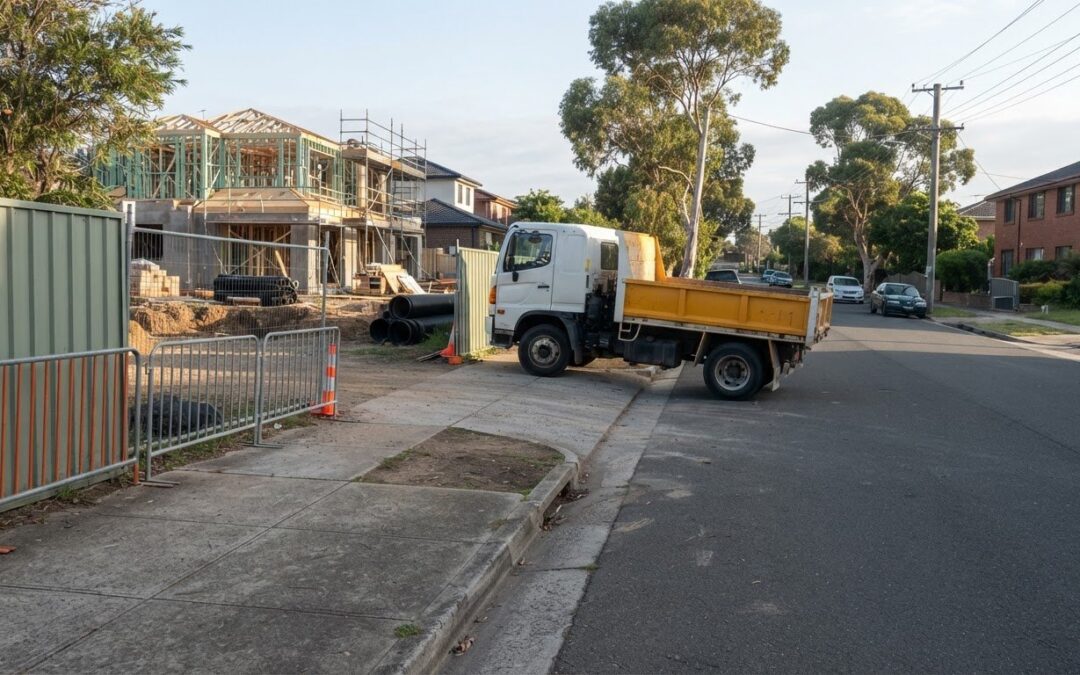
A construction traffic management plan can be both a safety requirement and a planning-approval condition. Australian PCBUs must prepare a traffic management plan to manage construction traffic risks, and work on or next to a public road requires a safe work method statement before it starts. The construction traffic management plan requirements also depend on the site and local approval conditions.
It’s reasonable to expect one clear checklist, but council rules and the effects of the works on nearby roads, pedestrians and cyclists can change what must be documented. This article explains what a construction traffic management plan should cover, when one may be required, and how Australian standards and local requirements shape site access and movements. It also shows how site conditions, construction stages and traffic impacts inform the plan and its supporting assessments.
Key Takeaways
- Plan for construction hours, delivery movements, haulage, worker parking and site access so logistics are clear across each project stage.
- Assess risks such as blind spots, high traffic volumes and interactions between vehicles, mobile plant and people, then select controls suited to the site.
- Check how Australian standards and local council approval conditions apply, as requirements can vary by location and project.
- For high-volume sites, account for existing road conditions, traffic volumes, nearby transport and the effects of proposed access arrangements.
- Use clear layouts for pedestrian, cyclist and vehicle movements, including walkways, barriers, signs and traffic routes.
What Is Included in Your Construction Traffic Management Plan?
A construction traffic management plan records the work, its likely effects on local traffic and the controls for managing those effects. Its level of detail should reflect the site, construction stages and vehicle movements the project will generate.
Assessing Construction Traffic Risks
A project-specific risk assessment identifies how construction activity could affect workers and road users. This matters because site access points, traffic volumes and the work sequence determine which controls can reduce exposure.
A Construction Traffic Impact Assessment examines potential effects in depth, while the management plan explains how each project stage will be managed. Assess site conditions, existing parking and access, road features, nearby transport options, public areas, blind spots and visibility. For larger projects, also consider traffic volumes, signal phasing and road safety concerns.
Set out the construction methodology, working hours, delivery schedules, truck volumes and frequencies, haulage routes, worker parking and site contact details. The plan can also address loading areas, road closures, detours, parking changes, pedestrians, cyclists, public transport and general traffic. Drawings can compare existing and proposed conditions at each stage, while Traffic Guidance Schemes show temporary devices around the site.
Traffic Controls and Site Access
Traffic controls are the measures that guide or separate people and vehicles around construction activity. The plan should show how traffic controllers, signs, barriers and vehicle access arrangements address the risks identified for the site.
There is no single work-zone speed limit suitable for every site. Specify a limit that fits the layout and operating conditions; an example site plan uses 10 km/h. Include access routes, loading areas and any one-way movements, then show where cones, barricades and signs will direct traffic. Traffic Guidance Schemes can locate temporary controls in relation to the work area.
Choose controls according to the risk hierarchy: first eliminate traffic hazards, then consider substitution, isolation and engineering controls. Use administrative controls for any remaining risks. High-visibility clothing can address visibility hazards, while separated routes and clear access arrangements help reduce interactions between people and vehicles.
Compliance Risks and Plan Reviews
Review the plan to check that its documented controls still match current work stages and site conditions. This is especially important when deliveries, access routes or traffic arrangements change during construction.
Review the plan when a construction stage changes, an incident reveals a weakness in the controls, or site access and traffic conditions shift. Work on or next to a public road is high-risk construction work in Australia, and a PCBU must prepare a safe work method statement before that work starts.
Non-compliance can expose workers, pedestrians and road users to vehicle collisions, falling loads and other traffic hazards. It can also create problems with project approvals or work arrangements. The consequences depend on the breach and applicable requirements, so there is no single penalty for every site. Record revisions to keep the plan aligned with the controls in place.
Australian Standard and council requirements
Australian standards provide a technical framework, while council conditions set local submission and approval requirements. The affected road network determines which authority’s requirements apply.
Council CTMP and CTIA Requirements
A council’s requirements for a construction traffic management plan (CTMP) and Construction Traffic Impact Assessment (CTIA) define the documents needed for its approval process. These requirements matter because they vary between local government areas and development consents.
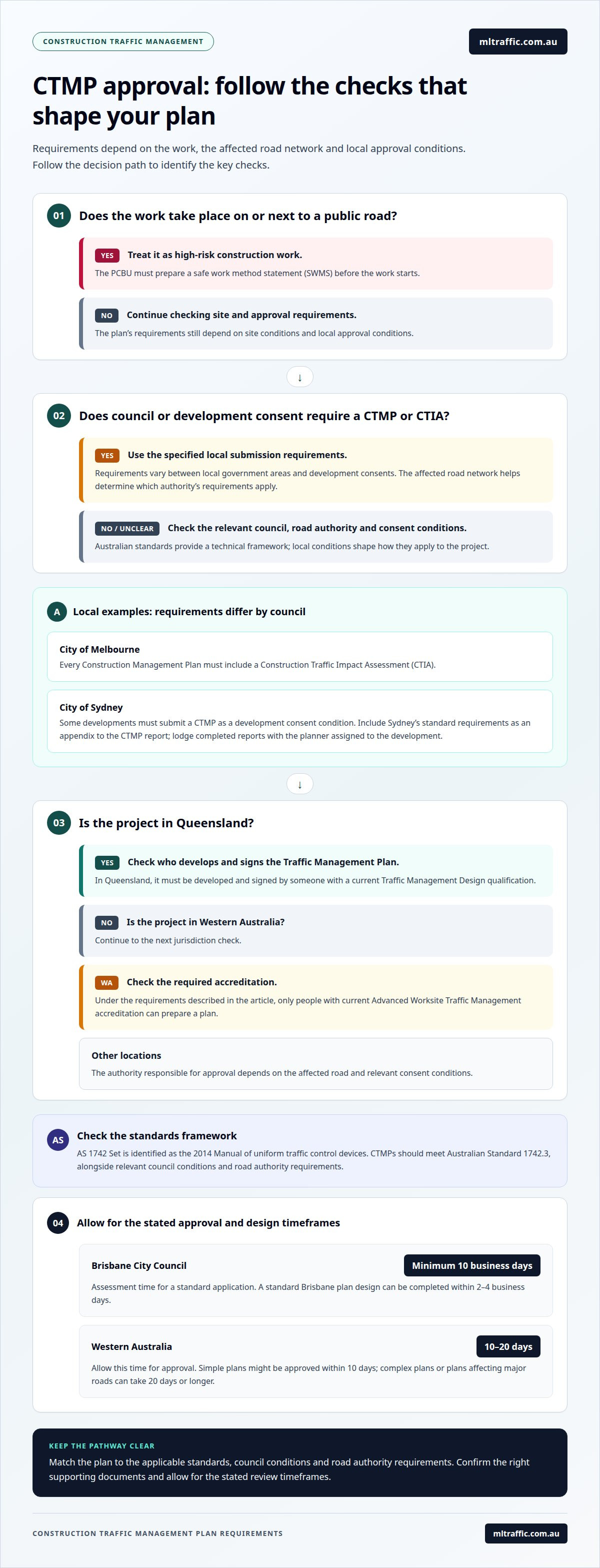
In the City of Melbourne, every Construction Management Plan must include a Construction Traffic Impact Assessment. In the City of Sydney, some developments must submit a CTMP for approval as a development consent condition. Sydney’s standard requirements must be included as an appendix to the CTMP report. Completed reports are lodged with the planner assigned to the development.
AS 1742 Set is identified as the 2014 Manual of uniform traffic control devices, and CTMPs should meet Australian Standard 1742.3. The relevant council’s conditions and the road authority’s requirements shape how these standards apply to the project.
Plan Preparation and Council Submission
Preparation turns the project’s traffic effects into documents and plans for review. Missing information or an unsuitable submission can affect the approval pathway and construction schedule.
In Queensland, a Traffic Management Plan must be developed and signed by someone with a current Traffic Management Design qualification. In Western Australia, under the requirements described there, only people with current Advanced Worksite Traffic Management accreditation can prepare a plan. The authority responsible for approval depends on the affected road and relevant consent conditions.
Brisbane City Council typically requires a minimum of 10 business days to assess a standard application. A standard Brisbane plan design can be completed within 2-4 business days. In Western Australia, allow 10 to 20 days for approval: simple plans might be approved within 10 days, while complex plans or those affecting major roads can take 20 days or longer.
Approvals and Supporting Documents
Supporting documents show how the proposed arrangements will work on the ground. They help a council or road authority assess the specific impacts and controls within its jurisdiction.
A submission may include Functional Layout Plans showing existing and proposed conditions for each construction stage, as well as Traffic Guidance Schemes showing temporary devices. A safe work method statement is required before work on or next to a public road starts. For work affecting a cycleway or shared path, the City of Sydney directs applicants to its traffic control plan guide.
In Western Australia, an accredited Road Works Traffic Manager must review and endorse higher-risk plans under Main Roads requirements. Work affecting signal operation or closing a lane within an intersection requires endorsement from an accredited Registered Traffic Manager and notification to the MRWA traffic operations centre. If work affects a bus stop, the principal contractor must notify TransPerth before work begins.
High-volume construction site access
High-volume sites need access arrangements based on actual worksite conditions and traffic demand. A site-specific analysis documents how construction vehicles connect with the surrounding road network.
Assessing Site and Traffic Conditions
Site and traffic analysis examines the worksite layout alongside nearby road and transport conditions. This matters because access designs need to address hazards and constraints specific to the site.
For a larger project, assess traffic volumes, road features, signal phasing, traffic treatments and road safety concerns. Record existing parking and access, nearby transport options, responsible road authorities and available crash data. Also consider overhead structures, public areas, blind spots and poor visibility.
These factors show where construction movements may conflict with existing traffic or site constraints. For example, a blind spot near an access point needs to be considered when planning vehicle movements and traffic controls. Overhead structures can limit the routes available to vehicles. Public areas and nearby transport options help identify where construction activity may affect people moving around the worksite.
Use the findings to document site-specific requirements rather than rely on a generic access layout. Compare each proposed entry, exit and internal route with worksite conditions and the surrounding road network. If construction is staged, assess the conditions relevant to each stage. This gives the plan a clear basis for explaining access and traffic management arrangements.
Planning High-Volume Site Access
High-volume access planning explains how construction vehicles enter, move through and leave the site. This matters because deliveries and haulage can affect both worksite operations and the surrounding road network.
Use the analysis to assess vehicle access, loading areas, haulage routes and delivery movements. Explain how each arrangement relates to site conditions and construction stages. Delivery schedules, truck volumes and frequencies help describe the traffic demand that the access arrangements must address.
For a large construction site, traffic treatments may extend beyond signs and barriers. Temporary measures can include turning lanes, median islands or new signal phasing. Their suitability depends on the road features, traffic volumes and impacts identified in the analysis. Stage-specific drawings can show proposed treatments alongside existing conditions.
Connect the written access guidance to the drawings. A haulage route diagram can show the intended route, while a Functional Layout Plan can illustrate proposed conditions for a construction stage. Traffic Guidance Schemes can show temporary devices in relation to the site. Together, these materials explain how access will work as construction progresses.
Reassess access arrangements when a construction stage changes or planned movements no longer match site conditions. For example, a change in haulage requirements may affect the route or loading arrangements shown in the plan. Keeping the analysis current gives project teams a practical basis for managing high-volume movements.
Pedestrian, cyclist and vehicle movements
A site traffic plan explains how construction traffic and regular road-user movements will operate around the worksite. Map where pedestrians, cyclists and vehicles may interact, and show how those interactions will be managed.
Managing Pedestrian and Cyclist Movements
Pedestrian and cyclist management separates vulnerable road users from construction vehicles and mobile plant. This matters because crossing points, changing work areas and restricted visibility can create conflicts during site operations.
Show walkways, barriers, signs and temporary changes to pedestrian or cyclist routes on the plan. Identify where people may cross vehicle access points and how often those movements intersect. For example, a delivery entrance beside a public walkway needs clear separation and visible directions around the work area.
Guidance prohibits pedestrians from working alongside operating mobile plant and generally recommends keeping them out of vehicle-restricted areas. Identify those restricted areas and show how pedestrian routes remain separate. If a route changes between construction stages, update the layout so site users can follow the intended route.
Vehicle movements also need a defined arrangement. One-way traffic flow can help manage collision risks involving vehicles and mobile plant. Use the site layout to show route direction and where vehicles turn, load or reverse. Signs and barriers should make the separation and movement pattern clear.
Coordinating Other Road and Site Users
Coordination accounts for people and services using the road network beside the site. This matters because construction activity can affect public transport, emergency access and access to nearby properties.
Describe how construction movements relate to general traffic and public transport. Show affected bus stops, routes or other transport facilities where relevant, and map any proposed changes to road access. The plan can identify nearby property entrances and explain how vehicle movements will be arranged around them.
Consider emergency access alongside planned site routes and temporary traffic controls. Identify the access path that must remain available, and show how barriers, loading activity or queues could affect it. This makes the relationship between construction operations and emergency movements clear on the site layout.
For work affecting a cycleway or shared path, the City of Sydney directs applicants to its traffic control plan guide. More broadly, the construction traffic strategy should cover pedestrian and cyclist management, public transport impacts and general traffic arrangements. Connect each movement to its route, control and relevant work stage.
Workers handling loads on mobile plant also need movement controls. Guidance recommends isolating plant movement by engaging the handbrake, putting the control in neutral and switching off the forklift. This reduces movement while workers interact with loads.
When a construction traffic management plan is required
In Australia, a PCBU must prepare a traffic management plan to manage construction traffic risks. A separate approval trigger may also apply: for example, a council may require a plan as a condition of development consent or a planning permit. Construction traffic management plan requirements therefore depend on both worksite risks and the approvals that apply to the project.
Work on or next to a public road is high-risk construction work, and a PCBU must prepare a safe work method statement before it starts. This requirement is distinct from a traffic management plan. The statement addresses safe work methods for the high-risk activity, while the plan sets out how construction traffic risks will be managed.
Look at the proposed work area first. Construction activity within a road reserve, beside moving traffic or near an intersection can affect road users, access and traffic conditions. In Western Australia, works within 30 metres of a signalised intersection require a site-specific traffic management plan. That distance is a specific trigger for that location, not a general national threshold.
Planning and consent conditions can create another trigger. In Victoria, a planning permit may require a construction traffic management plan before construction starts. In the City of Sydney, some developments must submit one for approval if required by development consent. The applicable condition determines whether submission is needed and what the plan must address.
Even without a specific council condition, assess whether construction vehicles and trucks create traffic risks that need to be managed. Construction sites of any size cause some disruption to the transport network. The scale and type of activity help identify the relevant impacts: regular deliveries, haulage routes, site access, pedestrian movements and changes to nearby parking can all affect how vehicles and other road users move.
A traffic management plan should reflect the project’s construction stages, not just its initial layout. Changes to access, haulage or work locations can alter interactions between construction traffic and public road users. For example, if a stage moves the site entrance closer to an intersection, the plan needs to address the changed access arrangement.
The practical takeaway is to establish both triggers early: whether the work creates traffic risks that need managing, and whether a permit, development consent or road authority condition requires a submitted plan. Then identify the affected road, work location and construction stages. This helps determine the required approvals and supporting documents before work begins, so traffic can be managed safely at each relevant stage.
ML Traffic Engineers Australia: Waste Management Plan
ML Traffic Engineers Australia prepares Waste Management Plans documenting how waste collection and vehicle movements fit a development’s site arrangements. For projects where construction or ongoing servicing affects access, a Traffic Impact Assessment (TIA) Report can assess potential effects on the surrounding road network. Vehicle Swept Path Analysis can assess whether design vehicles can manoeuvre through site access and circulation areas.
These assessments address different project questions. A Waste Management Plan focuses on waste-related arrangements, a TIA considers traffic impacts, and a Car Parking Demand Assessment addresses parking provision. Choose the assessment that matches the movement or planning issue the project needs to resolve.
Contact ML Traffic Engineers Australia to discuss your project’s traffic or waste management assessment needs.
Make the next project decision with confidence
Use the design stage to resolve how construction movements will interact with the site and surrounding roads. Applying construction traffic management plan requirements early can help align access decisions with project staging, before they are built into drawings and approvals. Keep the plan current as the project develops, and review the arrangements when access or vehicle movements change.
For decisions involving traffic effects, vehicle manoeuvring or parking provision, ML Traffic Engineers Australia offers a Traffic Impact Assessment (TIA) Report, Vehicle Swept Path Analysis and Car Parking Demand Assessment. Each addresses a different planning question and helps inform the technical decisions that support a development.
Discuss your project with ML Traffic Engineers Australia to identify which assessment fits your next planning decision. A clear view of the issue is a practical starting point for progressing site design and access planning.
Frequently Asked Questions
How long does it take to prepare a CTMP?
Preparation time depends on the design complexity, staging and traffic impacts. A standard Brisbane Traffic Management Plan design can be completed within 2-4 business days. That is a design timeframe, not the council’s assessment period. Plans involving major roads, multiple stages or complex pedestrian arrangements need more analysis, drawings and coordination. Allow time to resolve site-specific details before the planned works start.
Who regulates TMPs in Brisbane?
Brisbane City Council assesses standard Traffic Management Plan applications through its council process, while the responsible road authority’s requirements depend on which roads the work affects. The plan’s designer must also meet applicable qualification requirements: in Queensland, a Traffic Management Plan must be developed and signed by a person with a current Traffic Management Design qualification. Council assessment and road authority requirements are separate considerations.
What is a construction traffic management plan in Australia, and when is it required?
A construction traffic management plan explains how construction traffic risks and movements will be managed around a worksite. A PCBU must prepare a traffic management plan to manage construction traffic risks. Work on or next to a public road also requires a safe work method statement before it starts. Separate planning permit or development consent conditions may require a plan to be submitted before construction begins.
What must a construction traffic management plan include in Australia?
Include project details that explain the work and its likely traffic effects, such as construction hours, delivery schedules, truck movements, haulage, worker parking and site access. Identify pedestrian, cyclist and vehicle arrangements, relevant traffic controls, and effects on public transport and general traffic. Drawings can clarify temporary layouts and conditions for each construction stage. Supporting documents should reflect project-specific risks and authority requirements.
Which Australian laws, standards and codes govern construction traffic management plans?
Australian WHS duties require PCBUs to manage construction traffic risks, and work on or next to a public road is high-risk construction work requiring a safe work method statement before starting. AS 1742 Set is identified as the 2014 Manual of uniform traffic control devices; plans should meet Australian Standard 1742.3. Local planning conditions and road authority requirements can add project-specific requirements.
What are the steps to prepare and implement a construction traffic management plan?
Start by identifying worksite activities, traffic routes and the people affected. Assess interactions between vehicles, pedestrians and cyclists, then select controls and document access arrangements, construction stages and relevant drawings. Establish approval and supporting-document requirements for the affected roads. Before work begins, brief the people responsible for implementing the arrangements and put the controls in place. Review the plan when staging, access or site conditions change.
How much does it cost and how long does approval take for a construction traffic management plan in Australia?
Plan costs depend on the project and are provided after a quote request; factors include staging, road impacts, analysis and drawing requirements. Approval timing also varies by authority and complexity. Brisbane City Council typically requires a minimum of 10 business days to assess a standard application. In Western Australia, approval should be factored into project schedules for 10 to 20 days.
How do construction traffic management requirements differ by Australian state, territory and local council?
Requirements vary with state or territory rules, the road authority, council conditions and the location of the work. For example, Western Australia has specific accreditation requirements for plan preparation, while Queensland requires a current Traffic Management Design qualification for the plan’s developer and signatory. The City of Melbourne requires a Construction Traffic Impact Assessment in every Construction Management Plan. Development consent and permit conditions can add local requirements.

Disclaimer
The content on www.mltraffic.com.au, including all technical articles, guides, and resources, is provided for general informational and educational purposes only. It is not intended to constitute professional advice in traffic engineering, transportation planning, development approvals, or any other technical or legal field.
While ML Traffic Engineers makes every reasonable effort to ensure the accuracy, completeness, and timeliness of the information published, we do not provide any warranties or representations (express or implied) regarding its reliability, suitability, or availability for any particular purpose. Any reliance you place on the content is strictly at your own risk.
In no event shall ML Traffic Engineers, its directors, employees, authors, or affiliates be liable for any direct, indirect, incidental, special, consequential, or punitive damages (including, without limitation, loss of profits, data, or business opportunities) arising out of or in connection with the use of, or inability to use, any information provided on this website.
The articles and guides on this site are not a substitute for engaging a qualified, registered professional traffic engineer (such as an NPER or RPEQ engineer) to assess your specific project requirements. For tailored advice, compliance assessments, or traffic engineering services, please contact a competent professional.
This disclaimer may be updated from time to time without notice. By accessing or using this website, you agree to be bound by the most current version of this disclaimer.
