

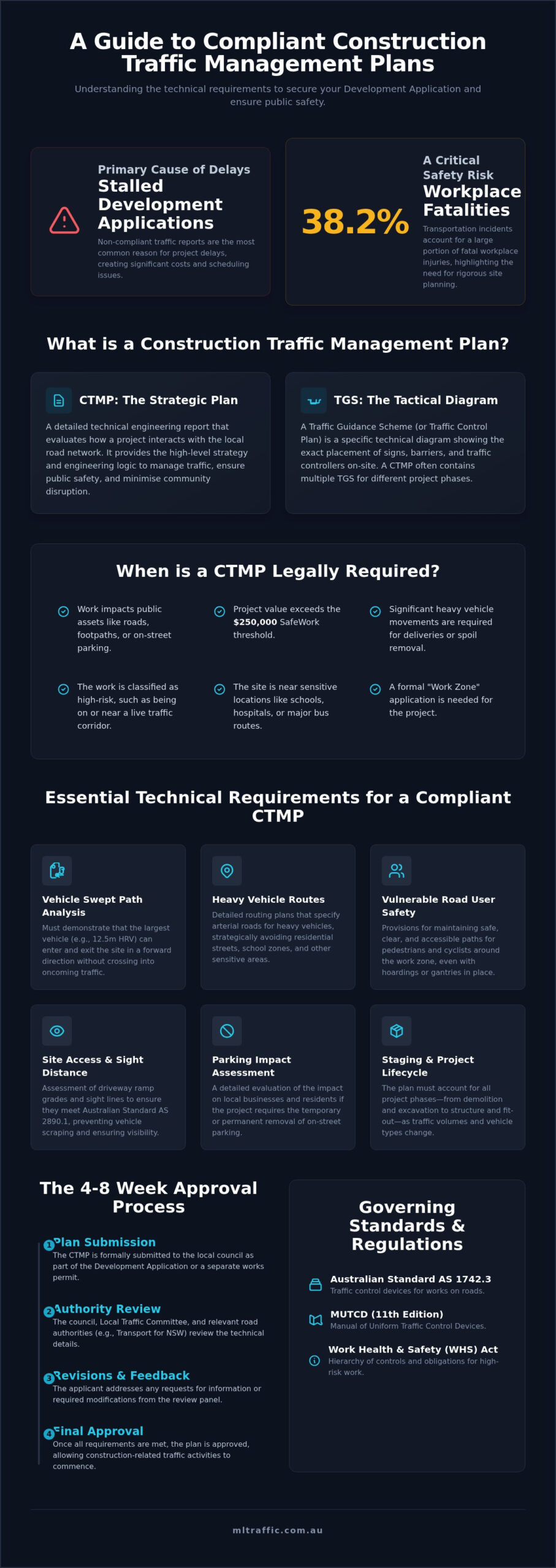
A non-compliant traffic report is the most common reason for stalled Development Applications in 2026. Failing to meet the specific construction traffic management plan requirements set by state authorities and local councils doesn’t just delay your start date; it exposes your project to significant liability and safety risks. With transportation incidents accounting for 38.2% of all fatal workplace injuries, the margin for error in your site planning has never been smaller.
You’re likely facing a complex web of overlapping regulations and high-pressure safety obligations for public road users near your site. We understand that navigating these technicalities is often the most frustrating hurdle in the pre-construction phase. This guide provides a definitive checklist of the regulatory and technical standards required to secure your project approvals without unnecessary back-and-forth with authorities. We will detail the essential components of a compliant plan, including the latest 11th Edition MUTCD standards and Revision 1 technical corrections. You’ll gain a clear understanding of site layout efficiency, vehicle swept path analysis, and the engineering assessments needed to maintain a safe, professional work zone that satisfies every regulatory body.
Key Takeaways
- Understand how a CTMP functions as a technical engineering report to balance site productivity with legal safety obligations for the public.
- Identify the specific construction traffic management plan requirements regarding heavy vehicle routing and traffic volumes necessary to secure council approval.
- Apply the hierarchy of controls and WHS Act obligations to mitigate high-risk traffic hazards and protect road users.
- Navigate the 4-8 week approval timeline by understanding the role of the Local Traffic Committee and road authorities in the review process.
- Utilise data-driven assessments such as Vehicle Swept Path Analysis to reduce the risk of non-compliant reports and project delays.
What is a Construction Traffic Management Plan (CTMP)?
A Construction Traffic Management Plan (CTMP) is a detailed technical report that evaluates how a proposed project will interact with the local road network. It isn’t just a simple safety document. It functions as a strategic framework that identifies potential conflicts between construction activities and existing traffic flows. The primary objective is to maintain Road traffic control that protects both site workers and the general public while keeping the surrounding infrastructure functional.
For most developers, understanding the construction traffic management plan requirements is essential for securing a Development Application (DA). Councils view the CTMP as a formal commitment to minimising community disruption. It details how you’ll manage heavy vehicle movements, site access, and pedestrian safety. It’s important to distinguish this from a Traffic Guidance Scheme (TGS). While a CTMP provides the high-level strategy and engineering logic, a TGS is the specific technical diagram showing the exact placement of signs, bollards, and workers.
When is a CTMP Legally Required?
SafeWork Australia identifies construction projects with a value exceeding $250,000 as a primary threshold for mandatory safety documentation. However, local councils often trigger construction traffic management plan requirements for much smaller projects if they impact public assets. You must provide a CTMP if your work involves road closures, footpath occupations, or significant heavy vehicle movements. Projects near schools, hospitals, or major bus routes face even stricter scrutiny. High-risk construction work, such as work carried out on or near a road or other traffic corridor, legally necessitates these plans to mitigate the risk of collisions and ensure public liability is managed.
The National Framework for Traffic Management
Australian Standards, specifically AS 1742.3, provide the technical foundation for traffic control at worksites. These standards ensure consistency across the country, yet state-based regulators and local councils retain the authority to interpret these rules for their specific jurisdictions. The Principal Contractor holds the legal responsibility for ensuring the CTMP remains a “live” document. It’s not a “set and forget” report. It must be updated as the project progresses through different stages, from excavation and piling to final fit-out. Professional traffic engineering services ensure these documents remain compliant as site conditions and regulatory expectations evolve.
Essential Technical Requirements for a Compliant CTMP
A compliant technical submission must account for every stage of the project life cycle. Councils evaluate construction traffic management plan requirements based on the intensity of movements during demolition, excavation, and structural phases. Each phase dictates different traffic volumes and heavy vehicle types. You must identify specific arterial road routes that avoid residential streets where possible. This technical rigour ensures that project logistics don’t compromise local network stability.
The plan must also address the safety of vulnerable road users. This involves maintaining clear, accessible paths for pedestrians and cyclists, even when footpaths are partially occupied by hoardings or gantries. Effective Transportation Management Plans (TMPs) balance these public access needs with the operational requirements of a busy site. If your project requires the removal of on-street parking, you must provide a detailed assessment of the impact on local businesses and residents. This often necessitates a formal “Work Zone” application to the local authority.
Vehicle Access and Swept Path Analysis
Site entry and exit points are high-risk zones. You must provide a Swept Path Analysis to prove that the largest anticipated vehicle, typically a 12.5m Heavy Rigid Vehicle (HRV), can enter and leave the site in a forward direction. It’s vital to demonstrate that these movements won’t require vehicles to cross into oncoming traffic lanes. We also assess driveway ramp grades to prevent vehicles scraping and ensure sight distance requirements meet Australian Standard AS 2890.1.
Traffic Guidance Schemes (TGS) and Signage
A TGS provides the tactical detail for your broader Traffic Management Plan. It specifies the exact location of every regulatory sign, bollard, and accredited traffic controller. These diagrams are essential for obtaining permits for road or lane closures. Accurate TGS documentation ensures that temporary traffic control signals are synchronised with existing network timings to prevent gridlock during peak hours.
Construction Waste and Logistics Management
Congestion often stems from poor logistics. Your plan must schedule deliveries outside of AM and PM peak periods to satisfy council conditions. Managing the removal of excavated material requires a coordinated approach to prevent trucks from queuing on public roads. This coordination involves multiple contractors and a strict booking system for loading zones. If you’re struggling to meet these technicalities, our team can provide a detailed Traffic Impact Assessment to streamline your approval process and keep your project on schedule.
Managing High-Risk Construction Work and Public Safety
The intersection of private worksites and public thoroughfares represents the highest risk profile for any Australian construction project. Developers must satisfy construction traffic management plan requirements by applying a rigorous hierarchy of controls to mitigate potential collisions. Under the Work Health and Safety (WHS) Act, the Principal Contractor holds a non-delegable duty of care to ensure the safety of both workers and the general public. This obligation requires a proactive risk assessment that accounts for fluctuating road usage, particularly during peak commuter times and within high-activity school zones where 40km/h limits and increased pedestrian volumes are standard.
Effective risk management follows a structured hierarchy to ensure maximum protection:
- Elimination: Redesigning site access to remove vehicle-pedestrian conflict points entirely.
- Substitution: Using smaller, more manoeuvrable plant in restricted urban areas to reduce the footprint of the work zone.
- Engineering: Installing physical water-filled barriers, crash cushions, or overhead gantries to provide a structural shield.
- Administrative: Implementing strict delivery windows and speed restrictions for site vehicles through formal site inductions.
Physical Separation of Plant and Pedestrians
Physical barriers remain the most effective method for managing the plant-pedestrian interface. Solid hoardings and overhead gantries protect the public from falling debris and unauthorised site entry. Within the site, you must establish clear exclusion zones for heavy machinery and mobile plant. Blind-spot management is a critical requirement. Reversing protocols must involve accredited spotters to prevent accidents in tight urban environments where visibility is often compromised by hoardings or site equipment. It’s essential that these zones are clearly marked and communicated to all personnel during daily pre-start meetings.
Impacts on Public Road Users
Public safety extends well beyond the site boundary. Your plan must prioritise vulnerable road users, including cyclists and individuals with mobility impairments. If a footpath is closed, the temporary detour must be intuitive and feature high-visibility directional signage that complies with local council standards. Accessibility must be maintained for wheelchairs and prams at all times. Noise and dust aren’t just environmental nuisances; they directly impact driver visibility and situational awareness. Effective dust suppression and noise mitigation are essential to maintain a safe environment for passing motorists. If you need assistance with these technical safety assessments, our traffic engineering services provide the data-driven insights required for complex site interfaces.
The Approval Process: Councils, Road Authorities, and Revisions
Securing approval for your site is a multi-layered process that requires significant lead time. You should expect a standard review period of 4 to 8 weeks depending on the complexity of your submission. Most local jurisdictions require the CTMP to be endorsed by a Local Traffic Committee (LTC) before any works commence. The LTC is a technical advisory body comprising representatives from the council, state police, and local government members. They evaluate how your project impacts the broader road network, public transport infrastructure, and local community safety.
It’s a mistake to assume a signed CTMP functions as a blanket permit to occupy the road. You will likely need separate approvals for standing plant, such as mobile cranes or concrete pumps, and specific permits for any temporary work zones. The construction traffic management plan requirements also dictate that the document remains “live”. If your construction methodology changes or site conditions shift during the project, you must submit a revised plan for formal approval to maintain legal compliance.
Inter-Agency Coordination
Complex sites often trigger requirements from multiple agencies simultaneously. If your site borders an arterial road, you must secure a Road Occupancy Licence (ROL) from the relevant state road authority in addition to council approval. This is a separate legal requirement that focuses on maintaining the capacity of the state’s most critical transport corridors. Projects located near rail corridors or major bus interchanges require even more technical coordination. You must demonstrate that your heavy vehicle movements won’t disrupt high-frequency public transport services or compromise rail safety exclusion zones.
Common Pitfalls in CTMP Submissions
RFIs (Requests for Information) are the primary cause of project delays and can be avoided with professional technical rigour. Common errors include:
- Inaccurate Swept Path Analysis: Providing generic vehicle diagrams instead of site-specific turning templates for your largest expected vehicle leads to immediate rejection by council engineers.
- Ignoring Cumulative Impacts: Your plan must account for neighbouring construction projects. Councils will not approve a plan that causes local gridlock due to multiple sites operating on the same street simultaneously.
- Stakeholder Neglect: Consultation with emergency services, local schools, and bus operators is mandatory for projects with significant impacts. Failure to include their feedback in your initial submission will stall the LTC review phase.
If your project involves complex inter-agency coordination or high-impact road usage, contact our senior principals for expert traffic engineering support to secure your permits and avoid costly commencement delays.
Why Professional Traffic Engineering is Critical for CTMP Success
Relying on generic safety checklists is a recurring mistake that leads to immediate council rejection and project delays. Professional Traffic Engineering expertise ensures your submission is a rigorous, data-driven technical report rather than a simple administrative filing. Councils and road authorities scrutinise these documents for engineering logic, looking for specific evidence that your site layout is operationally efficient. They need to know that your proposed traffic volumes won’t cripple local network stability during peak hours. Having an accredited expert sign off on your technical diagrams provides the authoritative assurance required by the Local Traffic Committee. This professional oversight minimises the risk of Request for Information (RFI) cycles that can stall a project for months.
Integrating the TIA and CTMP
You gain a significant strategic advantage by leveraging data from your initial Traffic Impact Assessment (TIA) during the construction planning phase. This integration ensures total consistency between your permanent development design and your temporary construction measures. A holistic approach prevents the need for major redesigns between the DA and Construction Certificate (CC) phases. It saves valuable time by addressing long-term traffic impacts and short-term logistics simultaneously. This ensures that construction traffic management plan requirements are met without conflicting with the final site use or permanent access points. Consistency across these reports simplifies the review process for planning officers and reduces the likelihood of contradictory conditions of consent.
The ML Traffic Engineers Australia Advantage
ML Traffic Engineers Australia provides a “no-gatekeepers” approach that distinguishes our consultancy from larger, more impersonal firms. You gain direct access to senior traffic engineers who possess over 15 years of specialised knowledge in Australian Standards, including AS 2890.1 and AS 2890.2. We don’t just provide a report; we offer a personnel continuity promise. The senior expert who initiates your project is the same one who performs the technical engineering work. This hands-on accountability ensures that complex site constraints are understood from day one. Our proven track record in delivering compliant reports for complex civil projects ensures your site layout is safe, efficient, and tailored to satisfy every regulatory body.
To ensure your project meets all Construction Traffic Management Plan requirements, get in touch with our senior principals today. We manage the technical and bureaucratic complexities of traffic planning so you can begin work without the burden of unnecessary administrative delays.
Securing Your Project Commencement in 2026
Meeting construction traffic management plan requirements is a technical necessity that goes beyond simple safety checklists. By integrating detailed engineering assessments with the regulatory timelines of local councils and state road authorities, you eliminate the common bottlenecks that stall project commencement. As discussed, the transition from the DA to the construction phase requires a “live” document that adapts to site-specific challenges while maintaining rigorous national standards. This technical rigour ensures that your site remains safe for the public and operationally efficient for your contractors.
ML Traffic Engineers Australia offers 15+ years of specialist experience, ensuring that every submission is technically sound and defensible before the Local Traffic Committee. Our senior-led delivery model means you’ll receive national compliance expertise directly from the experts performing the technical work. This personnel continuity reduces the risk of costly RFIs and ensures your site layout satisfies all regulatory bodies. Request a Technical Consultation for Your CTMP to ensure your project begins on schedule in 2026. We provide the technical certainty needed to navigate complex civil environments and secure your approvals with confidence.
Frequently Asked Questions
Is a Construction Traffic Management Plan mandatory for all developments?
A Construction Traffic Management Plan is not mandatory for every minor development, but it’s a standard requirement for projects with a value exceeding $250,000 as per SafeWork Australia guidelines. Councils also mandate these plans if the work impacts public assets, involves road closures, or requires heavy vehicle access. You should check your specific Development Consent conditions to determine if a plan is required for your site.
What is the difference between a TMP and a TGS?
The primary difference lies in the level of detail and strategic purpose. A TMP is a comprehensive report that outlines the broad strategy for managing traffic impacts and safety. In contrast, a Traffic Guidance Scheme (TGS) is a specific technical diagram illustrating the exact placement of signs, barriers, and traffic controllers. Both are essential to satisfy construction traffic management plan requirements during the approval process.
Who is responsible for preparing the CTMP?
The developer or Principal Contractor holds the legal responsibility for ensuring a compliant plan is in place. While the contractor manages the site, they typically engage a specialist traffic engineer to perform the technical assessments. This ensures the document meets Australian Standards and council expectations. Engaging an expert early reduces the risk of rejection and ensures that the plan remains operationally viable for the duration of the project.
Can I change the CTMP once construction has started?
Yes, you can and often must update the document as site conditions evolve. It’s a live document that should reflect the current stage of construction, such as moving from excavation to structural fit-out. However, significant changes to vehicle routes or road occupancy require formal resubmission and approval from the local council. Operating with an outdated or inaccurate plan can lead to safety breaches and potential fines.
How long does it take for a council to approve a CTMP?
Approval timelines typically range from 4 to 8 weeks. This duration accounts for the technical review by council engineers and the formal endorsement by the Local Traffic Committee, which often meets on a monthly cycle. If your project impacts arterial roads, additional time is required for state road authority approval. Providing a high-quality, data-driven submission on the first attempt is the most effective way to avoid lengthy delays.
What qualifications does a person need to prepare a CTMP?
A qualified professional with a current Traffic Management Designer certification or a degree in civil engineering should prepare the document. Local councils often require the plan to be signed off by an accredited expert to ensure it adheres to Australian Standard AS 1742.3. Using an unqualified individual increases the likelihood of technical errors, such as incorrect signage placement or inadequate safety buffers, which will lead to immediate rejection.
Do I need a Swept Path Analysis as part of my CTMP?
A Vehicle Swept Path Analysis is almost always required if your project involves heavy vehicle movements. This technical assessment proves that the largest expected vehicle can safely enter and exit the site in a forward direction without crossing into oncoming traffic. It’s a critical component of construction traffic management plan requirements because it provides the physical proof of manoeuvrability that council engineers demand before granting site access permits.
What happens if I operate without a compliant CTMP?
Operating without a compliant plan exposes you to severe legal and financial consequences. Authorities can issue immediate stop-work orders, and you may face substantial fines for breaching WHS regulations or council conditions. Most importantly, it creates a significant public liability risk. If an accident occurs near your site and you lack a certified traffic plan, your insurance coverage may be compromised, leaving the developer and contractor personally liable.

Disclaimer
The content on www.mltraffic.com.au, including all technical articles, guides, and resources, is provided for general informational and educational purposes only. It is not intended to constitute professional advice in traffic engineering, transportation planning, development approvals, or any other technical or legal field.
While ML Traffic Engineers makes every reasonable effort to ensure the accuracy, completeness, and timeliness of the information published, we do not provide any warranties or representations (express or implied) regarding its reliability, suitability, or availability for any particular purpose. Any reliance you place on the content is strictly at your own risk.
In no event shall ML Traffic Engineers, its directors, employees, authors, or affiliates be liable for any direct, indirect, incidental, special, consequential, or punitive damages (including, without limitation, loss of profits, data, or business opportunities) arising out of or in connection with the use of, or inability to use, any information provided on this website.
The articles and guides on this site are not a substitute for engaging a qualified, registered professional traffic engineer (such as an NPER or RPEQ engineer) to assess your specific project requirements. For tailored advice, compliance assessments, or traffic engineering services, please contact a competent professional.
This disclaimer may be updated from time to time without notice. By accessing or using this website, you agree to be bound by the most current version of this disclaimer.
