

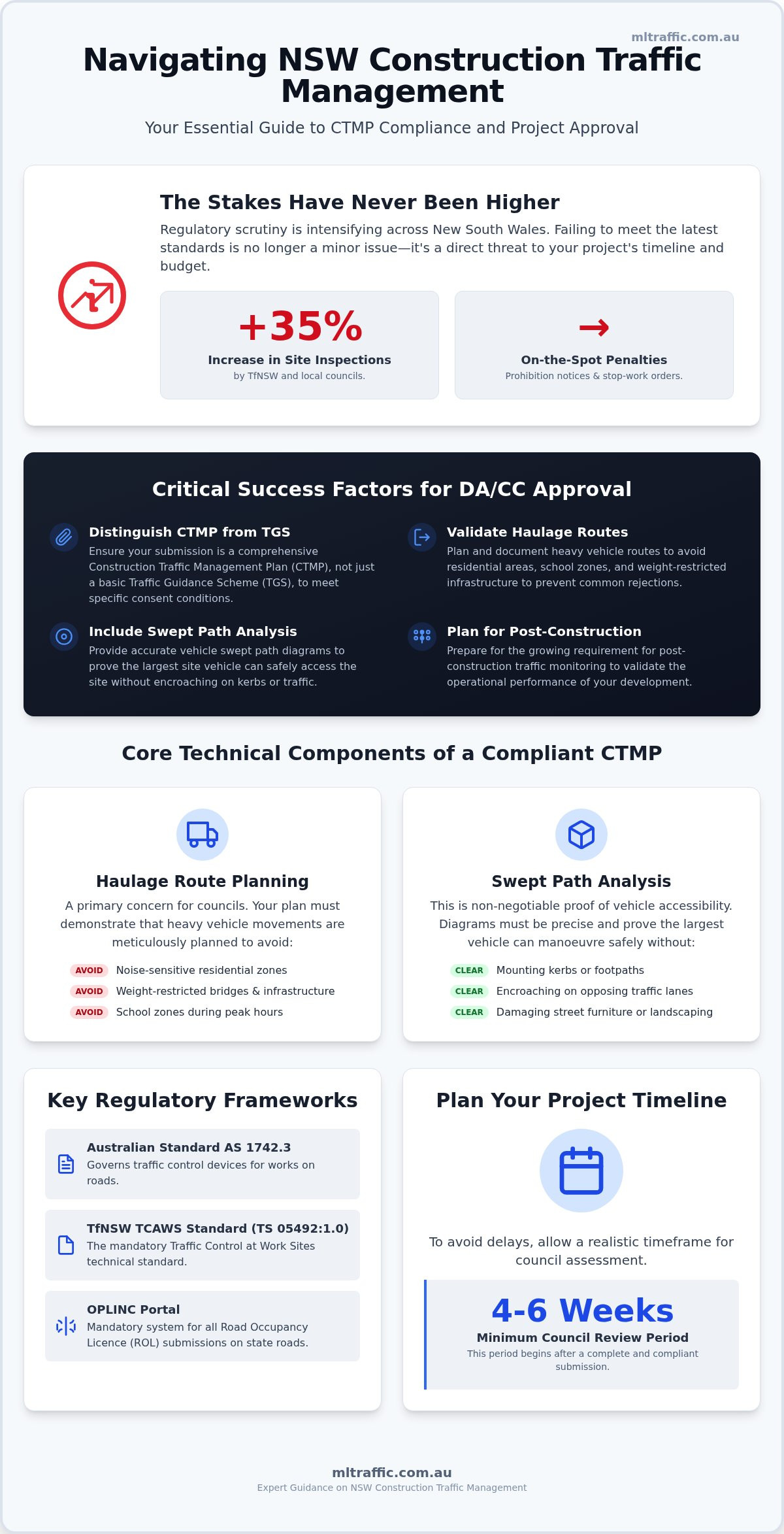
With TfNSW and local councils increasing site inspections by 35 per cent this year, the margin for error in your site planning has effectively vanished. SafeWork NSW inspectors are now issuing on-the-spot prohibition notices for setups that fail to meet the latest standards. Meeting the specific construction traffic management plan requirements nsw is no longer just a box-ticking exercise for your Development Application; it’s a critical strategy to prevent costly stop-work orders and project delays.
We understand the frustration of navigating the technical shift to Technical Standard TS 05492:1.0 and the confusion that often arises between a Traffic Guidance Scheme and a comprehensive Traffic Management Plan. This 2026 guide provides the technical clarity you need to secure DA and CC approvals without the friction of repeated council RFI cycles. You’ll gain a professional breakdown of mandatory OPLINC portal submissions, the latest Road Occupancy Licence protocols, and the emerging requirements for post-construction monitoring to ensure full compliance with the most recent regulatory frameworks.
Key Takeaways
- Distinguish between a comprehensive Construction Traffic Management Plan (CTMP) and a Traffic Guidance Scheme (TGS) to ensure your DA or CC submission meets specific council consent conditions.
- Identify the mandatory construction traffic management plan requirements nsw regarding haulage route planning and vehicle swept path analysis to prevent common application rejections.
- Prepare for the increasing requirement for post-construction traffic monitoring to validate intersection performance and parking demand once your development becomes operational.
- Optimise your project timeline by allowing a minimum of 4-6 weeks for the council review process, ensuring haulage routes avoid sensitive residential areas and weight-restricted infrastructure.
- Leverage senior engineering expertise to ensure full compliance with AS 2890 standards and TfNSW regulatory frameworks, reducing the risk of costly stop-work orders.
What is a Construction Traffic Management Plan (CTMP) in NSW?
A Construction Traffic Management Plan (CTMP) is a technical document that outlines the specific methodologies for managing vehicle and pedestrian movements around a development site. In New South Wales, this document is a standard requirement for most medium to large-scale projects. It typically appears as a mandatory condition of consent within a Development Application (DA) or a Construction Certificate (CC). The primary objective is to maintain high levels of public safety while reducing the operational impact on the existing road network and local residents.
Legally, a CTMP serves as a formal risk-mitigation strategy required under the NSW Environmental Planning and Assessment Act to address temporary changes to the urban environment. Effective Road traffic control principles must be applied to ensure that construction activities don’t compromise the efficiency of the surrounding transport infrastructure. Failing to meet the specific construction traffic management plan requirements nsw can lead to immediate stop-work orders or significant fines from regulatory bodies.
To better understand the core components of these plans, watch this overview of construction site traffic management:
When is a CTMP Legally Required?
Several triggers make a CTMP a legal necessity for developers. If your project involves work zones on public roads, heavy vehicle haulage routes, or requires significant pedestrian diversions, a plan is mandatory. Projects impacting state-managed or arterial roads fall under the jurisdiction of Transport for NSW (TfNSW) and require even more stringent documentation. Identifying the specific construction traffic management plan requirements nsw early in the design phase prevents costly revisions during the CC stage. Often, the initial Traffic Impact Assessment (TIA) performed during the planning phase will dictate the necessary scope and complexity of the subsequent CTMP.
Regulatory Bodies and Standards
Compliance isn’t optional. All plans must adhere to Australian Standard AS 1742.3 (Traffic control for works on roads) and the recently updated TfNSW Technical Standard TS 05492:1.0 (TCAWS). Local councils also maintain their own Development Control Plans (DCPs) which may include specific variations or additional requirements unique to their local government area.
Key regulatory frameworks include:
- Australian Standard AS 1742.3:2019 for traffic control devices.
- TfNSW Traffic Control at Work Sites (TCAWS) Technical Standard (June 2026 update).
- The NSW Planning Portal for all DA-related lodgements.
- The OPLINC system for mandatory Road Occupancy Licences (ROL) on state roads.
Core Technical Components of a Compliant NSW CTMP
A compliant submission must address several technical layers to satisfy local council and TfNSW assessors. Haulage route planning is a primary concern. You must demonstrate that heavy vehicle movements avoid noise-sensitive residential zones and weight-restricted bridges. Councils frequently reject plans that don’t account for local infrastructure limitations or school zones during peak hours. As of July 2026, all temporary speed limits within these zones must align with the Technical Standard TS 05492:1.0.
Accurate Swept Path Analysis is equally critical. These diagrams prove that the largest anticipated construction vehicle can safely enter and exit the site without mounting kerbs or encroaching on opposing traffic lanes. Using specialised software like AutoTURN ensures these simulations meet the rigorous construction traffic management plan requirements nsw. These simulations must reflect real-world conditions, including parked cars and existing street furniture, to be considered valid by council engineers.
TGS vs TMP: Understanding the Difference
The distinction between a Traffic Management Plan (TMP) and a Traffic Guidance Scheme (TGS) is a common point of confusion. A TMP is a high-level strategic document. It outlines the broad approach to safety, risk assessment, and stakeholder consultation. In contrast, a TGS is a tactical, site-specific diagram. It illustrates the exact placement of every sign, cone, and barrier required for a specific work phase. NSW councils typically require both for complex city-centre developments to ensure comprehensive oversight. Engaging a specialist in Traffic Engineering is the most reliable way to certify these documents for approval.
Vehicle Access and Loading Zone Requirements
Temporary work zones and loading bays must comply with AS 2890.2 standards for commercial vehicle facilities. This includes ensuring adequate sight distances and driveway gradients that prevent vehicle scraping. Your plan must also provide clear provisions for emergency vehicle access and regular waste collection services throughout the construction lifecycle. In high-density urban centres, you must integrate specific protections for pedestrians and cyclists. This might include overhead gantries, water-filled barriers, or managed crossing points to separate vulnerable road users from heavy machinery.
If your project involves complex constraints, you can speak directly with our senior engineers to ensure your technical diagrams meet all regulatory benchmarks.
The Rising Importance of Post-Construction Traffic Monitoring
Current regulatory trends in New South Wales have shifted focus beyond the initial build phase. Many NSW councils now mandate a post-construction traffic monitoring plan as a standard condition of consent. This requirement serves to validate the data and assumptions presented in the original Traffic Impact Assessment (TIA). The objective is to ensure that permanent traffic arrangements do not cause unforeseen congestion or safety issues on the local road network. These monitoring plans often involve structured 6-month and 12-month post-completion reviews to assess the development’s real-world operational impact.
This oversight is a significant addition to the construction traffic management plan requirements nsw. It moves the responsibility of the developer from simple site management to long-term network integrity. If a development fails to meet the performance benchmarks established during the planning phase, councils may require further remedial action. This lifecycle approach ensures that the urban environment remains functional as new high-density projects come online.
What is Included in a Post-Construction Monitoring Plan?
A comprehensive monitoring plan is data-driven and focuses on specific performance metrics. It typically includes the following technical assessments:
- Traffic count surveys: Detailed data collection at key site access points and adjacent intersections to compare actual volumes against TIA forecasts.
- Parking occupancy audits: Field observations to verify that the car park design effectively manages real-world demand without causing overspill into local streets.
- Queue length analysis: Measurements of vehicle queuing during morning and afternoon peak periods to ensure intersection capacity remains within acceptable limits.
- Pedestrian safety reviews: Observations of foot traffic patterns to identify any new conflict points created by the operational development.
Managing Compliance Failures Post-Build
It’s possible for a development to exceed its predicted traffic impact once fully occupied. If monitoring data reveals significant deviations from the approved plans, the developer must implement mitigation strategies. Common solutions include signal timing adjustments at nearby intersections or minor civil works to improve lane configurations. In these scenarios, the role of a senior traffic engineer is vital. We use actual field data to negotiate with council, ensuring that any required modifications are technically necessary and cost-effective. Professional representation ensures that compliance issues are resolved without unnecessary bureaucratic friction or excessive infrastructure costs.
Navigating the NSW Council Approval Process
Securing approval for your site logistics is a technical negotiation that requires precise timing. You should lodge your documentation through the NSW Planning Portal at least 4 to 6 weeks before your intended start date. While local council approval for traffic control plans typically takes 7 to 15 business days, the broader assessment of construction traffic management plan requirements nsw often involves multiple rounds of clarification. Early lodgement provides a necessary buffer for these technical revisions without delaying your construction schedule.
Council engineers frequently reject submissions due to technical oversights in vehicle movement simulations. Inadequate swept path analysis or haulage routes that conflict with local school zones are primary reasons for application failure. Your plan must account for real-world constraints like existing street furniture and narrow residential corridors. If your submission lacks professional certification from a qualified traffic engineer, it’s unlikely to pass the initial assessment phase. Providing senior-level oversight on these documents ensures that all technical diagrams meet the rigorous standards expected by metropolitan and regional councils alike.
Community engagement is another critical hurdle. During the public exhibition phase, resident objections regarding noise and parking loss can stall your project. A well-engineered plan addresses these concerns proactively by detailing specific noise-mitigation strategies and maintaining essential access for neighbours. Clear, data-backed responses to community feedback often prevent minor objections from escalating into significant project delays.
Dealing with TfNSW for State Roads
If your project impacts a state or arterial road, you must secure a Road Occupancy Licence (ROL) from Transport for NSW. This application is separate from your council CTMP and must be submitted via the Online Planned Incident System (OPLINC). TfNSW typically processes complete ROL applications within 10 business days. Coordination between local council and the Transport Management Centre (TMC) is vital for major city-centre developments. Failure to synchronise these approvals can result in conflicting work conditions that make site access legally impossible.
Avoiding Stop-Work Orders and Penalties
The cost of non-compliance has increased significantly in 2026. TfNSW and local councils have increased site inspections by 35 per cent compared to previous years. SafeWork NSW inspectors are now authorised to issue on-the-spot prohibition notices for non-compliant traffic setups. To protect your project from these penalties, you must maintain a compliant traffic control diary and detailed site records. Regular site audits ensure that the physical barriers and signage on-site match the approved Traffic Guidance Scheme exactly. This meticulous approach reduces legal liability and keeps your project moving.
To ensure your submission is right the first time, you can review our full range of traffic engineering services to see how we manage council negotiations.
Why Professional Traffic Engineering is Critical for NSW Projects
Adhering to the specific construction traffic management plan requirements nsw is a high-stakes technical exercise that leaves no room for junior-level oversight. ML Traffic Engineers Australia provides over 15 years of consultancy experience specifically within the NSW regulatory framework. We operate with a strict “no-gatekeepers” policy; the senior principal who performs your initial project assessment is the same expert who completes the technical work. This ensures that the intricate details discussed during your briefing aren’t lost in translation through a hierarchy of junior staff, which is a common failure point in larger, more impersonal firms.
Our methodology prioritises technical accuracy to prevent the expensive design rework that often plagues large-scale developments. By providing direct access to senior leadership, ML Traffic Engineers Australia maintains a high level of accountability for every TIA, swept path simulation, and Traffic Management Plan we produce. This senior-led approach is particularly valuable when negotiating with council engineers who require immediate, data-backed justifications for proposed site access arrangements. We don’t just provide reports; we provide defensible engineering solutions that stand up to rigorous regulatory scrutiny.
Tailored Solutions for Complex Sites
Constrained urban sites present unique challenges, particularly regarding basement access and tight loading docks where every millimetre counts. ML Traffic Engineers Australia specialises in designing solutions for these high-pressure environments, ensuring that every vehicle turn and driveway gradient is technically viable. Our team also integrates Waste Management Plans directly with your traffic logistics. This ensures that refuse collection vehicles can safely access the site without compromising the approved traffic flow or pedestrian safety zones. We have a proven track record of achieving approvals for diverse land-use categories, including subdivisions, childcare centres, and high-density mixed-use developments.
Partnering with ML Traffic Engineers Australia for Your Next DA
Our reporting is designed specifically for quick council turnarounds. We focus on meticulous adherence to AS 2890.1 and AS 2890.2 compliance to avoid the cost of design rework. By identifying potential access issues during the initial planning stage, we protect your project from expensive modifications later in the construction phase. We understand the technical nuances of the NSW Planning Portal and the OPLINC system, ensuring your submission meets all construction traffic management plan requirements nsw from the outset. Contact our senior principals today for a confidential project review and direct access to expert traffic engineering advice.
Securing Your Construction Timeline through Technical Compliance
Successful project delivery in the current NSW landscape requires a transition from basic site management to comprehensive network oversight. As detailed throughout this guide, the 2026 regulatory environment demands technical precision in everything from initial swept path simulations to the post-construction monitoring now favoured by many metropolitan councils. Meeting the specific construction traffic management plan requirements nsw is no longer just a hurdle for DA approval; it’s a critical strategy to protect your project from increased site inspections and the threat of on-the-spot prohibition notices.
ML Traffic Engineers Australia provides the seasoned expertise necessary to navigate these technical complexities with direct access to senior principals. Our approach ensures that every TIA and TGS is certified by the same expert who performs the technical assessment, providing a level of accountability that larger firms often lack. With over 15 years of experience in NSW planning approvals and comprehensive national service coverage, we ensure your project remains compliant from lodgement to operational sign-off.
Speak directly with a Senior Traffic Engineer at ML Traffic Engineers Australia today for a confidential review of your project. We look forward to securing your path to construction.
Frequently Asked Questions
Is a Traffic Management Plan the same as a Traffic Control Plan in NSW?
No, these are distinct documents with different purposes. A Traffic Management Plan (TMP) is a high-level strategic document outlining the broad safety and risk-mitigation framework. A Traffic Control Plan, now formally known as a Traffic Guidance Scheme (TGS), is the tactical diagram showing the exact placement of every sign and barrier. Most construction traffic management plan requirements nsw mandate both for complex developments.
How long does it take for a council to approve a CTMP?
Approval timelines depend on the complexity of the project and the specific council. Local council approval for specific traffic control plans typically takes 7 to 15 business days. However, the broader CTMP assessment for a Development Application should be lodged at least 4 to 6 weeks before work commences to allow for technical reviews and potential RFI cycles.
Do I need a traffic engineer to prepare my construction management plan?
Professional preparation is essential for securing project approval. Transport for NSW and local councils require plans to be prepared by a suitably qualified professional holding a current Work Zone Traffic Management qualification (PWZ) from a SafeWork NSW-approved provider. Self-prepared plans are frequently rejected due to a lack of technical certification and non-compliance with AS 1742.3:2019.
What is the penalty for working without a compliant CTMP in Sydney?
Working without a compliant plan carries severe legal and financial consequences. SafeWork NSW inspectors can issue on-the-spot prohibition notices that halt all site activity immediately. In 2026, enforcement has increased with 35 per cent more site inspections compared to 2024, and non-compliance can lead to significant fines and increased legal liability for the developer and site supervisor.
Can I prepare my own swept path analysis for a DA submission?
While a developer can attempt a swept path analysis, councils almost exclusively require simulations generated by specialised software like AutoTURN. These must be certified by a traffic engineer to prove that the largest anticipated heavy vehicles can safely enter and exit the site without mounting kerbs or encroaching on opposing traffic lanes. Precise simulations are a core component of construction traffic management plan requirements nsw.
What is a post-construction traffic monitoring plan and when is it triggered?
This is a lifecycle document required to validate initial Traffic Impact Assessment assumptions once a project is operational. It is typically triggered as a condition of consent for high-density or complex developments. Monitoring involves structured 6-month and 12-month reviews of intersection performance and parking demand to ensure the permanent development doesn’t cause unforeseen congestion on the local network.
How much does a professional construction traffic management plan cost?
The total cost depends on the project’s complexity and the specific requirements of the local government area. Factors influencing the investment include the number of construction stages, the requirement for detailed swept path analysis, and the inclusion of post-construction monitoring plans. Developers must also budget for local council lodgement and assessment fees, which can range from $150 to over $1,500.
What happens if my construction haulage route is rejected by council?
If a route is rejected, you must identify an alternative path that avoids restricted infrastructure or sensitive zones. Rejections usually occur when haulage routes impact residential streets, school zones during peak hours, or weight-restricted bridges. A traffic engineer can negotiate with the council by providing data-backed alternatives that maintain project efficiency while satisfying all safety and environmental constraints.

Disclaimer
The content on www.mltraffic.com.au, including all technical articles, guides, and resources, is provided for general informational and educational purposes only. It is not intended to constitute professional advice in traffic engineering, transportation planning, development approvals, or any other technical or legal field.
While ML Traffic Engineers makes every reasonable effort to ensure the accuracy, completeness, and timeliness of the information published, we do not provide any warranties or representations (express or implied) regarding its reliability, suitability, or availability for any particular purpose. Any reliance you place on the content is strictly at your own risk.
In no event shall ML Traffic Engineers, its directors, employees, authors, or affiliates be liable for any direct, indirect, incidental, special, consequential, or punitive damages (including, without limitation, loss of profits, data, or business opportunities) arising out of or in connection with the use of, or inability to use, any information provided on this website.
The articles and guides on this site are not a substitute for engaging a qualified, registered professional traffic engineer (such as an NPER or RPEQ engineer) to assess your specific project requirements. For tailored advice, compliance assessments, or traffic engineering services, please contact a competent professional.
This disclaimer may be updated from time to time without notice. By accessing or using this website, you agree to be bound by the most current version of this disclaimer.
