

A single non-compliant turn on a haulage route can trigger a stop-work order that costs your project tens of thousands of dollars in a single afternoon. You already know that navigating Council bureaucracy is the most significant hurdle to breaking ground on time. The complexity of construction vehicle route planning and approval has only increased with the introduction of the July 2026 HVNL Master Code and stricter local government oversight. It’s no longer enough to simply map a path; you must prove it works through rigorous technical data and engineering precision.
This guide provides a professional roadmap to secure your heavy vehicle permits without the typical back-and-forth with authorities. We’ll detail the exact steps required to align your project with AS 2890.2 and NHVR standards while ensuring your site remains operational. You’ll learn how to use vehicle swept path analysis to address Council concerns about truck manoeuvrability and how to integrate these assessments into a comprehensive Traffic Impact Assessment. This article delivers the technical strategy needed to minimise project delays and maintain full regulatory compliance.
Key Takeaways
- Understand why 2026 regulatory updates categorise road-side construction as high-risk work and how this affects your safety and logistics obligations.
- Master the technical requirements for construction vehicle route planning and approval by selecting the correct design vehicles based on AS 2890.2 standards.
- Utilise Vehicle Swept Path Analysis to provide Council with definitive proof of truck manoeuvrability on tight sites and complex intersections.
- Determine the optimal haulage path by evaluating the trade-offs between arterial road efficiency and the regulatory complexity of local street access.
- Follow a precise step-by-step process to prepare your Traffic Guidance Scheme and site-specific assessments for faster permit turnaround.
The Fundamentals of Construction Vehicle Route Planning
Effective construction vehicle route planning and approval is a technical requirement for any development involving heavy plant or high-frequency haulage. Under the 2026 regulatory framework, road-side construction is categorised as high-risk work. This classification demands a data-driven approach to logistics rather than simple guesswork. The process involves solving a complex Vehicle Routing Problem (VRP), where engineers must balance site accessibility with public safety and infrastructure protection. A robust route plan ensures that heavy vehicles enter and exit the site without compromising the structural integrity of local roads or the safety of other road users.
The Traffic Management Plan (TMP) serves as the core document within the project lifecycle. It integrates the approved haulage route with on-site operations to ensure seamless delivery schedules. Without a formalised TMP, project managers often face conflicting timelines between material deliveries and plant movements. ML Traffic Engineers Australia provides specialised traffic services to ensure these plans meet the rigorous standards of both local Councils and State road authorities.
Triggers for Formal Route Approval
Local government authorities and the National Heavy Vehicle Regulator (NHVR) mandate formal submissions when specific operational thresholds are met. You must seek approval if your project involves any of the following:
- Heavy vehicle movements that exceed the designed capacity of the local road network.
- The use of “Over-Size Over-Mass” (OSOM) vehicles or specialised plant requiring specific lane widths or bridge load ratings.
- Requirements for a dedicated Works Zone or any activity involving road occupation that alters standard traffic flow.
- Developments located within high-density urban centres or near sensitive infrastructure like schools and hospitals.
The Consequences of Non-Compliance
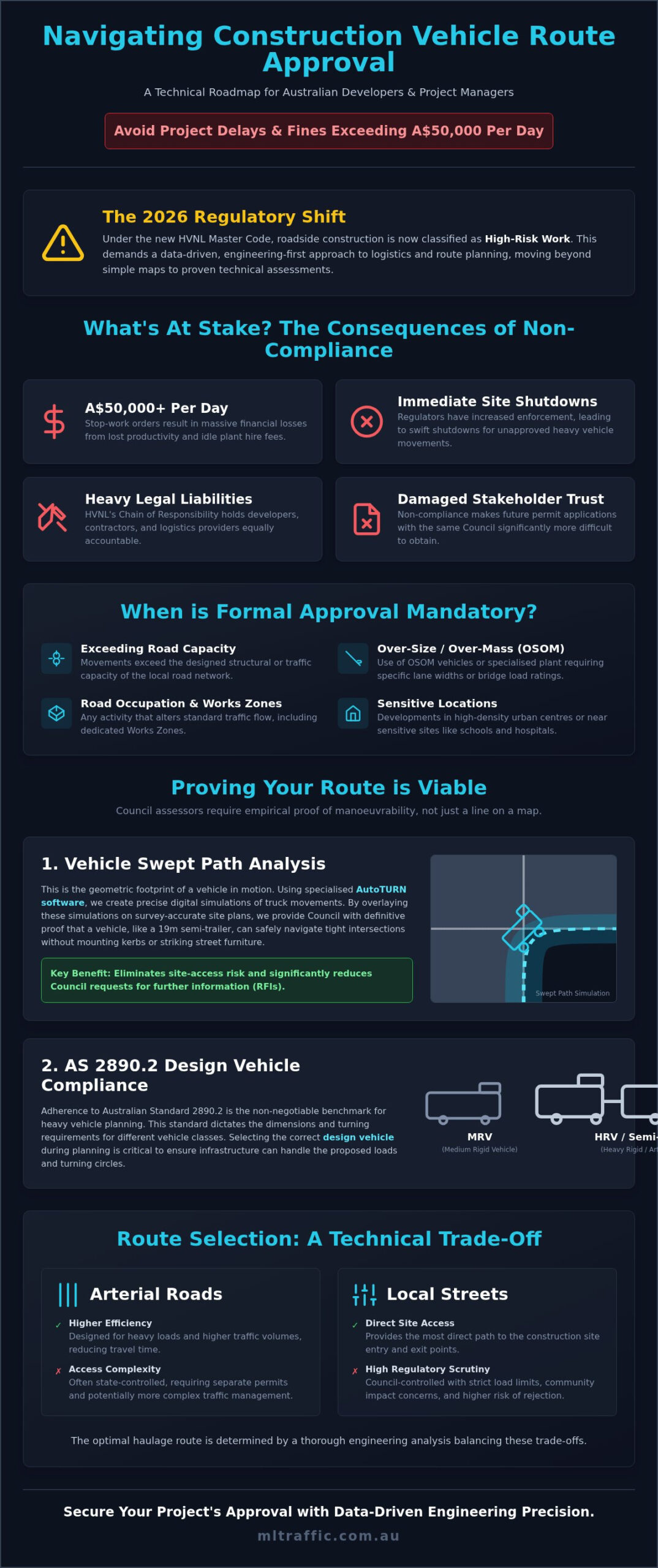
Failure to secure proper construction vehicle route planning and approval leads to immediate site shutdowns. In 2026, regulatory bodies have increased enforcement activity. Stop-work orders frequently cost developers upwards of A$50,000 per day in lost productivity and plant hire fees. Beyond financial penalties, non-compliance carries heavy legal liabilities under the Heavy Vehicle National Law (HVNL). This includes Chain of Responsibility provisions that hold developers, contractors, and logistics providers equally accountable for safety breaches. Unapproved routes also damage stakeholder trust. This makes future permit applications with the same Council significantly more difficult to obtain.
Technical Components: Proving Your Route is Viable
Council assessors require more than a line on a map; they demand empirical proof of manoeuvrability before granting any permits. This is where construction vehicle route planning and approval shifts from a logistical concept to a rigorous engineering reality. You must account for physical constraints like overhead clearances, axle load limits, and proximity to sensitive land uses such as hospitals or active school zones. Proving viability requires a data-backed approach that addresses every potential bottleneck on the haulage path. It’s about demonstrating that your heavy vehicle movements won’t compromise public assets or safety.
Vehicle Swept Path Analysis and AutoTURN
We use specialised AutoTURN software to provide precise evidence of vehicle movements. This tool simulates real-world truck dynamics to prove that a 19m semi-trailer can navigate a local intersection without mounting kerbs or striking essential street furniture. Swept Path Analysis is the geometric footprint of a vehicle in motion. By overlaying these digital simulations onto survey-accurate site plans, we eliminate the risk of site-access failure. This technical rigour is essential when proposing routes through narrow urban corridors where margins for error are often measured in millimetres. Providing these simulations as part of your application reduces the likelihood of Council requests for further information (RFIs).
AS 2890.2 Compliance for Heavy Vehicles
Adherence to AS 2890.2 is the benchmark for all heavy vehicle planning in Australia. This standard dictates the dimensions and turning requirements for various vehicle classes. You must distinguish between a Medium Rigid Vehicle (MRV) and a Heavy Rigid Vehicle (HRV) during the design phase to ensure the infrastructure can handle the load. Failure to account for these specific dimensions often results in vehicles being unable to enter the site without performing dangerous multi-point turns on public roads.
- MRV dimensions typically require a 6.5m inner turning radius for standard operations.
- HRV dimensions demand more substantial clearances for both entry and exit manoeuvres.
- Loading docks and site entries must accommodate these specific envelopes to prevent dangerous queueing on public roads.
- Sight distance assessments ensure that drivers have clear lines of vision for pedestrians and oncoming traffic at all access points.
Integrating these technical assessments early in the design phase prevents costly redesigns after the project has commenced. ML Traffic Engineers Australia offers comprehensive Vehicle Swept Path Analysis to ensure your project remains compliant with all Australian Standards and local government requirements. By solving these geometric challenges on paper, you protect your project from operational failures and regulatory penalties.
Selecting the Optimal Haulage Route: Arterials vs. Local Roads
Selecting the most efficient haulage path is a balancing act between distance and regulatory friction. In Australia, the road hierarchy dictates your approval strategy. State and regional roads are designed for heavy movements. Local streets are not. The construction vehicle route planning and approval process is significantly faster when you stay on established heavy vehicle networks. A five-kilometre detour on an arterial road is frequently more cost-effective than a direct route through a school zone that triggers community opposition and Council rejections. You must evaluate every turn for its impact on both project speed and public safety.
Physical barriers like low bridges or weight-restricted culverts are non-negotiable. You cannot drive a 40-tonne load over a culvert rated for 15 tonnes without causing structural damage. These constraints must be mapped during the preliminary planning phase. If a route requires crossing a bridge with a load limit, you must seek an OSOM permit from the NHVR. This adds weeks to your timeline. Identifying these bottlenecks early allows you to pivot to a viable alternative before committing to a site logistics plan.
The “Path of Least Resistance” Framework
Prioritise NHVR-approved heavy vehicle networks. These routes already have the geometric capacity for heavy plant and semi-trailers. Minimising right-hand turns across oncoming traffic reduces the risk of accidents and improves cycle times. You must also analyse traffic signal cycles. Peak-hour restrictions often apply to arterial roads. This means your route must be viable during off-peak windows. Turning a 19m semi-trailer at a signalised intersection requires sufficient green-time for the vehicle to clear the turn safely. If the signal cycle is too short, the vehicle may get stuck mid-turn and block multiple lanes.
Stakeholder and Amenity Management
Managing community impact is critical for project continuity. Residents often lodge complaints regarding noise and dust generated by constant truck movements. High-frequency haulage through residential “rat runs” is a primary cause for Council intervention and stop-work orders. Coordinating with local businesses is also necessary to maintain their access during deliveries. Professional Traffic Impact Assessments identify these friction points early. This allows us to develop mitigation strategies that satisfy regulators and the community alike. Effective planning keeps the project moving without the friction of constant stakeholder disputes.
How to Organise Route Approval: The Step-by-Step Process
Securing construction vehicle route planning and approval is a methodical process that demands technical accuracy at every stage. You shouldn’t treat the application as a mere formality. Council engineers and the National Heavy Vehicle Regulator (NHVR) scrutinise submissions for safety gaps and infrastructure risks. Following a structured sequence ensures your project avoids the common pitfalls of incomplete data or incorrect vehicle classifications. This linear approach minimises the risk of significant project delays.
- Step 1: Conduct a site-specific traffic and access assessment. This involves identifying physical constraints, such as kerb heights and existing street furniture, that may impede heavy vehicle movements.
- Step 2: Prepare the Traffic Guidance Scheme (TGS) and route maps. These documents must provide a clear visual representation of the haulage path and any required traffic control measures.
- Step 3: Lodge the application with the local Council or State Road Authority. This is the formal request for network access and must be accompanied by all supporting engineering data.
- Step 4: Secure NHVR permits for OSOM or restricted access vehicles. If your plant exceeds standard dimensions, you must obtain federal-level clearance through the NHVR portal.
- Step 5: Implement, monitor, and adjust. Once approved, you must execute the plan on-site and remain ready to modify it if local traffic conditions change unexpectedly.
Navigating Council and NHVR Requirements
It’s vital to distinguish between a Council Works Zone permit and a Haulage Route approval. A Works Zone permit specifically grants the right to occupy a portion of the road adjacent to the site for loading and unloading. Conversely, Haulage Route approval authorises the entire journey through the local government area. For restricted access vehicles, you must use the NHVR Portal to manage permit applications across multiple jurisdictions. This centralised system streamlines the process, but success depends on the quality of your engineering data. If the Council issues a Request for Further Information (RFI), you must respond with technical justifications immediately to prevent the application from stalling.
The Role of the Qualified Traffic Engineer
A qualified traffic engineer is essential for professional sign-off. In many Australian jurisdictions, an RPEQ or equivalent Chartered status is mandatory for the certification of traffic management documentation. This professional oversight provides the regulator with the assurance that the proposed route is safe and viable. The engineer acts as a technical bridge, translating complex developer needs into compliant regulatory submissions. At ML Traffic Engineers Australia, we maintain a personnel continuity promise. This means the senior principal who initiates your project is the one performing the technical work and signing off on the final report. To ensure your submission meets all regulatory benchmarks, contact our senior engineering team for a detailed consultation.
Securing Approval with ML Traffic Engineers
ML Traffic Engineers Australia specialises in the technical requirements of construction vehicle route planning and approval across all Australian jurisdictions. We bring over 15 years of consultancy experience to every project. This professional longevity provides us with a deep understanding of how local Councils and State Road Authorities evaluate haulage applications. Our focus is entirely on providing the engineering precision required to prevent stop-work orders and regulatory friction. We don’t just map a route; we provide the empirical evidence needed to secure a permit. This data-driven approach ensures your development moves from the planning phase to active construction without unnecessary delays.
Our specialised use of AutoTURN software allows us to demonstrate safe turning circles and swept paths for various vehicle classes. This includes everything from Medium Rigid Vehicles to complex OSOM plant. We ensure every plan adheres to AS 2890.1 and AS 2890.2 standards. Our experience covers an exhaustive list of project environments, including residential subdivisions, high-rise commercial developments, and industrial logistics hubs. We understand the specific bureaucratic requirements of different local government areas. This knowledge allows us to anticipate potential Council objections before they occur. The senior engineer who starts your project is the one who finishes it. This promise of personnel continuity is a core marker of our professional accountability.
Expertise in AS 2890.2 and Council Standards
Direct access to our senior leadership is a fundamental part of our service delivery. You won’t deal with junior staff or administrative gatekeepers when discussing your technical requirements. This “no-gatekeepers” approach ensures that your project benefits from senior-level expertise at every stage. We act as your technical partner to ensure your Traffic Guidance Scheme (TGS) and route maps meet all necessary benchmarks for immediate approval. Our track record in securing approvals for complex urban sites where space is at a premium is a testament to our meticulous planning process. We balance cost, safety, and speed to create customised route plans that satisfy both developers and regulators.
Get Started on Your Route Plan Today
Early engagement is critical for maintaining project timelines. Addressing traffic logistics during the initial design phase prevents expensive modifications to site entries or loading docks later. We provide clear, concise fee proposals tailored to your specific development needs. Our team is ready to assist with Traffic Impact Assessments, Swept Path Analysis, and comprehensive route planning. To begin the process, contact our principals for a detailed consultation. We provide a structured roadmap to help you navigate the complexities of modern traffic engineering. Let our experts handle the technical and regulatory hurdles so you can focus on delivering your project on time.
Secure Your Project Timeline with Engineering Precision
Navigating the 2026 regulatory landscape requires technical precision and engineering accountability. Success depends on aligning your project logistics with the July 2026 HVNL Master Code and rigorous Australian Standards. You must provide Council with empirical data, such as Swept Path Analysis, to prove your design vehicles can navigate tight urban site access points safely. Professional construction vehicle route planning and approval is the most effective way to eliminate the risk of stop-work orders and costly project shutdowns.
ML Traffic Engineers provides over 15 years of national experience and direct principal involvement in every project. We specialise in AS 2890.2 compliance and maintain a personnel continuity promise, ensuring the expert who initiates your project performs the technical work. Our no-gatekeepers approach gives you immediate access to senior expertise for every submission. Speak directly to a Senior Traffic Engineer about your route approval to ensure your development remains on schedule. Start your next development with the certainty of a compliant and data-backed haulage strategy.
Frequently Asked Questions
How long does it typically take to get a construction vehicle route approved?
Approval timelines generally range from four to six weeks for standard Council applications. If your project requires National Heavy Vehicle Regulator (NHVR) permits for over-size vehicles, the process can take longer depending on the complexity of the road network. Providing high-quality technical data and swept path simulations in your initial submission is the most effective way to prevent delays caused by Requests for Further Information (RFI).
Do I need a separate permit for every truck that enters my site?
No, route approvals apply to the specific vehicle class rather than individual trucks or registration numbers. Once an authority approves a route for a 19m semi-trailer, any vehicle meeting those dimensions can utilise the path. You must ensure all logistics providers adhere to the specific conditions of the permit, such as peak-hour restrictions and noise mitigation requirements outlined in your Traffic Management Plan.
What is the difference between a Traffic Management Plan and a Route Plan?
A Traffic Management Plan (TMP) is an exhaustive document covering all safety and logistics aspects of a project, while a Route Plan focuses exclusively on the haulage path. The TMP addresses on-site movements, pedestrian safety, and traffic control schemes. Conversely, the construction vehicle route planning and approval process specifically identifies the roads used for site access and justifies their suitability through engineering data.
Can Council reject a route if it is already an NHVR-approved network?
Yes, local Councils retain the authority to restrict access on their roads even if they are part of a gazetted heavy vehicle network. Assessors may reject a route due to temporary local constraints, such as nearby roadworks, school zone safety, or sensitive community assets. You must provide a site-specific justification to prove that your project’s vehicle frequency will not compromise local safety or infrastructure integrity.
What happens if my construction vehicles need to use a weight-restricted road?
You must either identify an alternative route or apply for a specific permit from the road authority to use the restricted road. Driving heavy vehicles on weight-restricted culverts or bridges without authorisation is a serious breach of the Heavy Vehicle National Law. If no alternative exists, an engineer must perform a structural assessment to negotiate a temporary access agreement with the relevant Council.
Do I need swept path analysis for a standard 12.5m heavy rigid vehicle?
Yes, swept path analysis is often mandatory for any vehicle larger than a passenger car if the site access involves tight turns or narrow urban streets. While a 12.5m vehicle is standard, its turning radius may exceed the physical geometry of existing intersections. Providing AutoTURN simulations proves the vehicle can enter and exit the site in a forward direction without mounting kerbs or crossing lanes.
How often should a construction traffic route be audited or updated?
Routes require a formal review at every major project phase or whenever local road conditions change significantly. An audit is essential if new traffic signals are installed, school zones are established, or nearby developments introduce new bottlenecks. Regular updates ensure your logistics remain compliant with the July 2026 HVNL Master Code and help you adjust delivery schedules to maintain project speed and safety.
What are the penalties for using an unapproved haulage route in Australia?
Penalties include heavy financial fines, immediate stop-work orders, and potential legal prosecution under Chain of Responsibility (CoR) laws. Using an unapproved route can lead to project shutdowns that cost upwards of A$50,000 per day in lost productivity. All parties in the transport chain, including developers and contractors, are accountable for ensuring that construction vehicle route planning and approval documentation is strictly followed at all times.

Disclaimer
The content on www.mltraffic.com.au, including all technical articles, guides, and resources, is provided for general informational and educational purposes only. It is not intended to constitute professional advice in traffic engineering, transportation planning, development approvals, or any other technical or legal field.
While ML Traffic Engineers makes every reasonable effort to ensure the accuracy, completeness, and timeliness of the information published, we do not provide any warranties or representations (express or implied) regarding its reliability, suitability, or availability for any particular purpose. Any reliance you place on the content is strictly at your own risk.
In no event shall ML Traffic Engineers, its directors, employees, authors, or affiliates be liable for any direct, indirect, incidental, special, consequential, or punitive damages (including, without limitation, loss of profits, data, or business opportunities) arising out of or in connection with the use of, or inability to use, any information provided on this website.
The articles and guides on this site are not a substitute for engaging a qualified, registered professional traffic engineer (such as an NPER or RPEQ engineer) to assess your specific project requirements. For tailored advice, compliance assessments, or traffic engineering services, please contact a competent professional.
This disclaimer may be updated from time to time without notice. By accessing or using this website, you agree to be bound by the most current version of this disclaimer.
