

A traffic project can be technically sound and still stall when authority feedback arrives at different stages, relies on different assumptions or points in conflicting directions. Coordinating with multiple authorities on traffic issues works best when responsibilities, review points and decisions are made clear from the outset.
Overlapping reviews can leave project teams unsure who needs what information. Late comments may also require changes to traffic layouts, access arrangements or supporting assessments. A clear coordination process turns separate reviews into a traceable project pathway.
This guide explains how to identify relevant stakeholders early, organise submissions around the information each review needs, and record comments, responses and design decisions in one place. It also covers practical ways to manage conflicting requirements and reduce avoidable rework. A Traffic Impact Assessment can consolidate project assumptions and explain potential network impacts, giving teams a clearer technical basis for responding to traffic-related feedback. ML Traffic Engineers Australia has more than 15 years of experience in traffic engineering and transport planning, supporting project planning and informed authority discussions across Australia.
Key Takeaways
- Start coordinating with multiple authorities on traffic issues by mapping stakeholders, responsibilities and key review points before design decisions become difficult to change.
- Plan the review sequence around the proposal, available evidence and relevant jurisdiction. Submission pathways and consultation timing vary by project.
- Separate genuine technical conflicts from comments addressing different risks, then track each item with its source, response owner, supporting evidence and status.
- Use a pre-submission check to align drawings, assumptions and analysis scope, and make response ownership clear.
- A Traffic Impact Assessment can bring project assumptions and network impacts together to support clear, consistent responses to traffic-related feedback.
Why coordinating with multiple authorities on traffic issues matters
Traffic-related project decisions can involve stakeholders with different responsibilities and review interests. Coordination means identifying who needs to contribute, clarifying what input is required and connecting the resulting decisions to the project design. It gives the team a structured way to manage traffic considerations across the broader transportation planning process, rather than treating each comment as a separate task.
Start engagement early enough to surface dependencies while design options are still being developed. A proposed access point, for example, may affect site circulation as well as how vehicles interact with the surrounding road network. Identifying these interfaces early helps the team determine which assumptions need review before they are built into drawings or supporting analysis. The appropriate sequence depends on the proposal and jurisdiction.
Clear coordination also helps distinguish responsibilities. A planning authority may consider the development proposal, while a road manager may focus on effects on the road network it manages. These functions can overlap, but they are not necessarily the same review. The project team should identify which questions belong to which stakeholder and keep the information consistent.
Which authorities and stakeholders may be involved?
Potential stakeholders include local councils and state or territory road authorities. Utilities, public transport operators and emergency services may also have relevant input if a proposal affects their infrastructure, operations or access. Build the stakeholder map around the project’s location, scope and potential impacts. Not every project needs input from every type of organisation, and roles can vary by jurisdiction.
What can go wrong when coordination starts late?
Late feedback can require changes to access arrangements or internal circulation, followed by revised drawings, further analysis or updated supporting documents. Unclear ownership creates another risk: a comment may remain unanswered because each party assumes someone else is responsible, or several people may duplicate the same work.
For example, imagine a development where a road access assumption is reviewed only after the layout has advanced. A stakeholder’s comment could prompt the team to reassess the access arrangement and update related documents. A named response owner and a record of the comment, decision and supporting evidence make the change easier to manage and the design rationale easier to explain.
Coordinating with multiple authorities on traffic issues supports informed review, but it doesn’t guarantee approval or replace each authority’s own assessment and processes. Its practical value is that relevant input is identified, responsibilities are clearer, and traffic-related decisions can be followed through the project.
How traffic authority reviews connect across project stages
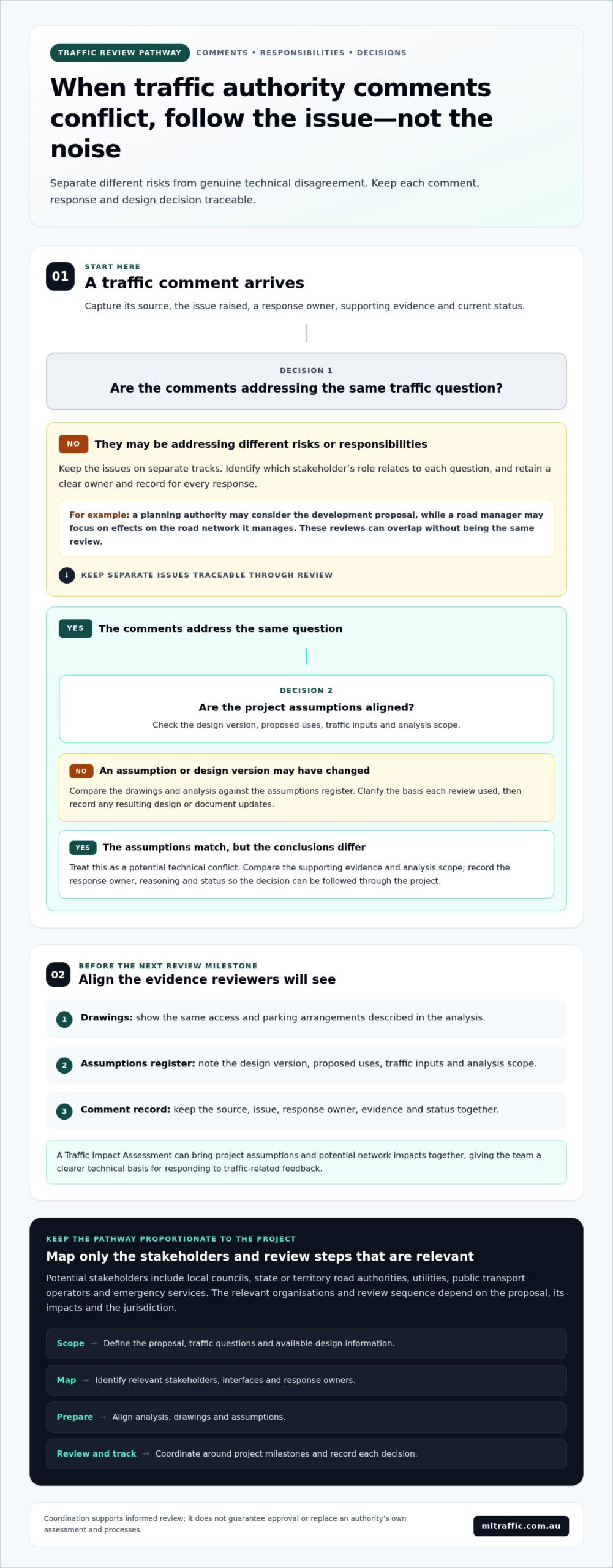
A coordinated review is a sequence, not a single submission. Scope the proposal, map relevant stakeholders, prepare supporting evidence, schedule review milestones and track each decision. This gives the project team a clear view of what information is needed, who is responsible for it and how feedback may affect the design. Consultation timing and submission pathways depend on the project and applicable jurisdiction, so don’t assume one process applies everywhere.
A stakeholder matrix is a project register that records who may need to contribute, their role and the input or decision relevant to them. It helps the team distinguish decision-makers from technical consultees and project delivery stakeholders, then assign a suitable contact pathway and response owner.
Build a stakeholder and responsibility map
For each stakeholder, record their potential role, relevant interface, contact pathway and expected input. Map connections between road access, intersections, loading, parking and construction arrangements. A change to one element may affect another, so flag dependencies early. For example, a revised access location may influence vehicle circulation and the traffic analysis being prepared for review. Keep the map proportionate to the proposal, because not every stakeholder will be relevant to every project.
Coordinate evidence and review milestones
Before each planned review milestone, align the concept design, traffic analysis and supporting documents. Check that drawings show the same access and parking arrangements described in the analysis. Keep a concise assumptions register with the design version, proposed uses, traffic inputs and analysis scope. Reviewers can then see the basis for conclusions and distinguish a changed project assumption from a disagreement about its implications.
Use a staged workflow to keep information moving:
- Scope: Define the proposal, key traffic questions and design information available.
- Map: Identify relevant stakeholders, interfaces and response owners.
- Prepare: Bring analysis, drawings and assumptions into alignment.
- Review: Coordinate discussions around project milestones and the applicable submission pathway.
- Track: Record comments, responses, evidence and resulting decisions.
For Australian projects, establish the review pathway that applies to the proposal and jurisdiction. Base the process on stakeholders’ roles and the information needed to assess the project, rather than relying on a generic sequence or assuming the same submission requirements apply nationally.
A traffic engineer can document the analysis basis and consolidate technical responses for project discussions. A Traffic Impact Assessment brings project assumptions and network impacts together as supporting evidence. For further information about traffic engineering services, see the services overview from ML Traffic Engineers.
How to handle conflicting traffic comments and competing requirements
Not every difference in feedback is a direct conflict. One comment may focus on access geometry, while another addresses parking, loading or construction impacts. These may be separate project risks that need to be considered together. A genuine technical conflict exists when two comments seek incompatible outcomes for the same design element or rely on assumptions that cannot both be applied.
For teams coordinating with multiple authorities on traffic issues, start by identifying what each comment asks the project to resolve. Don’t assume one stakeholder’s view overrides another’s. If comments appear inconsistent, set out the specific points of difference and request clarification through the relevant review pathway. Keep the query factual: identify the design element, the assumptions involved and the decision that needs clarification.
Sort comments by issue, impact and decision owner
Group feedback by practical topics such as access, network operation, safety, parking, loading or construction impacts. Then identify dependencies. For example, a question about vehicle access may need to be resolved before its effects on an intersection or internal circulation can be assessed. Record unresolved assumptions and note which later design decisions or analyses depend on them.
A comparison table makes the review manageable. Give each comment a separate entry and record:
- Comment and source: What was raised, and by whom?
- Issue and impact: Which design element or project risk does it concern?
- Response owner: Who will coordinate the answer?
- Evidence: What drawing, analysis or project information supports the response?
- Status: Is the item accepted, clarified, unresolved or awaiting a decision?
Document responses and design changes
Maintain a dated comment-response register. Link each response to the relevant evidence and note any resulting design change, including the drawing or analysis version affected. Summarise accepted, clarified and unresolved items accurately. If a stakeholder’s position remains open, record that status rather than presenting it as agreement.
Every response should link the comment, the supporting evidence and the resulting decision. This makes the project’s reasoning traceable and helps the team explain how feedback affected the design. It also reduces the risk of answering the same issue twice or overlooking a revision in later documents.
Specialist technical input can help assess whether comments raise a genuine inconsistency, address separate interfaces or require further analysis. ML Traffic Engineers provides Traffic Impact Assessments and intersection analysis to support clear, evidence-based responses during project discussions. See its traffic engineering services.
A practical checklist for coordinating traffic reviews
A controlled checklist helps the project team prepare consistent information, keep review actions visible and carry decisions into current project records. Use it as a working document and update it as the proposal develops. The aim is to make responsibilities and outstanding issues clear, not to assume every project follows the same authority process.
Prepare a clear, coordinated submission
Before engagement, define the proposal, scope, site access, expected traffic effects and the decisions where input is needed. Before submission, check that the traffic narrative, plans and supporting analysis describe the same design. Record the drawing version and analysis scope so reviewers can see what information they are assessing.
- Check consistency: Confirm that access, parking, loading and circulation shown on plans match the written description and analysis.
- State assumptions: Identify uncertain inputs clearly. Don’t present an unverified assumption as an agreed requirement.
- Assign ownership: Name the person responsible for each response and supporting evidence.
If construction activity may affect traffic arrangements, consider whether a Traffic Management Plan is relevant to the project. The Traffic Management Plan guide provides further context on this topic.
Keep review actions visible and accountable
During review, use one controlled register for correspondence, actions, response dates and dependencies. Give every item an owner, status and evidence reference. If an unresolved technical interface affects another design decision, record the dependency and raise it through the project’s agreed communication channels. This makes outstanding actions easier to see and reduces the risk of an open comment being lost between document updates.
- Before engagement: Confirm the proposal scope, access arrangements, likely traffic effects and questions requiring input.
- Before submission: Check document versions, drawing consistency, assumptions, analysis scope and response ownership.
- During review: Record incoming comments, agreed actions, responsible people, response dates and linked evidence.
- After review: Confirm decisions, list unresolved items and carry agreed changes into the current project records.
Keep a clear distinction between a decision, a proposed response and an item still awaiting clarification. After each review milestone, update the register and relevant documents so the project team works from the same current information.
ML Traffic Engineers has more than 15 years of experience in traffic engineering and transport planning. Its Traffic Impact Assessments, vehicle swept path analysis and car park design services support project planning and informed authority discussions.
How traffic engineering support can make authority coordination clearer
Technical advice gives project teams a consistent basis for discussing traffic effects with relevant stakeholders. A Traffic Impact Assessment (TIA) can describe a proposed development, outline its potential effects on access and the surrounding road network, and document the analysis and assumptions used. This helps reviewers understand what has been assessed and gives the team a sound reference point when responding to questions.
A TIA isn’t automatically required for every proposal. The appropriate assessment depends on the project’s context, scale and potential traffic effects, as well as the applicable review process. Where questions involve access, intersection operation, parking or network impacts, a traffic engineer can help define the technical issue and organise the supporting evidence. Consultants provide analysis and advice, while relevant authorities retain their own review processes and decisions.
When a traffic assessment can support coordination
An assessment is useful when project decisions need to be explained consistently across plans, analysis and discussions. Documenting the design basis, traffic assumptions and assessment scope helps keep comments focused on the same proposal. If a layout or assumption changes, the project team can identify which findings or documents may need to be revisited. This makes the reasoning easier to trace without implying that technical advice determines an authority’s decision.
Move from multiple comments to a managed project pathway
Keep the coordination sequence clear: scope the proposal, map relevant stakeholders, prepare aligned evidence, respond to technical feedback and record decisions. Specialist advice can help distinguish questions that need further analysis from those requiring a design change or clarification. It can also help maintain consistency between the technical response and the current project information.
For developers coordinating with multiple authorities on traffic issues, this structured approach supports clearer project discussions while leaving each authority’s process intact. ML Traffic Engineers has more than 15 years of experience in traffic engineering and transport planning, including preparing Traffic Impact Assessments and Statements for development applications. Its traffic engineering services support project planning and authority discussions, but do not guarantee approval or a particular outcome.
To discuss traffic engineering support for your project, contact ML Traffic Engineers.
Build a clearer pathway for your traffic reviews
Effective coordination starts with identifying relevant stakeholders and review points early. Keep technical comments organised by issue, assign clear response owners and maintain a record that connects feedback to evidence and design decisions. A Traffic Impact Assessment can bring project assumptions and potential network effects together to support informed discussions, while each authority retains its own review process.
For developers coordinating with multiple authorities on traffic issues, a consistent, traceable approach can help manage competing input and limit avoidable rework. ML Traffic Engineers prepares Traffic Impact Assessments and Statements for development applications, supported by more than 15 years of traffic engineering experience.
Discuss traffic engineering support for your project and take a clear, considered next step in planning your authority discussions.
Frequently Asked Questions
How do you coordinate with multiple authorities on traffic issues?
Start by defining the proposal and identifying stakeholders whose responsibilities intersect with its traffic effects. Map each stakeholder’s role, prepare consistent technical information, and use a shared register to track correspondence, assign comment owners and record responses. For example, a question about site access may need to be considered alongside intersection effects. When coordinating with multiple authorities on traffic issues, remember that processes vary by project and jurisdiction. A coordination workflow supports, but doesn’t replace, each authority’s review requirements.
Which authorities may need to be involved in a traffic assessment?
Relevant stakeholders can include local councils, state or territory road authorities, utilities, public transport operators and emergency services. The project’s location, proposal and potential impacts determine who may need to provide input. A development affecting road access may raise different questions from one that interfaces with public transport or utility infrastructure. Document why each stakeholder is relevant and establish the applicable review process for the project’s jurisdiction. Not every proposal requires consultation with every group.
What should a traffic authority coordination register include?
A coordination register should record each stakeholder, correspondence date, issue raised, relevant document or drawing, response owner, status and next action. Include an evidence reference and a note of any resulting design change. For example, a comment about access can be linked to the drawing and analysis used to prepare the response. A shared, current register helps the project team spot unresolved interfaces and keep actions visible across communications, without requiring a particular template or format.
What happens if two authorities provide conflicting traffic comments?
Record both comments accurately, then identify the design element and technical question involved. Check whether the comments address separate risks or request incompatible outcomes for the same issue. If they appear inconsistent, seek clarification through the appropriate project communication channels and provide evidence for the proposed response. Don’t assume one authority’s comment overrides another’s. Record any clarified interpretation, design change and unresolved issue so the project team can track what remains open.
When should traffic authorities be engaged during a development project?
Identify likely stakeholders and information needs during project scoping, then plan engagement around design development and submission milestones. Early discussion can expose review interfaces while design options remain flexible. Suitable timing depends on the proposal, approval pathway and relevant jurisdiction, so there isn’t one timeline for every development. Establish what decisions need input and what supporting information is available at each stage. Follow the applicable process for the project rather than assuming a universal statutory timeframe.
Can a Traffic Impact Assessment help coordinate authority feedback?
Yes. A Traffic Impact Assessment can set out a proposal’s traffic effects, assumptions and supporting analysis, giving project discussions a consistent technical reference. This can help organise responses to comments about access, intersections or network impacts. The assessment supports project planning and authority discussions, but it doesn’t replace consultation or an authority’s own review process. It also doesn’t guarantee approval or ensure different stakeholders will reach the same view. ML Traffic Engineers prepares Traffic Impact Assessments and Statements for development applications.

Disclaimer
The content on www.mltraffic.com.au, including all technical articles, guides, and resources, is provided for general informational and educational purposes only. It is not intended to constitute professional advice in traffic engineering, transportation planning, development approvals, or any other technical or legal field.
While ML Traffic Engineers makes every reasonable effort to ensure the accuracy, completeness, and timeliness of the information published, we do not provide any warranties or representations (express or implied) regarding its reliability, suitability, or availability for any particular purpose. Any reliance you place on the content is strictly at your own risk.
In no event shall ML Traffic Engineers, its directors, employees, authors, or affiliates be liable for any direct, indirect, incidental, special, consequential, or punitive damages (including, without limitation, loss of profits, data, or business opportunities) arising out of or in connection with the use of, or inability to use, any information provided on this website.
The articles and guides on this site are not a substitute for engaging a qualified, registered professional traffic engineer (such as an NPER or RPEQ engineer) to assess your specific project requirements. For tailored advice, compliance assessments, or traffic engineering services, please contact a competent professional.
This disclaimer may be updated from time to time without notice. By accessing or using this website, you agree to be bound by the most current version of this disclaimer.
