
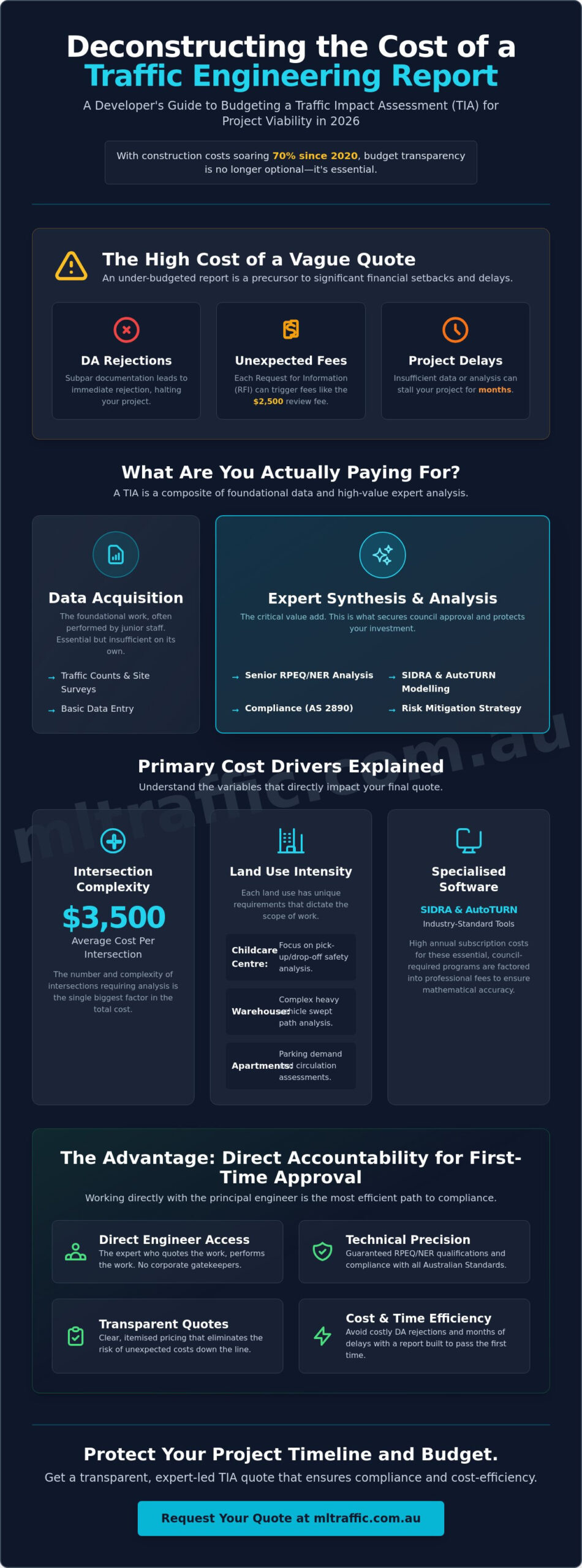
With construction costs rising 70% since 2020, every line item in your development budget requires absolute transparency. A vague quote for a Traffic Impact Assessment is often a precursor to a DA rejection or an unexpected $2,500 Raleigh review fee for every submittal. Understanding the cost breakdown of a traffic engineering report is no longer optional; it’s a requirement for project viability in 2026. You need to know if you’re paying for a junior staffer’s learning curve or the senior-level analysis required to pass council on the first submission.
It’s frustrating to receive opaque pricing from large firms only to have council request additional data halfway through the process. We understand the fear of project delays caused by subpar documentation. This guide explains exactly what drives the price of your TIA, from the $3,500 average cost per intersection to the impact of the new Virginia MUTCD 11.0 standards. You’ll learn how to evaluate engineering quotes and why direct access to the senior engineer who actually performs the work is the only way to ensure compliance and cost-efficiency for your next development.
Key Takeaways
- Identify the core technical components of a Traffic Impact Assessment, including the critical balance between data acquisition and senior-level expert synthesis.
- Analyze how the “Intersection Rule” and specific land-use intensity directly impact the total cost breakdown of a traffic engineering report.
- Recognize red flags in engineering quotes, such as vague pricing structures that don’t account for mandatory RPEQ or NER qualifications.
- Understand the technical and financial benefits of working directly with the principal engineer who prepares your report rather than navigating corporate gatekeepers.
- Learn how to ensure your submission meets Australian Standards and council requirements to avoid costly DA rejections and additional data requests.
Table of Contents
-
What is a Traffic Engineering Report and Why is it Necessary?
-
Variable Cost Drivers: Why One Project Costs More Than Another
-
The ML Traffic Engineers Australia Advantage: Direct Accountability and Technical Precision
What is a Traffic Engineering Report and Why is it Necessary?
A Traffic Impact Assessment (TIA) is a technical document required for Development Applications (DA) across Australia. It serves as a mandatory compliance document for Australian councils to mitigate transport risk by evaluating the interaction between a new development and the existing road network. The primary goal is to demonstrate that a proposed land use won’t adversely affect road safety or network efficiency. Every report must adhere to specific Australian Standards, particularly the AS 2890 series which governs parking facilities and off-street car parking.
The discipline of Traffic engineering involves the application of scientific principles and technical tools to achieve the safe and efficient movement of people and goods. When you submit a proposal, the council must ensure that the surrounding infrastructure can support the new demand without creating bottlenecks or safety hazards. This requires a level of detail that goes beyond simple observations; it demands rigorous data and expert synthesis.
To better understand this concept, watch this helpful video:
The Legal and Regulatory Requirement
Councils mandate these reports for various land-use types, including multi-unit apartments, childcare centers, and large-scale warehouses. Each land use presents unique challenges. A childcare center requires specific focus on pick-up and drop-off safety, while a warehouse necessitates complex vehicle swept path analysis for heavy articulated vehicles. The TIA forms a critical component of the Statement of Environmental Effects. It provides the evidence-based data needed for planning officers to approve the project. You can find more detail in our Traffic Impact Assessment: The Definitive Guide for Australian Developers.
Consequences of an Under-Budgeted Report
Choosing the lowest quote without understanding the technical requirements often leads to significant financial setbacks. An under-budgeted report frequently results in Requests for Further Information (RFIs) from the council. In Raleigh, North Carolina, for example, the TIA review process as of July 1, 2024, carries a $2,500 fee per submittal. Every RFI represents a project delay and potentially thousands of dollars in additional council fees. Technical precision is a form of insurance for developers.
When you review a cost breakdown of a traffic engineering report, you’re paying for the expert analysis that prevents these delays. Insufficient traffic data or a lack of senior engineer oversight can stall a project for months. Technical accuracy ensures that the first submission is the only submission. This protects your timeline and your budget from the hidden costs of bureaucratic friction. A detailed cost breakdown of a traffic engineering report should prioritize data quality and senior-level synthesis over the lowest possible entry price.
The Core Components: A Technical Work Breakdown Structure
Every professional traffic report is a composite of two distinct phases: data acquisition and expert synthesis. The cost breakdown of a traffic engineering report reflects the specific labor hours allocated to Registered Professional Engineers (RPEQ or NER) versus junior technicians. While a junior staffer might handle basic data entry, the technical synthesis required for council approval demands senior oversight. In larger firms, you often pay for a senior’s signature on a junior’s work; however, a more transparent model ensures the expert providing the quote is the one performing the analysis.
Specialized software licenses represent a significant overhead in the engineering field. Tools like SIDRA for intersection analysis and AutoTURN for vehicle swept paths are industry standards required by most Australian councils. These programs ensure mathematical accuracy and compliance with AS 2890, but they carry high annual subscription costs that are factored into the professional fee. Administrative overheads, including site visits, council liaison, and rigorous quality assurance, complete the technical work breakdown structure.
Phase 1: Field Data Collection
Field data collection is the foundation of any reliable report. Automated traffic counters are cost-effective for 24-hour volume surveys, but manual counts are often required for specific "Peak Hour" analysis at complex junctions to capture turning movements accurately. This phase also includes site-specific photography and physical sight-distance measurements to verify safety standards on-site. The complexity of the study area determines whether a simple tube count suffices or if multi-day manual observation is necessary.
Phase 2: Technical Analysis and Modelling
Technical analysis complexity scales with the project’s impact on the local network. Modelling a single signalized intersection in SIDRA is a standard procedure, but a network of three or more junctions increases the technical hours significantly. We also perform Swept Path Analysis: A Complete Guide for Australian Developments to ensure heavy vehicles can maneuver safely within the site boundaries without impacting traffic flow. If your project requires precise vehicle movement diagrams, you can request a technical quote for your specific site layout.
Phase 3: Reporting and Certification
The final phase involves synthesizing raw data into a council-ready Traffic Impact Statement (TIS). This document must clearly articulate how the development complies with local planning schemes and Australian Standards. A transparent Traffic Impact Analysis (TIA) review process relies on this technical precision to avoid the $2,500 fees often associated with addendum submissions. Certification of car park designs against AS 2890.1 is the final step in ensuring the project is ready for submission. For detailed information on professional certification, view our comprehensive ML Traffic Services.
Variable Cost Drivers: Why One Project Costs More Than Another
The cost breakdown of a traffic engineering report isn’t a fixed figure because no two sites share the same risk profile. The "Intersection Rule" remains the most significant financial driver in 2026. Analyzing a single priority-controlled junction is a standard procedure. However, if your development impacts three or more signalized intersections, the engineering hours scale accordingly. General industry guidelines suggest a baseline of $3,500 per intersection. This can reach $13,000 for a single complex junction in large-scale projects where multi-modal analysis is mandatory. This price variation reflects the depth of data needed to satisfy council planning officers.
Land-use intensity also dictates the level of technical analysis required. A warehouse generates minimal peak-hour trips compared to high-turnover developments like bars, medical centers, or fast-food outlets. High-turnover sites require granular trip generation modeling using the ITE Trip Generation Manual 11th Edition. Councils are increasingly meticulous. For example, San Diego increased its Development Impact Fees by 3.7% in 2025. This reflects the heightened scrutiny on infrastructure capacity. If your site has existing constraints such as limited sightlines or steep topography, the cost breakdown of a traffic engineering report will reflect the additional hours needed for detailed driveway ramp grade assessments and sight-distance measurements.
Scale of Development
Small-scale residential projects with fewer than 10 dwellings typically require a streamlined assessment. In contrast, large commercial precincts or multi-unit apartments demand extensive parking demand assessments. The scope of work expands as the potential for network conflict increases. Large projects often require more than just a simple count; they need comprehensive traffic modelling. Understanding the role of a traffic engineer in developments helps clarify why larger projects necessitate deeper technical involvement to secure a compliant DA submission on the first attempt.
Technical Complexity Factors
Technical complexity depends heavily on the type of intersection analysis required. Modelling a roundabout in SIDRA involves different parameters than a signalized crossing or a priority-controlled junction. Some jurisdictions require a Traffic Guidance Scheme (TGS) to manage construction-related impacts. Non-standard topography also adds to the workload. A standard driveway ramp grade assessment ensures compliance with AS 2890.1, but steep grades require custom engineering to prevent vehicle scraping. Each of these factors adds to the total report hours. Councils in high-growth corridors often demand more rigorous modelling to mitigate the cumulative impact of multiple developments. This ensures the local road network remains functional as density increases.
Evaluating Quotes: Beyond the Bottom Line
The lowest price on a fee proposal often masks significant technical gaps that lead to project delays. When reviewing a cost breakdown of a traffic engineering report, look for specific line items rather than vague "all-inclusive" figures. A professional quote must clearly define its data sources and the qualifications of the person performing the work. Quotes that lack detail often rely on unverified or outdated data, which Australian councils frequently reject. This results in a cycle of revisions that eventually costs more than a senior-led assessment would’ve initially.
The "Gatekeeper" problem is a common issue in larger engineering firms. In these environments, a senior principal provides the quote, but a junior technician with limited field experience performs the actual analysis. This disconnect often leads to reports that fail to address site-specific nuances, such as complex driveway ramp grades or tight sightlines. At ML Traffic Engineers Australia, we operate on a different principle: the traffic consultant who provides the quote, does the work. This direct accountability ensures that 30 to 40 years of expertise is applied to every calculation, from initial data collection to final certification.
Questions to Ask Your Traffic Consultant
Before signing a contract, perform the "Principal Access" test. Ask exactly who’ll be writing the report and if you’ll have a direct line to them. You should also clarify if data collection is included in the professional fee or if it’ll appear as a separate disbursement later. Finally, confirm how many rounds of revisions are included. A quote that doesn’t account for initial council queries (RFIs) can lead to unexpected invoices just when you need to move toward DA approval. Verify that your engineer holds the necessary NER or RPEQ credentials to ensure the report carries the required legal weight.
Hidden Costs to Watch For
Project budgets often overlook the distinction between professional consultant fees and municipal impact fees. In Pierce County, Washington, a new traffic impact fee schedule effective February 1, 2026, sets the fee for a single-family detached housing unit at $9,650.00 in TSA C. These are external costs developers must separate from their engineering budget. Another potential hidden cost is additional modelling. If your initial site layout fails compliance, your consultant may charge extra to model a second or third iteration in SIDRA. If your project is in a regional area, ensure the quote specifies travel expenses for mandatory site visits. Transparency in the initial cost breakdown of a traffic engineering report prevents these items from becoming budget-breaking surprises. If you want a transparent, expert-led quote for your next project, contact our senior engineers directly.
The ML Traffic Engineers Australia Advantage: Direct Accountability and Technical Precision
The technical integrity of your Development Application depends on the expertise of the individual performing the analysis. At ML Traffic Engineers Australia, we operate on a fundamental philosophy: the traffic consultant who provides the quote, does the work. This approach eliminates the "Gatekeeper" problem found in larger firms where senior principals delegate critical tasks to junior staff. When you review a cost breakdown of a traffic engineering report from us, you’re securing 30 to 40 years of senior engineering experience for every calculation and site assessment.
Since 2005, we’ve analyzed over 10,000 sites across the country. This extensive track record spans every conceivable land use, including apartments, bars, childcare centres, medical centres, temples, warehouses, and shopping centres. Our deep familiarity with council requirements and Australian Standards (AS 2890.1) means we anticipate potential issues before they become formal Requests for Further Information (RFIs). Senior-level involvement in every report ensures that your submission is technically robust, which streamlines the approval process and prevents the costly delays associated with subpar documentation.
Hands-On Expertise
Direct access to our principals, Michael Lee and Benny Chen, provides a level of accountability that saves you money over the project lifecycle. You don’t navigate through account managers or administrative layers; you speak directly to the experts responsible for your Traffic Impact Assessment. This transparency is a core component of our service. Our exhaustive experience across diverse land-use types allows us to provide precise Vehicle Swept Path Analysis and Car Parking Demand Assessments that reflect real-world conditions. You can verify our professional credentials and industry standing by visiting our About ML Traffic Engineers Australia page.
Get a Professional Quote Today
Accuracy in a cost breakdown of a traffic engineering report begins with the initial site plans. We require detailed layouts early in the process to provide a transparent, fixed-fee quote that covers all necessary technical components, from Intersection Analysis to Sight Distance Assessments. Our meticulously detailed reports are designed to pass council scrutiny on the first submission, protecting your development timeline from bureaucratic friction. We focus on providing private clients with the technical precision needed for successful Development Applications without the overheads of impersonal corporate structures. For a clear and transparent cost breakdown tailored to your specific site, contact ML Traffic Engineers Australia to discuss your project requirements with a senior consultant.
Secure Your Development Approval with Technical Precision
Project success in the 2026 planning environment requires a technical strategy that prioritizes accuracy over the lowest bid. As established, the cost breakdown of a traffic engineering report is a function of data precision and senior-level synthesis rather than mere page count. Cutting corners on intersection analysis or vehicle swept paths often leads to council RFIs and expensive project delays. By prioritizing a transparent work breakdown structure, you eliminate the risks associated with junior-led reporting and ensure your development budget remains predictable from the first submission.
ML Traffic Engineers Australia provides a direct line to senior principals who manage your project from inception to certification. We operate on a unique promise: the consultant who provides your quote is the expert who performs the work. This direct accountability ensures your report meets every requirement of AS 2890.1 and local planning schemes on the first submission. Don’t let your DA stall due to subpar traffic documentation. You can Get a Fixed-Fee Quote from Our Senior Engineers today and move forward with the assurance of expert-led compliance. We look forward to securing your project’s future.
Frequently Asked Questions
How much does a standard Traffic Impact Assessment cost in Australia?
Professional fees for a Traffic Impact Assessment are calculated based on project complexity and the number of intersections requiring SIDRA modelling. While a single intersection study may start at $3,500 according to general 2026 industry benchmarks, a comprehensive cost breakdown of a traffic engineering report for a large commercial site can exceed $15,000. These figures represent the professional engineering hours and data collection costs required for a compliant submission.
Is a traffic report always required for a small development?
No, but most Australian councils require at least a basic Traffic Impact Statement (TIS) if the development changes the land use or parking requirements. Even a small 4-unit townhouse development often triggers a Car Parking Demand Assessment if the design doesn’t strictly meet the minimum car space requirements of the local planning scheme. Council planning officers use these reports to verify that the local road network remains safe and functional.
How long does it take to produce a traffic engineering report?
A standard report typically takes between 14 and 21 business days to complete from the date of engagement. This timeline includes approximately 7 days for mandatory field data collection, such as automated tube counts, followed by technical modelling and report synthesis. Larger projects requiring multi-day manual peak-hour observations at several junctions will naturally extend this timeframe to ensure data accuracy for the council submission.
Can I use a general civil engineer for a traffic report?
It’s not recommended because councils specifically look for certification from a Registered Professional Engineer of Queensland (RPEQ) or a National Engineering Register (NER) member specializing in traffic. General civil engineers often lack the specialized SIDRA modelling software and the deep understanding of AS 2890.1 required to certify car park designs. Using a specialist ensures the report passes council scrutiny without triggering expensive Requests for Further Information (RFIs).
What data do I need to provide for an accurate quote?
You must provide a full set of architectural site plans and a clear description of the proposed land use. We specifically need to see the total number of dwellings, gross floor areas (GFA) for commercial spaces, and the proposed driveway locations. This information allows us to estimate the trip generation rates accurately and determine how many intersections require modelling, which is a primary driver in the cost breakdown of a traffic engineering report.
Does the cost include responding to council objections?
Most fixed-fee proposals include one round of responses to initial council queries or minor RFIs. However, if the council mandates entirely new data collection or significant design changes after the first submission, additional fees typically apply. It’s important to verify that your quote includes basic liaison with council planning officers to avoid unexpected invoices during the DA assessment phase.
What is the difference between a Traffic Impact Statement and a TIA?
A Traffic Impact Statement (TIS) is a concise document for low-impact developments that don’t significantly affect the broader road network. A Traffic Impact Analysis (TIA) is a more rigorous technical study required for high-impact projects. TIAs involve complex intersection modelling, multi-modal transport assessments, and detailed network capacity analysis to demonstrate that the development won’t create bottlenecks or safety hazards in the surrounding area.
Are there ongoing costs after the report is submitted?
Ongoing costs are usually limited to municipal review fees rather than additional consultant fees. For example, Raleigh, North Carolina, implemented a $2,500 TIA review fee per submittal as of July 1, 2024. In Australia, you may face additional costs only if the council requires an addendum due to major changes in your site plan. Ensuring your first report is technically precise is the best way to avoid these secondary expenses.
Which areas do you cover?
We are traffic engineers servicing Melbourne, Sydney, Brisbane, Gold Coast, Hobart, Perth, Adelaide, Darwin, Canberra and surrounding areas.

Disclaimer
The content on www.mltraffic.com.au, including all technical articles, guides, and resources, is provided for general informational and educational purposes only. It is not intended to constitute professional advice in traffic engineering, transportation planning, development approvals, or any other technical or legal field.
While ML Traffic Engineers makes every reasonable effort to ensure the accuracy, completeness, and timeliness of the information published, we do not provide any warranties or representations (express or implied) regarding its reliability, suitability, or availability for any particular purpose. Any reliance you place on the content is strictly at your own risk.
In no event shall ML Traffic Engineers, its directors, employees, authors, or affiliates be liable for any direct, indirect, incidental, special, consequential, or punitive damages (including, without limitation, loss of profits, data, or business opportunities) arising out of or in connection with the use of, or inability to use, any information provided on this website.
The articles and guides on this site are not a substitute for engaging a qualified, registered professional traffic engineer (such as an NPER or RPEQ engineer) to assess your specific project requirements. For tailored advice, compliance assessments, or traffic engineering services, please contact a competent professional.
This disclaimer may be updated from time to time without notice. By accessing or using this website, you agree to be bound by the most current version of this disclaimer.
