

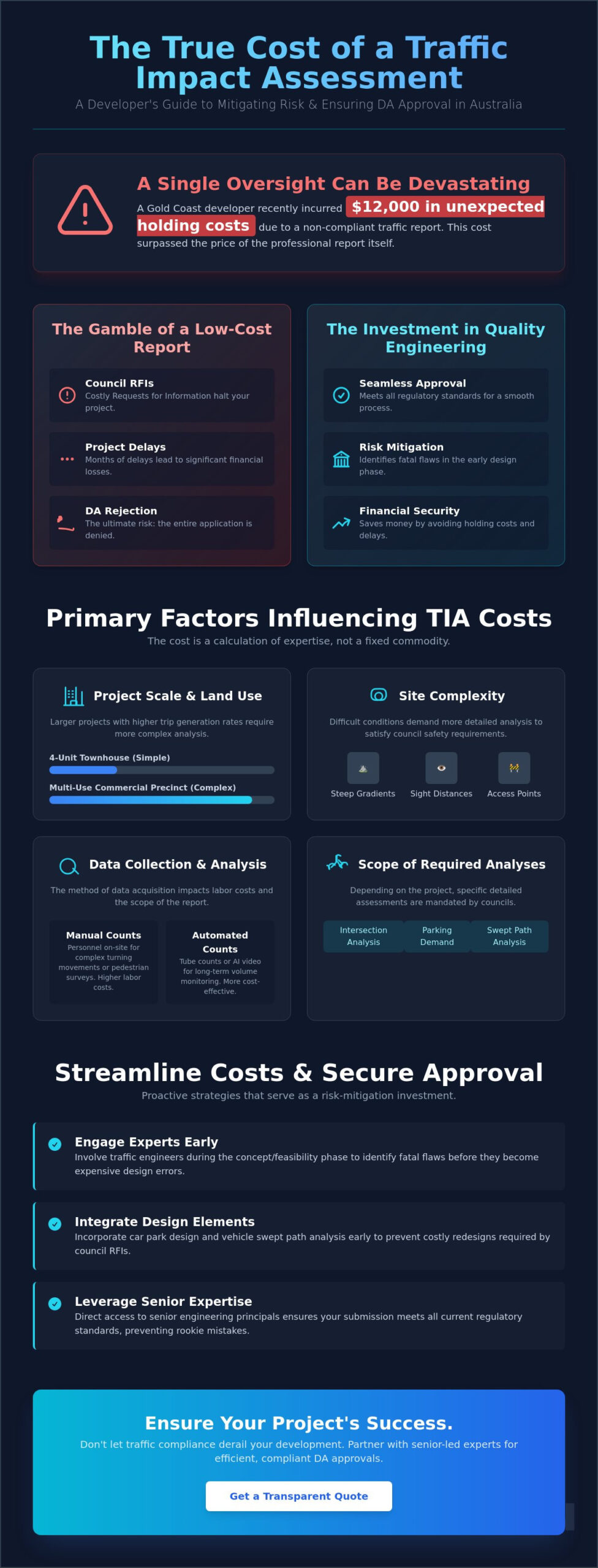
A single technical oversight in your traffic submission can cost more in holding fees than the professional report itself. In late 2023, a Gold Coast developer incurred $12,000 in unexpected holding costs for failing to address specific volume projections required by the Guide to Traffic Impact Assessment. If you’re frustrated by opaque engineering quotes or the fear of a council rejection, you aren’t alone. Determining the cost of a traffic impact assessment report australia requires looking beyond the initial quote to the technical variables that ensure regulatory compliance.
You likely want a transparent breakdown of engineering fees without the risk of council RFIs stalling your project for months. This guide clarifies exactly what you’re paying for, from "Safe System" design requirements to specific government data fees like those charged for Canberra Strategic Transport Model outputs. We’ll explain how to identify a compliant report that secures approval while mitigating traffic risks during the design phase. You’ll gain a clear understanding of how senior-led technical expertise acts as a risk-mitigation investment rather than a fixed commodity.
Key Takeaways
- Identify why local councils and state road authorities mandate specific reporting and how these requirements impact your project timeline.
- Analyze the technical variables, such as intersection complexity and project scale, that influence the final cost of a traffic impact assessment report australia.
- Avoid the financial risks associated with low-cost, non-compliant reports that frequently result in costly council Requests for Information (RFIs).
- Implement cost-saving strategies by engaging experts during the concept phase to integrate car park design and vehicle swept path analysis early.
- Leverage direct access to senior engineering principals to ensure your submission meets all current regulatory standards for a seamless approval process.
Table of Contents
-
Understanding the Financial and Regulatory Necessity of a Traffic Impact Assessment
-
Primary Factors Influencing the Cost of a Traffic Impact Assessment Report in Australia
-
Beyond the Quote: Analyzing the Long-Term Cost-Benefit of High-Quality Traffic Engineering
-
Strategic Ways Developers Can Streamline Traffic Assessment Costs
-
The ML Traffic Advantage: Direct Senior Expertise for Efficient DA Approvals
Understanding the Financial and Regulatory Necessity of a Traffic Impact Assessment
A Traffic Impact Assessment (TIA) is a mandatory technical document required for any Australian development that significantly alters local transport dynamics. Local councils and state road authorities use these reports to determine if a project’s projected vehicle movements will compromise safety or network efficiency. Without a compliant TIA, a Development Application (DA) cannot proceed through the assessment phase. It serves as your primary legal and technical defense, demonstrating that your proposed land use adheres to established traffic engineering principles and local planning schemes.
Budgeting for the cost of a traffic impact assessment report australia during the initial feasibility stage is a strategic necessity. Developers who treat traffic engineering as an afterthought often face project-stalling Requests for Information (RFIs) that can derail financing and construction schedules. Early engagement allows for the identification of fatal flaws in site access or parking configurations before they become permanent, expensive errors in the design phase.
To better understand this concept, watch this helpful video:
When is a Traffic Report Legally Required?
Regulatory triggers for a traffic report vary by jurisdiction, but common thresholds include increased vehicle movements, changes in site access, or a shortfall in on-site parking. Smaller projects might only require a basic Traffic Statement. However, a comprehensive Impact Assessment is necessary when a development exceeds specific trip-generation rates or impacts state-controlled roads. These reports are a critical component of the Statement of Environmental Effects, providing the data needed to justify the development’s footprint within the existing infrastructure.
The Financial Risk of Non-Compliance
Inadequate traffic planning is a primary cause of rejected Development Applications. When a submission fails to address safety or congestion, councils issue RFIs that can delay a project by months. These delays translate to significant financial losses through interest payments, holding costs, and lost market opportunity. For instance, a Gold Coast developer faced $12,000 in unexpected holding costs in 2023 due to a failure to address updated volume projections. The cost of a traffic impact assessment report australia is a small fraction of the capital lost during a three-month council delay. Investing in senior-led expertise early ensures the report sails through approval without these avoidable expenses.
Primary Factors Influencing the Cost of a Traffic Impact Assessment Report in Australia
The total cost of a traffic impact assessment report australia is not a fixed commodity. It’s a calculation of engineering hours, computational modeling, and field data acquisition. A four-unit townhouse development requires significantly less analysis than a multi-use commercial precinct. In larger projects, engineers must account for higher trip generation rates and more complex interactions with the surrounding road network. Site complexity also plays a role. Steep gradients, restricted sight distances, and difficult access points require detailed Intersection Analysis and Sight Distance Assessments to satisfy council safety requirements.
Data collection represents a distinct portion of the total fee. Engineering firms must choose between manual intersection counts, which involve personnel monitoring traffic in real-time, and automated methods like pneumatic tube counts or AI-driven video analysis. Manual counts are often necessary for pedestrian surveys or complex turning movements but carry higher labor costs. Conversely, automated data is cost-effective for long-term volume monitoring. You can review our full range of technical traffic assessment services to see how these data points integrate into a final report.
Land Use and Development Type
Development type dictates the depth of the Car Parking Demand Assessment and the complexity of the report. Residential projects often rely on standardized trip generation rates. However, commercial and industrial sites require Vehicle Swept Path Analysis to prove that heavy rigid vehicles can enter and exit in a forward direction. Specialized uses like childcare centers or medical clinics introduce high-turnover traffic patterns during specific peak hours. These scenarios demand more granular modeling to ensure the local network can absorb the concentrated influx of vehicles without failing.
Geographic and Infrastructure Constraints
Infrastructure proximity is a major cost driver. Developments adjacent to arterial roads often trigger the involvement of state road authorities, such as the Department of Transport and Main Roads (TMR). Compliance with Queensland’s Guide to Traffic Impact Assessment ensures that the project meets state-level safety standards, but it also requires more rigorous Intersection Analysis using SIDRA software. If the existing network is near capacity, the report must also detail potential mitigation works or intersection upgrades. Cumulative growth projections from nearby approved developments add another layer of computational complexity to the final engineering submission.
Beyond the Quote: Analyzing the Long-Term Cost-Benefit of High-Quality Traffic Engineering
Selecting a consultant based solely on the lowest quote is often a false economy; it’s a decision that frequently ignores the technical depth required by council engineers. A low initial cost of a traffic impact assessment report australia typically indicates a "checklist" approach. These superficial reports often trigger multiple Requests for Information (RFIs), leading to project delays that far exceed the initial savings. High-quality traffic engineering provides a strategic analysis of site constraints and opportunities. By proposing innovative mitigation strategies, an experienced engineer can often negotiate solutions that avoid million-dollar physical road upgrades or unnecessary signalization requirements. Technical advocacy of this caliber requires reporting grounded in rigorous data and professional experience.
Senior-level involvement is critical during these negotiations. Senior principals possess the professional reputation and technical authority to defend a proposal before council or state road authorities. They apply Austroads national guidelines to ensure every assessment meets best-practice standards, fostering trust with regulatory bodies and accelerating the approval timeline. Direct access to leadership ensures that the same expert who understands your project goals is the one presenting the technical evidence to the authorities. This continuity prevents the communication breakdowns common in larger, tiered firms.
Comparative Analysis: Budget vs. Professional Consultancy
A checklist report simply confirms compliance with minimum standards. In contrast, strategic engineering analysis seeks to optimize the development footprint. For example, precise Swept Path Analysis allows for tighter, more efficient site layouts without compromising safety. This prevents expensive redesigns during the construction phase when structural columns or boundary walls are already in place. Professional reputation directly impacts approval speed. Councils are more likely to accept findings from firms with a proven record of technical accuracy and personnel continuity. This trust reduces the likelihood of adversarial reviews and costly external peer assessments.
Quantifying the ROI of Professional Traffic Engineering
The ROI of professional traffic engineering is quantifiable in both time and project yield. A $2,000 saving on a report fee is irrelevant if poor Car Park Design results in the loss of three parking spaces; it’s a trade-off that costs the developer far more in the long run. In a high-density commercial or residential precinct, each lost space represents a significant reduction in project yield and market value. Expert analysis also reduces construction waste by optimizing driveway and ramp grades to minimize excavation requirements. Adherence to Australian Standards, specifically AS 2890.1 and AS 2890.2, ensures the site remains compliant for its entire operational life. This meticulous attention to detail mitigates future legal liabilities and operational bottlenecks that can arise from substandard design.
Strategic Ways Developers Can Streamline Traffic Assessment Costs
Developers often view traffic engineering as a late-stage requirement. This approach is inefficient and often increases the total cost of a traffic impact assessment report australia. To manage expenses, you should engage a consultant during the concept phase. Early involvement identifies "fatal flaws" in access or parking before you lodge the DA. Fixing these issues on a concept sketch costs significantly less than redesigning a fully drafted architectural set. This proactive approach prevents the technical debt that arises from non-compliant designs and ensures the engineering strategy aligns with your commercial objectives.
Consolidating your technical requirements into a single package is another effective strategy. Instead of sourcing separate quotes, you should bundle your Car Parking Demand Assessment, Vehicle Swept Path Analysis, and TIA into a unified submission. This reduces administrative overhead and ensures technical consistency across all documents. Providing high-quality site plans and clear architectural drawings further minimizes the time an engineer spends interpreting vague sketches. If recent traffic data exists for adjacent sites, it can often be leveraged. Traffic counts are generally valid for 12 to 18 months; using existing data can reduce the field labor component of your quote.
Concept Design Optimization
Smart site layout reduces the need for expensive intersection modeling. By optimizing access points early, you can often demonstrate that the development won’t require complex SIDRA analysis. Designing for compliance with AS 2890.1 from day one prevents the need for Driveway Ramp Grade Assessments to justify non-standard designs. Clear architectural drawings should include accurate boundary lines and existing kerb configurations. When engineers receive incomplete CAD files, they spend billable hours verifying basic site geometry rather than performing high-level analysis.
The Power of Clear Communication
Defining a precise scope of work is essential to avoid scope creep. You should hold proactive pre-DA meetings with council engineers to align on specific traffic requirements before finalizing the cost of a traffic impact assessment report australia. This clarity ensures that all Traffic Engineering inputs are integrated into the overall project timeline from the start. Direct communication with senior principals ensures that the technical strategy remains focused on project approval. To secure a technical strategy for your next development, speak with our senior engineering team.
The ML Traffic Advantage: Direct Senior Expertise for Efficient DA Approvals
ML Traffic brings over 15 years of professional experience to the Australian traffic and transport planning sector. This longevity provides a deep understanding of the evolving regulatory frameworks across various states and local government areas. We understand that the cost of a traffic impact assessment report australia is an investment in your project’s legal and technical viability. Our firm operates on a model of direct accountability. Every project receives direct oversight from senior principals who possess the technical qualifications and negotiation experience required for complex approvals. This approach ensures that your submission adheres to national standards and local planning schemes from the initial draft.
Our comprehensive suite of services supports developers through every stage of the design and approval process. We specialize in technical assessments including:
-
Vehicle Swept Path Analysis
-
Car Parking Demand Assessment
-
Intersection Analysis
-
Driveway Ramp Grade Assessment
-
Sight Distance Assessment
This breadth of internal capability allows us to handle multi-use commercial precincts and high-density residential developments with precision. We have a proven track record of navigating complex council requirements and state road authority standards, ensuring your project remains compliant and viable.
Why Senior Involvement Matters
Senior involvement eliminates the typical delays associated with junior engineers learning on your project. When the person who quotes the job is the one performing the technical work, accuracy increases and the risk of council RFIs decreases. Senior principals bring expert negotiation skills to council meetings and planning panels. They can defend technical findings with authority, often resolving potential disputes before they lead to formal rejections. This direct-access model distinguishes ML Traffic from larger firms where senior staff often act as gatekeepers rather than practitioners. It ensures that the technical strategy discussed during your initial consultation is the one executed in the final report.
Ready to Secure Your DA Approval?
Securing a compliant and cost-effective report starts with a clear project scope. To provide an accurate quote for the cost of a traffic impact assessment report australia, we require high-quality site plans and a detailed project description. Having these documents ready during your initial consultation allows us to identify potential infrastructure constraints early. We provide transparent pricing based on the specific technical requirements of your site, whether you need a standalone parking study or a full TIA. To discuss your project-specific requirements with a senior principal, visit our contact page for a direct consultation.
Securing Your Development Approval Through Technical Excellence
A Traffic Impact Assessment is more than a regulatory hurdle; it’s a strategic tool designed to protect your project from expensive council delays and design failures. By prioritizing senior-led analysis and early engagement, you ensure that your development adheres to AS 2890 standards and remains financially viable. Navigating the cost of a traffic impact assessment report australia requires balancing initial fees against the long-term protection of your project’s timeline and budget. Technical shortcuts often lead to costly RFIs that can stall a development for months.
ML Traffic provides 15+ years of Australian consultancy experience to help you achieve seamless council approvals. You’ll have direct access to senior principal engineers who specialize in complex traffic modeling and compliance. This direct-access model guarantees that the expert who initiates your project is the one performing the technical work. Don’t risk your development’s success with superficial reporting or junior-level oversight. Accurate data and senior-led advocacy are the most effective ways to mitigate project risks from the design phase.
Get a transparent, senior-led Traffic Impact Assessment quote today to move your project forward with confidence.
Frequently Asked Questions
How much does a basic traffic impact assessment cost in Australia?
Pricing for professional engineering reports depends on the project scale, site complexity, and specific data collection requirements. A report for a minor residential development involves fewer engineering hours than a large-scale commercial precinct. The final cost of a traffic impact assessment report australia is a direct reflection of the technical analysis depth and the intersection modeling required by the local council. You should request a project-specific quote to ensure all regulatory triggers for your site are addressed.
How long does it take to prepare a TIA report for a Development Application?
Preparation timelines typically range from two to four weeks depending on the availability of traffic count data. If manual field counts are required during peak periods, this adds to the technical lead time. Complex projects requiring detailed SIDRA modeling or extensive consultation with state road authorities may require additional time. Engaging an engineer during the concept phase allows these timelines to be integrated into your broader project schedule without causing late-stage delays.
What is the difference between a Traffic Impact Statement and a Traffic Impact Assessment?
A Traffic Impact Statement is a concise document for developments with minimal trip generation or minor access changes. In contrast, a Traffic Impact Assessment is a comprehensive technical report required for significant land-use changes. Assessments involve detailed intersection analysis, parking demand studies, and cumulative growth projections. The specific requirement is usually determined by local planning schemes or state-level guidelines, such as the Guide to Traffic Impact Assessment in Queensland.
Do I need a new traffic report if I am only making minor changes to a site?
You might not need a full report if the changes don’t increase trip generation or alter vehicle access points. However, any modification that impacts parking layout or driveway grades usually requires an updated Vehicle Swept Path Analysis or a Driveway Ramp Grade Assessment. It’s best to consult an engineer early to determine if a simple letter of support or a minor addendum will satisfy the council’s technical requirements.
Can a traffic engineer help me reduce the number of parking spaces required by council?
Yes, a traffic engineer can justify a parking shortfall through a Car Parking Demand Assessment. By using empirical data from similar developments or referencing specific peak-hour usage patterns, we can demonstrate that the actual demand is lower than the council’s generic rates. This analysis helps developers maximize site yield while ensuring the proposed parking provision remains functional and compliant with Australian Standards like AS 2890.1.
What happens if my traffic impact assessment report is rejected by council?
Rejection usually results in a formal Request for Information (RFI) from the council. This often happens when a report lacks senior-led technical advocacy or fails to address specific safety principles. Resolving an RFI requires detailed engineering responses and potentially updated modeling. Senior-level negotiation is often necessary to address the council’s technical concerns directly and prevent the project from being permanently stalled or refused.
Will a traffic report include swept path analysis for delivery trucks?
Vehicle Swept Path Analysis is a standard component for any development requiring heavy vehicle access or on-site loading. This analysis uses specialized software to simulate the turning movements of delivery trucks, waste vehicles, or emergency services. It ensures that these vehicles can enter and exit the site in a forward direction without striking structural elements. Including this in your report prevents expensive redesigns during the construction phase when walls are already in place.
How far in advance of my DA lodgement should I engage a traffic engineer?
You should engage a traffic engineer during the concept design stage, ideally three to four months before your intended DA lodgement. Early involvement allows for the identification of access constraints that could impact the total cost of a traffic impact assessment report australia. It also ensures that parking layouts and driveway configurations are compliant before the architectural plans are finalized. This proactive approach minimizes the risk of expensive revisions later in the process.
Which areas do you cover?
We are traffic engineers servicing Melbourne, Sydney, Brisbane, Gold Coast, Hobart, Perth, Adelaide, Darwin, Canberra and surrounding areas.

Disclaimer
The content on www.mltraffic.com.au, including all technical articles, guides, and resources, is provided for general informational and educational purposes only. It is not intended to constitute professional advice in traffic engineering, transportation planning, development approvals, or any other technical or legal field.
While ML Traffic Engineers makes every reasonable effort to ensure the accuracy, completeness, and timeliness of the information published, we do not provide any warranties or representations (express or implied) regarding its reliability, suitability, or availability for any particular purpose. Any reliance you place on the content is strictly at your own risk.
In no event shall ML Traffic Engineers, its directors, employees, authors, or affiliates be liable for any direct, indirect, incidental, special, consequential, or punitive damages (including, without limitation, loss of profits, data, or business opportunities) arising out of or in connection with the use of, or inability to use, any information provided on this website.
The articles and guides on this site are not a substitute for engaging a qualified, registered professional traffic engineer (such as an NPER or RPEQ engineer) to assess your specific project requirements. For tailored advice, compliance assessments, or traffic engineering services, please contact a competent professional.
This disclaimer may be updated from time to time without notice. By accessing or using this website, you agree to be bound by the most current version of this disclaimer.
