
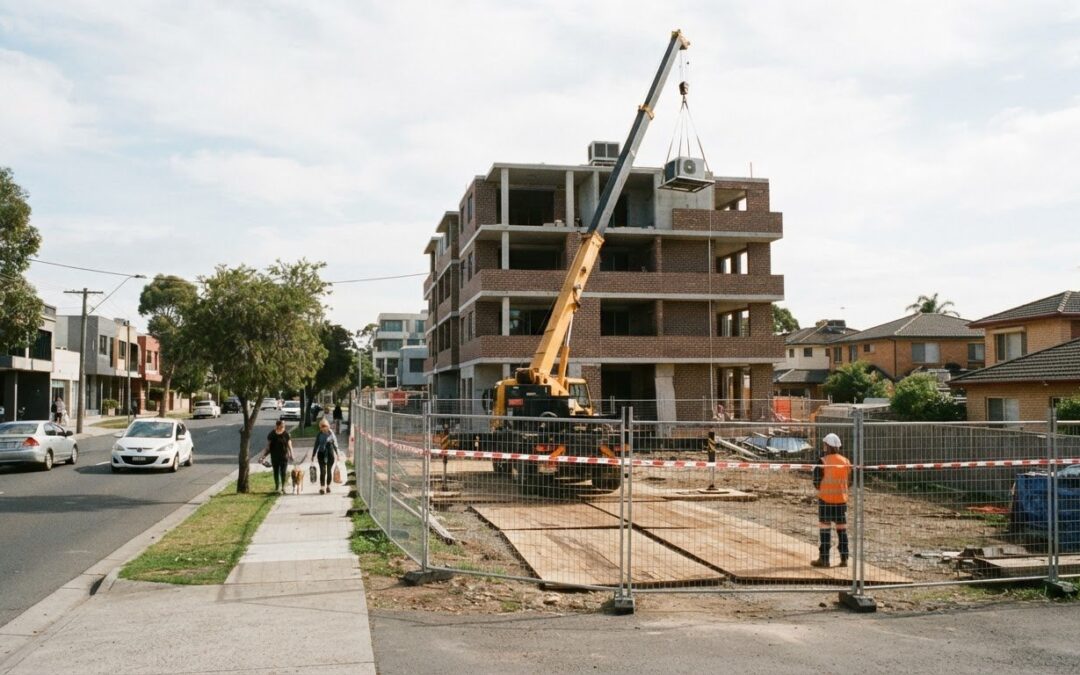
A crane lift can be technically planned and still create risks for pedestrians and road users if the surrounding area isn’t managed. A crane lift plan for traffic and pedestrian safety coordinates the crane setup and load path with exclusion zones, barriers, signage and safe routes around the work area. WorkSafe Victoria gives an example of a 5 m exclusion zone marked with bunting and signage and monitored by a spotter; the appropriate controls depend on the site and lift.
Keeping people clear of the crane and load path is essential, especially where footpaths, driveways or public roads are affected. A crane lift plan for traffic and pedestrian safety sets out how vehicle movements and pedestrian access will be managed, and identifies hazards and traffic controls around the site. If crane work affects a public road or footpath, approvals may be required, depending on the location and the relevant council or road authority.
This article explains how exclusion zones, barriers and visible signs help protect people, how lift timing can reduce disruption, and what to consider when planning traffic arrangements and approvals. It also explains how the traffic plan fits alongside the technical lift plan, so site access and pedestrian safety are considered with the crane setup and load path.
Key Takeaways
- Set exclusion zones around the crane setup and load path, with boundaries suited to the site’s hazards.
- Use barriers and clear signage to keep pedestrians away and guide them around the work area.
- Plan lift timing and crane movements to reduce disruption to traffic and nearby access.
- Identify whether road or footpath impacts require a traffic plan, permits or authority approvals.
- Coordinate pedestrian routes and vehicle movements so traffic controllers can maintain safe separation during the lift.
Crane swing-radius exclusion zones
A crane exclusion zone separates people and vehicles from the crane, its rotating superstructure and the suspended load. Its boundaries must reflect the lift area, surrounding access routes and site-specific hazards.
Setting Crane Swing-Radius Boundaries
An exclusion zone marks the area around the crane’s swing radius and the load’s travel path where unauthorised access is restricted. Its boundaries show workers, pedestrians and drivers where not to enter during lifting. They should account for the crane position, boom movement, load route and nearby structures, not just the crane’s footprint.
Assess lift hazards by mapping the crane setup, load path, pedestrian routes, vehicle movements and nearby structures. Check for uneven surfaces, slopes, trenches or other ground conditions that could affect crane stability, then identify overhead powerlines and required clearances. If powerlines are near the lift, clearance distances and involvement from the network operator may be necessary.
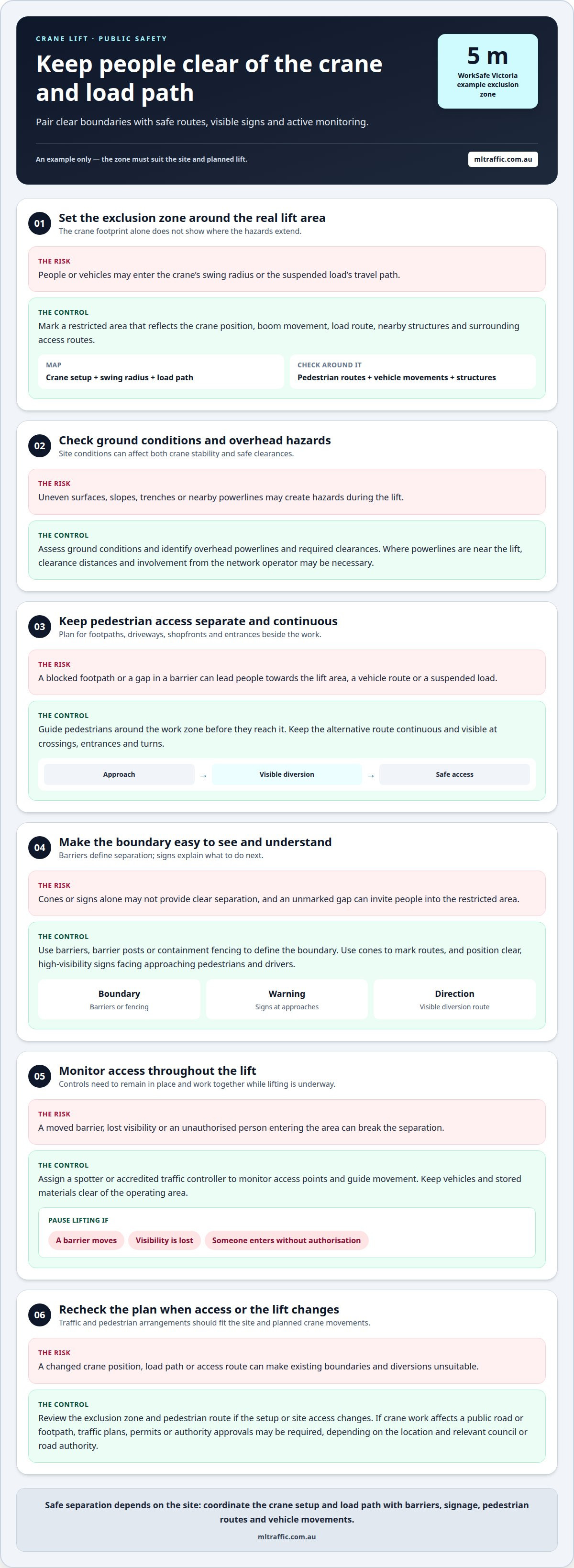
A SWMS example from WorkSafe Victoria specifies a 5 m exclusion zone marked with bunting and signage, monitored by a spotter. This is an example, not a universal radius for every crane or lift. The zone must match the site layout and planned movement, including the load’s path and the crane’s swing.
Protecting Pedestrians from Crane Hazards
Exclusion zones protect pedestrians by separating public and worker access from crane movements and suspended loads. They are important wherever a lift could cross a footpath, driveway, shopfront entrance or vehicle route. A clear boundary helps prevent people from walking beneath a load or entering the crane’s operating area while transport and lifting work is underway.
Key incident risks include pedestrians being struck by vehicles or mobile plant, injuries from falling loads, and collisions between vehicles or plant. These risks can overlap when a vehicle enters the crane’s working area or pedestrians use a route beside reversing plant. Keep pedestrian access outside the marked zone and redirect people before lifting begins.
Boundaries work only when they remain visible and intact throughout the lift. Before work starts, the site team should:
- Mark the crane setup area, swing radius and load path using barriers or bunting.
- Place signage at pedestrian approaches and vehicle entry points.
- Keep vehicles, stored materials and other obstructions clear of the operating area.
- Assign a spotter to monitor the boundary and alert the crew if someone approaches.
- Pause lifting if a barrier moves, visibility is lost or an unauthorised person enters.
Review the zone if the crane position, load path or site access changes. A public road, footpath or transport route beside the lift can affect barrier placement and pedestrian diversions. Permits and traffic arrangements may also be relevant when crane work affects public access.
Physical barriers and high-visibility signage
Barriers and signs make restricted areas clear to pedestrians, drivers and workers around a construction lift. The control layout should show where people can move safely and where crane-related access is prohibited.
Separating Pedestrian Paths from Lift Areas
A clearly marked pedestrian path provides a route around the crane work area, separated from vehicle movements and lifting activity. This matters when a footpath, shopfront or building entrance is beside the site. Use barrier posts, containment fencing, signs or ground markings to guide people along the alternative route and keep them out of the lift area.
Plan the route around actual access points. For example, if a crane blocks the usual footpath past a shopfront, direct pedestrians to a safe alternative before they reach the work zone. Keep the route continuous and visible at crossings, site entrances and turns. A gap in a barrier can invite people to take a shortcut through the restricted area.
Barriers should also separate pedestrians from site vehicles and mobile plant. Position them to protect the walking route while preserving clear sightlines at corners and entrances. If a diversion changes how pedestrians approach traffic, place signs early enough for people to follow the route without first entering the work area.
Using Barriers, Cones and Signage
Physical barriers define the boundary, while cones and high-visibility signs make it easier to see and understand. Use signs to identify crane operations, warn people not to enter and point towards the pedestrian diversion. This gives people clear information before they reach the restricted area.
Cones can mark a route or highlight a boundary, while barrier posts or containment fences provide clearer separation. Choose and position controls for the location: cones may guide people along a diversion, but should not leave an unmarked gap beside an active lift area. Signs should face the direction from which pedestrians and drivers approach.
During the lift, a spotter or accredited traffic controller can monitor access points, guide movement and respond if someone approaches the restricted area. Warning lights, signs and barricades can also make crane operations more visible to surrounding traffic. These controls work together: a sign cannot direct pedestrians around a barrier that blocks the intended route.
- Mark pedestrian access and diversion routes with visible signs, markings or barrier posts.
- Place warning signs at approaches, entrances and route changes.
- Use barriers to maintain separation from vehicles, mobile plant and crane activity.
- Keep access controls in place and visible throughout the lift.
- Have a spotter or accredited traffic controller oversee key access points.
Across Australia, footpaths, shopfronts and building entrances near a crane load path need active management. Clear, consistent controls help pedestrians understand where to go and help site teams maintain safe movement around construction work.
Scheduling lifts to reduce disruption
Lift timing affects road access, site movements and disruption to nearby businesses. Coordinate crane arrival, setup, lifting and departure with traffic conditions and any required council approvals.
Planning Lifts Around Traffic
Scheduling lifts around traffic means choosing a work period that limits conflicts with busy vehicle and pedestrian movements. This helps keep access routes manageable while the crane is delivered, set up and removed. Plan every activity, not just the lift itself, because transport vehicles and setup can also affect roads and site access.
Plan crane arrival, setup and departure in advance so the work area can be cleared before mobile plant arrives. Where possible, schedule lifting outside peak traffic periods. Early morning and late afternoon are possible windows, but the best time depends on local traffic flows and nearby site activity.
For example, a crane beside a busy road may need its setup and lifting window coordinated with the affected access route. Map when vehicles, pedestrians and deliveries use the area, then plan the lift around those movements. Council or road authority approvals may be required for work affecting public roads or footpaths, and lead times vary by location.
Scheduling Critical Lifts Near Public Spaces
A critical lift near a public space needs to be timed around the load path, site access and public activity. This matters when a load travels over or near an occupied building, road or public area. A documented lift plan is particularly important in these locations, as timing must align with the specific lift controls.
Multi-crane coordination and lifts using at least 90% of crane capacity are classified as critical lifts. Schedule these operations with the required crew and equipment ready, and minimise access conflicts around the lift area. If the work affects a public road, footpath or parking area, factor relevant approvals into the program before confirming the lifting window.
Choosing Night or Weekend Lift Times
Early, late or weekend lifts can reduce disruption where daytime traffic is heavy. These options are relevant when a site has limited working space or busy daytime access. They still require coordination with the crane crew, transport movements and any council or road authority approvals affecting public areas.
Choose a time that allows crane operators to conduct the lift safely and gives the site team time to prepare access arrangements. Consider nearby residents and businesses, and inform them about the planned work to avoid surprises. A quiet road alone doesn’t make a lift suitable; the crane setup, load path and crew coordination still govern the plan.
Weather can also change the schedule. Wind speeds above 36 km/h are a typical rescheduling threshold for mobile-crane lifts, subject to crane-specific limits. Include a process for reviewing conditions and adjusting the timing if the planned lift cannot proceed safely.
Traffic Management Plans and legal compliance
A traffic management plan sets out how vehicle movements, pedestrian access and hazards will be managed around crane work. Requirements depend on the location and the public areas affected.
Approving and Supervising Traffic Plans
The relevant council or road authority handles approvals for work affecting public roads, while site management coordinates the plan’s implementation. Approval requirements depend on the location, and the site team must put the approved arrangements into practice on the day.
In NSW, hoisting over or above a public road, including its roadway, footpaths and cycleways, requires approval under section 68 of the Local Government Act and section 138 of the Roads Act. For wet-hire crane work, the crane contractor prepares and owns the lift plan; the client or site manager supplies accurate load and site information.
Planning Detours and Lane Management
A traffic management plan explains how traffic will move past or around the crane work area. It is important when a lift requires lane closures, affects a road or changes access to nearby properties. The plan should identify traffic flows, control measures and potential hazards around the construction site.
Show designated vehicle routes and visible stop/slow signs. Include an alternative route for emergencies. If crane setup or lifting affects road space, plan any lane closure and traffic control around the operation. Keep sightlines clear, including at corners, and prevent vehicle movements from conflicting with the crane’s work area.
Managing Pedestrian and Cyclist Access
Pedestrian and cyclist management keeps public access routes clear of crane operations and vehicle movements. It matters when a lift affects a footpath or cycleway, or when the load travels near a public area.
Identify affected routes and show how people will be redirected or kept clear. Consider the risk of pedestrians being injured by vehicles, mobile plant or falling loads. Keep alternative access clear and visible, and coordinate changes with traffic controls so people do not unexpectedly enter a vehicle route or lifting area.
Coordinating Traffic Management
Traffic management coordination brings the lift plan, site movements and public access controls together. The plan should account for site-specific traffic hazards, vehicle types, traffic flows and the load path. This helps the site team align crane activity with the surrounding road network.
Set out who communicates and how. Identify the crane operator, dogger, rigger and supervisor, then establish how the crew will coordinate during the lift. A traffic plan should also make clear:
- Vehicle routes, parking areas and any site speed controls.
- Stop/slow sign locations and traffic control measures.
- Pedestrian and cyclist access arrangements.
- The emergency alternative route and how it will be activated.
Provide relevant plans, documents and notifications to local authorities when seeking necessary permits. Before work begins, check that traffic arrangements align with the crane setup and lifting sequence.
Traffic controllers and pedestrian safety
Traffic controllers coordinate people and vehicles around crane operations. Their role is to keep pedestrian movements separate from vehicle movements and the active lift area, using clear instructions and agreed communication with the site crew. A crane lift plan for traffic and pedestrian safety should show where movements may conflict and how the team will manage them.
Before lifting starts, the site team should identify where a controller is needed, such as at a vehicle entrance, road crossing or pedestrian diversion. The controller can guide people away from restricted areas and direct vehicles along designated routes. This is particularly relevant where a driver’s view is restricted or vehicle movements cross a pedestrian route.
Traffic control depends on clear communication. The lift plan should identify the operator, dogger, rigger and supervisor, and set out how the crew will communicate. If a pedestrian needs to attract a mobile plant operator’s attention, they should use an agreed signal or UHF radio and remain in a designated zone. AS 2550.1 provides for hand signals as a backup communication method.
Controllers and workers need to be visible to drivers and pedestrians. Hard hats, boots and other personal protective equipment support site safety, while high-visibility signs and stop/slow signs help communicate traffic movements. Vehicles fitted with rotating or flashing lights should use them while driving on site, including contractors’ vehicles.
A site traffic plan should explain how those controls work together. It can set out vehicle routes, parking areas, speed controls and an alternative route for emergencies. An example traffic management plan sets a site-wide speed limit of 10 km/h. Marking “Keep clear” zones at corners can help maintain sightlines for drivers and controllers.
Pedestrians must not work alongside operating mobile plant. Any interaction with a load should be managed carefully to keep people clear of moving equipment. For example, isolation can involve engaging the handbrake, placing controls in neutral and switching off a forklift. These controls prevent routine interactions from putting someone beside moving equipment.
Controllers do not replace the lift plan or the site’s access controls. Their instructions need to match planned vehicle routes and pedestrian arrangements. If traffic flow changes, signs are obscured or communication fails, the crew should stop the affected movement until controls are restored. A crane lift plan for traffic and pedestrian safety can document these interfaces, while a Traffic Guidance Scheme (TGS) sets out traffic arrangements for crane operations. Physical traffic control is a separate activity.
For a documented traffic arrangement around crane work, request a Traffic Guidance Scheme that addresses vehicle and pedestrian movements around the site.
ML Traffic Engineers Australia: Waste Management Plan
ML Traffic Engineers Australia prepares Waste Management Plans and traffic assessments to support development planning where site access and vehicle movements need consideration. A Traffic Impact Assessment (TIA) Report can assess traffic implications, while Vehicle Swept Path Analysis examines vehicle paths for site access and manoeuvring. These services are relevant when a project’s vehicle routes or access arrangements form part of its planning requirements. A Car Parking Demand Assessment addresses parking needs as another element of development planning. For crane-related traffic planning, these assessments can help clarify how a proposal interacts with surrounding roads and site movements; they don’t replace the lift contractor’s technical lift plan or on-site traffic control. Contact ML Traffic Engineers Australia to discuss your project’s planning needs.
Plan the next stage with confidence
Before crane mobilisation, align the lift programme with the project’s broader access and development requirements. A crane lift plan for traffic and pedestrian safety addresses the immediate operation, while project planning may also need to consider how ongoing vehicle movements, site access and parking affect surrounding roads.
ML Traffic Engineers Australia prepares Traffic Impact Assessment (TIA) Reports to assess traffic implications, Vehicle Swept Path Analyses to examine vehicle paths, and Car Parking Demand Assessments to consider parking needs. These assessments can inform planning decisions when traffic and access are part of the project scope. They support, but do not replace, the crane contractor’s technical lift plan and site controls.
Taking this planning step early can help bring project access considerations into focus before work proceeds. Discuss your project with ML Traffic Engineers Australia and identify the traffic assessment that fits your planning needs.
Frequently Asked Questions
What is a Construction Crane Traffic Plan?
A construction crane traffic plan explains how site and public traffic will be managed during crane work. It connects the crane operation with the movement of vehicles, pedestrians and cyclists around the worksite. For example, it can show how a delivery vehicle enters while another route remains available to people using nearby public access. The plan should reflect the actual lift sequence and site layout, not a generic traffic arrangement.
Is a lift plan a legal requirement?
A lift plan is required for some higher-risk lifting scenarios, but the requirement is not the same for every lift. The available Australian guidance identifies lifts exceeding 75% of rated crane capacity as a scenario requiring a plan. Lifts using at least 90% of capacity or involving multiple cranes are classified as critical lifts. Commercial builders also commonly require the lift plan and SWMS before crane mobilisation.
What Australian WHS laws and codes of practice apply to crane lifts near roads and pedestrians?
Relevant references include AS 2550.5 and the Work Health and Safety Regulation 2011 for lift planning in high-risk operations. AS 2550.1 covers hand signals used as a backup communication method. The applicable requirements depend on the work and jurisdiction, so a reference to a standard does not replace the project’s risk assessment or approvals for public-road impacts. Keep the lift documentation aligned with the site’s actual work activities.
What exclusion zones and safety distances are required around crane lifts in Australia?
There is no single exclusion distance that suits every crane lift. Set the boundary according to the crane’s movement, the load path, site access and nearby hazards. A 5 m example is not a universal Australian requirement; the working area must reflect the specific lift and site conditions. Extend or reposition controls where the load path, vehicle access or pedestrian routes create additional exposure.
How should traffic management plans coordinate with crane lift plans on Australian worksites?
Coordinate the documents so the crane’s planned position and load movement fit the traffic arrangement. For example, if a lift changes a delivery route, the traffic plan should show the alternative route and the lift sequence should avoid conflicting vehicle movements. Match any road or footpath restrictions with relevant approvals, site access arrangements and work timing. Update both plans together if the crane position or traffic layout changes.
What should a crane lift plan specify for communication, emergency response and changing site conditions?
Identify the operator, dogger, rigger and supervisor, then record how they will communicate during the lift. The plan should state how the crew will respond if communication fails or an emergency route is needed. It should also address conditions that could affect the operation, such as changing wind or ground conditions. If site conditions differ from the plan, pause the affected activity and reassess the controls before continuing.

Disclaimer
The content on www.mltraffic.com.au, including all technical articles, guides, and resources, is provided for general informational and educational purposes only. It is not intended to constitute professional advice in traffic engineering, transportation planning, development approvals, or any other technical or legal field.
While ML Traffic Engineers makes every reasonable effort to ensure the accuracy, completeness, and timeliness of the information published, we do not provide any warranties or representations (express or implied) regarding its reliability, suitability, or availability for any particular purpose. Any reliance you place on the content is strictly at your own risk.
In no event shall ML Traffic Engineers, its directors, employees, authors, or affiliates be liable for any direct, indirect, incidental, special, consequential, or punitive damages (including, without limitation, loss of profits, data, or business opportunities) arising out of or in connection with the use of, or inability to use, any information provided on this website.
The articles and guides on this site are not a substitute for engaging a qualified, registered professional traffic engineer (such as an NPER or RPEQ engineer) to assess your specific project requirements. For tailored advice, compliance assessments, or traffic engineering services, please contact a competent professional.
This disclaimer may be updated from time to time without notice. By accessing or using this website, you agree to be bound by the most current version of this disclaimer.
