

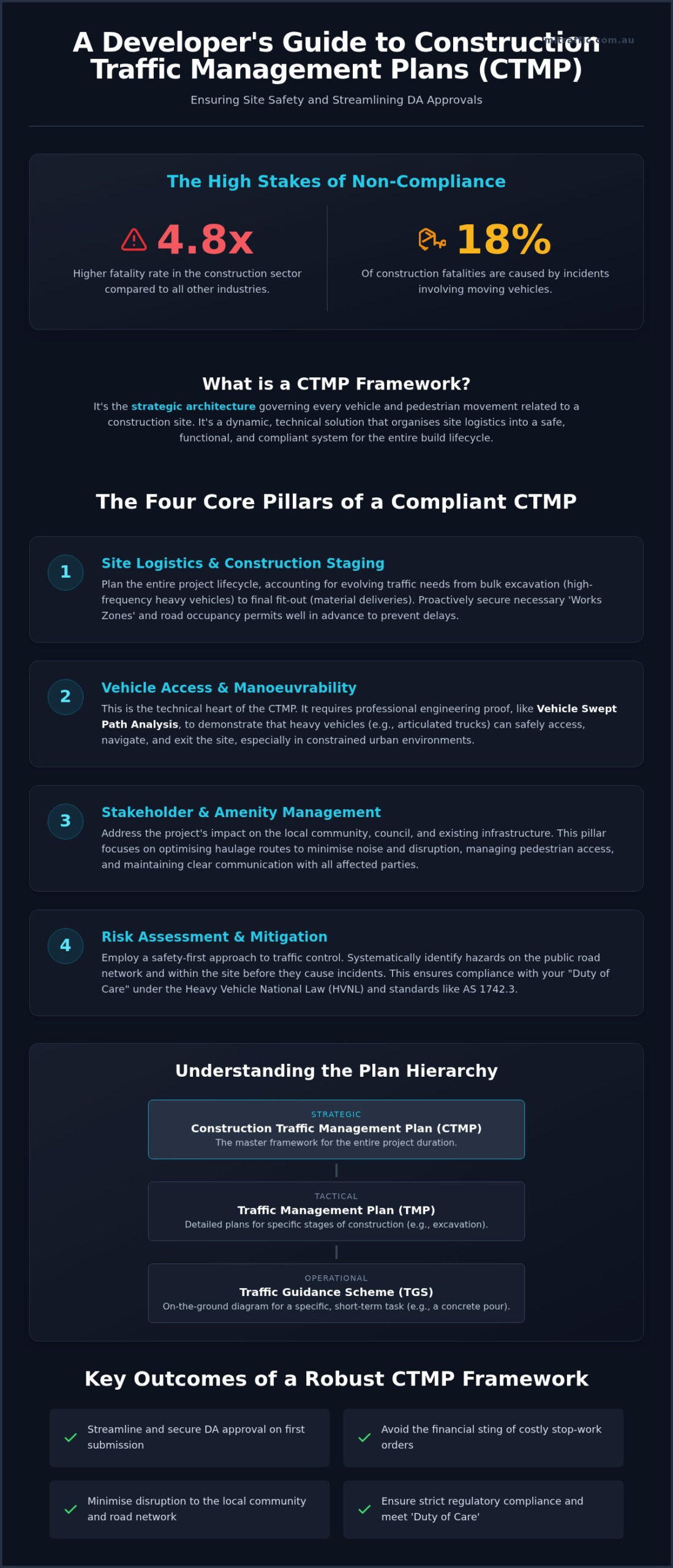
In 2024/25, the construction sector recorded a fatality rate 4.8 times the average for all other industries, with 18% of those deaths caused by moving vehicles. For developers, these statistics aren’t just numbers; they represent the high stakes involved in site logistics. Implementing a robust Construction Traffic Management Plan (CTMP) framework is the only way to ensure site safety while avoiding the financial sting of a stop-work order. Non-compliance often stems from a failure to address site access or heavy vehicle haulage early in the planning phase.
You’re likely aware that council scrutiny has never been tighter, especially regarding constrained urban developments. This article provides a clear roadmap for CTMP development to help you secure DA approval on your first submission and minimise disruption to the surrounding road network. We’ll examine the essential structural pillars of the framework, including how to distinguish strategic TMPs from operational Traffic Guidance Schemes (TGS) and how to manage complex vehicle swept paths with precision.
Key Takeaways
- Learn how the Construction Traffic Management Plan (CTMP) framework serves as the primary strategic document for managing site logistics across the entire build lifecycle.
- Understand the hierarchy between strategic plans and operational schemes to ensure your Traffic Guidance Schemes (TGS) align with council expectations.
- Utilise technical methodologies like Vehicle Swept Path Analysis to prove site accessibility for heavy haulage vehicles on constrained urban blocks.
- Optimise haulage routes for articulated vehicles to minimise community disruption and ensure strict regulatory compliance.
- Streamline the DA approval process by securing professional engineering certification to address potential council Requests for Information (RFI) proactively.
Defining the Construction Traffic Management Plan (CTMP) Framework
A Construction Traffic Management Plan (CTMP) framework is not just a static document kept in a site office. It is the strategic architecture that governs every vehicle and pedestrian movement around your development. While a “requirement” is simply a condition of consent issued by the council, the framework is the technical solution that organises these requirements into a functional, safe, and compliant system. It serves as the primary tool for managing the complex interaction between heavy machinery and the public road network.
To better understand how these plans function on-site, watch this helpful video:
Relying on a generic checklist is a high-risk strategy for modern developers. Every site has unique constraints, from narrow laneways to proximity to schools or hospitals. Failing to address these through a formal framework increases your legal liability significantly. Effective road traffic control is a life-saving necessity. For context, the construction sector consistently sees higher fatality rates than other industries, often due to vehicle-related incidents. A site-specific framework ensures you meet your safety obligations while maintaining operational momentum.
The Purpose of a Structured Framework
The Construction Traffic Management Plan (CTMP) framework is the blueprint for site-related transport logistics. It establishes clear lines of accountability between the developer, the lead contractor, and the traffic engineer. This structure ensures that as a site evolves from excavation to fit-out, the methodology remains scalable. It prevents the operational disconnect that often leads to stop-work orders. By defining roles and response protocols early, you create a system that adapts to changing site conditions without compromising safety.
Regulatory Triggers and Council Expectations
A formal framework typically becomes a mandatory condition of consent for medium and high-density developments. Councils expect these documents to adhere to national standards such as AS 1742.3 and relevant state-specific supplements. Beyond local planning laws, developers must understand their “Duty of Care” under the Heavy Vehicle National Law (HVNL). This law places direct responsibility on everyone in the supply chain to ensure transport safety. Engaging expert traffic engineering services ensures these regulatory triggers are met with technical precision and professional sign-off.
Core Pillars of a Compliant CTMP Framework
A compliant Construction Traffic Management Plan (CTMP) framework relies on four structural pillars. These pillars provide a comprehensive approach to safety, regulatory compliance, and operational flow. Without this structure, a plan becomes a collection of reactive measures rather than a proactive strategy. Precision is mandatory. By embedding these pillars into your Construction Traffic Management Plan (CTMP) framework, you reduce the risk of council RFIs and site-wide shutdowns.
- Pillar 1: Site Logistics and Staging. This involves planning the entire lifecycle of the build to account for changing traffic volumes.
- Pillar 2: Vehicle Access and Manoeuvrability. This is the technical heart. It requires engineering proof that heavy vehicles can navigate the site safely.
- Pillar 3: Stakeholder and Amenity Management. This pillar focuses on the impact on the local community, council, and existing infrastructure.
- Pillar 4: Risk Assessment and Mitigation. This is the safety-first approach to traffic control, identifying hazards before they cause incidents on the public road network.
Site Logistics and Construction Staging
Traffic requirements evolve significantly from the initial bulk excavation to the final fit-out. Early stages often require high-frequency heavy vehicle movements for soil removal. Later stages shift toward material deliveries and specialised trade access. A robust framework plans for these shifts by identifying necessary ‘Works Zones’ and securing temporary road occupancy permits well in advance. Integrating expert traffic consultancy for waste management and material delivery schedules prevents logistical bottlenecks that often lead to costly project delays.
Public Domain and Amenity Protection
Maintaining the public domain is a critical council expectation. A successful framework includes strategies for minimising the impact on local parking and pedestrian flow. This involves more than just signage. It requires a detailed analysis of how noise, dust, and vibration from traffic movements affect the surrounding area. Protecting vulnerable road users, such as cyclists and pedestrians, is non-negotiable. The framework must ensure safe passage through well-defined detours and clear sightlines at all site entry points. This level of detail ensures that the development maintains a positive relationship with the local community while fulfilling its legal obligations.
Strategic Framework vs. Operational Schemes: Navigating TGS and TMP
The Construction Traffic Management Plan (CTMP) framework operates as the overarching “parent” document for all site-specific traffic activities. It sets the strategic direction for the entire project lifecycle. You cannot have a valid Traffic Guidance Scheme (TGS) without this broader framework to provide the necessary context and justification. While the framework defines the project’s long-term transport logistics, the TGS handles the immediate, street-level execution. This hierarchy ensures that every temporary sign or bollard serves the project’s primary safety and compliance goals.
The framework dictates the “Rules of Engagement” for on-site traffic controllers. It provides the mandate for how vehicles enter and exit the site over the project’s multi-year lifespan. In contrast, operational schemes are often transient. A strategic framework remains active from the first day of demolition to the final landscaping. Short-term plans are retired as soon as the specific task, like a concrete pour, is complete. This distinction is critical for developers who must manage both high-level regulatory commitments and daily site realities.
What is a Traffic Guidance Scheme (TGS)?
A TGS is the diagrammatic representation of the physical signs and devices used to manage traffic at a specific location. It is a technical requirement for high-risk tasks such as crane lifts, concrete pours, or service connections. Every TGS must be audited against the Construction Traffic Management Plan (CTMP) framework to ensure it doesn’t contradict established haulage routes or community amenity agreements. It provides the granular detail that field crews need to implement safe traffic guidance schemes on the ground. Precision in these diagrams prevents confusion and reduces the risk of onsite incidents.
Integrating TGS into the Master Framework
Consistency between high-level haulage routes and street-level signage is essential for regulatory compliance. The Traffic Guidance Scheme plays a vital role in daily site operations by translating strategic goals into actionable instructions. Managing the transition between “short-term” measures and “long-term” traffic control requires a disciplined approach. If a TGS deviates from the master framework, it creates legal vulnerability and operational confusion. Every operational plan must reinforce the core safety pillars established in the strategic document to maintain site integrity and council approval.
Technical Methodologies: Vehicle Access and Swept Path Analysis
Technical precision in vehicle access is the defining characteristic of a professional Construction Traffic Management Plan (CTMP) framework. Every framework must identify the “critical vehicle” for the project. This is the largest anticipated vehicle, such as a 12.5m heavy rigid truck or a 19m articulated vehicle, that requires site access during any phase of construction. Designing for the critical vehicle ensures that loading and unloading zones remain functional without encroaching on live traffic lanes or pedestrian footpaths. This technical rigour prevents the operational bottlenecks that lead to site congestion and council complaints.
Loading and unloading zone design within the CTMP framework must account for more than just the vehicle’s footprint. It requires a detailed understanding of the “swept path” or the area a vehicle covers while turning. Failure to design these zones accurately often results in vehicles being forced to perform illegal or dangerous manoeuvres on public roads. If you require technical verification for your site access points, you can contact our senior engineers for a detailed assessment and professional sign-off.
The Role of Swept Path Analysis in Approvals
Councils demand Swept Path Analysis for every construction gate to verify that heavy vehicles can enter and exit in a forward direction. We utilise industry-standard software like AutoTURN to simulate complex manoeuvres in tight urban corridors. These simulations account for the specific dimensions and turning circles of the vehicles used by your contractors. Empirical swept path data removes subjective council objections by providing mathematical proof of manoeuvrability. It transforms a developer’s request into an engineering certainty, significantly increasing the likelihood of first-time DA approval.
Heavy Vehicle Haulage and Route Management
Haulage route management requires identifying “Approved” routes that avoid weight-restricted residential streets and low-clearance bridges. These routes must align with the National Heavy Vehicle Regulator (NHVR) standards to ensure legal compliance across state and local jurisdictions. Managing the “holding” of trucks off-site is another critical strategy within the framework. By establishing designated holding areas, you prevent local traffic congestion and ensure that trucks only arrive at the site when the loading zone is clear. This level of coordination is essential for maintaining site efficiency and community goodwill in constrained CBD environments.
Finalising the Framework: Engineering Certification and Submission
Finalising the Construction Traffic Management Plan (CTMP) framework requires more than administrative filing. It demands formal engineering certification to ensure the proposed logistics are technically sound and legally defensible. An accredited traffic engineer provides the professional sign-off that councils require to satisfy development consent conditions. This certification is a critical component of your project’s professional indemnity and site insurance profile. Without it, you risk immediate stop-work orders if an incident occurs on the public road network.
The council “Request for Information” (RFI) process is often where developments stall. A robust framework, backed by the empirical data discussed in earlier sections, allows for more effective negotiation with local authorities. Many developers face delays because their initial Traffic Impact Assessment (TIA) does not align with their construction-phase logistics. Having the same engineer manage the project from the initial TIA through to the final CTMP submission ensures technical continuity. This engineer understands the site’s history and can address council queries without the need for redundant re-briefing. This integration is essential for securing approval on the first submission and avoiding the costs of a stalled site.
Engaging a Qualified Traffic Engineer
There is a significant difference between a traffic controller and a Traffic Engineer during the planning phase. Controllers manage the daily flow, but engineers design the strategic methodology. Direct access to senior principals at ML Traffic Engineers Australia ensures that your technical work is performed by experts with over 15 years of consultancy experience. This “no-gatekeepers” approach eliminates the delays often associated with larger firms. Senior leadership involvement means your Construction Traffic Management Plan (CTMP) framework is designed to meet national standards, including AS 2890 and MUTCD 11th Edition, from the outset.
Monitoring and Adjusting the Framework
A professional framework is a living document. It requires a structured schedule for auditing and adjustment as site conditions shift. For example, if a neighbouring development starts work or a local road becomes weight-restricted, your framework must adapt. Handling these “Variations” through a formal engineering process maintains the document’s legal integrity. Proactive monitoring ensures that your site remains compliant and operational throughout every phase of the build. Contact ML Traffic Engineers Australia to develop your compliant CTMP framework today.
Securing Your Site Logistics and Regulatory Approval
A professionally developed Construction Traffic Management Plan (CTMP) framework is the most effective tool for mitigating site risk and ensuring project continuity. By integrating technical methodologies such as Swept Path Analysis early in the planning phase, you provide councils with the empirical evidence required for rapid DA approval. This strategic approach ensures that daily operations, including Traffic Guidance Schemes (TGS) and heavy vehicle haulage, remain compliant with national standards throughout the build lifecycle.
ML Traffic Engineers Australia provides over 15 years of Australian planning experience to every project. Our senior principals personally handle every assessment, specialising in the complexities of complex urban site logistics. This direct access to expertise eliminates unnecessary bureaucracy and ensures your framework is technically robust from the first submission. Secure your DA approval with a professional CTMP framework from ML Traffic Engineers Australia and ensure your development moves forward without the threat of stop-work orders or regulatory delays. Your project deserves the certainty that only seasoned engineering expertise can provide.
Frequently Asked Questions
What is the difference between a TMP and a CTMP framework?
A Traffic Management Plan (TMP) is a strategic document while a CTMP framework is a site-specific plan for the construction phase. The CTMP details gate locations, truck routes, and safety measures for the build duration. While a TMP covers general traffic impacts for the development’s lifespan, the CTMP focuses on construction logistics. This includes managing heavy vehicle haulage and site-specific access points to maintain safety.
When does a local council require a formal CTMP framework?
Local councils mandate a formal Construction Traffic Management Plan (CTMP) framework as a condition of consent for most medium to high-density developments. This requirement is triggered when projects involve significant heavy vehicle movements or disruption to public roads. It’s a binding document once approved. You must satisfy this condition to avoid stop-work orders and ensure your project remains compliant with local planning laws.
Can I create a CTMP framework without a qualified traffic engineer?
Councils require an accredited traffic engineer to sign off on the technical components of the plan. Professional engineering certification ensures your logistics comply with national standards like AS 1742.3. Submitting a plan without professional sign-off results in rejection and a Request for Information (RFI). This delays your project and increases the risk of non-compliance during the critical early stages of construction.
How often does a CTMP framework need to be updated during construction?
You must update the framework whenever site conditions or construction stages change significantly. This includes moving site access points or shifting from excavation to the fit-out phase. Regular audits ensure the plan reflects actual on-site conditions. Maintaining an accurate document is essential for fulfilling your development consent conditions and ensuring the safety of all road users throughout the project lifecycle.
Does the CTMP framework cover pedestrian and cyclist safety?
Protecting vulnerable road users is a mandatory component of any compliant framework. The plan must detail specific measures such as hoardings, clear sightlines at gates, and safe detour routes for pedestrians and cyclists. Councils prioritise these safety measures to minimise risk during high-frequency truck movements. Failure to address these concerns often leads to delays in the approval process or council-imposed site restrictions.
What are the common reasons a CTMP framework is rejected by council?
Rejection often occurs due to inadequate swept path data or failure to address local parking impacts. Other common reasons include proposing haulage routes on weight-restricted residential streets or failing to coordinate with nearby construction sites. A lack of technical detail regarding works zones or truck holding areas also leads to a council RFI. Precision in these technical areas is vital for first-time approval.
How does Swept Path Analysis integrate into the CTMP framework?
Swept Path Analysis provides the empirical proof that heavy vehicles can enter and exit the site in a forward direction. It justifies the location of site gates and the dimensions of loading zones. This analysis removes subjective objections from council engineers by demonstrating that the critical vehicle can manoeuvre safely. It is a technical necessity for any modern development application in constrained urban areas.
What role does the 11th Edition MUTCD play in CTMP planning for 2026?
The 11th Edition MUTCD provides the national standards for traffic control devices and signage that must be used in 2026. All plans must adhere to these updated guidelines to ensure consistency and safety across the road network. Compliance with these standards is a primary metric used by councils to assess the technical validity of your traffic management strategy and overall site safety.

Disclaimer
The content on www.mltraffic.com.au, including all technical articles, guides, and resources, is provided for general informational and educational purposes only. It is not intended to constitute professional advice in traffic engineering, transportation planning, development approvals, or any other technical or legal field.
While ML Traffic Engineers makes every reasonable effort to ensure the accuracy, completeness, and timeliness of the information published, we do not provide any warranties or representations (express or implied) regarding its reliability, suitability, or availability for any particular purpose. Any reliance you place on the content is strictly at your own risk.
In no event shall ML Traffic Engineers, its directors, employees, authors, or affiliates be liable for any direct, indirect, incidental, special, consequential, or punitive damages (including, without limitation, loss of profits, data, or business opportunities) arising out of or in connection with the use of, or inability to use, any information provided on this website.
The articles and guides on this site are not a substitute for engaging a qualified, registered professional traffic engineer (such as an NPER or RPEQ engineer) to assess your specific project requirements. For tailored advice, compliance assessments, or traffic engineering services, please contact a competent professional.
This disclaimer may be updated from time to time without notice. By accessing or using this website, you agree to be bound by the most current version of this disclaimer.
