
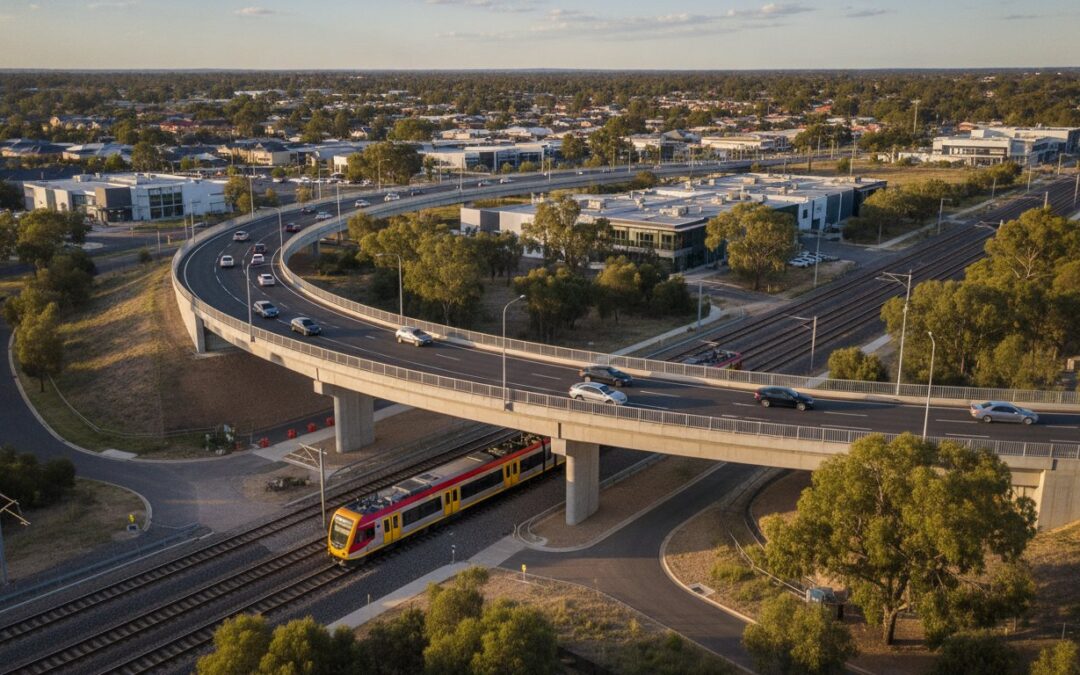
With approximately 21,000 vehicles navigating the current bottleneck daily, the $250 million Curtis Road Adelaide Level Crossing Removal is a critical transformation for northern Adelaide’s transport network. You likely know that the boom gates at this crossing stay down for up to 15 minutes every hour during peak periods, causing significant delays and safety risks. As the project moves through the design phase in 2026 toward construction in late 2027, the shift to a road overpass will fundamentally alter local traffic flow and property access.
We understand the uncertainty this creates for developers regarding new access points and the potential for increased congestion during the multi-year construction phase. You’ll discover the technical traffic engineering implications of this project and learn how to ensure your development remains compliant as Council TIA requirements evolve. This article provides expert insight into the road overpass design and specific swept path requirements near these major works.
We’ll examine the impact of converting side street connections to left-in, left-out only and the planned $15 million upgrade at the Curtis and Andrews Road intersection. By reviewing these infrastructure shifts now, you can maintain your DA’s integrity and prepare for the project’s completion in 2030.
Key Takeaways
- Understand why a road overpass was selected over an underpass due to local flood risks and specific topographical constraints at the Munno Para site.
- Learn why major infrastructure shifts necessitate an updated Traffic Impact Assessment (TIA) to account for changes in traffic distribution and network flow.
- Discover the technical implications of the Curtis Road Adelaide Level Crossing Removal on local property access and the conversion of side streets to left-in, left-out configurations.
- Identify the critical role of Vehicle Swept Path Analysis in maintaining heavy vehicle access and site functionality during construction detours and major works.
- Gain insight into securing development application compliance through professional intersection analysis and direct senior leadership involvement in Council negotiations.
Project Overview: The Curtis Road Adelaide Level Crossing Removal
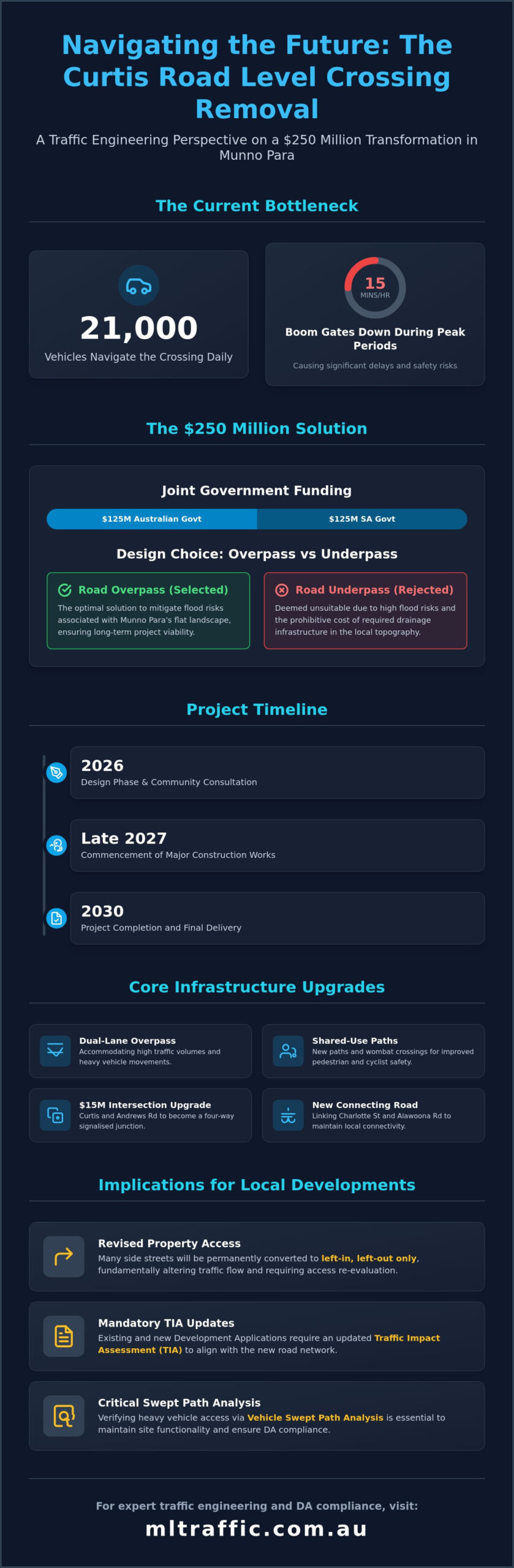
The Curtis Road Adelaide Level Crossing Removal is a $250 million infrastructure project jointly funded by the Australian and South Australian Governments. Each tier of government is contributing $125 million to address a critical bottleneck in Munno Para where the Gawler rail line intersects with one of northern Adelaide’s primary arterial roads. Current data indicates that 21,000 vehicles navigate this crossing daily, facing significant delays that hinder local productivity and commuter efficiency.
The project transitions from the design phase throughout 2026, following community information sessions held in June 2026 at the Playford Uniting Church. Major construction works are anticipated to commence in late 2027, with geotechnical investigations already underway as of mid-2026. The final delivery of the project is scheduled for 2030, providing a long-term solution for the expanding Playford Alive East housing development.
To visualise the scale of these works and the impact on the northern suburbs, watch this project summary video:
Key Infrastructure Components
The selected design solution is a dual-lane road overpass. Engineers determined that an underpass was unsuitable for this site due to the flat landscape and inherent flood risks in the Munno Para area. The overpass structure includes several critical elements:
- Dual-lane carriageways designed to accommodate high traffic volumes and heavy vehicle movements.
- Integrated shared-use paths and new “wombat” crossings to improve safety for pedestrians and cyclists.
- Relocation and installation of major water mains and stormwater infrastructure.
- A new connecting road between Charlotte Street and Alawoona Road to maintain local connectivity.
Beyond the structural roadworks, the project includes $15 million in additional funding to upgrade the Curtis Road and Andrews Road intersection to a four-way signalised junction. The space beneath the overpass presents opportunities for landscaping and community areas, ensuring the infrastructure integrates with the local urban fabric.
Project Drivers and Necessity
The primary rationale for this level crossing removal is the elimination of peak-hour congestion. Currently, boom gates are down for up to 15 minutes every hour during peak periods, creating unpredictable travel times. This inefficiency impacts both private commuters and commercial freight operators who rely on Curtis Road as a primary transit corridor. Safety is the other non-negotiable driver, as removing the interface between heavy rail and road vehicles eliminates the risk of collisions.
For developers, the Curtis Road Adelaide Level Crossing Removal necessitates a proactive review of Traffic Impact Assessment (TIA) requirements. As side street connections shift to left-in, left-out configurations, existing site access plans must be re-evaluated. Maintaining regulatory compliance requires precise engineering data to account for these permanent changes in traffic distribution.
Evaluating Design Solutions for Level Crossing Removals
Selecting the correct engineering solution for the Curtis Road Adelaide Level Crossing Removal requires a balance of topographical constraints, rail service continuity, and long-term maintenance costs. While underpasses are often preferred in high-density urban centres to minimise visual bulk, they were ruled out for the Munno Para site. The region’s flat landscape and documented flood risks make depressed road surfaces technically unviable and prohibitively expensive to drain.
A rail overpass was also considered but ultimately bypassed in favour of a road overpass. Rail-over-road designs typically necessitate extensive shutdowns of the rail network, which would severely disrupt the Gawler rail line. By choosing a road overpass, the project team can construct the majority of the bridge structure adjacent to the existing tracks, reducing the need for prolonged rail replacement bus services.
The Road Overpass Advantage
Road overpasses offer distinct advantages in speed of delivery and cost-effectiveness. Because the structure is built for road vehicles rather than heavy freight trains, the engineering tolerances and structural mass are less demanding than a rail bridge. This choice ensures that the $250 million budget is utilised efficiently while providing a grade-separated solution that eliminates boom gate downtime. Road overpasses are preferred in flood-prone Australian landscapes because they avoid the complex drainage and pumping systems required for depressed road surfaces that can become inundated during extreme weather events.
Traffic Flow and Congestion Modelling
Traffic engineers rely on Traffic Impact Assessment guidelines to project how the new overpass will interact with the broader arterial network. Modelling for 2026 and beyond accounts for the removal of the 15-minute boom gate delays, which currently cause significant vehicle idling. Reducing these delays directly lowers the environmental impact of the corridor by decreasing carbon emissions from stationary traffic.
The overpass design must also integrate with the $15 million upgrade at the Curtis and Andrews Road intersection. This signalised four-way intersection is essential for managing the redistributed traffic volumes that will flow once the level crossing bottleneck is removed. If your project is located near these works, conducting a professional intersection analysis is a necessary step to confirm that your site access remains functional under these new conditions.
Maintaining traffic flow on Curtis Road during the construction phase remains a priority. Engineers use complex Traffic Guidance Schemes to ensure that the 21,000 daily vehicles can still navigate the area while major works progress toward the 2030 completion date. This proactive approach to traffic management is vital for minimising the economic impact on local businesses during the build.
Traffic Impact Assessments for Developments Near Major Roadworks
Major infrastructure projects like the Curtis Road Adelaide Level Crossing Removal fundamentally shift the traffic dynamics of a precinct. If you have an active development application (DA) or are planning a new project near Munno Para, your previous baseline data is likely obsolete. Traditional Traffic Impact Assessment (TIA) reports rely on current road conditions to predict future performance. However, the introduction of a dual-lane road overpass and the removal of rail-related delays will redistribute local traffic in ways that existing models cannot account for.
The role of ML Traffic Engineers Australia is to bridge the gap between your development goals and the strict requirements of state transport bodies. We negotiate directly with the City of Playford and the Department for Infrastructure and Transport to ensure your site access remains viable despite the conversion of side streets to left-in, left-out only. This technical advocacy is essential for developers who need to maintain site functionality while adhering to the Gawler rail line’s updated corridor requirements.
Essential Components of a Post-Removal TIA
A post-removal TIA must be comprehensive and forward-looking. It needs to account for the upgraded intersection at Andrews Road and the new connecting road between Charlotte Street and Alawoona Road. Key technical requirements include:
- Revised intersection analysis: Models must incorporate the new overpass ramps and the impact of the four-way signalised junction at Andrews Road.
- Updated volume projections: Traffic estimates for 2026 and the 2030 completion date must be calibrated against the removal of the rail crossing bottleneck.
- Pedestrian and cyclist safety: New infrastructure, such as “wombat” crossings and shared-use paths, requires specific safety assessments within the urban realm.
Navigating Planning Approvals
Securing planning approval in a shifting infrastructure environment requires meticulous attention to regulatory detail. Compliance with the City of Playford’s updated requirements is mandatory for any project seeking a DA near the Curtis Road works. Your Statement of Environmental Effects (SEE) must accurately reflect how your site will interact with the new road geometry and altered traffic patterns. Learn more about our TIA services to see how ML Traffic Engineers Australia assists developers in maintaining compliance during these major shifts. We ensure that your project meets national standards while addressing the specific local challenges posed by the Curtis Road Adelaide Level Crossing Removal.
Swept Path Analysis and Construction Traffic Management
The Curtis Road Adelaide Level Crossing Removal introduces significant logistical challenges during the construction window scheduled between late 2027 and 2030. For properties adjacent to the works, maintaining access for heavy rigid vehicles (HRVs) is a complex regulatory requirement. Construction detours often narrow available carriageways or introduce temporary geometry that can impede larger vehicles. Without precise engineering oversight, these temporary shifts can render existing loading docks and waste collection points inaccessible.
Implementing a robust Traffic Guidance Scheme (TGS) is essential for minimising disruption to business operations. These schemes must account for the 21,000 daily vehicles currently using the corridor while providing safe work zones for contractors. A critical but often overlooked aspect of major overpass construction is the change in road levels. As the overpass ramps are graded, the interface between the public road and private driveways may shift. We perform a driveway ramp grade assessment to ensure your property access remains compliant with AS 2890.1 standards despite these elevation changes.
Manoeuvring and Access Compliance
Technical verification of vehicle movements during the construction phase requires advanced modelling. We use AutoTURN software to simulate truck turning paths, ensuring that HRVs can navigate temporary road closures and narrowed lanes without striking infrastructure or encroaching on pedestrian zones. This analysis is vital for maintaining the operational integrity of commercial sites near the Munno Para works. For a deeper understanding of these technical requirements, read our complete guide to swept path analysis. Key compliance factors include:
- Sight distance requirements: Maintaining clear lines of sight at newly formed temporary intersections and site egress points.
- Turning radii verification: Confirming that service vehicles can enter and exit sites in a single forward motion.
- Clearance heights: Assessing the impact of temporary overhead structures or scaffolding on heavy vehicle access.
Construction Management Plans
Developing a comprehensive Traffic Management Plan (TMP) is a prerequisite for developments adjacent to the Curtis Road Adelaide Level Crossing Removal. This document must detail how construction traffic will be segregated from the public and how site deliveries will be managed. Coordinating waste management and loading dock access is particularly challenging during peak construction periods when road occupancy is high. Our engineers work with developers to design TGS layouts that prioritise pedestrian safety while allowing for the continuous flow of commercial freight. This meticulous approach to construction traffic management prevents costly delays and ensures your site remains functional throughout the project’s multi-year duration.
Expert Traffic Engineering Consultancy for Australian Developers
ML Traffic Engineers Australia operates as a national consultancy with more than 15 years of specialised experience in the civil engineering and urban planning sectors. We provide the technical rigour required to navigate the regulatory shifts associated with the Curtis Road Adelaide Level Crossing Removal. Our firm understands the specific bureaucratic and engineering hurdles developers face when major infrastructure upgrades alter established road networks. We offer a results-oriented approach that prioritises regulatory compliance and project continuity.
Our professional status is defined by a hands-on, accountable philosophy. Unlike larger firms where work is often delegated to junior staff, ML Traffic Engineers Australia ensures that senior principals are directly involved in every technical assessment and Council negotiation. This personnel continuity promise means the expert who initiates your project is the one performing the detailed engineering work. This direct access to leadership serves as a marker of reliability for clients managing high-stakes developments near major transport corridors.
Why Partner with a Specialist Traffic Engineer?
Meticulous technical reporting is the primary tool for avoiding costly delays during the planning process. As the transport landscape near Munno Para evolves, developers must ensure their projects remain compliant with updated local and state requirements. Partnering with a specialist provides several distinct advantages:
- Regulatory Compliance: We ensure all car park designs and site access points meet the rigorous requirements of the AS 2890 series and other national standards.
- Expert Representation: We provide authoritative advocacy in negotiations with the City of Playford and the Department for Infrastructure and Transport.
- Risk Mitigation: Early identification of potential access or swept path issues prevents expensive redesigns after the DA has been lodged.
- Operational Efficiency: Our technical assessments optimise the flow of vehicles and pedestrians within your site, enhancing long-term commercial viability.
Get Started with Your Traffic Assessment
We provide customised solutions for an exhaustive list of project types, including retail centres, industrial complexes, and high-density residential developments. Whether you require a comprehensive TIA Report, a Vehicle Swept Path Analysis, or a detailed Waste Management Plan, our team delivers results-oriented documentation that stands up to the closest scrutiny. We are committed to helping you achieve your development goals while maintaining the highest standards of safety and efficiency. Contact ML Traffic Engineers Australia today to discuss your project requirements and secure the expert insight your development deserves.
Securing DA Compliance for Future Curtis Road Developments
The transition to a road overpass and the resulting changes to local street geometry demand a proactive approach to development planning. You’ve seen how the Curtis Road Adelaide Level Crossing Removal alters baseline traffic volumes and necessitates updated intersection analysis for any project near the Munno Para precinct. Meticulous swept path modelling and driveway ramp grade assessments are non-negotiable for maintaining site functionality during and after the construction phase.
ML Traffic Engineers Australia brings over 15 years of specialist experience to your project. We ensure direct principal involvement in every technical report, providing the national expertise required for AS 2890 compliance and rigorous TIA preparation. This hands-on accountability helps you avoid costly planning delays and secures the technical advocacy your development requires. It’s essential to address these infrastructure shifts early to maintain your project’s timeline and regulatory standing.
Secure your Traffic Impact Assessment from the experts at ML Traffic Engineers Australia to discuss your specific site requirements. We look forward to ensuring your project remains compliant and accessible throughout this major infrastructure transformation.
Frequently Asked Questions
How does a level crossing removal affect my existing development application?
A level crossing removal often necessitates a revision of existing development applications because it fundamentally changes the surrounding road geometry and traffic distribution. Previous assumptions regarding site access and intersection performance may no longer align with the updated infrastructure design. This shift often requires a technical review to maintain regulatory compliance during the Curtis Road Adelaide Level Crossing Removal project.
What is a Traffic Impact Assessment (TIA) and when is it required?
A Traffic Impact Assessment (TIA) is a technical report that evaluates the potential effects of a proposed development on the existing transport network. It’s typically required by Councils or state transport authorities during the planning phase for new projects or significant changes in land use. The report ensures that the proposed development doesn’t adversely affect the safety or efficiency of the surrounding road network.
Why is Swept Path Analysis important for commercial sites near Curtis Road?
Swept Path Analysis is critical for verifying that heavy rigid vehicles can safely enter and exit your site without striking infrastructure or encroaching on pedestrian zones. During the Curtis Road Adelaide Level Crossing Removal, temporary road closures and narrowed lanes make this modelling essential. It ensures that commercial loading and waste collection operations remain functional throughout the construction period.
How do road overpasses improve traffic flow compared to boom gates?
Road overpasses improve traffic flow by providing grade separation between rail and road vehicles, which permanently eliminates the need for boom gates. This removal stops the cyclical congestion caused by passing trains. It allows for a continuous flow of traffic, which significantly reduces vehicle idling times and unpredictable delays for northern suburb commuters.
Will the Curtis Road project impact my property access during construction?
Construction activities will likely affect property access through temporary detours, lane closures, and changes to road surface elevations. Developers and landholders should monitor these shifts closely. Permanent changes to road levels may require a professional driveway ramp grade assessment to ensure continued compliance with national access standards once the overpass is complete.
What Australian Standards govern car park design and driveway grades?
Car park design and driveway grades are primarily governed by the AS 2890 series of standards. This includes AS 2890.1 for off-street car parking and AS 2890.2 for commercial vehicle facilities. Adherence to these standards is mandatory for securing Council approval and ensuring the long-term safety of all road users within a private development.
Can a traffic engineer help with Council negotiations for my DA?
Expert traffic engineers provide technical advocacy during Council negotiations by presenting evidence-based reports that address specific planning concerns. This representation is vital for resolving disputes regarding site access, parking shortfalls, or intersection performance. Professional mediation helps to streamline the DA approval process by addressing bureaucratic requirements through technical expertise.
How long does it take to prepare a professional traffic report?
The time required to prepare a professional traffic report depends on the project’s complexity and the specific requirements of the local authority. While standard assessments can often be completed within two to three weeks, larger projects involving complex intersection modelling may require additional time. It’s best to engage an expert early to ensure all data collection and analysis align with your project timeline.

Disclaimer
The content on www.mltraffic.com.au, including all technical articles, guides, and resources, is provided for general informational and educational purposes only. It is not intended to constitute professional advice in traffic engineering, transportation planning, development approvals, or any other technical or legal field.While ML Traffic Engineers makes every reasonable effort to ensure the accuracy, completeness, and timeliness of the information published, we do not provide any warranties or representations (express or implied) regarding its reliability, suitability, or availability for any particular purpose. Any reliance you place on the content is strictly at your own risk.In no event shall ML Traffic Engineers, its directors, employees, authors, or affiliates be liable for any direct, indirect, incidental, special, consequential, or punitive damages (including, without limitation, loss of profits, data, or business opportunities) arising out of or in connection with the use of, or inability to use, any information provided on this website.The articles and guides on this site are not a substitute for engaging a qualified, registered professional traffic engineer (such as an NPER or RPEQ engineer) to assess your specific project requirements. For tailored advice, compliance assessments, or traffic engineering services, please contact a competent professional.This disclaimer may be updated from time to time without notice. By accessing or using this website, you agree to be bound by the most current version of this disclaimer.
