

Most developers assume a full Traffic Impact Assessment is mandatory for every project, but over-specifying your technical reports can be just as costly as ignoring them. You likely feel the weight of local council thresholds and the constant pressure of a Request for Further Information (RFI) stalling your progress. It’s frustrating to budget for specialist consultancy fees without knowing exactly when is a traffic report required for a DA or if your specific site qualifies for a simplified assessment. We understand that navigating these bureaucratic requirements requires technical precision and an authoritative grasp of current regulations.
This guide provides the clarity you need to move forward with confidence. You’ll discover the specific triggers that mandate a report and how to determine the most cost-effective path for your development application. We’ll break down the latest 2026 regulatory standards across Australian jurisdictions, including the updated TfNSW guidelines and the new ACT Transport Impact Assessment Guidelines trial. By the end, you’ll know how to right-size your technical documentation to ensure a seamless approval process with fewer council objections. Whether you need a concise Traffic Statement or a comprehensive TIA, understanding these thresholds is the first step toward a successful project outcome.
Key Takeaways
- Identify the specific land-use and density thresholds that determine when a professional traffic assessment is mandatory for your council submission.
- Determine exactly when is a traffic report required for a DA by identifying “minor development” status and leveraging existing parking credits.
- Recognise the risks of omitting technical documentation, such as “stop the clock” RFIs that can significantly delay project timelines.
- Discover how to use historical usage data to justify negligible traffic impacts and avoid the need for a comprehensive assessment.
- Benefit from direct access to senior principals who provide personnel continuity from the initial assessment through to final DA approval.
Understanding the Thresholds for Traffic Reports in a DA
A traffic report is a technical document designed to assess how a proposed development influences road safety, traffic flow, and parking availability. It serves as an essential component of the Statement of Environmental Effects (SEE) for most non-residential and high-density residential applications. Local councils mandate these reports to verify that existing transport infrastructure can accommodate the change in land use without compromising the public network. This requirement typically arises when a project reaches a specific scale or demonstrates the potential for significant impact on the surrounding environment. This process adheres to the broader principles of impact assessments, ensuring that planning decisions are based on empirical data rather than subjective assumptions.
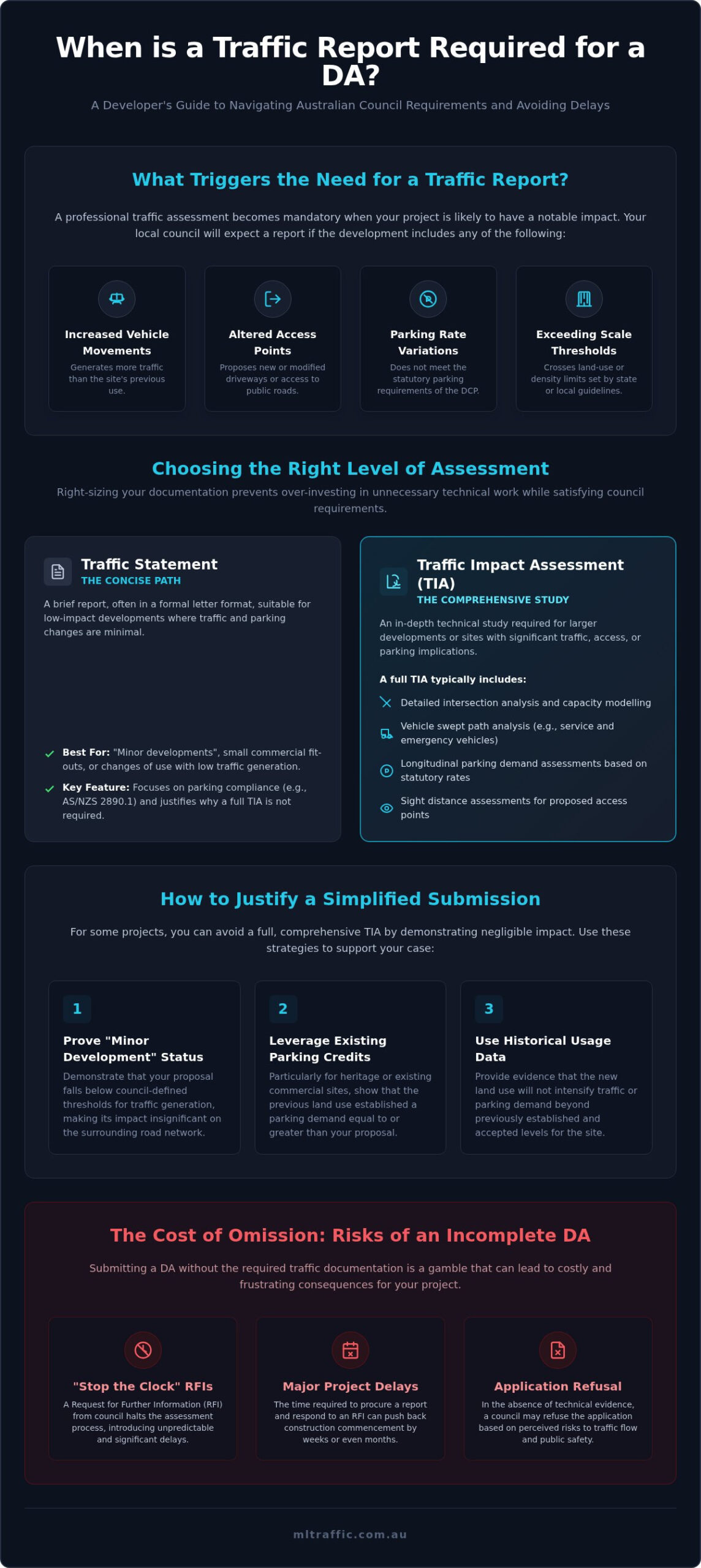
Determining exactly when is a traffic report required for a DA is vital for establishing project timelines and consultancy budgets. The requirement is not arbitrary; it’s triggered by statutory thresholds defined in local planning instruments and state-based guidelines. If a development is likely to increase vehicle movements, alter access points, or require a variation to statutory parking rates, the planning officer will expect a technical justification. Providing this information early prevents the common pitfall of receiving a Request for Further Information (RFI), which effectively stops the assessment clock and delays construction commencement.
The Role of Traffic Engineering in the Planning Process
Councils prioritise traffic flow and pedestrian safety to maintain the functional integrity of local neighbourhoods. A professionally prepared report provides the technical evidence necessary to counter community objections or council concerns regarding congestion. It translates complex vehicle movements into data-driven justifications that support the proposed development. This engineering-led approach ensures that urban planning outcomes remain sustainable and safe. For developers, these technical services act as a risk mitigation tool, ensuring that the project meets national standards such as AS/NZS 2890.1:2004 for off-street parking. Without this evidence, applications often face significant delays or refusal based on perceived traffic risks.
The Difference Between a Traffic Statement and a TIA
The level of documentation required depends on the complexity and scale of the site. A Traffic Statement is a concise document, often presented as a formal letter. It’s suitable for low-impact developments where parking changes are minor and vehicle trips remain below specific peak-hour thresholds. In contrast, a Traffic Impact Assessment (TIA) is a comprehensive study required for larger developments or high-traffic sites. A TIA typically includes:
- Detailed intersection analysis and capacity modelling.
- Vehicle swept path analysis for service and emergency vehicles.
- Longitudinal parking demand assessments based on statutory rates.
- Sight distance assessments at proposed access points.
Determining when is a traffic report required for a DA versus a full TIA involves reviewing local Development Control Plans (DCPs) and current state guidelines, such as the NSW TS 00085 v1.1. Selecting the correct level of assessment prevents over-investing in unnecessary technical work while still satisfying regulatory requirements.
Achieving DA Approval Without a Comprehensive Traffic Report
Not every development application necessitates a multi-page technical study. Understanding exactly when is a traffic report required for a DA involves identifying whether your project qualifies as a “minor development.” Many councils allow for simplified submissions if you can demonstrate that the proposal has a negligible impact on the local road network. This often involves using existing parking credits or historical usage data to justify that the new land use won’t increase demand beyond established levels. Consulting with a traffic engineer early in the design phase can determine if a simple covering letter or a technical memorandum suffices, potentially saving thousands in specialist fees.
Parking credits are particularly useful for heritage sites or existing commercial buildings where the previous use already established a high parking demand. By proving the new use requires fewer or equal spaces, you bypass the need for a full Car Parking Demand Assessment. This strategy is essential for urban infill projects where physical space for new parking is non-existent. A direct assessment of your site’s history can often reveal these opportunities to streamline your application.
When is a Development Considered “Negligible Impact”?
A development is typically considered to have a negligible impact if it involves small-scale residential changes or minor change-of-use applications. For example, Western Australian guidelines suggest no formal assessment is required for developments generating under 10 peak-hour trips. Similarly, the QLD government’s traffic impact guide provides frameworks for assessing whether a project adds less than 5% to critical intersection movements. If your site does not alter existing access points or parking arrangements, you may be exempt from a full TIA. Councils look for evidence that the infrastructure can absorb the change without safety risks or increased congestion.
The “Traffic Statement” Alternative
A Traffic Statement serves as a professional certification that a full assessment is unnecessary. This document is a streamlined alternative that addresses specific council concerns without the exhaustive data collection of a full report. It’s particularly effective for projects where the only concern is vehicle manoeuvrability. In these cases, a standalone Swept Path Analysis can solve specific access hurdles, such as proving a waste truck can enter and exit in a forward direction. This targeted approach satisfies planning officers while keeping the application moving. A professional assessment determines when is a traffic report required for a DA and when a simplified Traffic Statement is the superior option for your budget. To ensure your documentation matches your project’s scale, you can contact our senior principals for direct technical advice.
Development Types That Trigger Mandatory Traffic Assessments
Identifying when is a traffic report required for a DA depends largely on the proposed land use and its expected trip generation. High-intensity developments naturally place greater strain on the surrounding road network, necessitating formal engineering verification. Councils rely on these assessments to mitigate safety risks and prevent localised congestion. Certain project categories possess inherent operational risks that make technical documentation a non-negotiable requirement for submission.
- High-density residential flat buildings and significant multi-dwelling housing projects.
- Commercial hubs, retail centres, and large-scale hospitality venues.
- Medical clinics and childcare facilities with high vehicle turnover rates.
- Industrial warehouses and distribution centres requiring heavy vehicle access.
- Education facilities, private colleges, and places of public worship.
Residential and Commercial Triggers
For residential projects, the number of units or the total Gross Floor Area (GFA) usually dictates the assessment level. Significant multi-dwelling housing projects often trigger mandatory reports once they exceed local unit thresholds, such as the 20-dwelling limit frequently cited in metropolitan planning instruments. Childcare and medical centres are particularly sensitive due to high peak-hour turnover and strict drop-off requirements. Even small sites in these categories often require detailed reports to address pedestrian safety and parking demand. All designs must demonstrate strict compliance with AS 2890.1 for off-street parking. Failure to adhere to these national standards is a primary cause for council refusal or costly design revisions.
Industrial and Special Use Sites
Industrial developments, such as warehouses and distribution centres, prioritise heavy vehicle management. These sites require a formal Vehicle Swept Path Analysis to prove that semi-trailers or B-doubles can navigate the site safely without encroaching on pedestrian zones or opposing traffic lanes. Loading dock efficiency and onsite queueing space are critical metrics for council approval. A “Change of Use” application in an industrial zone often triggers a fresh traffic review if the new tenant increases the frequency or size of vehicle movements. Special use sites, including schools and places of public worship, present unique challenges due to concentrated arrival and departure windows. These applications must address sight distance and intersection capacity to ensure the local network remains functional during peak events. Understanding when is a traffic report required for a DA in these contexts ensures that your technical documentation addresses the specific operational risks of your site.
The Risks of Omission: Why Council May Reject Your DA
Omitting a traffic report when the scale of development warrants one is a primary cause of project failure. Planning officers frequently issue a “stop the clock” Request for Further Information (RFI) if the technical documentation is absent or insufficient. This administrative pause halts the assessment period, often for several months, while the applicant sources a specialist consultant. Beyond administrative delays, a lack of technical evidence increases the risk of formal objections from neighbours or transport authorities. Without a professional Traffic Impact Assessment, councils may refuse a DA based on “unacceptable traffic or parking impacts.” This is a broad justification that is difficult to appeal without existing data to prove otherwise.
The Cost of DA Delays vs. The Cost of a Report
Holding costs during a typical three-month RFI delay can far exceed the initial fee for a technical report. For developers, time is a critical metric of project viability. A proactive report is consistently more cost-effective than a reactive one, as it addresses potential hurdles before they become formal objections. By identifying exactly when is a traffic report required for a DA and submitting it upfront, you build a “bulletproof” application. This transparency allows council officers to progress the file quickly, avoiding the back-and-forth negotiations that characterise poorly prepared submissions. Our team provides direct access to senior principals, ensuring your technical documentation is accurate from the first submission.
Common Red Flags for Council Planning Officers
Planning officers look for specific technical failures that indicate a lack of professional engineering input. These “red flags” often trigger immediate scrutiny of the entire application. Common issues include:
- Non-compliant driveway gradients that risk vehicle scraping or poor accessibility.
- Blind spots within the car park layout that compromise pedestrian safety.
- Inadequate on-site parking relative to the proposed land use, leading to street congestion.
- Poor sight distances at property entrances that fail to meet Australian Standards.
Addressing these issues late in the process often requires significant site redesigns, which can reduce the total yield of a project. Redesigning a basement or access ramp after the structural plans are finalised is a prohibitively expensive exercise. This is why identifying when is a traffic report required for a DA during the pre-lodgement phase is essential for project risk management. To avoid these costly revisions and secure a faster approval, contact ML Traffic Engineers for a preliminary assessment of your site requirements.
Navigating the Approval Process with ML Traffic Engineers
ML Traffic Engineers provides a direct path to council compliance through technical expertise and a pragmatic consultancy model. We eliminate the gatekeepers common in larger firms, ensuring clients have direct access to senior principals who perform the technical work personally. This hands-on approach is critical when determining exactly when is a traffic report required for a DA, as it allows for an immediate, expert-led assessment of your site’s specific constraints. With over 15 years of experience negotiating with local government authorities across Australia, we understand the nuances of various Development Control Plans and the technical justifications required to secure a favourable outcome.
Our comprehensive suite of technical services covers every stage of the planning process. From initial Traffic Impact Assessment (TIA) reports to detailed Vehicle Swept Path Analysis and Car Park Design, we provide the empirical evidence necessary for seamless planning approvals. Our focus remains on achieving your desired project outcome while maintaining strict adherence to national regulatory standards. We dislike unnecessary bureaucracy and focus entirely on conveying the competence required to move your project forward.
Expertise Backed by 10,000+ Projects
Since 2005, our team has assessed over 10,000 sites across a vast range of environments, including residential flat buildings, multi-dwelling housing, retail centres, medical clinics, childcare facilities, industrial warehouses, distribution centres, education facilities, hospitality venues, and places of public worship. This volume of work has fostered deep professional relationships with council planning departments, providing us with a clear understanding of their expectations and common points of friction. A core signature of our brand is the “Personnel Continuity Promise”. This guarantee ensures that the same registered traffic engineer who initiates your project will be the one performing the technical analysis and signing off on the final report. You can contact our traffic engineering team for a preliminary assessment to verify the specific documentation needs of your site.
Streamlining Your DA Submission
We function as a specialised extension of your project team, integrating seamlessly with your architect and town planner. This collaborative approach ensures that traffic and parking considerations are embedded in the design phase, preventing costly late-stage revisions. By using industry-standard software such as SIDRA for intersection analysis and AutoTURN for swept path simulations, we generate undeniable evidence of site functionality. These tools allow us to provide precise answers when is a traffic report required for a DA, often justifying a more streamlined assessment for lower-impact projects. If you are ready to progress your application, get in touch for an obligation-free quote and direct access to our senior leadership.
Secure Your Planning Approval with Technical Precision
Navigating council requirements doesn’t have to be a source of project delay. Understanding exactly when is a traffic report required for a DA allows you to right-size your technical documentation and avoid the holding costs of an unexpected RFI. Whether your project involves a high-density residential flat building or a minor change of use, the technical justification must be empirical and compliant with current Australian Standards. Proactive engagement with a specialist ensures that your site layout and parking arrangements are certified before they face council scrutiny.
ML Traffic Engineers offers over 30 years of combined traffic engineering expertise to help you achieve seamless planning approvals. Our NPER and RPEQ registered professionals provide direct, principal-led service on every project we undertake. You can contact ML Traffic Engineers for a professional DA traffic assessment to ensure your submission is accurate and authoritative from the outset. We look forward to facilitating a faster approval process for your next development project.
Frequently Asked Questions
Can I prepare my own traffic report for a DA?
Councils generally do not accept self-prepared traffic documentation for development applications. Planning authorities require reports from qualified professionals, typically registered traffic engineers with NPER or RPEQ status. A professional report provides the technical authority and software validation, such as SIDRA or AutoTURN, needed to verify compliance with Australian Standards. Submitting your own assessment lacks the engineering rigour required to withstand council scrutiny or community objections during the public exhibition phase.
How much does a traffic impact assessment typically cost?
The cost of a technical assessment depends entirely on the scale and complexity of the proposed development. A minor change-of-use application requires significantly less data collection and modelling than a high-density residential flat building or a large industrial distribution centre. Fees reflect the involvement of senior principals and the use of specialised engineering software. We recommend obtaining a project-specific quote to ensure the technical work matches the precise requirements of your local council.
How long does it take to complete a traffic report for council?
Turnaround times vary based on the depth of the assessment required. A concise Traffic Statement for a low-impact site can often be completed within a few business days. In contrast, a comprehensive Traffic Impact Assessment involving intersection analysis or longitudinal parking demand surveys may take longer to finalise. Engaging a traffic engineer early in the planning process is the most effective way to avoid the much longer delays associated with council RFIs.
What happens if the council disagrees with my traffic report?
If a planning officer has concerns, they will typically issue a Request for Further Information (RFI). A qualified traffic engineer then reviews the feedback and provides additional technical justification or amended modelling to address the specific issues raised. Having your report prepared by a registered professional provides a robust foundation for these negotiations. This expertise is vital if you need to represent the project’s technical merits before a planning panel or transport authority.
Do I need a traffic report for a small home-based business?
Most small home-based businesses do not require a formal report because they fall under the “negligible impact” threshold. However, if the business significantly increases vehicle movements or requires dedicated customer parking that exceeds on-site capacity, a council may request a simplified Traffic Statement. Determining exactly when is a traffic report required for a DA depends on your local council’s specific trip generation limits and whether the business alters existing access arrangements.
What is the difference between a Traffic Management Plan and a Traffic Impact Assessment?
A Traffic Impact Assessment (TIA) evaluates the permanent, long-term effect of a new development on the surrounding road network and parking supply. Conversely, a Traffic Management Plan, or a Traffic Guidance Scheme in NSW, focuses on short-term safety and vehicle flow during the construction phase or for specific events. Most development applications require a TIA to prove the site is functional for its intended use once the construction work is finished.
Is a swept path analysis always part of a traffic report?
Vehicle swept path analysis is not mandatory for every report, but it’s essential for sites with complex layouts or heavy vehicle requirements. It uses specialized software to prove that semitrailers, waste trucks, or emergency vehicles can manoeuvre safely within the site boundaries. If the primary concern of the planning officer is vehicle access rather than trip generation, a swept path assessment can sometimes be submitted as a standalone document to satisfy council requirements.
When should I engage a traffic engineer in the DA process?
You should ideally engage a traffic engineer during the pre-lodgement or initial design phase. This allows the consultant to influence the car park design and driveway gradients before your architectural plans are finalised. Early involvement helps you identify exactly when is a traffic report required for a DA for your specific project. This proactive approach prevents expensive structural redesigns and ensures your application meets Australian Standards for parking and access from the first submission.

Disclaimer
The content on www.mltraffic.com.au, including all technical articles, guides, and resources, is provided for general informational and educational purposes only. It is not intended to constitute professional advice in traffic engineering, transportation planning, development approvals, or any other technical or legal field.
While ML Traffic Engineers makes every reasonable effort to ensure the accuracy, completeness, and timeliness of the information published, we do not provide any warranties or representations (express or implied) regarding its reliability, suitability, or availability for any particular purpose. Any reliance you place on the content is strictly at your own risk.
In no event shall ML Traffic Engineers, its directors, employees, authors, or affiliates be liable for any direct, indirect, incidental, special, consequential, or punitive damages (including, without limitation, loss of profits, data, or business opportunities) arising out of or in connection with the use of, or inability to use, any information provided on this website.
The articles and guides on this site are not a substitute for engaging a qualified, registered professional traffic engineer (such as an NPER or RPEQ engineer) to assess your specific project requirements. For tailored advice, compliance assessments, or traffic engineering services, please contact a competent professional.
This disclaimer may be updated from time to time without notice. By accessing or using this website, you agree to be bound by the most current version of this disclaimer.
