

Why is your local Council demanding fifty parking spaces for a facility that will be operated by only three technicians? It’s a common frustration for developers who find themselves caught between rigid, outdated local planning schemes and the unique operational reality of high-tech infrastructure. Navigating the State Significant Development pathway in New South Wales or the 2026 technical requirements in South Australia adds layers of bureaucratic complexity that can stall a project for months.
Securing a robust traffic assessment for data centre development is the only way to bridge this gap and avoid costly delays. We recognise that these projects are not about commuter volume. Instead, they focus on high-impact heavy vehicle logistics for cooling units and construction-phase mitigation. This guide provides the technical roadmap you need to master these complexities, ensuring your project meets AS 2890.2 standards for heavy vehicle access while reducing infrastructure costs through accurate parking demand assessments. You’ll learn how to challenge excessive Council requirements and align your application with the latest state-level planning frameworks to secure a clear path to DA approval.
Key Takeaways
- Understand how specialised Traffic Impact Assessment (TIA) reports align high-tech infrastructure requirements with complex state and local planning pathways.
- Learn first-principles methodologies for traffic assessment for data centre development to justify reduced parking demand based on actual low-staff operational data.
- Ensure site compliance with AS 2890.2 by conducting detailed Vehicle Swept Path Analysis for the delivery of oversized cooling towers and power generators.
- Navigate the latest regulatory requirements, including the 2024 TfNSW Guide and emerging 2026 national frameworks, to maintain compliance across interstate projects.
- Minimise project delays and reduce the risk of Council Requests for Information (RFIs) by providing authoritative, senior-led engineering data for planning panels.
Understanding the Role of Traffic Assessments in Data Centre Planning
A Traffic Impact Assessment (TIA) is a technical report required by planning authorities to evaluate how a new development affects the surrounding road network. For data centres, this document is a critical component of the Statement of Environmental Effects (SEE). It provides the evidentiary basis for planning approval. A comprehensive Traffic Impact Study (TIS) ensures that the proposed facility does not compromise road safety or intersection performance. Unlike standard commercial builds, data centre traffic is bifurcated. The construction phase involves high-volume movements of contractors and equipment. The operational phase is characterised by low-volume, high-frequency security patrols and periodic heavy vehicle deliveries for infrastructure upgrades.
Councils and State authorities require specialised reports because data centres are often classified as State Significant Development (SSD) or require ministerial assessment. These high-tech facilities place unique demands on local infrastructure that standard planning codes do not cover. Authorities scrutinise the construction phase heavily because of the temporary but intense pressure on local intersections. A traffic assessment for data centre development must detail how several hundred workers will access the site daily without causing gridlock. Conversely, operational traffic is about reliability. Data centres require 24/7 access for emergency maintenance. Any design that restricts this access compromises the facility’s core purpose.
The Unique Traffic Profile of a Data Centre
Data centres present a unique challenge for local Councils. Standard Development Control Plans (DCPs) often calculate parking requirements based on Gross Floor Area (GFA). For a 20,000sqm data centre, a generic calculation might mandate hundreds of parking spaces. However, the operational reality is a “Low Staff Paradox.” These facilities typically house high-density server racks but very few permanent employees. A professional traffic assessment for data centre development uses first-principles analysis to justify a significant reduction in parking. This prevents the unnecessary cost of constructing redundant asphalt. Maintenance cycles and 24/7 operational requirements also mean that trip generation differs significantly from traditional industrial or warehouse uses, where activity is usually concentrated during standard business hours.
Why Early Engagement with a Traffic Engineer is Critical
Engaging a traffic engineer during the due diligence phase is vital for project feasibility. Identifying access constraints early prevents expensive site layout redesigns. A preliminary swept path analysis determines if the building footprint allows for the safe movement of Heavy Rigid Vehicles (HRV) or Articulated Vehicles (AV). These vehicles are essential for delivering cooling towers and backup generators. If the driveway grades or turning circles are non-compliant with AS 2890.2, the project may face immediate rejection or costly remediation. Linking traffic engineering to the broader project feasibility study ensures that the site can actually support the necessary logistics infrastructure before you commit to the purchase.
Analysing Trip Generation and Parking Demand for Data Centres
Calculating accurate trip rates for high-tech infrastructure requires a departure from standard land-use categories. Most local planning schemes rely on Gross Floor Area (GFA) to determine traffic impact, but this metric fails for data centres. A 50,000sqm facility might only employ 20 staff per shift. Relying on outdated benchmarks leads to over-engineered road upgrades and unnecessary costs. Instead, a professional traffic assessment for data centre development utilises a “First Principles” approach. This methodology calculates trip volumes based on actual staff numbers, shift cross-overs, and scheduled maintenance frequencies rather than arbitrary floor space ratios. We verify these figures against the latest 2026 state-specific guidelines to ensure the data holds up under regulatory scrutiny.
The 24-hour operational cycle of these facilities introduces specific peaks that differ from traditional morning and afternoon commuter rushes. While the total volume is low, shift changes at 6:00 am or 10:00 pm must be analysed to ensure local intersection capacity is not breached. Industry resources provide updated data on Trip Generation and Parking Demand, which helps engineers substantiate claims for lower impact. This data-driven evidence is essential when presenting to planning panels or state authorities who may be unfamiliar with the specific logistics of digital infrastructure.
Justifying Reduced Parking Requirements
Data centres do not require the expansive parking lots associated with industrial warehouses. Modern automation and remote monitoring mean on-site personnel are minimal. We use empirical data from existing facilities to prove that actual demand often sits well below one space per 100sqm of GFA. A traffic assessment for data centre development that includes site-specific occupancy data can successfully challenge onerous Council requirements. Negotiating these reductions allows developers to repurpose land for additional server halls or critical cooling infrastructure. A robust Car Parking Demand Assessment is the primary tool for securing these concessions from Council.
AS 2890.1 Compliance for Staff and Visitor Parking
Even with reduced numbers, all parking areas must strictly adhere to AS 2890.1 standards. This includes precise stall dimensions, aisle widths, and ramp grades to ensure safety. Compliance also extends to:
- Provision of accessible parking spaces near main entry points.
- Dedicated bicycle parking and end-of-trip facilities to support sustainable transport goals.
- Clear pedestrian sightlines and designated walkways to separate foot traffic from vehicle movements.
Maintaining these standards ensures the site remains functional and safe for the lifetime of the facility. Our senior engineers perform all technical work to ensure these designs meet national regulatory expectations without the need for gatekeepers.
Managing Heavy Vehicle Access and Swept Path Requirements
Heavy vehicle logistics represent the most significant engineering challenge for data centre sites. While operational staff numbers remain low, the infrastructure required to support high-density computing is immense. Every cooling tower, diesel generator, and server rack arrives via Heavy Rigid Vehicles (HRV) or Articulated Vehicles (AV). A traffic assessment for data centre development must verify that these vehicles can enter, circulate, and exit the site in a forward direction. This is a mandatory requirement under AS 2890.2 for off-street commercial vehicle facilities. Compliance ensures that the site can handle the physical dimensions of modern industrial transport without compromising safety.
Oversize/over-mass (OSOM) loads are common during the initial structural build and primary fit-out. These movements require specific route assessments and occasionally temporary road closures to accommodate large-scale cooling infrastructure. If these requirements aren’t accounted for in the early planning stages, developers often find site access points are physically incapable of receiving critical components. This results in costly delays and potential redesigns after the DA has been lodged. Our senior engineers perform these assessments directly to ensure the site layout is functional from day one.
Designing for Delivery and Maintenance
Loading docks must be designed with technical precision. They need to accommodate sensitive electronic equipment while ensuring adequate vertical clearance for large trucks. A detailed swept path analysis is the primary tool used to simulate vehicle movements using specialised software. It prevents operational bottlenecks by proving that trucks won’t clip curbs or conflict with permanent structures. This technical validation is essential for securing approval from state authorities. They often reference rigorous standards, such as the Maryland Department of Transportation’s Traffic Impact Study Guidelines, to evaluate complex industrial logistics and intersection performance.
Construction Traffic Management Plans (CTMP)
The construction phase often presents the highest hurdle for project approval due to its intensity. During peak fit-out periods, a site may host several hundred contractors simultaneously. This temporary surge in volume can overwhelm local roads if not managed correctly. A comprehensive traffic management plan (TMP) is required to mitigate these impacts. It outlines designated haulage routes, contractor parking strategies, and pedestrian safety protocols. Addressing these concerns in your traffic assessment for data centre development reduces the likelihood of Council objections based on community disruption and local road capacity.
Navigating Regulatory Compliance and Australian Standards
Compliance with national and state-level regulations is the foundation of a successful planning application. Every traffic assessment for data centre development must strictly adhere to the AS 2890 series. This includes AS 2890.1 for off-street car parking and AS 2890.2 for commercial vehicle facilities. Large-scale projects classified as State Significant Development (SSD) must also address Secretary’s Environmental Assessment Requirements (SEARs). These requirements often mandate a more granular level of reporting than standard local Council applications. They frequently include detailed assessments of construction haulage routes and cumulative impacts on the regional transport network.
State-specific guidelines add another layer of complexity. In New South Wales, the November 2024 Guide to Transport Impact Assessment (Version 1.1) is now the primary reference. It supersedes the older 2002 guide that many local Development Control Plans (DCPs) still reference. In Victoria and Queensland, developers must navigate the specific requirements of the Department of Transport and Planning or the Department of Transport and Main Roads (TMR). Our senior engineers ensure your project meets these varying standards across all Australian jurisdictions. We provide direct access to the experts performing the technical work, eliminating the delays associated with larger consultancy firms.
A professional Traffic Impact Assessment (TIA) must also include a rigorous sight distance assessment at all site access points. This ensures that vehicles exiting the data centre have a clear line of sight to oncoming traffic, meeting the requirements of Austroads and relevant Australian Standards. This is particularly critical for facilities located in high-speed industrial zones or on arterial roads where heavy vehicle egress must be managed with precision to prevent collisions.
Intersection Analysis and Performance
We use SIDRA software to model the impact of your development on the existing road network. This analysis determines the “Level of Service” (LoS) at nearby intersections. Authorities generally require that a development does not significantly degrade the current LoS. If the model indicates that capacity has been reached, we propose practical road upgrades or calculate developer contributions under Section 7.11 or 7.12. This proactive approach prevents the project from being stalled by unexpected infrastructure demands from the Department of Transport.
Safety Audits and Risk Mitigation
Identifying conflict points between heavy vehicles and pedestrians is a core component of risk mitigation. The role of a traffic engineer in developments is to conduct safety audits that verify the integrity of the internal site design. We ensure that driveway grades are compliant with AS 2890.2 to prevent heavy vehicles from scraping or bottoming out during equipment deliveries. These technical checks are vital for protecting both the physical infrastructure and the safety of all site users. Meticulous design at the DA stage reduces the likelihood of costly remediation works during the construction phase.
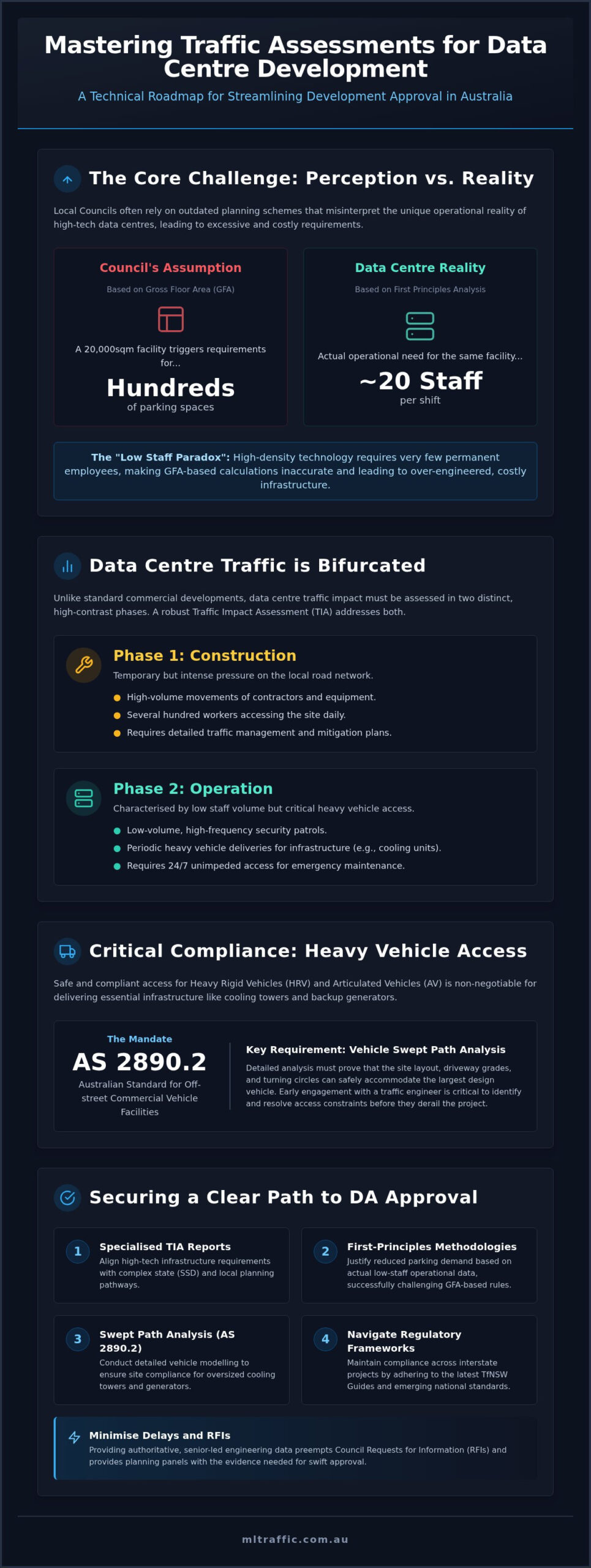
Securing DA Approval: How Professional Traffic Engineering Streamlines the Process
A robust traffic assessment for data centre development is more than a compliance document. It is a strategic tool designed to minimise project risk. Councils frequently issue Requests for Information (RFIs) when traffic data is vague or fails to address specific site constraints. These requests can delay a project for several months. By providing a detailed, senior-led report from the outset, you address potential concerns before they become formal objections. This proactive approach ensures the planning officer has the technical evidence required to recommend approval without hesitation. It transforms traffic engineering from a perceived hurdle into a design asset that justifies your site’s operational efficiency.
Strategic engineering also provides a safeguard during the appeals process. If a development is referred to a planning panel or a regional court, having an expert witness who performed the actual technical work is invaluable. Our “no-gatekeepers” approach means the person defending the design is the same senior principal who calculated the swept paths and parking demand. This level of accountability builds significant trust with authorities. It ensures that your project’s technical merits are communicated clearly and authoritatively, reducing the likelihood of successful third-party challenges.
The ML Traffic Engineers Advantage
We bring over 15 years of national experience to every project. Our expertise in traffic engineering spans complex industrial, commercial, and high-tech infrastructure. Choosing a single consultancy for your TIA, Swept Path Analysis, and Car Park Design creates a seamless workflow that protects your project timeline.
- Direct access to senior principals ensures every calculation is accurate and defensible.
- Our national footprint supports developers with interstate portfolios, maintaining consistency across different state jurisdictions.
- Personnel continuity is guaranteed. The expert who starts your project will be the one who completes the technical assessments.
- We specialise in AS 2890.1 and AS 2890.2 compliance to ensure your site is functional for heavy vehicle logistics.
Next Steps for Your Data Centre Project
To begin the process, our team requires a basic site plan and the projected operational headcount. We use this information to develop a tailored fee proposal that addresses the specific requirements of your local Council or state planning authority. This initial traffic assessment for data centre development sets the foundation for your entire DA submission. Contact our team for a confidential discussion about your site. We will provide the technical roadmap needed to secure your planning approval and reduce unnecessary infrastructure costs.
Streamline Your Planning Approval with Expert Engineering
Securing a traffic assessment for data centre development requires a technical approach that balances low operational volumes with high-impact heavy vehicle logistics. You’ve seen how accurate parking demand assessments can reduce redundant infrastructure costs. Detailed swept path analysis ensures compliance with AS 2890.2. Navigating the complex 2026 national frameworks and state-specific SSD pathways is essential for project continuity. Our team provides 15+ years of Australian consultancy experience to ensure your technical documentation is robust and defensible. We offer national coverage for all DA and SSD projects; this ensures your interstate portfolios receive consistent, senior-level attention.
At ML Traffic Engineers, we eliminate the delays associated with larger, impersonal firms. Senior principals perform all technical work directly. This provides a no-gatekeepers approach and personnel continuity from project inception to final approval. This level of accountability is vital for managing Council expectations and securing your project’s future.
Get a professional Traffic Impact Assessment for your data centre project to ensure your next development moves forward without unnecessary bureaucratic delays. We look forward to supporting your project’s success.
Frequently Asked Questions
Do data centres really need a full Traffic Impact Assessment if staff numbers are low?
Yes, a full TIA is necessary because authorities must evaluate the construction phase and heavy vehicle logistics. While operational staff levels are minimal, the initial build involves significant contractor movements and oversized equipment deliveries. A traffic assessment for data centre development provides the evidence needed to prove that these temporary impacts are manageable and that the facility will not compromise the performance of the local road network during 24-hour operations.
What is the most common traffic-related reason for data centre DA delays?
Inadequate provision for heavy vehicle access is the primary cause of delays. If a site layout cannot accommodate the turning circles of Articulated Vehicles (AV) delivering cooling towers or generators, the Council will issue a Request for Information (RFI). Failing to verify driveway grades and vertical clearances early in the design process often leads to forced site redesigns. Providing technical validation through swept path analysis at the lodgement stage prevents these costly setbacks.
How does AS 2890.2 differ from AS 2890.1 in a data centre context?
AS 2890.1 governs the design of off-street car parking for staff and visitors, focusing on stall dimensions and aisle widths. Conversely, AS 2890.2 is the mandatory standard for off-street commercial vehicle facilities. In a data centre context, AS 2890.2 is critical for ensuring that Heavy Rigid Vehicles (HRV) and Articulated Vehicles can safely navigate the site. This includes specific requirements for loading docks, service areas, and forward-entry or forward-exit movements.
Can I reduce the number of required car spaces for my data centre development?
You can often justify a significant reduction in parking by using a First Principles assessment. Most local Council DCPs use floor area to calculate parking, which leads to excessive requirements for low-occupancy data centres. We use empirical data and actual shift-staffing numbers to prove that the facility requires far fewer spaces. This allows you to repurpose land for critical infrastructure while still maintaining compliance with essential safety standards for the staff on site.
How long does it take to prepare a Traffic Assessment for a data centre?
A standard Traffic Impact Assessment typically takes between two and four weeks to complete. This timeframe depends on the project’s complexity and whether intersection modelling or SIDRA analysis is required. Early engagement is essential to ensure that the traffic assessment for data centre development is integrated into the broader project timeline. This allows enough time for senior engineers to perform the technical work and verify all site-specific data against current state guidelines.
What is a Swept Path Analysis and why is it mandatory for data centres?
Swept Path Analysis is a computer-simulated model that tracks the path of a vehicle’s body and tyres during a turn. It is mandatory because data centres rely on the delivery of massive infrastructure components like backup generators and cooling units. This analysis proves to planning authorities that design vehicles can navigate the site without hitting curbs, walls, or other structures. It ensures the site is physically capable of supporting the logistics required for 24/7 operations.
Are there specific traffic requirements for State Significant Developments (SSD)?
SSD projects must comply with Secretary’s Environmental Assessment Requirements (SEARs). These requirements often mandate a higher level of detail than local Council applications, including cumulative impact studies and detailed construction traffic management plans. In New South Wales, large-scale data centres often trigger the SSD pathway, requiring adherence to the November 2024 TfNSW Guide to Transport Impact Assessment. These assessments focus heavily on the impact of the development on the regional arterial road network.
How do you manage construction traffic for a data centre in a residential area?
Construction traffic is managed through a comprehensive Construction Traffic Management Plan (CTMP). This document outlines specific haulage routes that avoid narrow residential streets where possible. It also includes strategies for contractor parking and scheduled delivery windows to minimise noise and disruption for local residents. A well-prepared CTMP addresses Council concerns regarding community impact and road safety, which is vital for securing approval when a high-intensity build occurs near sensitive land uses.

Disclaimer
The content on www.mltraffic.com.au, including all technical articles, guides, and resources, is provided for general informational and educational purposes only. It is not intended to constitute professional advice in traffic engineering, transportation planning, development approvals, or any other technical or legal field.
While ML Traffic Engineers makes every reasonable effort to ensure the accuracy, completeness, and timeliness of the information published, we do not provide any warranties or representations (express or implied) regarding its reliability, suitability, or availability for any particular purpose. Any reliance you place on the content is strictly at your own risk.
In no event shall ML Traffic Engineers, its directors, employees, authors, or affiliates be liable for any direct, indirect, incidental, special, consequential, or punitive damages (including, without limitation, loss of profits, data, or business opportunities) arising out of or in connection with the use of, or inability to use, any information provided on this website.
The articles and guides on this site are not a substitute for engaging a qualified, registered professional traffic engineer (such as an NPER or RPEQ engineer) to assess your specific project requirements. For tailored advice, compliance assessments, or traffic engineering services, please contact a competent professional.
This disclaimer may be updated from time to time without notice. By accessing or using this website, you agree to be bound by the most current version of this disclaimer.
