

What if your development’s projected profit is being undermined by a design flaw you haven’t even identified yet? For Australian developers, the planning phase is often fraught with uncertainty, particularly when navigating local Council requirements for parking and access. A single Request for Information (RFI) regarding traffic can stall a project for months, eroding margins through increased holding costs. By de-risking a development with a traffic feasibility study during the due diligence phase, you transition from speculative planning to technical certainty.
Early technical intervention protects site yield and prevents the loss of Gross Floor Area (GFA) to inefficient parking layouts. This guide explains how strategic traffic analysis identifies fatal flaws before you commit significant capital to a project. You’ll learn how tools like Vehicle Swept Path Analysis and strict compliance with Australian Standards (AS 2890) ensure your site is operationally viable. We will examine the critical timing for these studies and how they facilitate a smoother DA approval process while maximizing your site’s potential.
Key Takeaways
- Establish technical site viability by differentiating between proactive feasibility audits and standard, Council-mandated Traffic Impact Assessment (TIA) reports.
- Learn the specific methodology for de-risking a development with a traffic feasibility study to prevent unexpected Council RFIs and protect your Gross Floor Area.
- Leverage Vehicle Swept Path Analysis and Car Parking Demand Assessments to optimize car park layouts and ensure compliance with national regulatory standards.
- Identify the strategic timing for traffic assessments, focusing on the “Go/No-Go” decision during pre-purchase due diligence and early masterplanning.
- Secure project certainty through direct access to senior principals who manage technical assessments personally rather than delegating to junior staff.
What is a Traffic Feasibility Study in Property Development?
A traffic feasibility study is a preliminary technical audit designed to evaluate the practical limitations of a site’s access and parking. Unlike a generic survey, this assessment provides a baseline of viability for any proposed land use by scrutinizing existing road capacity and projected trip generation rates. De-risking a development with a traffic feasibility study ensures that your concept design aligns with physical and regulatory constraints before you commit significant capital to a formal Development Application (DA).
This process relies on empirical data. We analyze how many vehicles will enter and exit the site based on the specific land use, whether it’s a residential high-rise, a commercial warehouse, or a mixed-use precinct. This data allows for early-stage adjustments to the site footprint. It prevents the need for expensive redesigns once the planning process is underway. To better understand how these studies fit into the broader development process, watch this helpful video:
The Difference Between Feasibility and Impact Assessment
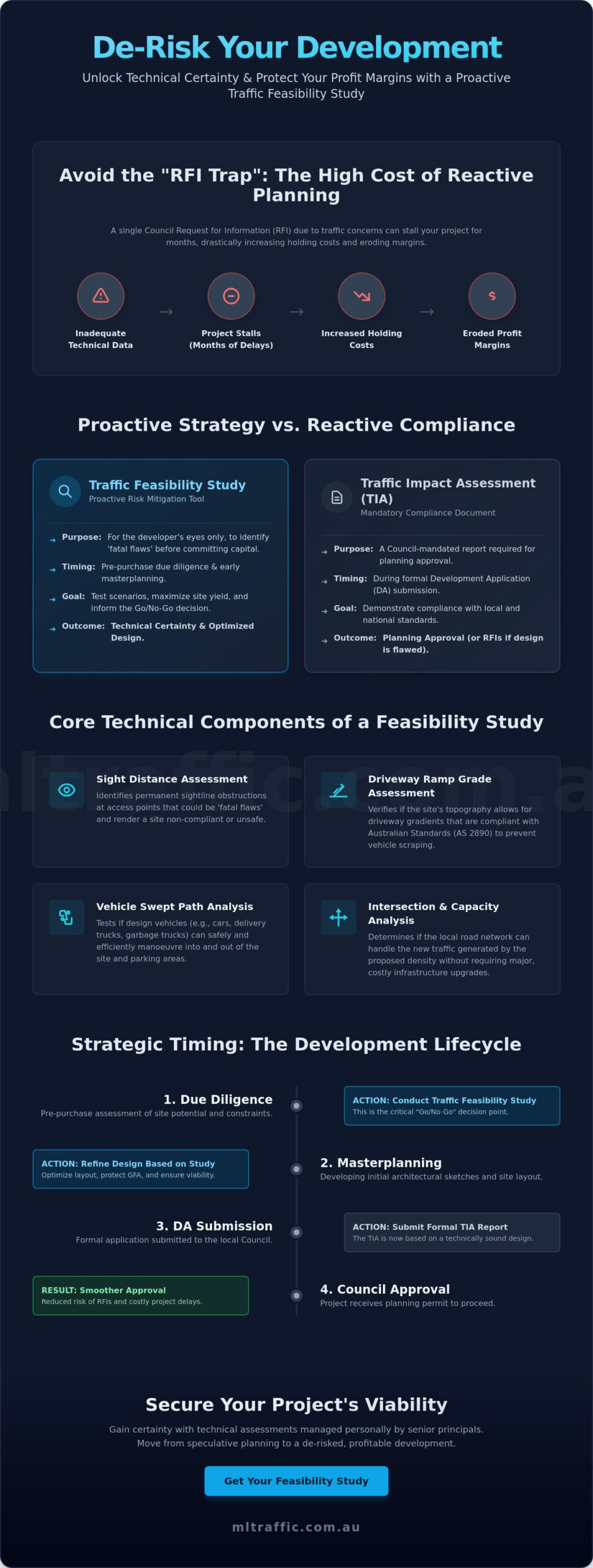
Confusion often exists between a feasibility study and a Traffic Impact Assessment (TIA) Report. A TIA is a Council-mandated document required for planning approval. A feasibility study is conducted for the developer’s eyes only. The feasibility study informs the initial site masterplan by testing various scenarios. This involves Transportation forecasting to predict how future traffic loads will interact with the local network. Traffic feasibility is a proactive risk-mitigation tool used prior to formal DA submission.
Core Objectives of De-Risking Through Traffic Analysis
The primary goal is to identify “fatal flaws” that could render a site undevelopable or significantly reduce its profit margins. These technical failures are often missed during preliminary architectural sketches. Our technical services focus on identifying these risks before they become permanent liabilities. Key objectives include:
- Identifying sightline obstructions: Sight Distance Assessments identify permanent barriers that can’t be mitigated easily.
- Verifying driveway gradients: Driveway Ramp Grade Assessments reveal if the land’s topography allows for compliant vehicle access.
- Testing vehicle maneuverability: Vehicle Swept Path Analysis proves the site can physically accommodate the vehicles required for its intended use, such as heavy rigid vehicles for loading bays.
- Matching density to capacity: Intersection Analysis determines if the local road network can handle the proposed density without requiring massive infrastructure upgrades.
By verifying these technical details early, you ensure the proposed density matches the current performance of the local road network. This level of due diligence provides certainty to investors and senior leadership that the site is operationally viable. It’s about finding the maximum yield that the infrastructure can actually support.
Identifying and Mitigating High-Impact Development Risks
The financial viability of any development hinges on two primary factors: total site yield and the speed of planning approval. When traffic planning is treated as an afterthought, projects often fall into the “RFI Trap.” This occurs when a Council issues a formal Request for Information due to inadequate technical data regarding vehicle access or parking. These delays can stall a project for months. In the current Australian interest rate environment, a six-month delay significantly increases holding costs and erodes project margins. De-risking a development with a traffic feasibility study allows you to identify these bottlenecks before they reach the Council’s desk.
Proactive risk management involves addressing compliance and safety from the initial concept stage. This includes ensuring strict adherence to Australian Standards (AS 2890). We verify that sight distance requirements are met. This prevents future legal liability. Identifying these issues during the due diligence phase protects your capital. For expert guidance on your next project, consult with ML Traffic Engineers Australia to move forward with confidence.
Preventing Yield Loss and Design Inefficiency
Yield protection is a fundamental objective for any developer. Inefficient car park designs often result in the loss of valuable Gross Floor Area (GFA) or a reduction in the number of residential units. A specialist traffic engineer uses Car Parking Demand Assessments to justify parking rates that may deviate from standard Development Control Plan (DCP) requirements. This prevents “over-parking,” which wastes construction budget on unnecessary basement levels, and “under-parking,” which leads to certain rejection. For a deeper understanding of these technical requirements, review our AS 2890.1 compliance guide. Optimizing the layout ensures every square meter of the site is utilized for maximum ROI.
Avoiding Council RFIs and Planning Bottlenecks
Council rejections often stem from poorly documented traffic impacts or non-compliant driveway gradients. A feasibility study pre-empts these objections by providing evidence-based solutions backed by technical data. By adhering to the Austroads Guide to Traffic Management, we ensure the data presented is accurate and comprehensive. This professional rigor reduces the likelihood of an RFI. It provides the Council with the certainty they need to move the application through the DA phase without unnecessary friction. De-risking a development with a traffic feasibility study converts operational uncertainty into a bankable development plan. It’s the most effective way to ensure your project stays on schedule and within budget.
Core Technical Components of a Risk-Mitigating Traffic Report
De-risking a development with a traffic feasibility study requires a granular analysis of technical constraints. It’s not enough to assume a site functions based on a standard architectural plan. We use specific analytical tools to convert theoretical designs into operationally viable assets. These components provide the evidence required to satisfy both internal stakeholders and external regulatory bodies. When de-risking a development with a traffic feasibility study, the focus shifts from general site capacity to physical practicality.
A comprehensive feasibility report consists of four primary technical pillars:
- Vehicle Swept Path Analysis: Digital simulations that prove the largest expected vehicles can maneuver safely within the site.
- Parking Demand Assessments: Data-driven justifications for parking rates that may differ from standard Development Control Plan (DCP) requirements.
- Sight Distance Assessments: Technical verification that entry and exit points provide safe visibility for all road users.
- Intersection and Traffic Flow Modeling: Quantitative analysis of how the development’s peak hour trips impact the surrounding road network.
Swept Path Analysis and Access Viability
Swept Path Analysis is the most critical de-risking tool for sites featuring loading docks or complex basement ramps. We use specialized software to simulate the movements of Waste Collection Vehicles (WCV) and heavy delivery trucks. If a waste truck can’t turn within the site, the Council will likely reject the DA. This analysis identifies pinch points in the design before the footprint is finalized. It’s much cheaper to move a structural column on a concept plan than to rectify a basement after the concrete is poured. For a deeper technical look at this process, refer to our Swept Path Analysis guide.
Compliance with Australian Standards (AS 2890)
Strict adherence to Australian Standards (AS 2890) is non-negotiable for commercial and residential developments. This standard dictates specific requirements for ramp grades, headroom clearances, and parking bay dimensions. In the world of planning approvals, “near enough” is not good enough. Council building certifiers require exact compliance to issue final occupancy certificates. Non-compliance often leads to expensive structural rectifications or a permanent loss of parking spaces. By verifying these dimensions during the feasibility stage, we protect the developer from future liability and ensure the project meets all national regulatory benchmarks. This meticulous approach provides the certainty needed to commit capital to the next phase of development.
Strategic Timing: When to Conduct Your Feasibility Study
Timing determines whether a traffic report acts as a proactive strategy or a reactive fix. For maximum capital protection, de-risking a development with a traffic feasibility study must happen well before the formal planning stages. Engaging with technical constraints early allows for design adjustments that are impossible once the building footprint is locked. Strategic timing ensures that traffic requirements dictate the design rather than the design creating avoidable traffic problems.
The development lifecycle includes four critical stages where traffic analysis provides essential value:
- Stage 1: Pre-Purchase Due Diligence: This is the “Go/No-Go” phase. We verify if the site can physically support the intended land use and density before you commit to the acquisition.
- Stage 2: Masterplanning and Concept Design: During this stage, we optimize the site footprint. We ensure parking layouts and access points are efficient, protecting your project’s yield.
- Stage 3: Pre-DA Submission: Here, we finalize the technical evidence. This involves preparing the formal Traffic Impact Assessment (TIA) based on the refined concept.
- Stage 4: Post-DA: After submission, we provide technical support to respond to Council conditions of consent or specific technical RFIs.
The High Cost of Late-Stage Traffic Engineering
Engaging a traffic engineer after the architectural design is finalized is a high-risk strategy. Late-stage changes often trigger a domino effect of redesigns across structural, civil, and environmental disciplines. Early involvement allows for minor design tweaks that save thousands in construction costs. A $5,000 study can save $50,000 in redesign fees by identifying access issues before they are integrated into the structural plans. Proactive analysis prevents the “RFI Trap” mentioned previously, keeping your project timeline intact.
Integrating Traffic with Other Feasibility Streams
Traffic feasibility does not exist in a vacuum. It overlaps significantly with environmental and civil engineering requirements. For instance, driveway placements must account for existing street trees, utility pits, and stormwater drainage. Your traffic consultant must collaborate with your architect during the concept phase to ensure the Statement of Environmental Effects (SEE) is supported by robust technical data. This coordination ensures that the traffic report aligns with the broader planning narrative. If you are currently in the due diligence phase, contact our senior principals to discuss your site’s access requirements. De-risking a development with a traffic feasibility study at the outset provides the technical foundation for a successful, compliant, and high-yield project.
De-Risking Your Next Project with ML Traffic Engineers Australia
ML Traffic Engineers Australia provides a distinct technical advantage through over 15 years of national expertise in the Australian development sector. We’ve secured thousands of successful DA approvals by providing precise, data-driven reports that withstand the scrutiny of both Council planners and project financiers. De-risking a development with a traffic feasibility study is most effective when the analysis is performed by seasoned experts who understand the intersection of regulatory compliance and commercial site yield. Our firm focuses on delivering certainty in complex urban environments where access and parking constraints often stall less rigorous applications.
Our track record spans a vast range of project environments and land-use categories, including:
- High-density residential flat buildings and mixed-use precincts.
- Commercial office developments and retail shopping centers.
- Industrial warehouses and heavy vehicle distribution hubs.
- Childcare centers, medical clinics, and educational facilities.
- Specialized tourist accommodation and recreational developments.
Our Hands-On Approach to Technical Accuracy
We operate on a personnel continuity promise. The senior principal who initiates your project is the same expert who performs the technical work. Unlike larger, impersonal firms that delegate critical analysis to junior staff, ML Traffic Engineers Australia ensures every feasibility study is overseen by a senior traffic engineer. This direct access to leadership guarantees accountability and technical rigor. We utilize industry-standard software for precision Vehicle Swept Path Analysis. This ensures that every maneuver, from waste collection to basement entry, is verified against physical site constraints. Explore our full range of traffic engineering services to see how we support every stage of the development lifecycle.
Secure Your Planning Approval Today
De-risking a development with a traffic feasibility study starts with a clear understanding of your site plan and proposed land use. We translate these requirements into a compliant technical framework that minimizes the risk of Council RFIs. Developers across Australia trust ML Traffic Engineers Australia for our ability to navigate the most complex sites and provide bankable results. We don’t just identify problems; we engineer the technical solutions required to protect your project yield. To initiate a preliminary review of your site’s access and parking viability, contact our senior principals directly. Providing us with your concept plan allows our team to identify potential fatal flaws before you commit significant capital to a formal submission.
Securing Technical Certainty for Your Development Site
Successful property development requires technical certainty from the initial due diligence phase. Identifying fatal design flaws and optimizing parking layouts early ensures your project remains operationally viable and financially sound. De-risking a development with a traffic feasibility study provides the evidence-based data needed to satisfy Council planners and secure project financing without the friction of unexpected RFIs. Proactive planning is the most effective way to protect your yield and accelerate your approval timeline.
ML Traffic Engineers provides over 15 years of national expertise and a record of thousands of successful DA approvals across Australia. Every project benefits from direct principal involvement. This ensures your technical assessments are handled by senior experts rather than junior staff. This hands-on approach delivers the professional rigor required for complex urban sites and diverse land-use categories. Contact ML Traffic Engineers for a Site Feasibility Consultation to establish your site’s baseline of viability today. We look forward to providing the technical foundation for your next successful project.
Frequently Asked Questions
What is the primary goal of a traffic feasibility study?
The primary goal is to establish a technical baseline of viability regarding site access and parking before capital is committed. By identifying physical constraints early, the study ensures that the proposed land use and density are operationally practical and compliant with national regulatory standards.
How much does a traffic feasibility study typically cost for a medium-scale development?
Costs for traffic studies vary based on the number of intersections analyzed and the complexity of the proposed land use. While industry guidelines suggest general ranges for intersection analysis, developers should consult directly with a senior traffic engineer to obtain a site-specific scope that reflects their project’s unique requirements.
Can a traffic feasibility study help in reducing the number of required parking spots?
Yes, a Car Parking Demand Assessment can justify parking rates that deviate from standard Development Control Plan (DCP) requirements. We use empirical data and local surveys to prove that a lower parking provision is sufficient, which can save substantial construction costs related to basement excavation and structural work.
What happens if a feasibility study identifies a fatal flaw in my site design?
Identifying a fatal flaw early allows you to modify the site footprint or reconsider the acquisition before significant funds are spent. This is the core benefit of de-risking a development with a traffic feasibility study; it prevents you from proceeding with a design that Council will inevitably reject due to non-compliance.
How long does it take to complete a comprehensive traffic feasibility report?
A comprehensive report typically takes between one and three weeks to complete. This timeline depends on the availability of existing traffic data and the complexity of the required modeling, such as Vehicle Swept Path Analysis or detailed Intersection Analysis for the surrounding road network.
Do I need a traffic feasibility study if my development is small?
Small developments often face the tightest physical constraints regarding driveway gradients and sight distances. Even a minor project requires technical verification to ensure compliance with AS 2890. Ignoring these details can lead to expensive rectifications or the inability to obtain a final occupancy certificate from the certifier.
Is a traffic feasibility study the same as a Traffic Impact Assessment (TIA)?
No, these documents serve different purposes in the planning lifecycle. A feasibility study is a preliminary audit used for internal due diligence and initial masterplanning. A Traffic Impact Assessment (TIA) is a formal report required by Council as part of a Development Application to demonstrate regulatory compliance.
Will a traffic feasibility study guarantee Council approval?
No consultant can guarantee Council approval as the final decision rests with the planning authority. However, de-risking a development with a traffic feasibility study ensures your application is backed by robust technical evidence. This approach minimizes the likelihood of unexpected Requests for Information (RFIs) and positions the project for a smoother approval process.

Disclaimer
The content on www.mltraffic.com.au, including all technical articles, guides, and resources, is provided for general informational and educational purposes only. It is not intended to constitute professional advice in traffic engineering, transportation planning, development approvals, or any other technical or legal field.
While ML Traffic Engineers makes every reasonable effort to ensure the accuracy, completeness, and timeliness of the information published, we do not provide any warranties or representations (express or implied) regarding its reliability, suitability, or availability for any particular purpose. Any reliance you place on the content is strictly at your own risk.
In no event shall ML Traffic Engineers, its directors, employees, authors, or affiliates be liable for any direct, indirect, incidental, special, consequential, or punitive damages (including, without limitation, loss of profits, data, or business opportunities) arising out of or in connection with the use of, or inability to use, any information provided on this website.
The articles and guides on this site are not a substitute for engaging a qualified, registered professional traffic engineer (such as an NPER or RPEQ engineer) to assess your specific project requirements. For tailored advice, compliance assessments, or traffic engineering services, please contact a competent professional.
This disclaimer may be updated from time to time without notice. By accessing or using this website, you agree to be bound by the most current version of this disclaimer.
