
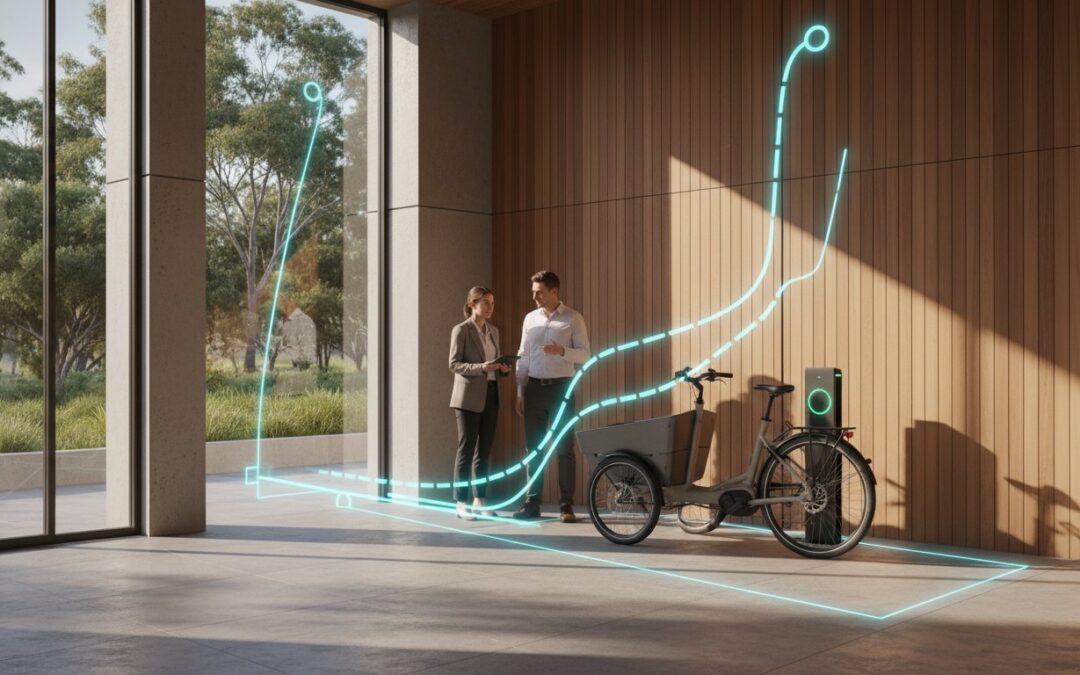
If your development design fails to account for the physical footprint of a heavy-duty e-cargo bike, you aren’t just missing a trend; you are designing a stranded asset that institutional lenders may soon refuse to finance. With transport accounting for 17% of Australia’s greenhouse gas emissions, planning panels now demand rigorous proof of micro-mobility integration. Designing for light electric vehicle (LEV) access has evolved from a secondary consideration into a core engineering requirement for modern Development Applications. You likely find that current council expectations for 100% EV-ready residential sites and specific spatial needs for e-bikes create significant design friction and a high risk of DA rejection.
We understand that navigating the ambiguity of varying council requirements while trying to maintain site yield is a complex balancing act. This guide provides the technical clarity you need to master spatial standards and safety protocols for micro-mobility. You’ll gain a clear understanding of how to integrate e-bikes and cargo bikes into compliant layouts that prioritize safety and efficiency. We will detail the specific vehicle swept path analysis and bay dimensions required to ensure your traffic reports meet the highest regulatory standards and secure project approval.
Key Takeaways
- Understand the technical distinctions between standard micro-mobility and heavy-duty cargo bikes to ensure site infrastructure meets accurate real-world dimensions.
- Master the application of vehicle swept path analysis to accommodate the unique turning radii of long-tail LEVs and prevent spatial conflicts in high-traffic areas.
- Learn the protocols for designing for light electric vehicle (LEV) access alongside AS 2890.1 car parking standards to manage safe interaction in shared zones.
- Identify critical fire safety and spatial requirements for high-density lithium-ion battery charging stations within residential and commercial developments.
- Discover how professional Traffic Impact Assessment (TIA) reports leverage specific LEV data to overcome council objections and secure DA approval.
Defining LEV Access in Modern Australian Developments
Australian urban planning is transitioning away from car-centric models toward active transport integration. Developers must understand What are Light Electric Vehicles (LEVs)? to remain compliant with evolving council expectations. LEVs encompass a broad category of transport including pedelecs, mopeds, and heavy-duty cargo bikes. Designing for light electric vehicle (LEV) access requires a departure from traditional bicycle parking templates. These legacy designs fail to accommodate the increased weight, battery charging requirements, and physical dimensions of modern electric fleets.
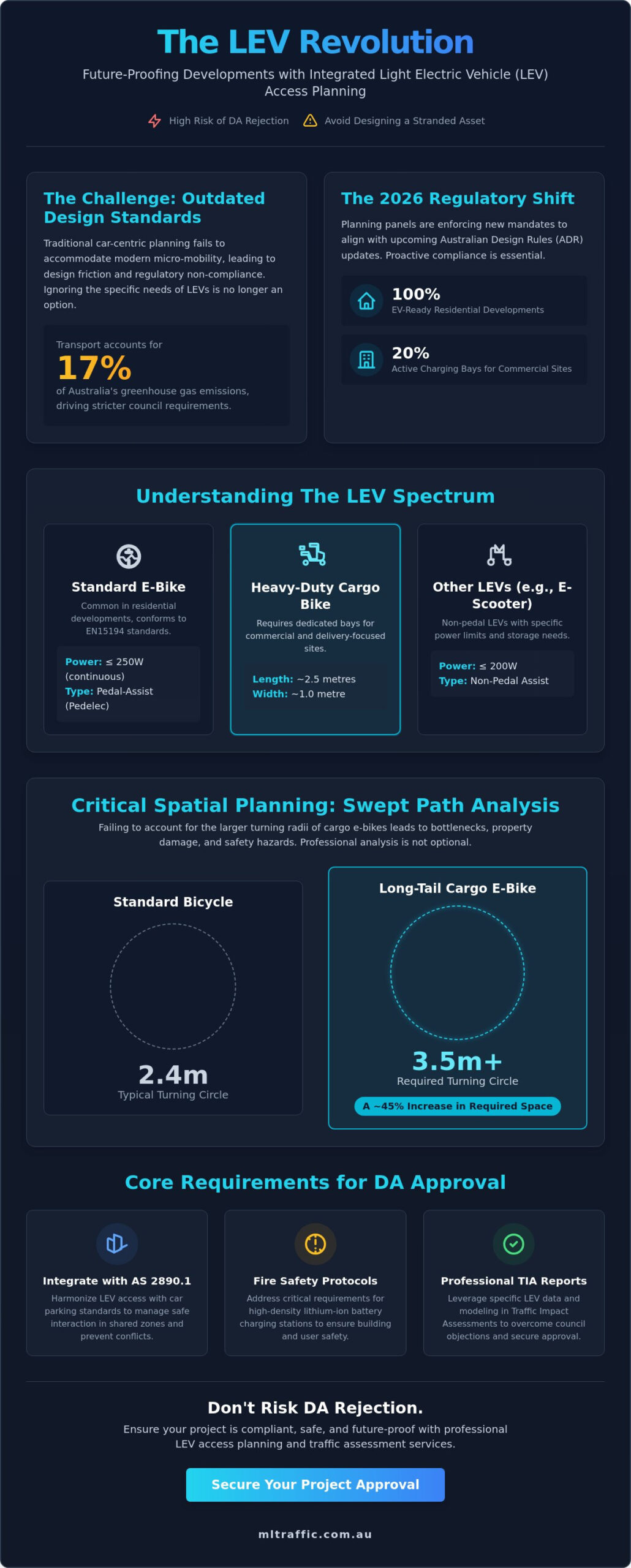
Councils now exert significant regulatory pressure on new developments to align with the 2026 Australian Design Rules (ADR) updates. With transport contributing 17% of Australia’s greenhouse gas emissions, planning panels prioritize projects that demonstrate high site permeability and reduced carbon footprints. By 2026, major Australian cities expect 100% EV-ready residential developments and 20% active charging bays for commercial sites. These mandates mean a standard bike rack is no longer a sufficient response to micro-mobility requirements. Developers who ignore these standards risk immediate DA rejection and long-term asset obsolescence.
To better understand how these systems integrate into accessible design, watch this video:
The LEV Spectrum: From E-Bikes to Micro-Pods
Engineering for LEVs requires categorization based on physical dimensions and operational speed. Residential developments often see high volumes of standard e-bikes conforming to EN15194 standards, which limit continuous power to 250W. In contrast, commercial and delivery-focused sites must accommodate heavy-duty cargo models and mopeds that require more substantial spatial allocation. A typical 3-wheel electric cargo bike occupies a footprint of approximately 2.5 metres in length and 1.0 metre in width. These dimensions necessitate dedicated parking bays rather than vertical wall mounts or narrow floor racks. Australian standards also differentiate between pedal-assist units and non-pedal LEVs like e-scooters, which are limited to 200W of power. Engineering for these variations requires understanding their specific weight classes and battery storage needs to ensure fire safety compliance.
Why Traditional Traffic Engineering Must Evolve
Traditional engineering focuses on private vehicle throughput and heavy vehicle loading. Designing for light electric vehicle (LEV) access introduces a third tier of traffic flow that bridges the gap between pedestrians and cars. LEVs improve first-mile last-mile connectivity but create safety conflicts if not segregated correctly from heavy vehicles. Poorly planned shared zones increase the risk of accidents and DA rejection. Modern site layouts must prioritize LEV-specific flow to manage the projected $40 billion annual cost of road congestion by 2031. Professional traffic assessment services are now essential to validate these complex multi-modal designs and ensure compliance with AS 2890.1 standards.
Technical Spatial Standards and Swept Path Analysis for LEVs
Designing for light electric vehicle (LEV) access requires precise geometric modeling to avoid operational failure. Unlike standard bicycles, heavy-duty e-cargo bikes have significant wheelbases that dictate the turning radii of paths and access points. Professional engineers use specialized software like AutoTURN to simulate these movements before construction begins. A standard bicycle typically has a turning circle of approximately 2.4 metres, whereas a long-tail electric cargo bike can require 3.5 metres or more. Failing to account for these dimensions leads to bottlenecks, property damage, and safety hazards between LEVs and pedestrians.
Vertical clearance and ramp grades are equally critical for site permeability. While LEVs utilize power assistance, steep driveway ramps pose stability risks and can exceed the torque capabilities of smaller motors. You should verify your designs with a professional driveway ramp grade assessment to ensure compliance and user safety. These assessments prevent the creation of “dead zones” where LEVs cannot physically transition between street level and basement storage.
Critical Dimensions for LEV Access Routes
Minimum lane widths for safe two-way LEV traffic should start at 2.5 metres to allow for passing maneuvers. Door widths for secure storage rooms must exceed standard 900mm openings; a minimum of 1200mm is recommended for cargo models. Basement access presents specific challenges for horizontal and vertical clearances. Clearances must accommodate the rider’s height and the physical dimensions of cargo boxes. Effective accessible LEV charging design also depends on these spatial standards to ensure users with limited mobility can maneuver into charging bays without obstruction.
Swept Path Simulation: Ensuring Maneuverability
A rigorous swept path analysis is the only way to guarantee a layout functions as intended. This process identifies common pinch points, such as tight corners, gate entries, and lift lobbies, where larger LEVs may struggle. Simulations provide the empirical data needed to justify design choices to council planners. A layout’s functionality is defined by its most restrictive point; therefore, you must simulate the swept path of the largest expected LEV to ensure total site permeability. This proactive approach eliminates the need for costly post-construction retrofits and ensures your development is future-proofed for the next generation of micro-mobility.
Integrating LEV Access with AS 2890.1 Car Parking Standards
Compliance with AS 2890.1 parking standards is the mandatory baseline for any Australian development. Designing for light electric vehicle (LEV) access requires an overlay of these existing standards with micro-mobility spatial needs. Standard car parking bays often lack the width to accommodate LEVs safely when parked adjacent to traditional vehicles. Research indicates that adding 200mm to standard bay widths is necessary to facilitate movement around plugged-in vehicles. Developers must also account for AS 2890.6 requirements, where 5% of EV charging bays in new commercial sites must be fully accessible.
Shared zones present the highest risk for safety conflicts within a basement. LEVs operate at speeds that exceed pedestrian pace but fall below typical car speeds. Segregating these flows is essential to prevent accidents and liability issues. Physical barriers or dedicated lanes should separate LEV routes from heavy vehicle loading docks to mitigate the risk of high-impact collisions. These design choices directly influence the success of a project’s Traffic Impact Assessment and help prevent council objections during the DA process.
Conflict Management in Shared Parking Environments
Effective conflict management relies on clear spatial segregation and visual cues. Pavement markings and specific signage must direct LEV traffic away from blind corners and high-turnover car bays. You should use traffic engineering expertise to validate these safety measures during the design phase. Key strategies include:
- Installing high-visibility bollards at the transition points of shared zones.
- Implementing dedicated LEV entry and exit points that bypass car-heavy ramps.
- Using color-coded pavement to define micro-mobility corridors.
- Ensuring sight distances are maintained at all LEV and car intersections.
Spatial Efficiency: Car vs. LEV Parking Yield
Repurposing redundant car spaces into LEV hubs significantly increases site yield. A single standard car space can be converted into 4 to 6 high-density LEV bays. This conversion is particularly effective in urban developments where car parking demand is decreasing while micro-mobility usage rises. Designing for light electric vehicle (LEV) access also involves creating end-of-trip facilities that cater specifically to electric fleets. These facilities must include secure storage and charging infrastructure capable of handling various LEV types. A layout that maximizes LEV yield while maintaining AS 2890.1 compliance demonstrates a sophisticated approach to modern urban density and supports a robust Traffic Impact Assessment.
Safety, Security, and Charging Infrastructure Design
High-density lithium-ion battery storage requires specialized fire safety considerations. In enclosed basement environments, standard sprinkler systems are often insufficient for thermal runaway events. Designing for light electric vehicle (LEV) access involves integrated fire-rated partitions and dedicated smoke extraction systems to mitigate chemical fire risks. Secure access control is another technical priority. Open-plan sites are highly vulnerable to LEV theft. Developers should implement RFID-controlled lockers or gated cages with 24-hour surveillance. These measures protect the asset and reduce insurance liability for the owners corporation while providing peace of mind for residents and commercial tenants.
Lighting and sight distance requirements for LEV paths are paramount for night-time safety. Paths must maintain a minimum illuminance level that exceeds standard pedestrian walkway requirements to account for higher travel speeds. Shadows cast by building columns or heavy landscaping can mask oncoming LEVs. Ensuring that sight lines remain unobstructed at every intersection is the only way to minimize collision risks. Adequate sight lines significantly reduce liability for developers by demonstrating a proactive approach to user safety and risk management.
Designing for Safe Charging and Power Access
Charging bays must comply with specific accessibility standards to ensure inclusivity. Current projections for 2026 indicate that 5% of all EV charging bays in new commercial developments must be fully accessible. This requires a 2.4-metre wide bay adjacent to a 2.4-metre wide shared zone to comply with AS 2890.6 and the Disability Discrimination Act. Power supply lines should be recessed or overhead to prevent trip hazards for pedestrians in high-traffic zones. Ventilation is critical in enclosed charging rooms to mitigate heat buildup during peak charging cycles. Professional car park design ensures that these electrical requirements don’t compromise the structural integrity or spatial efficiency of the basement.
Visibility and Sight Distance Standards
LEVs have unique speed profiles that differ from both cars and pedestrians. Standard sight distance principles must be adapted to account for the rapid acceleration of electric motors and the low acoustic profile of quiet vehicles. Building columns and landscaping often create blind spots that are hazardous for micro-mobility users. Developers must ensure that sight lines are unobstructed at all conflict points. This reduces the risk of collisions and limits legal liability for the site operator. You can verify your layout’s safety through a professional sight distance assessment to ensure every intersection meets national safety standards.
Securing DA Approval with Professional LEV Access Planning
Professional certification of micro-mobility infrastructure is now a mandatory requirement for securing Development Application approval in high-density Australian environments. Council planners increasingly scrutinize the technical feasibility of active transport claims to ensure they aren’t merely “greenwashing” a project. A formal Traffic Impact Assessment must provide the empirical data necessary to justify your design choices. By engaging a traffic engineer during the concept phase, you ensure that the spatial requirements for micro-mobility are integrated before architectural constraints become locked. This strategic timing prevents the design friction that often leads to costly post-submission revisions or outright DA rejection.
The involvement of senior leadership is vital when navigating complex planning negotiations with local authorities. When a council challenges the safety of a shared zone or the adequacy of LEV parking yield, technical arguments must be irrefutable. Professional engineers translate high-level urban planning policies into actionable site layouts that satisfy both regulatory mandates and developer commercial interests. Meticulous planning ensures your project aligns with the latest state-based micro-mobility targets, providing a reliable path to project consent.
The Role of the TIA in Micro-Mobility Compliance
A comprehensive TIA report serves as the primary document for communicating your LEV access strategies to planning authorities. This documentation is essential for addressing the “green travel plan” requirements that many Australian councils now impose as a condition of consent. Engineering-led reports provide the data-backed parking demand assessments needed to justify reduced car parking in favor of high-density LEV hubs. We provide precise analysis on:
- Documenting specific LEV trip generation rates based on land-use category.
- Addressing conflict point analysis within shared basement environments.
- Ensuring compliance with AS 2890.1 and AS 2890.6 for inclusive charging access.
- Providing evidence-based justification for all micro-mobility spatial allocations.
Partnering with ML Traffic Engineers Australia
Our personnel continuity promise ensures that the senior expert who initiates your project is the one performing the technical work. This direct access to leadership at ML Traffic Engineers Australia eliminates the bureaucratic friction found in larger firms and ensures total accountability at every stage. Our expertise in designing for light electric vehicle (LEV) access is fully integrated into our broader suite of professional services, including vehicle swept path analysis and car park design. We focus on delivering compliant, results-oriented solutions that withstand the most rigorous council scrutiny. Contact the principals at ML Traffic Engineers Australia today to discuss your specific site requirements and secure your development’s approval.
Future-Proofing Your Development Through Precise LEV Engineering
Transitioning from traditional car-centric layouts to integrated micro-mobility requires more than just high-level planning. It demands the technical precision of specialized vehicle swept path analysis and a deep understanding of evolving Australian Standards. Mastering the requirements for designing for light electric vehicle (LEV) access allows you to mitigate fire safety risks and spatial conflicts while maximizing your site’s parking yield. As regulatory pressure from councils intensifies, these engineering-led strategies transform potential design bottlenecks into competitive advantages for your development.
At ML Traffic Engineers Australia, we bring over 15 years of national traffic engineering experience to every project. We provide direct access to senior principals, ensuring that our specialized AutoTURN simulations and car park designs meet the highest professional standards. Our personnel continuity promise means the expert who initiates your project remains accountable for the technical results. Consult with our senior traffic engineers on your LEV access design to ensure your next project is both compliant and future-proof. We look forward to securing your development’s operational success.
Frequently Asked Questions
Do I need a separate swept path analysis for LEVs if I already have one for cars?
Yes, you must perform a dedicated vehicle swept path analysis for LEVs. Standard car simulations don’t account for the unique wheelbases or the 3.5-metre turning circles required by long-tail cargo bikes. Using AutoTURN to simulate these specific vehicle profiles prevents post-construction bottlenecks. It’s a critical step in verifying that the site layout accommodates the largest expected micro-mobility units without damaging property or obstructing pedestrian flow.
Are there specific Australian Standards for electric cargo bike parking?
Current Australian Standards don’t have a standalone category for electric cargo bikes. Instead, designers must refer to AS 2890.3 for bicycle parking facilities and adapt AS 2890.1 for shared zones. The 2026 Australian Design Rules updates further emphasize the need for compliant charging infrastructure. Designing for light electric vehicle (LEV) access requires integrating these existing standards with the specific physical footprints of electrified fleets to ensure total regulatory compliance.
How does designing for LEVs affect my total car parking requirement?
Providing high-quality LEV infrastructure can justify a reduction in mandatory car parking rates. Councils increasingly accept lower car parking demand assessments if the development demonstrates superior micro-mobility integration and a robust Green Travel Plan. This strategy allows developers to maximize site yield by repurposing redundant car bays into high-density LEV storage. It’s an effective way to meet density targets while reducing the overall cost of basement excavation.
What are the main fire safety risks when designing LEV charging areas?
Thermal runaway in high-density lithium-ion battery storage is the primary fire safety risk. Designing for light electric vehicle (LEV) access in enclosed basements requires fire-rated partitions and dedicated smoke extraction systems that exceed standard residential requirements. You must also ensure that charging stations don’t obstruct emergency egress paths. Proper ventilation is essential to manage heat buildup during peak charging cycles and prevent chemical fire hazards within the facility.
Can LEVs share the same driveway ramps as passenger vehicles?
LEVs can share ramps with passenger vehicles, but this creates significant safety conflicts and operational issues. Driveway ramp grades must be assessed to ensure they don’t exceed the torque capabilities of smaller LEV motors or compromise rider stability. A professional driveway ramp grade assessment is necessary to validate these transitions. Segregated access points or widened shared-use ramps are preferred to minimize the risk of collisions between cars and micro-mobility users.
How do councils view developments that prioritize LEV access over car parking?
Councils generally favor developments that prioritize LEV access as it helps meet national targets for reducing greenhouse gas emissions. With transport accounting for 17% of Australia’s emissions, micro-mobility is seen as a key solution to urban congestion. Projects that include professional LEV planning often face fewer objections during the planning panel review. It demonstrates a commitment to sustainable transport and helps future-proof the asset against evolving urban planning mandates.
What is the minimum width required for a two-way e-bike path on a private site?
A minimum width of 2.5 metres is required for safe two-way LEV traffic on a private site. This width allows for the safe passage of wider three-wheel cargo bikes and provides sufficient clearance for riders to maneuver without impacting walls or curbs. Narrower paths lead to operational friction and increased accident risks. Ensuring these dimensions are maintained throughout the site is vital for maintaining high permeability and user safety.
Does a Traffic Impact Assessment (TIA) always need to include micro-mobility?
A Traffic Impact Assessment must include micro-mobility data for all modern Australian developments. Planning authorities now require detailed analysis of how LEVs interact with the broader transport network. Failing to document LEV access strategies in a formal transport report often results in DA rejection or requests for further information. Including this data from the concept phase ensures a smoother approval process and demonstrates comprehensive traffic engineering oversight.

Disclaimer
The content on www.mltraffic.com.au, including all technical articles, guides, and resources, is provided for general informational and educational purposes only. It is not intended to constitute professional advice in traffic engineering, transportation planning, development approvals, or any other technical or legal field.
While ML Traffic Engineers makes every reasonable effort to ensure the accuracy, completeness, and timeliness of the information published, we do not provide any warranties or representations (express or implied) regarding its reliability, suitability, or availability for any particular purpose. Any reliance you place on the content is strictly at your own risk.
In no event shall ML Traffic Engineers, its directors, employees, authors, or affiliates be liable for any direct, indirect, incidental, special, consequential, or punitive damages (including, without limitation, loss of profits, data, or business opportunities) arising out of or in connection with the use of, or inability to use, any information provided on this website.
The articles and guides on this site are not a substitute for engaging a qualified, registered professional traffic engineer (such as an NPER or RPEQ engineer) to assess your specific project requirements. For tailored advice, compliance assessments, or traffic engineering services, please contact a competent professional.
This disclaimer may be updated from time to time without notice. By accessing or using this website, you agree to be bound by the most current version of this disclaimer.
