

Securing a permit for designing vehicle access on a state-controlled road is not a matter of simple geometry; it’s a high-stakes negotiation with a 50% crash reduction mandate. You likely understand the frustration of having a local council approve your site plan only to have the state Department of Transportation reject the access point due to strict Limited Access policies. The financial risk of a late-stage redesign is a legitimate concern that can stall a project before construction even begins.
This guide provides the technical roadmap and regulatory clarity you need to navigate these bureaucratic requirements. We’ll outline the specific steps to secure vehicle access approval on high-traffic networks while minimizing the risk of rejection. You will learn about the critical role of Traffic Impact Assessment (TIA) reports, the necessity of precise Sight Distance Assessments, and how to apply current AASHTO standards. By understanding these technical deal-breakers early, you can ensure a successful DA approval with minimal revisions and avoid the high costs of project delays.
Key Takeaways
- Learn the technical requirements for designing vehicle access on a state-controlled road, focusing on design vehicle selection and mandatory sight distance criteria.
- Identify why early engagement through pre-lodgement meetings is essential to navigating “Limited Access” policies without costly redesigns.
- Understand the critical role of a Traffic Impact Assessment (TIA) Report in demonstrating that your development won’t compromise public network efficiency.
- Discover the benefits of partnering with chartered engineers who provide personnel continuity from the initial site assessment through to final DA approval.
What is a State-Controlled Road and Why is Access Restricted?
A state-controlled road is a high-volume transit corridor managed by state government agencies rather than local councils. These roads form the primary network for regional movement, designed to facilitate the efficient transport of people and freight. When designing vehicle access on a state-controlled road, developers must recognize that the authority’s mandate is to protect the integrity of this network. This protection is often enforced through “Limited Access” policies, where the government restricts the number of entry and exit points to minimize traffic disruptions and maintain high-speed throughput.
To better understand how vehicle tracking impacts access design, watch this technical demonstration:
Authorities prefer consolidated access points because every new driveway creates a conflict point. On a Controlled-access highway or major arterial, these conflict points increase the probability of accidents. The state government prioritizes regional traffic flow and safety over individual property access requirements. This dual priority means that an access point that seems logical for a development site might be rejected if it compromises the broader road network’s performance.
The Hierarchy of Road Management in Australia
Roads are categorized into a hierarchy: Arterial, Sub-Arterial, and Local. State authorities manage Arterial and major Sub-Arterial roads, while local councils handle lower-order streets. Even if a local council supports your development proposal, the state government holds the final veto for any site fronting a state-controlled corridor. Many of these roads carry a “Limited Access” designation. This is a legal status that can strictly prohibit new driveways. You must verify this designation during the due diligence phase to determine if designing vehicle access on a state-controlled road is even feasible for your specific lot.
The Risks of Non-Compliant Access Design
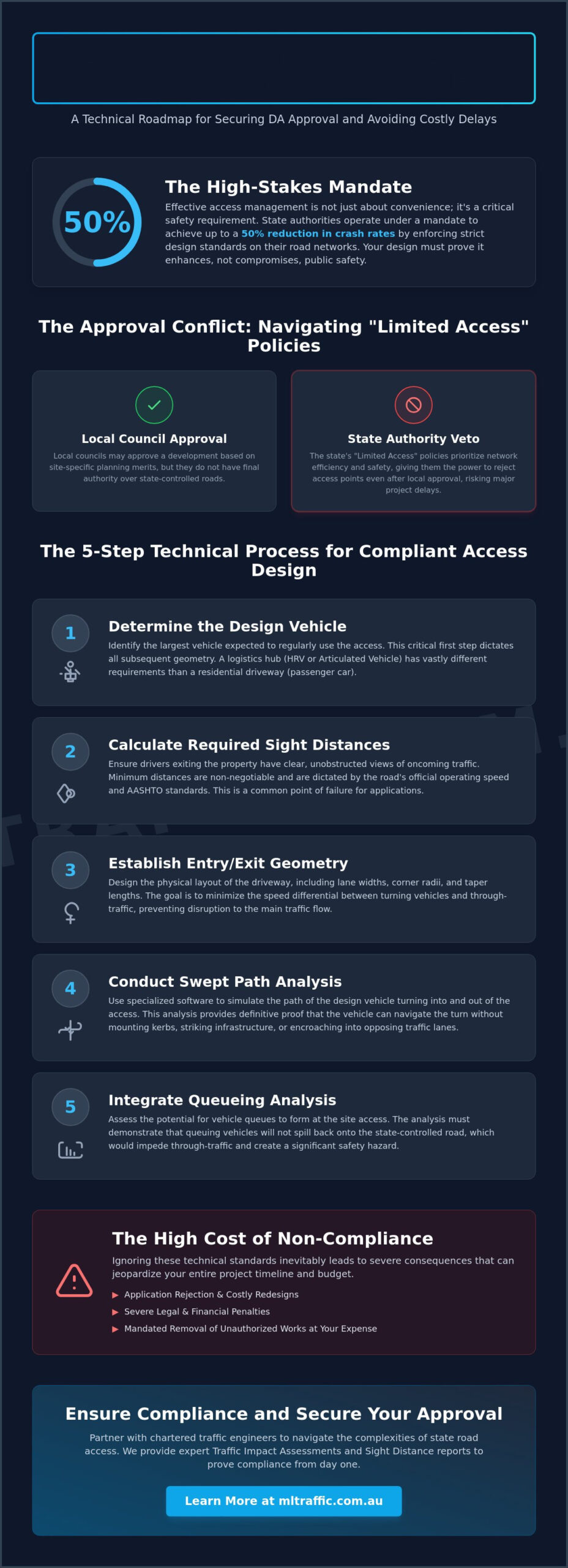
Poorly designed access points cause significant regional issues that state authorities are trained to identify immediately. Driveways with inadequate geometry force heavy vehicles to slow down excessively or swing into adjacent lanes, which reduces overall throughput. In high-speed environments, any deviation from strict entry and exit standards creates immediate safety hazards. According to the Federal Highway Administration, effective access management can reduce crash rates by up to 50%. Ignoring these standards leads to application rejections. Unauthorized works within a state road corridor also carry severe legal and financial consequences. Beyond potential fines, you may be required to remove non-compliant infrastructure at your own expense. This is why we provide specialized Traffic Impact Assessment (TIA) Reports and Sight Distance Assessments to prove compliance before construction begins.
Key Technical Criteria for Designing Compliant Vehicle Access
Designing vehicle access on a state-controlled road requires a systematic engineering approach. State authorities don’t accept conceptual sketches; they require technical proof that the proposed access meets national standards. You must verify that your approach to designing vehicle access on a state-controlled road accounts for both internal site flow and external network safety. This involves a five-step technical process:
- Step 1: Determine the Design Vehicle. Identify the largest vehicle expected to use the access regularly. A residential development uses a standard passenger car, but a logistics hub requires modeling for Heavy Rigid Vehicles (HRV) or Articulated Vehicles.
- Step 2: Calculate Required Sight Distances. Minimum distances are dictated by the operating speed of the road.
- Step 3: Establish Entry/Exit Geometry. Design the driveway to minimize the speed differential between turning vehicles and through-traffic.
- Step 4: Conduct Swept Path Analysis. This proves the design vehicle can negotiate the turn without mounting kerbs.
- Step 5: Integrate Queueing Analysis. Ensure the internal site layout allows for enough vehicle storage so that waiting cars don’t spill back onto the state road.
Sight Distance and Safety Standards
Safety is the primary metric for approval. Engineers distinguish between Stopping Sight Distance (SSD) and Safe Intersection Sight Distance (SISD). SISD is the distance required for a driver to perceive and react to a hazard. While SSD is the absolute minimum for a vehicle to stop, SISD provides a higher safety margin for drivers entering the traffic stream. Obstacles like overgrown vegetation, boundary fences, or poorly placed signage can invalidate an access design. We provide detailed Sight Distance Assessments to confirm these clear zones are maintained throughout the life of the development.
Vehicle Swept Path Analysis: Proving Maneuverability
State authorities require empirical evidence that vehicles can move safely within the proposed layout. We use AutoTURN software to model these movements with precision. On high-volume state roads, “left-in, left-out” configurations are frequently the only acceptable solution to prevent dangerous right-hand turns across multiple lanes. It’s a non-negotiable requirement that the design vehicle must enter and exit the site in a forward direction. Reversing onto a state-controlled road is a universal deal-breaker for any application. For a deeper look at this process, see our Vehicle Swept Path Analysis guide. Our experts ensure your Car Park Design integrates these technical requirements from the initial site plan.
Navigating the “Safety vs. Efficiency” Framework
State authorities operate under a strict mandate to preserve the functional intent of the regional road network. When designing vehicle access on a state-controlled road, you must navigate the inherent tension between private property rights and public infrastructure performance. Authorities view every new driveway as a potential conflict point that disrupts the laminar flow of traffic. This disruption isn’t just a safety concern; it’s a direct threat to the economic efficiency of the freight and commuter corridors they manage. Your design must prove that the proposed access point doesn’t create “friction” that slows down the thousands of vehicles already using the network.
Balancing your need for site access with the public’s need for uninterrupted travel requires a data-driven approach. Authorities use “Functional Requirements” to determine if a design is appropriate. For instance, a driveway that requires a vehicle to slow down significantly on a high-speed arterial will likely be rejected unless it includes a dedicated deceleration lane. Proving your case requires rigorous Intersection Analysis to demonstrate that the new movements won’t cause systemic delays.
Impact on Road Network Efficiency
Approval often hinges on the “Degree of Saturation” (DOS) at your proposed entry point. This metric identifies how close the road is to reaching its maximum capacity. Peak-hour traffic volume is the deciding factor here. If the road is already operating at or near capacity during morning or afternoon peaks, the authority will likely demand mitigation strategies. These might include auxiliary lanes, such as left-turn slip lanes, to remove turning traffic from the through-lanes. We use detailed modeling to show that your site’s traffic won’t degrade the current Level of Service (LOS) for other road users.
Future-Proofing: Planned Road Intent
Current compliance doesn’t guarantee a permit if the state has long-term plans for the corridor. You must check for future road widening or planned intersection upgrades that might intersect with your property boundary. A driveway that meets all technical standards today could be invalidated by a corridor upgrade scheduled for three years from now. State infrastructure plans are public documents, but they require expert interpretation to understand how they impact specific site boundaries. Consulting these plans during the initial phase of designing vehicle access on a state-controlled road prevents the high cost of redesigning access points after a project has already been committed to construction.
The Application Process for State Road Access Permits
The application process for designing vehicle access on a state-controlled road follows a specific sequence that differs significantly from standard local council approvals. You must manage a dual-track approval system where the state authority acts as a referral agency for your Development Application (DA). Success begins with a pre-lodgement meeting. This early consultation allows you to present a preliminary site plan and receive feedback on potential “deal-breakers” before you commit to expensive technical drawings. Talking to the authority early can save months of delays by identifying non-negotiable requirements regarding driveway placement or median treatments.
Once the design is refined, you must obtain a Road Corridor Permit (RCP) or an equivalent state-level approval. This permit is separate from your DA and specifically covers any works within the state-managed road reserve. Coordination is critical; the local Council cannot grant final approval until the state authority provides its concurrence or conditions. We manage this coordination by providing the technical documentation required to satisfy both jurisdictions simultaneously.
The Role of the Traffic Impact Assessment (TIA)
A professional TIA is the cornerstone of your application package. State-level scrutiny is far more rigorous than local government reviews. Your TIA must include empirical data such as seven-day traffic counts, 85th percentile speed surveys, and a five-year crash history analysis of the surrounding network. This data proves that your access design is based on actual road conditions rather than theoretical models. For a comprehensive breakdown of these requirements, see our Traffic Impact Assessment guide. Our engineers ensure every TIA we produce meets the exact evidentiary standards required by state reviewers.
Post-Approval: Construction and Compliance
Approval of the design does not conclude the process. Before construction begins, you must submit a Traffic Guidance Scheme (TGS). This document outlines how traffic will be managed safely around the work site while the new access is being built. After construction, a final inspection is mandatory. This certification ensures the physical build matches the approved engineering drawings, particularly regarding ramp grades and sight lines. Managing the transition from temporary construction access to permanent operational access requires meticulous planning to avoid network disruption. If you are currently designing vehicle access on a state-controlled road, contact our senior principals today to ensure your application is compliant from the first submission.
Partnering with Expert Traffic Engineers for Approval
State authorities prioritize technical accuracy and professional accountability. Reports submitted by Registered Professional Engineers of Queensland (RPEQ) or chartered engineers carry significant weight during the assessment process. These credentials signify a verified level of expertise in applying national regulatory standards. When designing vehicle access on a state-controlled road, using a certified expert reduces the likelihood of the authority questioning the underlying data or methodology. ML Traffic brings over 15 years of experience to this specialized field, navigating the complex bureaucratic nuances and technical expectations of state departments.
Our firm operates on a principle of personnel continuity. The expert who initiates your project is the same professional who performs the technical work. This approach eliminates the information loss common in larger firms where senior staff secure the contract but junior staff execute the analysis. Direct involvement from our senior leadership ensures that complex issues are identified and resolved before the report reaches the reviewer’s desk. This proactive strategy significantly reduces the risk of costly Request for Information (RFI) loops that can stall a project for months.
Why Technical Precision Matters
A “standard” driveway designed for a local street won’t meet the rigorous standards of a state-controlled corridor. Expert modeling can find viable solutions where authorities initially see safety or efficiency problems. We ensure total compliance with AS 2890.1 for off-street car parking and AS 2890.2 for commercial vehicle facilities. This precision is essential for all vehicle types, from standard passenger cars to heavy freight vehicles. By delivering accurate Vehicle Swept Path Analysis and Sight Distance Assessments, we provide the empirical evidence needed to secure approval.
Streamlining Your Development Approval
We streamline the approval process by providing accurate, first-time-compliant reports. Our clients have direct access to our senior principals, ensuring accountability at every stage of the design. By delivering precise Traffic Impact Assessment (TIA) Reports and intersection analyses, we help you maintain your project timeline and avoid the high costs of late-stage redesigns. If you require professional guidance on designing vehicle access on a state-controlled road, contact ML Traffic Engineers for expert access design advice. Our results-oriented approach focuses on achieving successful DA approval with minimal revisions.
Secure Your Project’s Access Approval
Successfully designing vehicle access on a state-controlled road requires a shift from conceptual planning to rigorous engineering compliance. State authorities prioritize regional network performance over individual site convenience. This means every technical detail, from Safe Intersection Sight Distance to swept path maneuverability, must be backed by empirical data and professional certification. Early consultation and high-quality documentation are the most effective tools for avoiding costly RFI loops and project delays.
ML Traffic provides the technical expertise and senior-level accountability needed to navigate these complex regulatory environments. With over 15 years of specialist traffic engineering experience and national coverage across all Australian states, we ensure your application meets the exact evidentiary standards required by state departments. You deal directly with our senior principal engineers throughout the process. This ensures personnel continuity and a results-oriented approach to your site’s specific challenges.
Get a Professional Traffic Assessment for Your State Road Project
Take the first step toward a compliant and efficient access solution today.
Frequently Asked Questions
What is considered a state-controlled road in Australia?
A state-controlled road is a primary transit corridor managed by state government agencies such as Transport and Main Roads (TMR) in Queensland or Transport for NSW. These roads are typically designated as highways, motorways, or major arterials under specific legislation like the Transport Infrastructure Act. They are distinguished from local roads by their high traffic volumes and their role in regional freight and commuter movement.
Can I have more than one access point on a state-controlled road?
State authorities generally restrict property to a single access point to minimize conflict points and maintain traffic flow. Multiple driveways are rarely approved unless the developer can provide a technical justification through an Intersection Analysis. If the property has frontage on a lower-order local road, the authority will often mandate that all vehicle access be directed away from the state road entirely.
What is a Limited Access Road policy?
Limited Access is a formal legal designation applied to specific road corridors where the state has restricted or prohibited direct property access. This policy protects the high-speed environment by preventing the “friction” caused by turning vehicles. If your site fronts a Limited Access road, you may be legally barred from constructing a driveway, requiring you to negotiate access through adjacent parcels or local street networks.
Do I need a traffic engineer for a single driveway on a main road?
Yes, because designing vehicle access on a state-controlled road involves higher safety risks than local street design. State agencies require certified RPEQ or chartered engineers to sign off on technical drawings and assessments. This ensures that even a single driveway meets strict national standards for sight distance and entry geometry, which are essential for preventing high-speed rear-end or turning collisions.
How long does it take to get vehicle access approval from the state authority?
Standard referral periods for state authorities typically range from 20 to 40 business days, though this varies by jurisdiction. If the application is complex or requires a major intersection upgrade, the process can extend to several months. Early engagement through a pre-lodgement meeting is the most effective way to identify potential delays and ensure the initial submission is technically sound.
What happens if my access application is refused by the state road department?
If an application is refused, the developer must either redesign the access to address the specific safety or efficiency objections or appeal the decision through relevant administrative tribunals. Refusals often occur when a design fails to meet minimum Sight Distance Assessments or compromises the road’s Level of Service. Our senior principals specialize in resolving these technical disputes by finding compliant design alternatives that satisfy regulatory reviewers.
Is a Traffic Impact Assessment (TIA) mandatory for all state road developments?
A TIA is mandatory for any development that significantly alters the volume, type, or direction of traffic on the state network. While minor residential additions might only require a basic assessment, commercial or multi-unit projects must provide a full TIA. This report is the primary evidentiary tool used by authorities to determine if designing vehicle access on a state-controlled road is safe for the broader public.
What is the difference between a Road Corridor Permit and a Council DA?
A Council Development Approval (DA) grants permission for the land use and general site layout, but it does not authorize works on state land. A Road Corridor Permit (RCP) is a specific state-level approval required to perform physical construction within the road reserve. You must secure concurrence from the state authority during the DA process before you can apply for the operational RCP needed to build the driveway.

Disclaimer
The content on www.mltraffic.com.au, including all technical articles, guides, and resources, is provided for general informational and educational purposes only. It is not intended to constitute professional advice in traffic engineering, transportation planning, development approvals, or any other technical or legal field.
While ML Traffic Engineers makes every reasonable effort to ensure the accuracy, completeness, and timeliness of the information published, we do not provide any warranties or representations (express or implied) regarding its reliability, suitability, or availability for any particular purpose. Any reliance you place on the content is strictly at your own risk.
In no event shall ML Traffic Engineers, its directors, employees, authors, or affiliates be liable for any direct, indirect, incidental, special, consequential, or punitive damages (including, without limitation, loss of profits, data, or business opportunities) arising out of or in connection with the use of, or inability to use, any information provided on this website.
The articles and guides on this site are not a substitute for engaging a qualified, registered professional traffic engineer (such as an NPER or RPEQ engineer) to assess your specific project requirements. For tailored advice, compliance assessments, or traffic engineering services, please contact a competent professional.
This disclaimer may be updated from time to time without notice. By accessing or using this website, you agree to be bound by the most current version of this disclaimer.
