

A single non-compliant driveway ramp grade or a miscalculated parking yield can turn a profitable Australian site acquisition into a multi-million dollar liability before the first brick is laid. Relying on guesswork during the acquisition phase is a risk no professional developer should take. A comprehensive developer due diligence traffic assessment is the only way to identify technical constraints before you commit to a purchase. We understand the frustration of discovering access non-compliance or receiving unforeseen council RFIs that delay construction by months.
This article shows you how a strategic traffic engineering assessment identifies site constraints and prevents costly planning delays. You’ll learn how to secure technical certainty to support your site offer and ensure your proposed yield is achievable regarding parking. At ML Traffic Engineers Australia, we provide the technical roadmap to de-risk your next acquisition and protect your margins. This guide covers everything from swept path analysis to Australian Standard compliance, ensuring your feasibility study is backed by engineering fact.
Key Takeaways
- Identify fatal technical flaws early through a preliminary audit to prevent sunk costs on unviable development sites.
- Evaluate site access safety and sight-line requirements to ensure the proposed yield is physically possible before committing to a purchase.
- Conduct a professional developer due diligence traffic assessment to secure technical certainty and avoid unforeseen council RFIs during the planning phase.
- Recognize critical deal-breakers such as non-compliant driveway ramp grades and insufficient space for heavy vehicle swept paths.
- Utilize a structured acquisition checklist backed by experts with over 15 years of experience and 10,000 successful site assessments.
Table of Contents
The Strategic Value of Traffic Engineering Due Diligence
Traffic due diligence is a preliminary technical audit of a site’s transport feasibility. It forms a critical part of the broader due diligence process. Most developers treat traffic as a post-acquisition box-ticking exercise. This is a mistake. A professional developer due diligence traffic assessment identifies technical constraints before capital is committed. It transforms guesswork into engineering certainty. This proactive approach prevents sunk costs on sites that cannot support the intended development yield.
Reactive responses to council Requests for Further Information (RFIs) are expensive and time-consuming. They often lead to forced redesigns that reduce parking capacity or require costly basement adjustments. By conducting an assessment early, you determine if a site’s transport requirements are physically and financially viable. Our engineers focus on maximizing site yield and parking efficiency from day one. We ensure every square metre of the site is utilized effectively while remaining compliant with relevant Australian Standards like AS 2890.1.
To better understand this concept, watch this helpful video:
De-Risking Site Acquisition
Identifying fatal flaws is the primary objective of an early audit. We evaluate driveway ramp grades and conduct Sight-Line Assessments before you sign an unconditional contract. Within the Australian planning landscape, infrastructure contribution requirements can vary significantly between local government areas. A developer due diligence traffic assessment uncovers these potential levies and upgrade costs during the feasibility stage. We also ensure your proposed land use aligns with the existing road network capacity to avoid massive off-site upgrade requirements that could render a project unviable.
Competitive Advantage in Planning
Technical certainty allows for more aggressive site offers. If you know the parking yield is defensible, you can bid with confidence. This data builds a robust foundation for the future Traffic Impact Assessment. Preliminary assessments allow you to negotiate better outcomes with local planning authorities before a formal application is lodged. It moves the conversation from speculation to engineering fact. At ML Traffic Engineers Australia, the traffic consultant who provides the quote, does the work. This direct accountability ensures your planning strategy is backed by senior expertise from the very beginning.
Core Components of a Preliminary Traffic Assessment
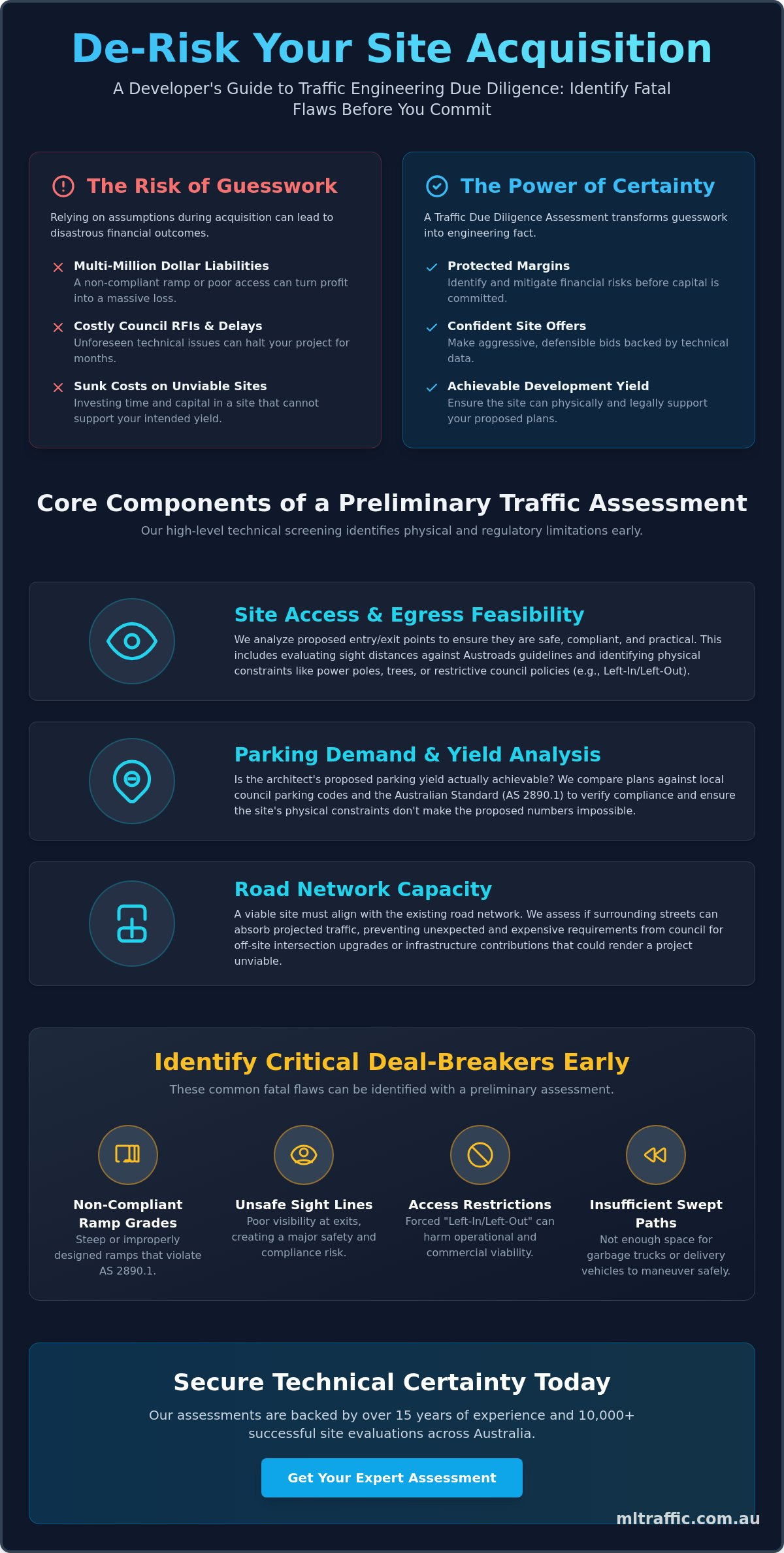
A preliminary assessment is a high-level technical screening designed to identify physical and regulatory limitations before you commit capital. While a full Traffic Impact Assessment is a requirement for a Development Application, a developer due diligence traffic assessment acts as a targeted risk management tool. We evaluate the site against the AS 2890 series to ensure the architect’s proposed yield is actually achievable within the land’s physical constraints. This process determines if the project can proceed as envisioned or if the site layout requires significant modification.
The core components of this preliminary audit include:
-
Site Access Review: Evaluating sight distances and the safety of proposed entry and exit points against Austroads guidelines.
-
Parking Demand Analysis: Comparing architectural yields against local council parking codes to verify if the project is physically viable.
-
Road Network Capacity: Determining if surrounding streets can absorb the projected traffic without triggering expensive external intersection upgrades.
Site Access and Egress Feasibility
Driveway placement is often restricted by existing infrastructure such as power poles, street trees, or bus stops. We analyse proposed locations relative to nearby intersections and median strips. A common constraint in Australian urban environments is the "Left-In/Left-Out" restriction. If a council or state road authority imposes this, it can significantly alter the site’s operational efficiency and commercial attractiveness. We assess if traffic signals or nearby pedestrian crossings will impede your access strategy, providing the technical certainty required before making a binding offer.
Trip Generation and Impact Analysis
Calculating traffic volume is a standard requirement for determining infrastructure impact. We utilize the ITE Trip Generation Manual, 11th Edition, to determine accurate rates for various land uses. This data helps us predict how many vehicle trips a residential or commercial project will produce during peak hours. This technical methodology aligns with the Austroads Guide to Traffic Management, which provides the framework for evaluating development impacts on Australian road networks. Early identification of these impacts tells you if a full intersection modelling report will be required for the DA, keeping your project timeline and budget predictable.
Identifying Critical Deal-Breaker Constraints
A developer due diligence traffic assessment serves as a technical filter for high-risk sites. Identifying technical deal-breakers early prevents you from purchasing a property that cannot accommodate your required yield. Most technical constraints only surface during the detailed design phase when fixing them is expensive. Detecting these issues before the contract is unconditional is the only way to protect your margins and avoid unviable acquisitions.
Four critical constraints often compromise development feasibility:
-
Non-compliant driveway ramp grades: If the gradient exceeds Australian Standards, you might be forced to redesign the entire basement level, significantly increasing excavation costs.
-
Heavy vehicle manoeuvring: Insufficient space for waste collection or delivery trucks often leads to a flat refusal from council.
-
Inadequate sight distances: If sight lines are blocked by permanent infrastructure or neighbouring buildings, you may need to acquire additional land or sacrifice frontage to meet safety requirements.
-
Parking shortfalls: While councils allow some discretion, exceeding their allowable ‘discretionary’ limits usually results in a refused Development Application.
Swept Path Analysis in Due Diligence
Verifying loading dock functionality is impossible without a swept path analysis. We simulate the movement of garbage trucks and delivery vehicles to ensure your waste management plan is viable. If a 12.5-metre Heavy Rigid Vehicle (HRV) cannot enter and exit the site in a forward direction, the site may be unviable for commercial or high-density residential use. We identify these spatial requirements during the acquisition phase so you don’t discover them when it’s too late to withdraw. This technical certainty is a core part of any comprehensive developer due diligence traffic assessment.
Parking Compliance and AS 2890.1
Architectural layouts frequently overlook the strict requirements of AS 2890.1 standards. We check column placements and aisle widths to ensure every bay is functional and compliant. Dead-end aisles or excessively tight turns are common reasons for council rejection. If the site area is limited, we evaluate the feasibility of car stackers or mechanical parking systems. These systems have specific height and maintenance requirements that must be factored into your initial feasibility study. Technical certainty regarding the parking layout ensures that your proposed unit count is actually achievable within the physical footprint of the site.
The Developer’s Due Diligence Checklist for Site Acquisition
A systematic approach to technical risk management is the only way to avoid buying a site with hidden infrastructure liabilities. Relying on an architect’s preliminary sketch without engineering verification is a common mistake that leads to costly redesigns. A developer due diligence traffic assessment provides the technical framework needed to validate your feasibility study before you make a binding offer. Use this structured checklist to ensure no transport constraints are overlooked during your next acquisition.
-
Obtain a preliminary yield study: Request a baseline parking layout and unit count from your architect. This serves as the starting point for technical verification.
-
Engage a traffic engineer: We review the architect’s layout against local council parking codes and site access requirements. We ensure the design doesn’t just look good but actually works on the ground.
-
Conduct high-level swept path checks: We simulate the movement of the most critical vehicles, such as waste trucks or delivery vans. This confirms the site can handle necessary operational logistics.
-
Identify infrastructure contributions: We determine if the project will trigger required road upgrades or external contributions. In Florida, local governments must establish interlocal agreements for coordinating these impacts by October 1, 2025.
-
Adjust your feasibility model: Incorporate our findings into your final offer price. Technical certainty allows you to bid with confidence while protecting your profit margins.
Engagement with Council and Authorities
Determining road ownership is critical. We identify if the site frontage falls under state or local government control. This distinction dictates which standards apply and how long approval timelines will be. We check for future road widening gazettals or public transport corridor plans that could reduce your developable land area. Reviewing nearby development precedents helps us predict council’s likely stance on parking reductions. If you’re looking at sites in Pinellas County, keep in mind their Multimodal Impact Fee Ordinance update is scheduled for completion by June 2026. These shifts in local policy can significantly impact your project’s financial viability.
Internal Site Logistics
Site safety starts at the entrance. We evaluate pedestrian separation from vehicle movements to ensure the design meets modern safety standards. Bicycle parking requirements can also consume significant Gross Floor Area (GFA) if not planned early. For specialized land uses like child care or drive-throughs, we verify that the site can accommodate the required queueing distances. If vehicles spill out onto the public road, council will reject the application. Securing technical advice early ensures your internal logistics are compliant and efficient. To get started on your next project, contact our senior engineers for a direct consultation.
Securing Technical Certainty with ML Traffic Engineers
Technical certainty is the only way to protect your development margins. At ML Traffic Engineers, we provide a hands-on approach that larger, impersonal firms cannot match. Our core philosophy is simple: the traffic consultant who provides the quote, does the work. This ensures that the senior expertise you pay for is the same expertise applied to your project. We’ve been trading since 2005 and have completed over 10,000 successful site assessments across Australia. This volume of work provides us with a deep understanding of varied council requirements and technical constraints.
Senior-level involvement is a prerequisite for a reliable developer due diligence traffic assessment. It reduces the risk of missed constraints like non-compliant driveway grades or inadequate swept paths. Our experience spans an exhaustive list of land-use types. We have delivered results for apartments, bars, temples, warehouses, child care centres, and shopping malls. This breadth of knowledge allows us to identify potential issues that junior staff might overlook. We don’t just provide data; we provide defensible engineering solutions that support your site offer.
Direct Access to Senior Expertise
Clients work directly with our principals, Michael Lee or Benny Chen. Both Michael and Benny bring between 30 and 40 years of individual experience to every project. This direct access eliminates gatekeepers and ensures accountability. From the initial quote to the final Traffic Engineering report, you have a direct line to the experts. We understand that site acquisition deadlines are often time-sensitive. Our streamlined structure allows for rapid response times without compromising technical accuracy. You get the certainty you need to meet your due diligence deadlines.
Next Steps for Your Development
Transitioning from a preliminary assessment to a full Development Application requires a clear technical roadmap. Once your due diligence is complete, we provide a seamless transition to a full Traffic Impact Assessment (TIA). This ensures consistency in the engineering arguments presented to council. We use the latest standards, including the ITE Trip Generation Manual 11th Edition, to ensure your application is compliant with current requirements. If you’re evaluating a potential site, don’t rely on architectural sketches alone. Contact ML Traffic Engineers to de-risk your next site acquisition with a professional developer due diligence traffic assessment. We provide the technical certainty required to turn a potential site into a successful development.
Secure Your Site Acquisition with Technical Certainty
Technical risk management is the difference between a profitable development and a failed acquisition. Identifying fatal flaws such as non-compliant driveway grades or heavy vehicle swept path issues early protects your capital. A professional developer due diligence traffic assessment ensures your proposed yield is achievable before you sign an unconditional contract. We’ve seen how ignoring impact fees or parking requirements leads to costly redesigns and planning delays.
ML Traffic Engineers provides the senior-level involvement required to de-risk your project. With 15+ years of experience and over 10,000 sites assessed, our principals handle every project personally. You don’t have to deal with junior staff or gatekeepers. We provide the technical certainty needed to make aggressive, defensible offers. Get a Due Diligence Quote from a Senior Traffic Engineer today and proceed with confidence. Your next successful development starts with expert engineering advice.
Frequently Asked Questions
What is the difference between a Traffic Impact Statement and a full Assessment?
A Traffic Impact Statement (TIS) is a concise report for developments with low traffic generation. It focuses on basic access and parking compliance. A full Traffic Impact Assessment (TIA) is a comprehensive study for larger projects that require complex intersection modelling and network analysis. Councils typically trigger the need for a TIA when a project exceeds specific trip generation thresholds defined in the ITE Trip Generation Manual 11th Edition.
When should I engage a traffic engineer during the due diligence process?
You should engage a traffic engineer during the pre-purchase feasibility phase, ideally before the contract becomes unconditional. This allows for a developer due diligence traffic assessment to identify fatal flaws like non-compliant sight distances or access restrictions. Early engagement prevents you from committing capital to a site that cannot support your intended development yield or requires expensive infrastructure upgrades.
Can a traffic assessment help me increase my development yield?
Expert traffic engineering can increase your development yield by optimizing car park layouts and justifying parking reductions. We use empirical data and site-specific surveys to prove that council’s standard parking rates are often excessive for your specific project. This technical justification often allows for additional units or commercial floor area within the same building footprint while remaining compliant with AS 2890.1.
What are the most common traffic issues that cause DA rejection?
The most common issues causing DA rejection include non-compliant driveway ramp grades and insufficient swept path clearance for waste collection vehicles. Sight-line failures at the site entrance and parking layouts that violate Australian Standards also lead to immediate refusals. Identifying these constraints during the due diligence phase allows for design adjustments before you lodge a formal application with council.
How much does a preliminary traffic due diligence report typically cost?
Preliminary report costs vary based on the project’s complexity and the number of intersections requiring analysis. We don’t provide fixed prices without reviewing site details because a shopping centre review is more resource-intensive than a small residential project. The investment is a small fraction of the cost of a forced basement redesign. We provide a fixed-fee quote after reviewing your preliminary plans.
Does ML Traffic Engineers handle assessments for all types of developments?
ML Traffic Engineers handles assessments for all land-use types, from high-density apartments and bars to specialized facilities like temples and warehouses. We’ve completed over 10,000 site assessments since 2005. Our experience covers residential, commercial, industrial, and community developments across all Australian jurisdictions. This vast experience ensures we understand the specific transport requirements for any project type.
How long does it take to complete a traffic due diligence assessment?
A standard due diligence assessment typically takes 5 to 10 business days to complete. This timeframe allows for a thorough review of council codes, site access feasibility, and preliminary swept path simulations. If your acquisition deadline is urgent, our senior engineers can often prioritize the review to meet your timeline. We understand that speed is critical during a competitive site acquisition process.
What information do I need to provide for a traffic engineering quote?
To provide an accurate quote, we require the site address and any preliminary architectural sketches or yield studies. You should also specify the proposed land use and the approximate number of units or Gross Floor Area (GFA). This information allows us to calculate expected trip generation rates and determine the required scope of work, including any necessary intersection modelling or surveys.
Which areas do you cover?
We are traffic engineers servicing Melbourne, Sydney, Brisbane, Gold Coast, Hobart, Perth, Adelaide, Darwin, Canberra and surrounding areas.

Disclaimer
The content on www.mltraffic.com.au, including all technical articles, guides, and resources, is provided for general informational and educational purposes only. It is not intended to constitute professional advice in traffic engineering, transportation planning, development approvals, or any other technical or legal field.
While ML Traffic Engineers makes every reasonable effort to ensure the accuracy, completeness, and timeliness of the information published, we do not provide any warranties or representations (express or implied) regarding its reliability, suitability, or availability for any particular purpose. Any reliance you place on the content is strictly at your own risk.
In no event shall ML Traffic Engineers, its directors, employees, authors, or affiliates be liable for any direct, indirect, incidental, special, consequential, or punitive damages (including, without limitation, loss of profits, data, or business opportunities) arising out of or in connection with the use of, or inability to use, any information provided on this website.
The articles and guides on this site are not a substitute for engaging a qualified, registered professional traffic engineer (such as an NPER or RPEQ engineer) to assess your specific project requirements. For tailored advice, compliance assessments, or traffic engineering services, please contact a competent professional.
This disclaimer may be updated from time to time without notice. By accessing or using this website, you agree to be bound by the most current version of this disclaimer.
